


Follow the race with us on Sunday: our live coverage begins at 2:15 a.m. ET.
Tigst Assefa can earn up to €110,000 at the Berlin Marathon on Sunday, the most the race pays any single athlete, if she wins in a world record, according to the prize structure in the organizers’ media guide.
Three separate payments make up that figure. The winner of each race receives €30,000. A woman who wins in under 2:15:00 adds a €30,000 time bonus, and a new world record is worth a further €50,000 on top, which only the winner can collect. Berlin limits each athlete to one time bonus, so the smaller €15,000 bonus for going under 2:17:00, available to the first two women across the line, does not add to the larger one. That limit applies to the time bonuses only; the record bonus is listed as a separate payment. The men’s race pays the same amounts, with its time bonuses set at 2:02:00 and 2:03:00.

The record Assefa would be chasing is not her own. She ran 2:11:53 in Berlin in 2023, and just over a year later Ruth Chepngetich went under it at the Chicago Marathon. Chepngetich’s 2:09:56 from October 2024 is the official mark, and World Athletics ratified it that December. Chepngetich was banned for three years in October 2025 after testing positive for the diuretic hydrochlorothiazide. The ban runs from April 2025, and the Athletics Integrity Unit disqualified her results only from March 14, 2025, the date of the sample, so the Chicago record is still on the books.
Getting under it means running 2:09:55 or faster, 1:58 quicker than Assefa has ever gone, at an average of a shade under 3:05 per kilometer (4:57 per mile) the whole way. She has not been shy about the target. “It is a great pleasure for me to return to the streets of Berlin three years after setting my world record here in 2023. I am excited to once again try to break the world record,” she said when the organizers announced the women’s field.
Short of the record, the money falls away quickly. A win in 2:12:00 would pay €60,000, and a win in 2:16:00 would pay €45,000. If the pace goes wrong and she wins outside 2:17:00, she leaves with only the €30,000 first prize. Second place is worth €15,000, or €30,000 with a time under 2:17:00. The top 10 in each race share €85,000, which puts the open-division purse at €170,000 before any bonuses are paid.
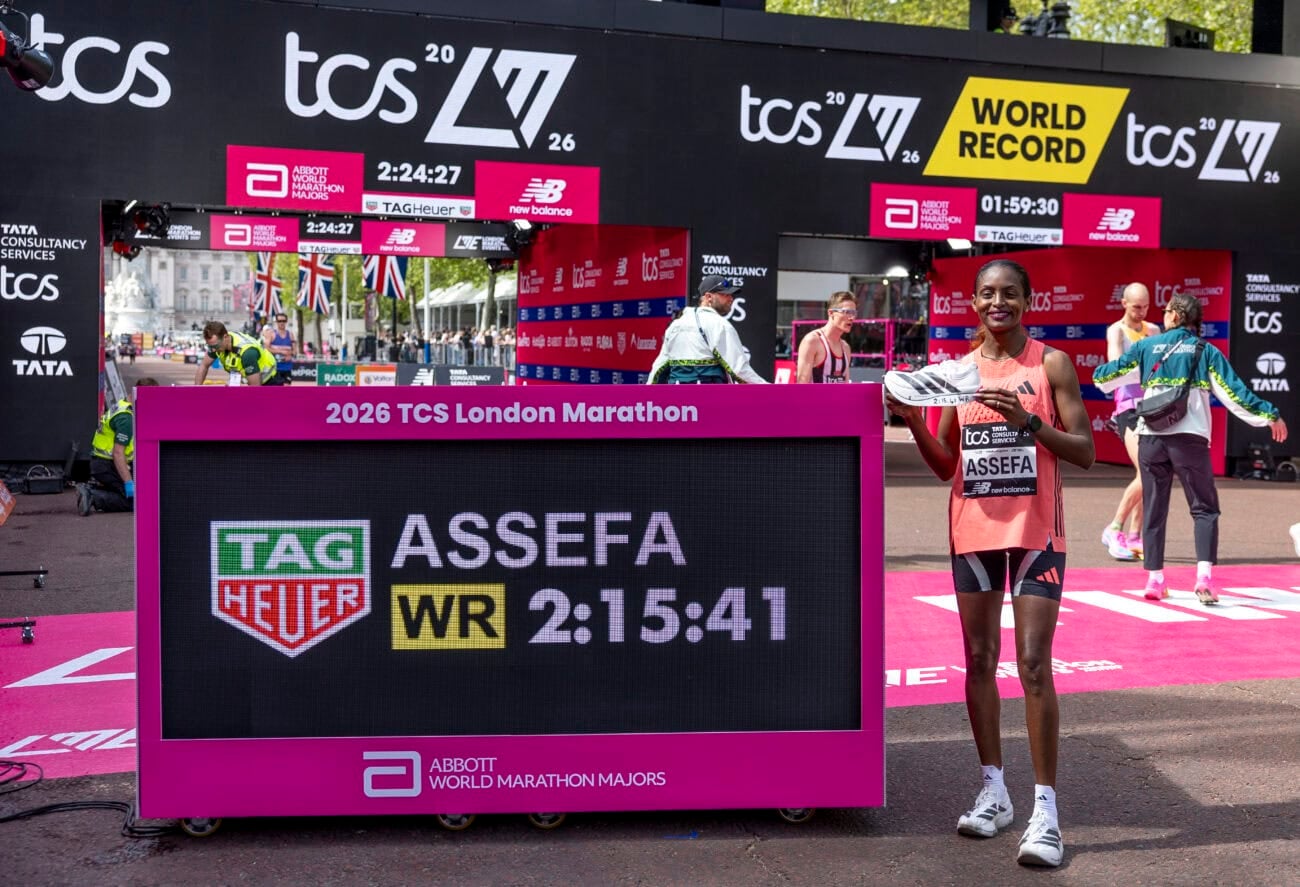
Those sums look small next to what Assefa made in London in April. Her 2:15:41 women-only world record there brought her $55,000 for the win, $125,000 for the record and $25,000 for the course record, $205,000 in all, and Sabastian Sawe collected $355,000 from the same race for his 1:59:30. Chicago paid Chepngetich $150,000, the $100,000 winner’s prize plus a $50,000 record bonus, Sportico reported. Valencia went much further for its 2025 race, offering €1 million to anyone who broke a world record on its course.
Eliud Kipchoge collected €120,000, including the record bonus, in Berlin in 2022, when he ran 30 seconds faster than his own previous world record, the Austrian news agency APA reported. Assefa was the women’s winner that day in 2:15:37.

On the men’s side, the record bonus looks safe. Sawe withdrew from Berlin with an injury in August, and nobody left in the field has run within two minutes of his 1:59:30. The fastest personal best belongs to Kenenisa Bekele, now 44, who ran 2:01:41 in Berlin in 2019.
Assefa, the Olympic silver medalist in Paris and runner-up at last year’s World Championships, starts as the clear favorite in the women’s race. Her 2:11:53 is more than four minutes quicker than the next-best personal best on the start list, Rosemary Wanjiru’s 2:16:14, according to Watch Athletics. The Kenyan won in Berlin last year in 2:21:05 and returns to defend her title.
RunClub
Get more running stories — join RunClub
Daily running news, a community of 300,000+ runners, free training plans for every distance, and a daily running game. Free to join — no card.
Already a member? Log in →





Start the conversation