


The Boston Athletic Association has refused 13 qualifying times from the Edmonton Marathon because organizers had reduced them to account for a course that ran 674.7 meters (about 0.42 miles) too long. The 92 other qualifying times from the same race, left exactly as the clock recorded them, were accepted. Edmonton organizers announced the split on Thursday, in a decision first reported by The Canadian Press.
Boston’s rules leave no room for arithmetic of that kind. The association takes a runner’s official net time from a course certified by USA Track and Field, AIMS, or a national governing body, and it does not correct those times itself, in either direction. Chris Lotsbom, the BAA’s media director, told Global News last month that “so long as the results and times are official and unadjusted, they could be used for the qualifying.” Anyone whose real time on the long course still beat the standard for their age and gender group kept their qualifier. The 13 who did not got there only once the surplus distance came off.

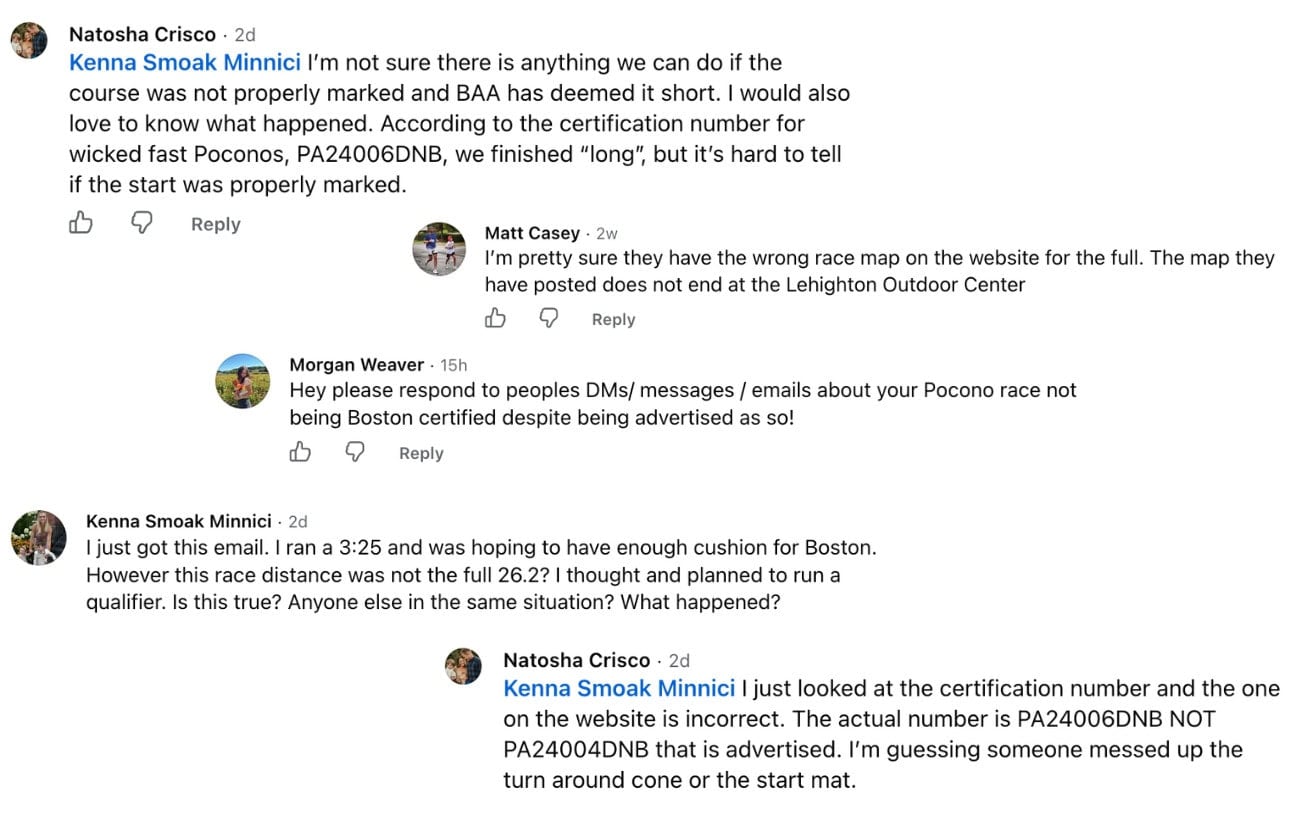
The mistake came out of a detour. The route was pushed around the Wellington Bridge and through the Glenora neighborhood, and organizers said the turnaround they built into that stretch did not give back what the detour had added. The half-marathon ran long too. For several days the organizers defended their measurement while runners posted GPS files saying otherwise, and then their own review found the error. Two course records were set on the long route anyway, one in the men’s marathon and one in the women’s.
Run at the pace the Boston standards demand, 674.7 meters is worth about 2:48 to a man aged 18 to 34 chasing 2:55:00, and about 5:07 to a woman aged 80 or over chasing 5:20:00. For scale, the cut-off for the 2026 race, the margin applicants had to beat their standard by to get in at all, was 4:34.
Certified courses are measured by calibrated bicycle under World Athletics and AIMS rules, and measurers build in a short course prevention factor of 1.001, roughly 42 meters on a marathon, so that a certified course can never come up short. Edmonton’s overage was about 16 times that cushion. Athletics Canada requires any course altered from one year to the next to be measured again and re-certified.
Boston has held this line before. The Woodlands Marathon in Texas misdirected its field in 2017, cutting about 0.8 miles off the course, and roughly 120 runners lost qualifying times when the association declined to accept results corrected for the error.

Registration for the 2027 Boston Marathon, to be run April 19, opens Sept. 14 and closes at 5 p.m. ET on Sept. 18. It is also the first Boston registration to apply time index adjustments to qualifying performances run on courses with more than 1,500 feet (457.2 meters) of net elevation drop, a change the BAA announced in July, and the first to hand about 1,000 places to a random draw among qualifiers who miss the cut-off.
Organizers in Edmonton said they are contacting the 13 runners and will work with Athletics Canada to review the course certification process.
“It is evident the community that gathers through this event is resilient, passionate, kind and deserving of nothing less than our very best,” race director Tom Keogh said in Thursday’s statement. “We commit that this distance miscalculation does not happen again.”
The qualifying window for the 2028 Boston Marathon does not open until Sept. 19, which means the 13 will need a new time from a certified marathon run on or after that date.
RunClub
Get more running stories — join RunClub
Daily running news, a community of 300,000+ runners, free training plans for every distance, and a daily running game. Free to join — no card.
Already a member? Log in →









Start the conversation