


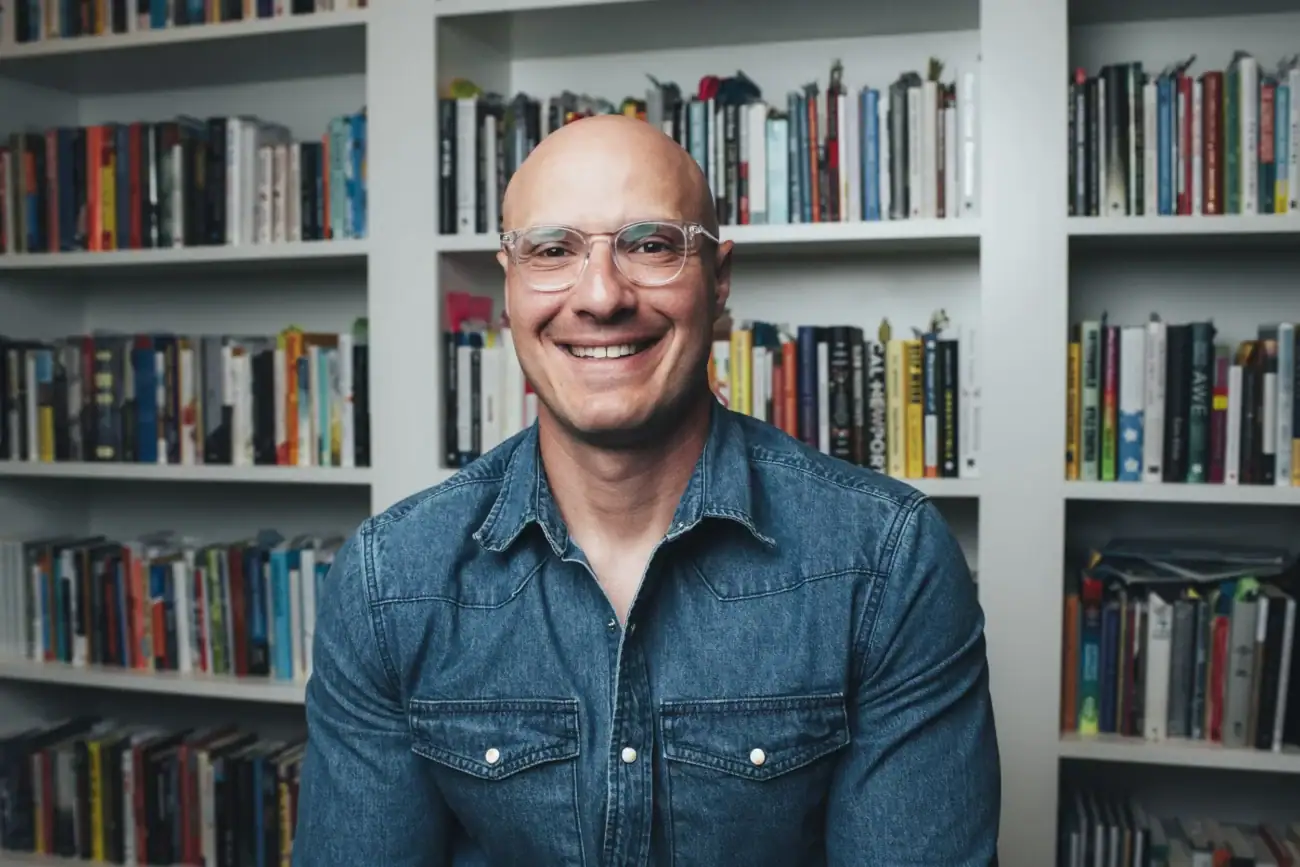
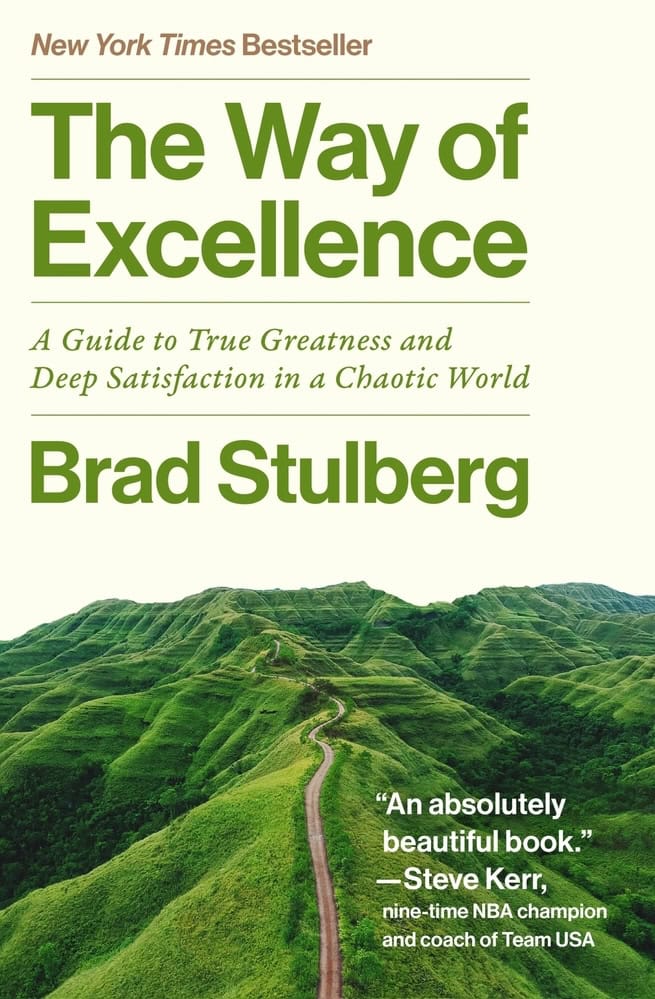
Bestselling author and performance coach Brad Stulberg has spent years studying what actually drives sustainable high performance — in athletes, executives, artists, and everyone in between. His new book, The Way of Excellence: A Path to Greatness, Satisfaction, and Belonging in a Chaotic World, has been cited by both Sabastian Sawe’s team and Eliud Kipchoge for its insights into mental performance. The book makes the case that excellence isn’t about hacks, hustle, or highlight reels. It’s a way of approaching your craft – and your life.
We sat down with Brad to talk about how everyday runners can apply those ideas to their own training, what it really means to “build confidence based on evidence,” and why the best performers obsess less over being the best and more over getting better.
1. How can regular runners — with limited time, jobs, and family commitments — actually think about “excellence” and apply it to their running?
People confuse an excellent result with the process of pursuing excellence. The former is determined by how you stack up against a field, your genetics, your time to train, and so on. The latter is an ongoing approach to craft and mastery that is available to anyone, from the best in the world to age-groupers.
The pursuit of excellence means that you care about what you are doing, you approach it with intention and focus, and you do it in a way that aligns with your values. The outcome is not only your best performance, but also how it shapes you as a person.
Another way to think of it: you may think you are working on your goal of running a marathon, but the goal of running a marathon is also working on you. It’s teaching you about commitment, persistence, patience, resilience, toughness, discomfort, satisfaction, and all these other qualities that can carry over into other areas of your life.
Before the term excellence got bastardized by all the hustle-culture bros and influencers, it meant a process of throwing your all into something, living up to your potential, and shaping your character. I want to reclaim that definition.
The last thing I’ll say is — the best way to give yourself a shot at an excellent result is by throwing yourself into the process. It’s not process over outcomes. It’s that you can’t control the outcome, so you might as well focus on the process, and by doing so you give yourself the best shot at attaining the outcome you want anyway.
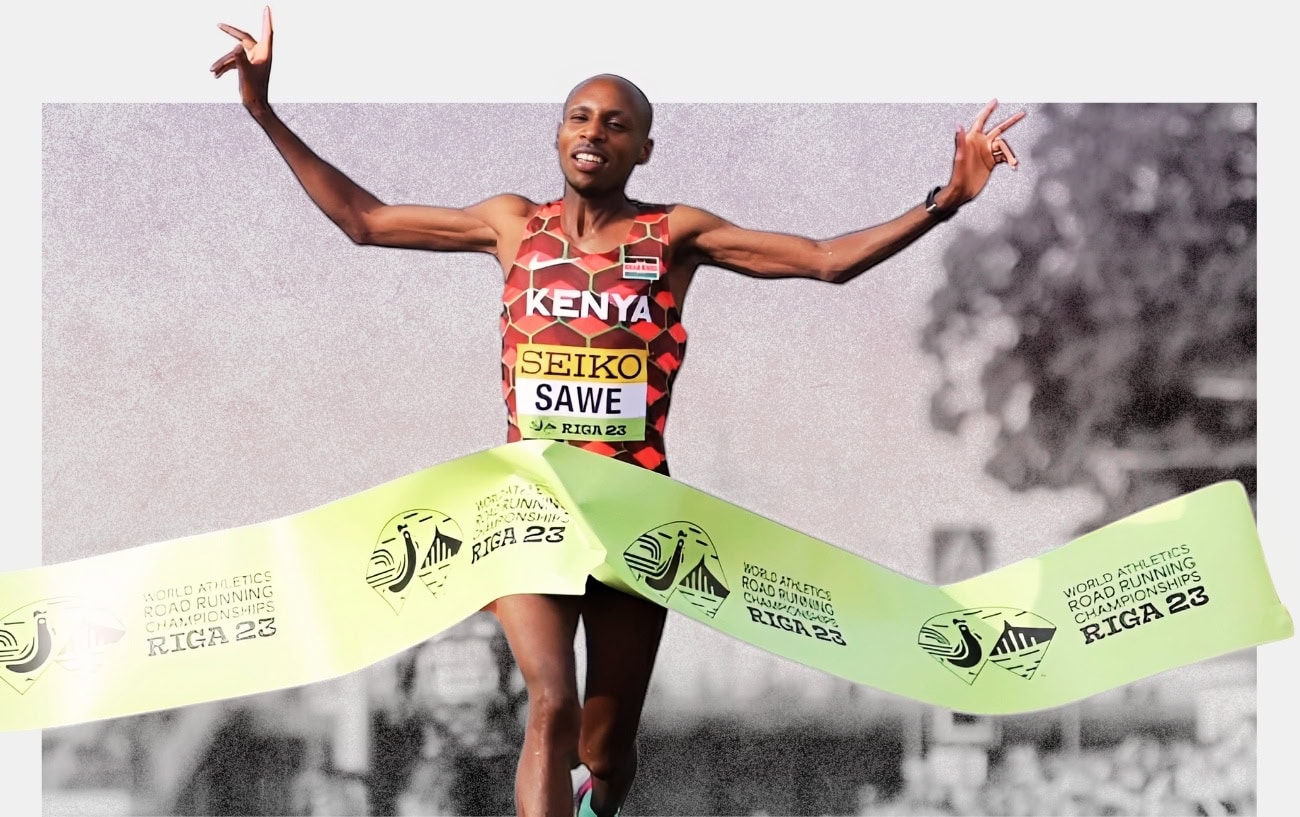
2. Sebastian Sawe’s coach told you they worked to the mantra “confidence is based on evidence.” For an everyday runner training for a goal race, what does building that evidence bank actually look like?
It means doing workouts that you can look back upon on the start line of your race and say, “I know I am ready because I did that workout.”
It also means getting through rough patches in training so that when you are late in a race and the wheels are falling off the bus, or you miss an aid station, or you are dealing with a strong headwind, you can remember those rough patches from training and how you got through them.
It’s essentially doing what you need to prove to your body (specific workouts) and mind (navigating all the hard stuff that comes up in training) that you belong and you are ready to let it rip. So it’s the key workouts. It’s the accumulation of volume. And just as important, it’s how you respond when things don’t go to plan. You get to practice all of that in training.
3. You distinguish actual excellence from pseudo-excellence — the hacks, hustle, and highlight reels. Where do you see recreational runners getting most caught up in the pseudo version?
In no particular order:
The comparison game — “I’m going to train for this race because everyone on Instagram is posting about it,” not because you actually want to.
The supplements — there are like 31 flavors with a new one every week.
A lot of stuff around body dysmorphia that is largely born out of social media.
And thinking the latest and greatest gadget is the key to unlocking your best performance, when really it’s about stacking good days, weeks, and months of training instead.
4. You have a “48-hour rule” — celebrate or grieve for two days, then get back to the work. What does “the work” look like for an amateur runner in the week after their goal race?
It depends on what the goal race was and the recovery demands.
If it’s a shorter-distance race, then “the work” is getting back into training — even if it’s primarily easy runs. If it’s a longer race or something with higher recovery demands, the work may be reading a book that is going to help you reflect and get inspired; doing mobility exercises to help with recovery; meeting with your coach (or, if you are self-coached, meeting with yourself) to reflect on the last training cycle and then make updates for the next one.
As you may be putting together, the “work” is really all about coming back to the process.

5. Runners pin a lot of identity on times — sub-3, BQ, age-group rankings. Why are these benchmark goals so important to us, and are they the right things to chase?
They are important to us because there is something extremely satisfying about a concrete and objective marker of your effort. So much in the modern world is wishy-washy and contrived. To be able to say “this is my time,” or “I BQ’d,” or “I was on the age-group podium” is the total opposite. It is utterly objective and real. You can’t fake or market your way to a sub-3 marathon. You’ve got to earn it.
At the same time, it can be a source of stress or even diminishing performance if you let those times and benchmarks define you. Because whether or not you get them, the show must go on. If you fall short of your goal you may be dejected. If you achieve your goal you may be complacent.
An interesting observation I had time and time again when working on the book is that the best performers don’t obsess over being the best — they obsess over being the best at getting better.
I also like to think about this dichotomy in terms of finite games and infinite games. In finite games there is a start and an end, and the goal is to win or attain a specific result. In infinite games, the entire goal is to keep playing, learning, and growing. I think the best performers — at any level, from age-group to the pros — learn to play both finite and infinite games at the same time.
What this means is that it’s totally okay (good, even!) to care about the time and the benchmark. At the same time, you also realize that you are playing an infinite game, and that’s actually the more important one.
6. You argue we should set goals based on who we want to become, not just what we want to achieve. What’s the better question to ask before signing up for a marathon than “what time do I want to run?”
What is the experience I want to have? Who are the people that are going to be involved? And what qualities and character traits do I hope to build from the training and competition?
7. Arianna Huffington called your book an antidote to “zombie burnout.” Does that pattern show up in running — and what does it look like?
Zombie burnout is a concept in the book that came out of reporting where I observed that, while some people burn out from doing too much, there’s another kind of burnout that isn’t talked about nearly as much — when people burn out from not doing enough of what lights them up and makes them feel alive. It’s when you feel like you are always just kind of going through the motions.
I do think this can show up in running, but it’s a very fine line and there is a lot of nuance. Here’s the deal: any good training plan is going to have periods — sometimes long ones — of monotony, tedium, and boredom. That’s just part of the process. I actually think a key to good training is learning to find interesting what other people find boring.
However, if you are finding the whole of running to be unmotivating, then perhaps it’s time for a change.
An easy way to experiment with this is to try a cycle where you switch up the goal. If you’re a marathoner, maybe do a 4-month block where you focus on the mile. And if you’re a miler, maybe train for a half marathon. Another good way to inject some novelty into your training is to do a cycle where you train without the watch or heart-rate monitor, or at least where you do more workouts by feel. Essentially, you’re trying to make things interesting.

8. You’re more of a strength guy than an endurance guy, but you do run. What does your training look like right now, and how do you balance being a parent with consistency?
I actually don’t run much these days. I developed something called chronic exertional compartment syndrome in my calf that made running virtually impossible. I’ve had surgery to try and correct it, and unfortunately, it wasn’t very successful. I ran for 10 years. I loved it. It’s a huge bummer, but I’ve made my peace with it. (It’s been over 7 years.)
Now, my training is mainly strength-based, and I’m able to manage my aerobic health with long walks and some ski-erg, bike, and rowing-machine work.
As for my strength training, my mantra has always been “train as much as possible.” I love this because the as possible part is really important. What it means right now is I train 4 days a week for about 90 minutes a session. Within that constraint, I am trying to get as strong as possible.
I’ve learned so much from the barbell. It’s an incredible teacher for life, no different from the roads or the track. When you push hard toward a physical goal and do it with intention, you can’t help but learn about yourself and grow. I love it.
9. Outside your own books, what’s the one book — running or otherwise — you’d put in a serious runner’s hands this year?
For my books, the one I think is best is The Way of Excellence. It took me many years to finally nail a book, and I think this is the one.
The other book I’d recommend is The Inner Game of Tennis. It’s about tennis, but it’s really about performance in everything. It’s the perfect complement to Excellence. If you read the two books together, I can almost guarantee it will change your approach to running — and life — for the better.
Brad Stulberg’s new book, The Way of Excellence: A Path to Greatness, Satisfaction, and Belonging in a Chaotic World, is available now.
RunClub
Get more running stories — join RunClub
Daily running news, a community of 300,000+ runners, free training plans for every distance, and a daily running game. Free to join — no card.
Already a member? Log in →



Start the conversation