


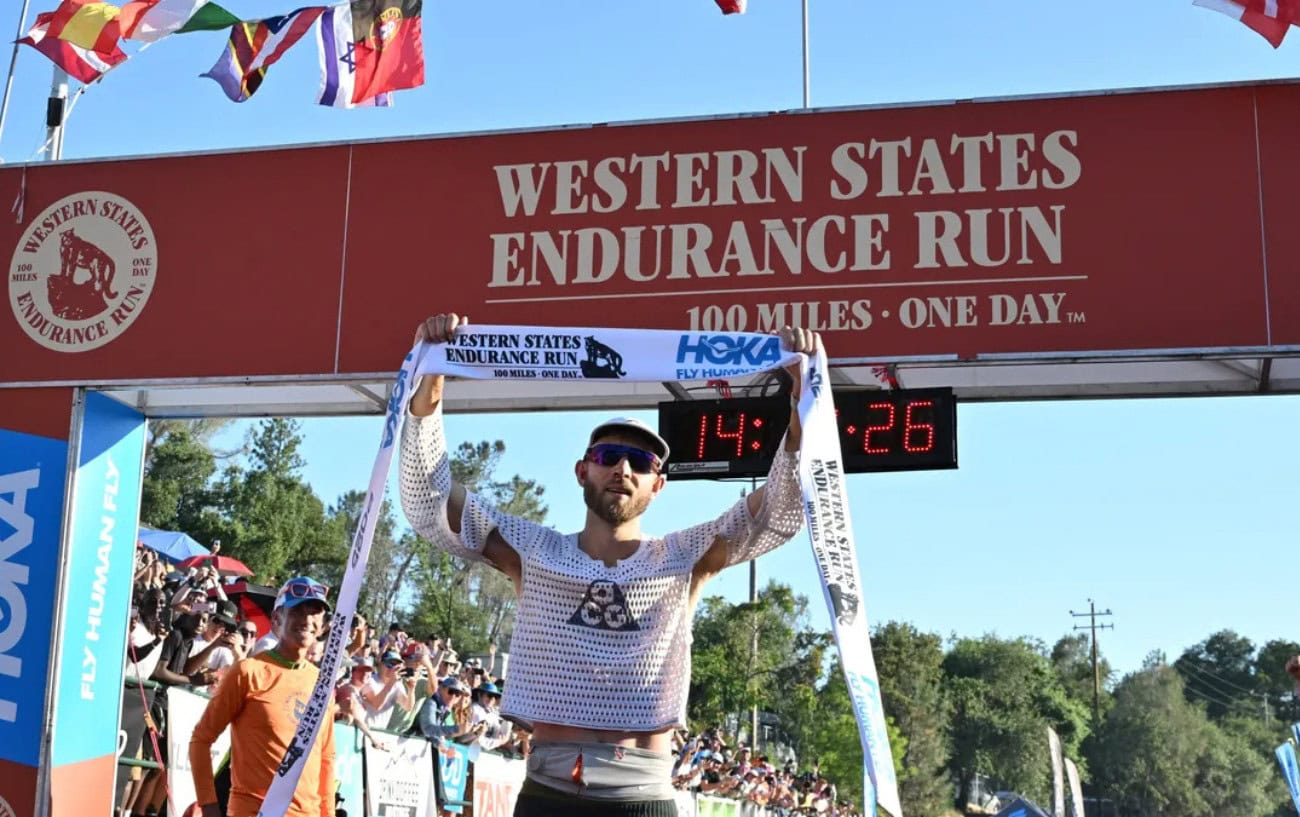
Caleb Olson didn’t just win the Western States 100 this year; he came within two minutes of breaking one of the most revered course records in ultrarunning.
Finishing in 14 hours, 11 minutes, and 25 seconds, Olson posted the second-fastest time in race history, just behind Jim Walmsley’s 2019 record of 14:09:28.
It was a massive leap from his debut performance last year, when he ran the fastest first-time finish ever, and a statement that he’s now among the world’s best ultrarunners.
What made the performance even more impressive was the way he handled one of the toughest years on record.
Temperatures in the canyons climbed above 100°F (40°C), making even seasoned veterans wilt. Olson not only survived the heat, he looked steady the entire way.
By Foresthill, he had built a gap on the field. And by the time he hit the track in Auburn, it was clear no one was going to catch him.
A big part of that? He fueled like a machine.
While many runners bonk or fade late in the day, Olson managed to stay dialed from start to finish.
According to a post from his fueling sponsor, Precision Fuel & Hydration, he was hitting between 80 to 100 grams of carbohydrates per hour, using a mix of energy gels (including caffeine versions) and electrolytes stashed in iced soft flasks.
Over 14 hours, that adds up to over 1,100 grams of carbs, a number that would’ve sounded outrageous in ultrarunning circles a decade ago but is now increasingly common among elite athletes who train their gut to handle it.
The science backs it up.
Studies in endurance performance show that high-carb fueling, particularly in the 90g/hr range, can delay fatigue and improve race-day output, especially in events longer than four hours. When combined with enough fluids and sodium, it also helps runners stay ahead of the energy crash that can derail even the fittest competitors.
Olson’s hydration strategy also deserves credit.
Rather than relying on ice bandanas or water-dousing alone, he carried iced soft flasks, a small but meaningful cooling tactic, especially during the brutal middle miles. Heat management at Western States has long been a deciding factor, and Olson executed as if he’d been racing this course for years.
Chris Myers, who ran shoulder to shoulder with Olson for long stretches, ultimately finished second. Kilian Jornet, returning to Western States for the first time in 14 years, took third. Though Jornet’s presence added global star power to the event, the day belonged to Olson.
The win puts Olson in rare company. Only a handful of men have ever broken 15 hours at Western States, and even fewer have gotten within arm’s reach of Walmsley’s record. Olson now holds two of the fastest ten times in race history, and he’s only 29.
With past top-20 finishes at CCC (the 100K sister race to UTMB), Olson was already on the radar of international trail fans. Now, he’s front and center. If he lines up in Chamonix this August, he won’t be flying under the radar.
Until then, he can enjoy the aftermath of a nearly perfect day at Western States, smart pacing, elite company, brutal heat, and enough carbs to fuel a bakery.



Start the conversation