


Hank, a running coach who posts on X as @HankFrank, sat down after the Chicago Marathon and added up everything the weekend had cost him, right down to the gels. The total came to $5,748.48. Since he shared the list on Oct. 14 it has been viewed 2.2 million times, and much of the reaction in the 300 replies has taken aim at the $1,199.99 Garmin on his wrist. The watch is only the most visible line on the bill. Getting to Chicago, sleeping there and moving around the city cost him more than all of his gear put together, while the race entry, at $266, made up just 4.6 percent of the total.
That split is the useful part of the post, because it gets to what has changed about running one of the World Marathon Majors. Going for a run still costs nothing, and most marathons still cost a few hundred dollars to enter. The seven Majors have become something closer to a travel product, priced the way any city prices a weekend when tens of thousands of visitors all want the same hotel rooms.
Running is supposed to be one of the cheapest sports in the world. Anyway, I decided to calculate how much it cost me to run the Chicago Marathon. Including the full retail value of EVERYTHING I was wearing on race day. RACE DAY GEAR Garmin watch: $1,199.99 Oakley Meta Vanguards: $499 SOAR racing singlet: $295 ASICS racing shoes: $269.99 Bandit half tights: $125 Handheld bottle: $30 Running socks: $18 RACE DAY FUELING 7 SiS gels: $18.69 Maurten Bicarb: $17.50 2 LMNT packets: $3 Electrolyte drink mix: $2 RACE WEEKEND Flights for 2: $1,593.60 Airbnb (3 nights): $970.25 Marathon entry: $266 Race insurance: $42.56 Uber/Lyft: $195.45 Public transit: $7.50 3-day carb load (estimated): $100 MarathonFoto: $94.95 TOTAL OF EVERYTHING LISTED: $5,748.48 You can judge me for the $1,200 watch, but I’ll defend the $94.95 race photos every single time. Running is free, though.
— Hank (@HankFrank) October 14, 2026
What Was on the Bill
Hank split his list into three parts. Race-day gear came to $2,436.98: the watch, a pair of Oakley Meta Vanguard glasses at $499, a $295 SOAR racing singlet, ASICS racing shoes at $269.99 and a few smaller items. His fueling added only $41.19. The weekend itself, everything from flights to the carb load, accounted for the remaining $3,270.31.
Most of that gear will be worn again, which several of his replies pointed out, and the $1,593.60 in flights covered two people, not one. Strip the trip down to the costs that only exist because of the race, though, and it still comes to $2,766.80 for flights, three nights in an Airbnb at $970.25, $195.45 in Uber and Lyft rides and $7.50 on public transit. That is 48 percent of everything he listed, against 42 percent for the gear.
“You can judge me for the $1,200 watch, but I’ll defend the $94.95 race photos every single time,” he wrote, before adding: “Running is free, though.”

The Entry Fee Has Outpaced Inflation
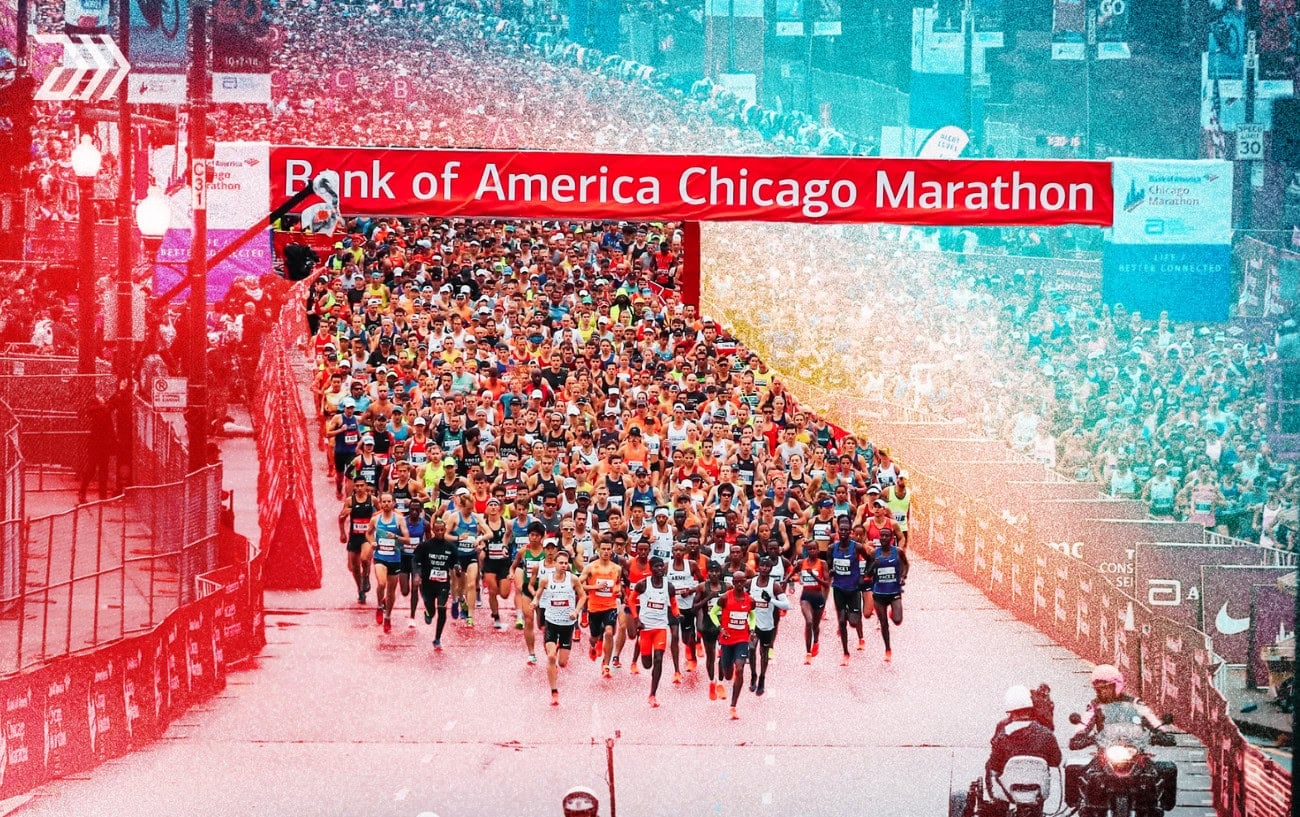
Chicago charges U.S. residents $250 to enter and everyone else $260, plus a processing fee, which explains the $266 on Hank’s list. The fee is unchanged for the 2027 race, but it has climbed a long way over two decades. In 2008 the race cost $110, according to a table of Major entry fees compiled by Stride Nation in 2012. Adjusted with the Bureau of Labor Statistics’ consumer price index, that $110 is worth about $172 today, so the current fee is roughly 45 percent above where inflation alone would have taken it.
The price of a charity place has risen faster. A runner taking one of Chicago’s charity spots for 2027 has to raise at least $2,500, up from $2,200 for 2026, and pays a $325 charity entry fee on top ($335 from outside the U.S.), according to the race’s application page. About a third of this year’s field was expected to run for a charity, the race said in December.
At several of the other Majors, a runner from abroad pays more than a local just to enter. The London Marathon charges U.K. runners £79.99 ($106) if they win a ballot place and international runners £275 ($365), a fee that includes a carbon offset for their travel. Tokyo charges ¥19,800 ($125) to domestic runners and $230 to overseas entrants, according to the race’s 2027 guidelines. Berlin has a single fee, which rose to €215 ($241) for 2027 from €205.
Hotel Rates Climb on Race Weekend
The rest of the bill is set by the host city’s hotels and airlines, and they price marathon weekend accordingly. Ahead of this year’s race, travel technology company Amadeus reported that Chicago hotels were 85.9 percent booked for the Friday to Sunday of marathon weekend at an average daily rate of $364, 10.2 percent higher than at the same point a year earlier. Across all of 2025, Chicago hotels took in $2.9 billion over 11.9 million room nights, according to Choose Chicago, the city’s tourism agency. That works out to about $244 a night, so a room on race weekend was costing visitors around 50 percent more than the city’s yearly average.
Hank’s Airbnb, at about $323 a night, came in under those hotel rates. New York is following the same pattern ahead of its race next month: Amadeus had the average daily rate for marathon weekend at $369, up 12.4 percent on last year. Flights are getting busier too: Amadeus projected domestic air travel up 13 percent for Chicago’s race week and 45 percent for New York’s.
Almost everyone in a Major field is paying those prices. More than 75 percent of the 2025 Chicago Marathon’s participants traveled from outside Illinois, according to an economic impact study by Jones & Associates Economics. This year, about 41 percent of the race’s 54,581 finishers came from outside the U.S., and the field represented 160 countries. For a runner flying in from Mexico City, London or São Paulo, the $260 entry is small change next to the price of the flight.
A pair of running shoes and a local marathon still get most runners to a start line for a few hundred dollars, and Hank’s own list shows how much of his spending was optional. The Majors are a different purchase. A record 55,000-plus runners signed up for Chicago this year knowing what the weekend would cost, and applications for the 2027 drawing, at the same $250 entry fee, are open until 2 p.m. Central on Oct. 29.
RunClub
Get more running stories — join RunClub
Daily running news, a community of 300,000+ runners, free training plans for every distance, and a daily running game. Free to join — no card.
Already a member? Log in →









Join the conversation
MH
I find this (the original post, not MH reporting on it) EXTREMELY disingenuous. It’s just clickbait. I am not a coach or an elite runner, but I am a very dedicated amateur who has run in the 2:50 range on multiple occasions, so I feel that I can give some valid perspective on this.
First of all, including race gear as a race expense is a nonstarter for me. Let’s break it down.
Gear:
Garmin watch - This is a TRAINING expense, and a chosen one at that. You can run the race and train without it. There are also options that are under $100 that will cover the necessary pace and heart rate measuring during a race and in training.
Oakleys - I ran Chicago in my prescription Warby Parker sunglasses held on with silicone ear hooks. They were “free” with insurance. I have run dozens of other races with my $20 Goodr sunglasses.
Singlet - The race gives you a shirt you can wear. You could choose a very high quality singlet that costs less than 25% of the SOAR singlet - see Nike, Brooks, New Balance, and literally dozens of others that range from free race swag to under $100 for very high quality gear, especially when looking at clearance sales. Running clothes are a training expense. This singlet did not have to be purchased for this race.
Shoes - Again, they CHOSE super shoes. Shoes are also a training expense. Buying super shoes is not a marathon-major-exclusive expense.
Half tights - Same as the singlet. You can get high quality shorts, pants, and tights for extremely fair prices on clearance sales, from races, and plenty of other places.
Handheld bottle - This is a training choice. There are hydration and medical stations on the course. This is not required for the race.
Running socks - Again, not purchased for the marathon. You can train in normal socks if you want to. Running socks are a choice.
In summary:
Watch - Not purchased solely for the race
Sunglasses - Not purchased solely for the race
Singlet - Not purchased solely for the race
Shoes - Not a required purchase for the race
Tights - Not purchased solely for the race
Bottle - Not purchased solely for the race
Socks - Not purchased solely for the race
That is $0 in required gear ONLY for the race.
Fueling:
This is not a requirement for the race, but you could very easily argue that it is a requirement for a strong performance. I only used about $20 of gels personally and had more Gatorade than usual during the week leading up to the race. I’ll give them this one.
Race Weekend:
Flights for two - Let’s cut this in half. If your partner goes on a business trip with you, your company isn’t expensing their ticket. All of the other prices on this list are for one person, so doubling this one up is just dishonest. $796.80 on domestic round trip flights stings a bit, but it’s not unreasonable.
Airbnb - Yes, lodging is a major expense for these trips. Hotels and the like all KNOW that this is a huge event. Supply and Demand principles apply. It sucks, but you know that it’s going to be expensive to find lodging in one of the biggest cities in the country for a major event like this. You also don’t have to be there for three nights to run the race. I stayed Friday and Saturday and left on Sunday.
Marathon entry - These races are a massive undertaking, now more than ever since so many people are participating. It sucks, but it is a known factor.
Race insurance - This is not a requirement to run the race.
Ride share - This was a choice. Chicago has ample public transit that was foregone. I took public transit everywhere for race weekend and had no problems.
Public transit - Use it more. Let’s quadruple it to make up for not using ride share service.
3-day carb load - You have to eat food whether you are running a race or not. A heavy carb diet costs about the same as a regular diet. I went to a grocery store and didn’t eat out the entire weekend because I don’t like waiting in huge lines at restaurants.
Marathonfoto - NOT A REQUIREMENT FOR THE RACE
Fueling and race weekend summary:
Fueling - $41.19
Flight for one - $796.80
Lodging - $970.25
Entry - $266
Insurance - Not required
Uber/lyft - Not required
Public transit - $30 (quadrupled to make up for cars)
Carb load - not required specifically. You have to eat.
Marathonfoto - Not required.
NEW TOTAL: $2128.99
This is 37% of the supposed “total cost” for this person. Using prices of gear that they already own or will continue to use after this race is disingenuous. Using a flight price for two people is laughably dishonest for these purposes. Use public transit instead of ride share services. Eat more frugally. Don’t get ripped off by Marathonfoto.
It’s still expensive to run a major. It it is too expensive, support a smaller race. They are a blast, and are often easier to run than the big ones.
Running is still free. Racing is not.