


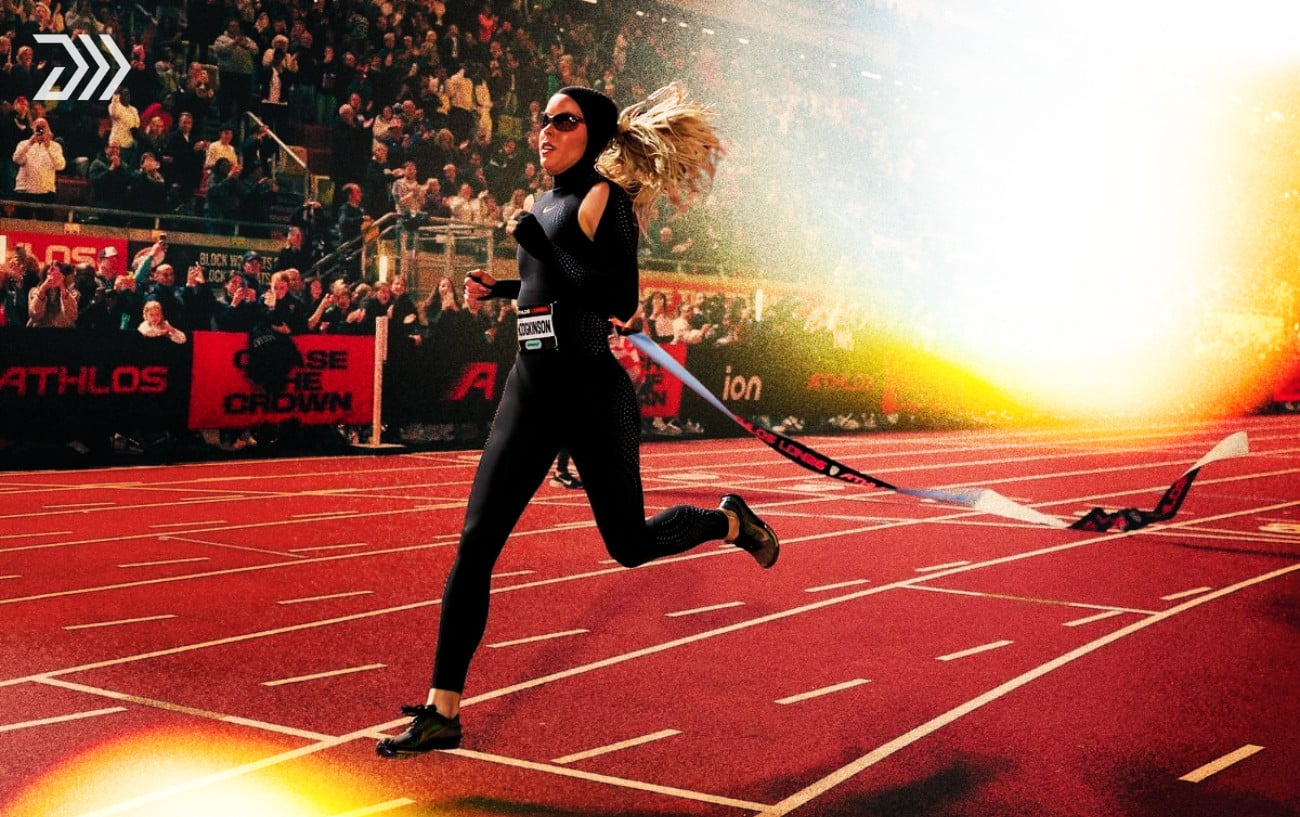
Keely Hodgkinson won the 800m at Athlos London on Friday night in 1:56.40, racing in a black hooded Nike suit made for her and nobody else, covered in 3D-printed nodes shaped to cut drag.
Valentina Rosamilia of Switzerland took second in 1:58.75, 2.35 seconds back, and France’s Rénelle Lamote was third in 2:00.15. The winning time is a meeting record. Athlos pays its winner $65,000 and gives out Tiffany & Co. crowns rather than medals.
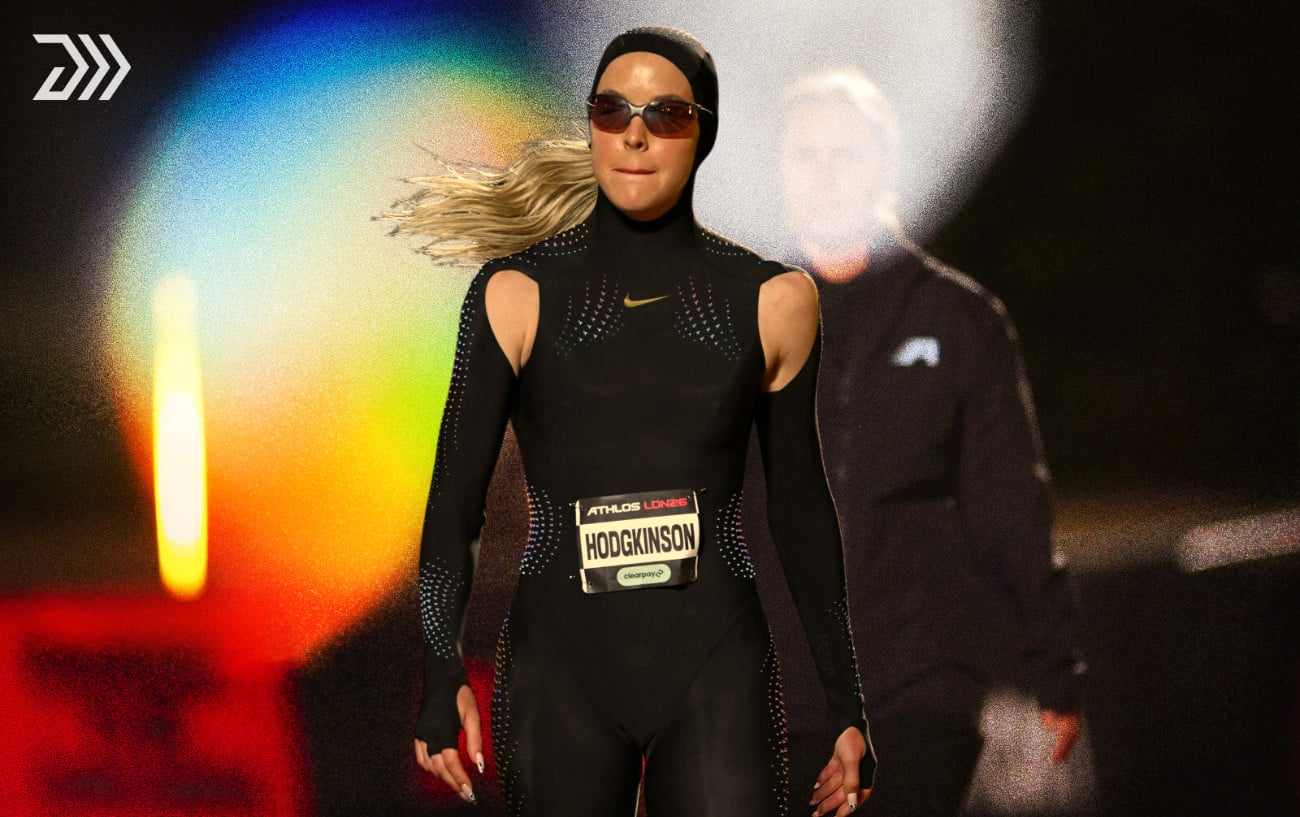
She had never raced in the suit before. It runs from a hood down to her ankles, opens across the back, and carries rows of small delta-shaped nodes on the shoulders, thighs, torso and head, with a gap cut at the crown for her ponytail. She wore sunglasses with it. “I was a little nervous, walking out,” she told the Press Association. “The shades helped me block out the noise, but it was really fun and it’s something I’ll remember forever.”
What the Nodes Actually Do
Nike calls them vortex generators, and they are 3D-printed in delta shapes and arrayed across the suit. The company says six months went into the design at its innovation center in Oregon, under Hannah Amis, its director of innovation apparel product design, with the arrays computed separately for each part of the body. Hodgkinson told PA the whole thing, fittings included, took about a year. The nodes trip the airflow into small eddies that cling to the fabric instead of letting it peel away into a wider wake.
The idea has a published history that is not brand copy. In 2016, researchers including Len Brownlie and Edward Harber, both of whom had worked on Nike’s earlier racing suits, reported in Procedia Engineering that vortex generators on full-scale mannequins cut aerodynamic drag by 3.7 to 6.8 percent against the racing apparel of the 2012 Olympics. Modelling a conservative 4 percent for male athletes, they put the saving at 0.013 seconds over 100m and half a second over 1,500m. The paper does not model the 800m, though two laps would presumably come in under the 1,500m figure. Audrey Werro beat Hodgkinson by only 0.20 seconds at the European Championships in August, which is roughly the scale at which it starts to count.
The one place the engineering and the athlete disagreed was the hair. Amis said the hood “streamlines the hairline and manages the chaotic aerodynamics of hair in motion.” Hodgkinson wore her ponytail out anyway, through the opening cut for it. “The science was like technically with the air drag you’re slower with your hair out, but I was like, ‘that’s a non-negotiable. My hair is staying out’,” she said. Slits run down the sides of the hood so her sunglasses, 18 grams of them, sit without pulling at the fabric.
Nobody had to approve any of it. World Athletics certifies racing shoes down to the millimeter and keeps a public database of the legal ones, while its clothing rule asks only that what athletes wear be clean, opaque when wet and not objectionable. A catch-all further down the book bans technology that hands an athlete an advantage they could not have got from permitted kit, and it exempts shoes rather than clothing, though there is no certification behind it. Hodgkinson told PA she thinks the suit is within the rules.
Nike Has Built This Suit Before
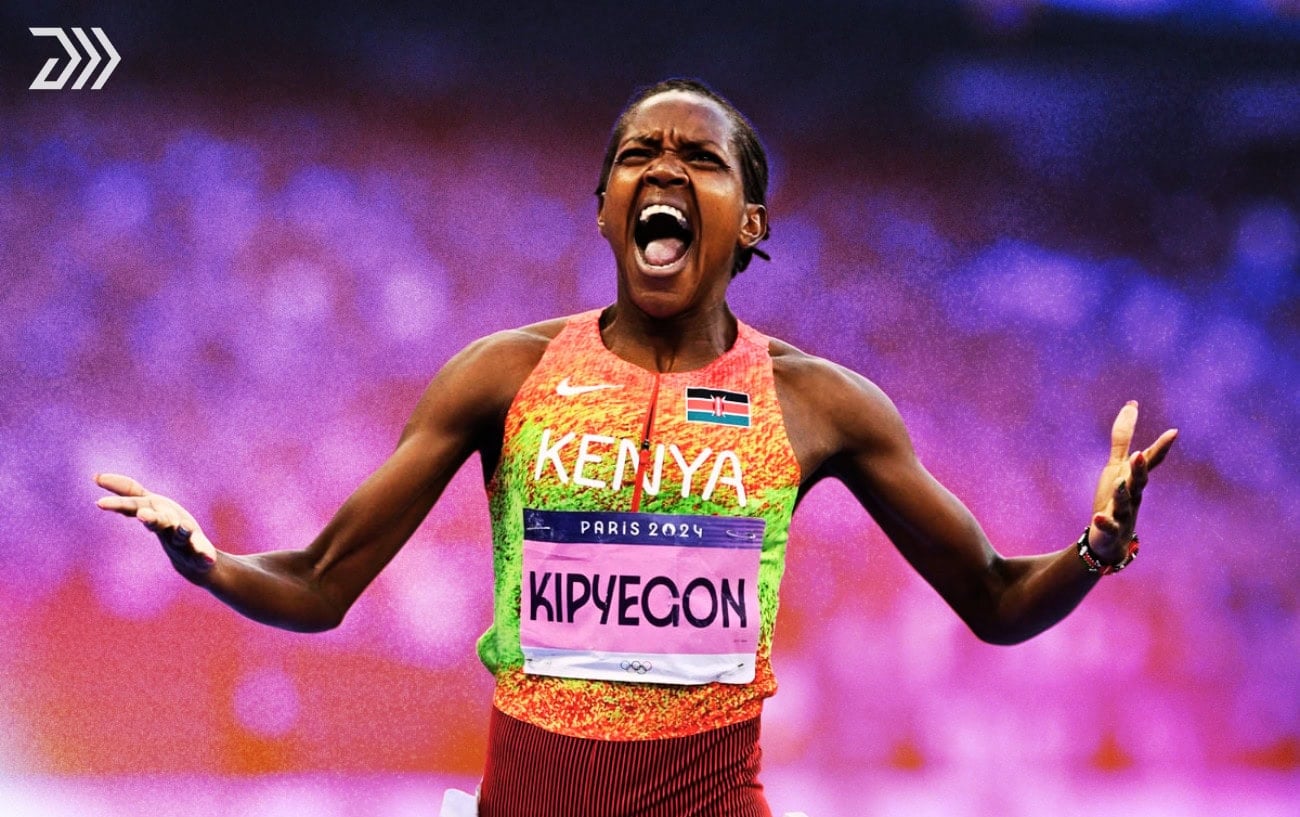
Cathy Freeman won the Olympic 400m in Sydney in 49.11 on Sept. 25, 2000, in a hooded full-body Swift Suit that Nike started designing in 1998, its surface textured differently on each body segment according to how fast that segment moves. Harber’s studio worked on it. Faith Kipyegon ran her Breaking4 mile in Paris in June 2025 in a Fly Suit covered in half-sphere Aeronodes, some of which Nike describes as “smaller than a pencil tip,” and Nike told CITIUS Mag it “applied learnings from Breaking4” when it came to build this one. Kipyegon’s attempt was an exhibition Nike staged itself, with pacers and no record at stake, and Hodgkinson’s suit came out at a one-night invitational Alexis Ohanian created, which lost its second date last month.
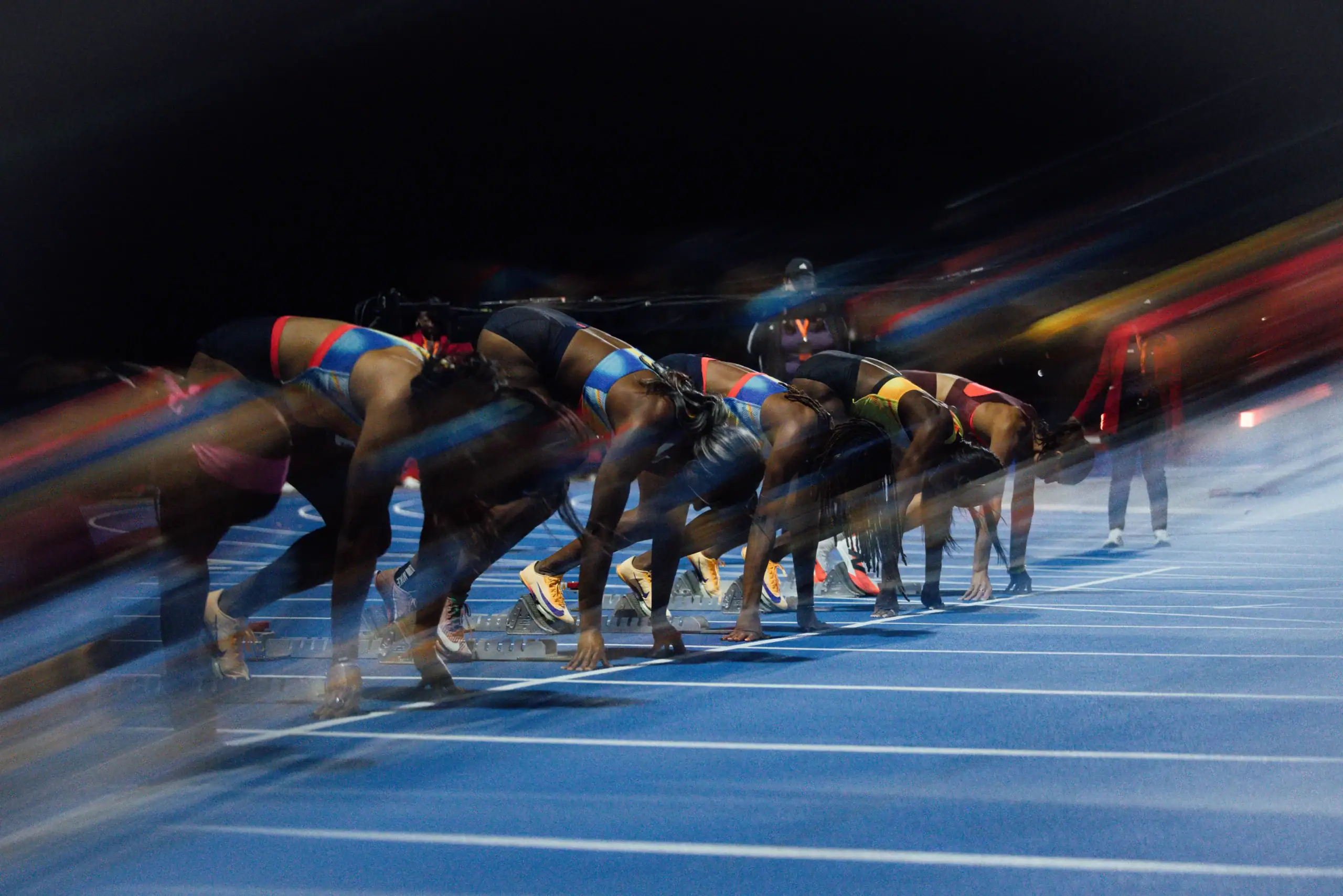
Athlos has now run three times, twice at Icahn Stadium in New York and once in London. The card is seven events, six athletes in each, over a single night. Klaudia Kazimierska took the mile in 4:19.43, 0.11 seconds ahead of Georgia Hunter Bell. Marileidy Paulino ran 48.73 in the 400m and Henriette Jaeger went with her to a Norwegian record of 48.78. Sha’Carri Richardson and Gabby Thomas won the sprints, in 10.80 and 22.13.
Hodgkinson had not won a race since July. The season behind Friday was a strange one: she broke the indoor 800m world record in Liévin on Feb. 19 with 1:54.87, 0.95 seconds inside a mark Jolanda Ceplak had held since 2002, then took her first world indoor title in Torun and ran a British record of 1:54.33 in Stockholm in June. A fall on a cooldown run in July set her back. Werro beat her at the European Championships in Birmingham in August, a race in which she tore a hamstring tendon that is split in two where most people have one, and beat her again in Budapest last week.
PA put it to her that the whole field might be dressed this way by the Los Angeles Olympics in 2028. “We might know some things that people don’t,” Hodgkinson said.
RunClub
Get more running stories — join RunClub
Daily running news, a community of 300,000+ runners, free training plans for every distance, and a daily running game. Free to join — no card.
Already a member? Log in →






Join the conversation
Keely is awesome. She gets people interested in track athletics. She’s a real northern lass with sass. Love it.
I watch and enjoy almost most televised athetics events if i cant attend. Athlos was the most boring and forced event ever. More like a video game with arranged results rather than a real athletics meet. Americanized loud hype and shouting childish presenters didnt help. Left the shoe after 15 minutes as could not watch any more. Relooked on bbc iplayer and had to skip through most of the americanised hype to see athletics, again gave up. Even the keely hyped race was all prearranged win...just look at the line up. Wont ever look at athlos again. Would rather watch paint dry