


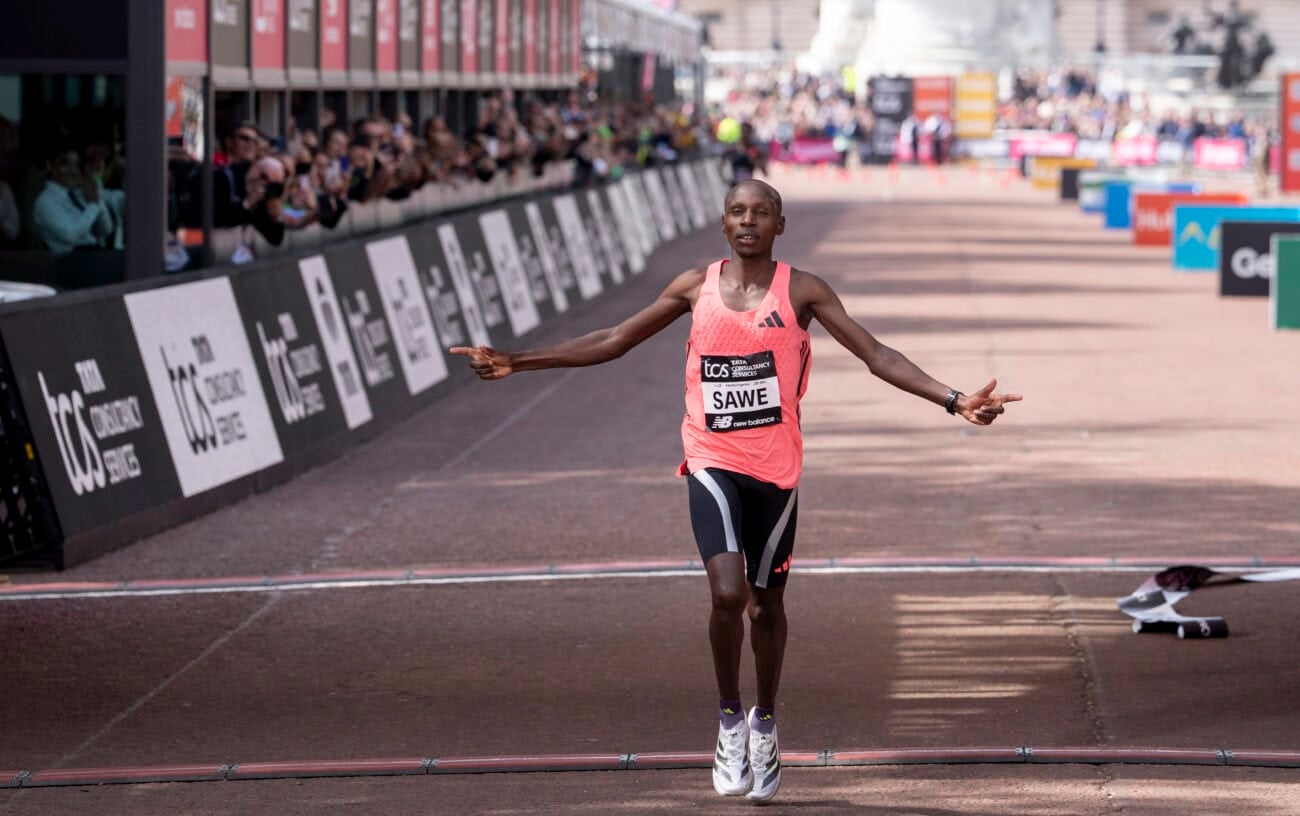
Sabastian Sawe became the first person to officially run a marathon in under two hours on Sunday, finishing the London Marathon in 1:59:30. The Kenyan held a pace of 2:50 per kilometer over the full 42.2 km course, setting a new world record and breaking a barrier that had stood as the sport’s defining frontier for decades.
Sawe, who won London in 2025, had spent the past 12 months preparing for this single race. He worked closely with his coach Claudio and Swedish sports nutrition company Maurten on a fueling protocol designed for one purpose: getting him under two hours in an open, record-eligible event.
He kept his goal quiet at home in Kenya.
“When I go home, they always ask about my training and preparation,” Sawe said. “I haven’t shared with them my ambition to run a world record, because in our culture we don’t talk about such things in advance — only when they happen.”

A year of testing in Kenya
Between April 2025 and April 2026, staff from Maurten flew to Kenya six times, spending a total of 32 days with Sawe in Kapsabet. The work was led by Joshua Rowe, the company’s Head of Sports Tech.
“It’s been an honor to work so closely with Sabastian as he prepared for this incredible achievement,” Rowe said. “The trust he and his coach Claudio put in us to get Sabastian’s fueling right is not something we take lightly.”
Rowe also offered a less familiar take on what made Sawe’s run possible. “Anyone who’s seen Sabastian run knows he’s an extraordinary athlete — once-in-a-generation, really. What is perhaps not as well-known is that he’s also one of the best fuelers the marathon has ever seen.”
The testing itself was unusually thorough. Rowe listed stable isotope ¹³C labeling to measure how much external carbohydrate Sawe could actually absorb, doubly labeled water to track energy expenditure, VO2 max and running economy assessments, lactate testing, blood sampling, body composition checks using bioelectrical impedance analysis, training-load monitoring, thermoregulation data, and detailed food-intake logs.
“We left no stone unturned, really,” Rowe said. “We carried out extensive testing and analysis to guide the nutrition and training strategy. We went deep.”

Training the gut
Running fast on race day is one thing. Tolerating high amounts of carbohydrate at race pace is another. Sawe’s team built a separate gut-training plan to prepare his stomach for the volume of carbs he would take in during the race.
In training, he took a Maurten gel before long sessions and sipped Maurten Drink Mix at the same intervals he would use on race day. The idea was to repeat the schedule often enough that his gut adapted, lowering the risk of distress while improving how much carbohydrate he could actually use as fuel. Maurten relies on a hydrogel formulation designed to carry carbs through the stomach with less GI disruption than traditional gels.
After months of adjustment, the team locked in a final race-day plan.
The race-day fueling plan
Sawe carb-loaded with Drink Mix 320 in the two days before the start. On race morning, he ate a light breakfast, then took the Maurten Bicarb System at 6:45 a.m. and sipped Drink Mix 320 on the bus to the start. Five minutes before the gun, he had a Gel 100.
During the race, the schedule was tightly mapped to the kilometer markers. Sawe drank 160 milliliters of Drink Mix 320 at 5 km, 10 km, and 15 km. At 20 km, he switched to a caffeinated gel, the Gel 100 Caf 100, paired with 130 ml of Drink Mix 160. From 25 km to 40 km, he drank 130 ml of Drink Mix 320 every five kilometers.
Across the full race, Sawe averaged 115 grams of carbohydrate per hour. That is roughly the upper end of what trained endurance athletes can absorb, and it is well above the 60 to 90 grams per hour that has long been considered the standard target for marathoners.
RunClub
Get more running stories — join RunClub
Daily running news, a community of 300,000+ runners, free training plans for every distance, and a daily running game. Free to join — no card.
Already a member? Log in →








Start the conversation