


There is a certain kind of sports nutrition study that always gets runners’ attention: the one that hints your gel might be doing more than just giving you sugar.
Sodium alginate gels fall into that category. The pitch is appealing. Wrap the carbohydrate in a hydrogel to improve gastric handling, smooth out blood sugar, and maybe hold your pace together better late in the race. A new study tested that idea in a real marathon (which already makes it more interesting than most fueling papers).1Zhang, P., Gu, Z., Xu, K., Zhao, Y., Chen, G., & Dai, J. (2026). Impact of sodium alginate energy gel on the marathon performance of amateur runners: a randomized controlled study. Frontiers in Physiology, 17. https://doi.org/10.3389/fphys.2026.1746392

The researchers recruited 81 male amateur marathoners and split them by performance level into elite and advanced groups, then randomly assigned each runner to either a sodium alginate gel or a traditional gel. That created four groups: elite sodium alginate, elite traditional, advanced sodium alginate, and advanced traditional.
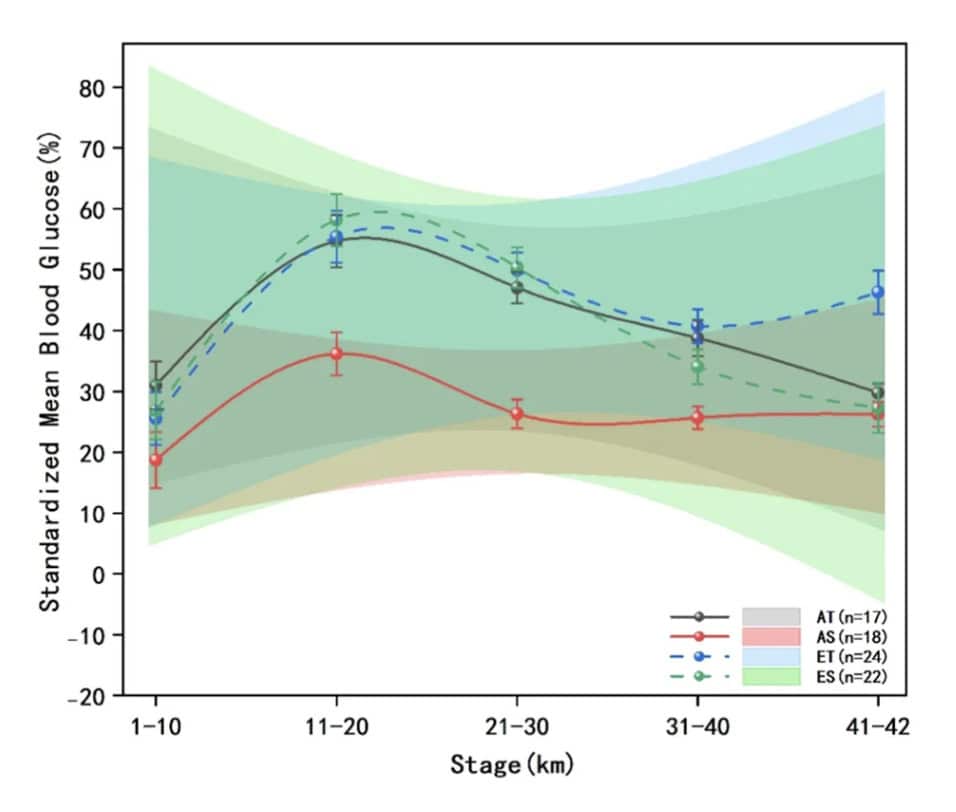
All runners wore continuous glucose monitors for a week before the race to establish baseline glucose levels, then raced the 2024 Nanjing Marathon using a prescribed fueling strategy targeting 60 grams of carbohydrate per hour. Pace and glucose data were standardized so the researchers could more fairly compare runners of different levels.
Sodium alginate gels did not improve finish times. The elite sodium alginate group finished slightly faster on average than the elite traditional group, and the same was true for the advanced groups, but those differences were not statistically meaningful. Average race pace also did not differ clearly.
Even though overall race outcomes were largely the same, the sodium alginate gels seemed to affect how runners finished the race. In the elite runners, the sodium alginate group showed smaller percentage changes in pace across all five race segments than the traditional gel group. In other words, their pacing was steadier. Among advanced runners, the sodium alginate group showed smaller pace changes in the first half of the race, especially from miles 1–6 and 7–12, though that advantage did not carry cleanly through to the very end of the race.
For advanced runners, sodium alginate gels were associated with lower blood glucose fluctuation in the 7–12 mile and 19–24 mile segments, which suggests a more stable mid-race metabolic profile. But that benefit was not universal. Early in the race and again in the closing segment, glucose fluctuation was actually greater in the sodium alginate group.
What this means for runners
This study does not say you need a sodium alginate gel to run your best marathon. It says this type of gel may help some runners maintain a steadier pace and keep blood sugar fluctuations a little more controlled during key segments of the race, even if it does not lower finish time outright. That makes it a potentially worthwhile option for runners who already struggle to tolerate regular gels or who tend to get erratic with pacing and fueling mid-marathon. I would especially view it as a gastrointestinal and pacing-management tool.
References
RunClub — Free
Join 300,000+ runners in RunClub
Free training plans for every distance, a daily running game, exclusive coaching content, and a real community of runners. Create your free account in 20 seconds — no card.
Already a member? Log in →








Start the conversation