


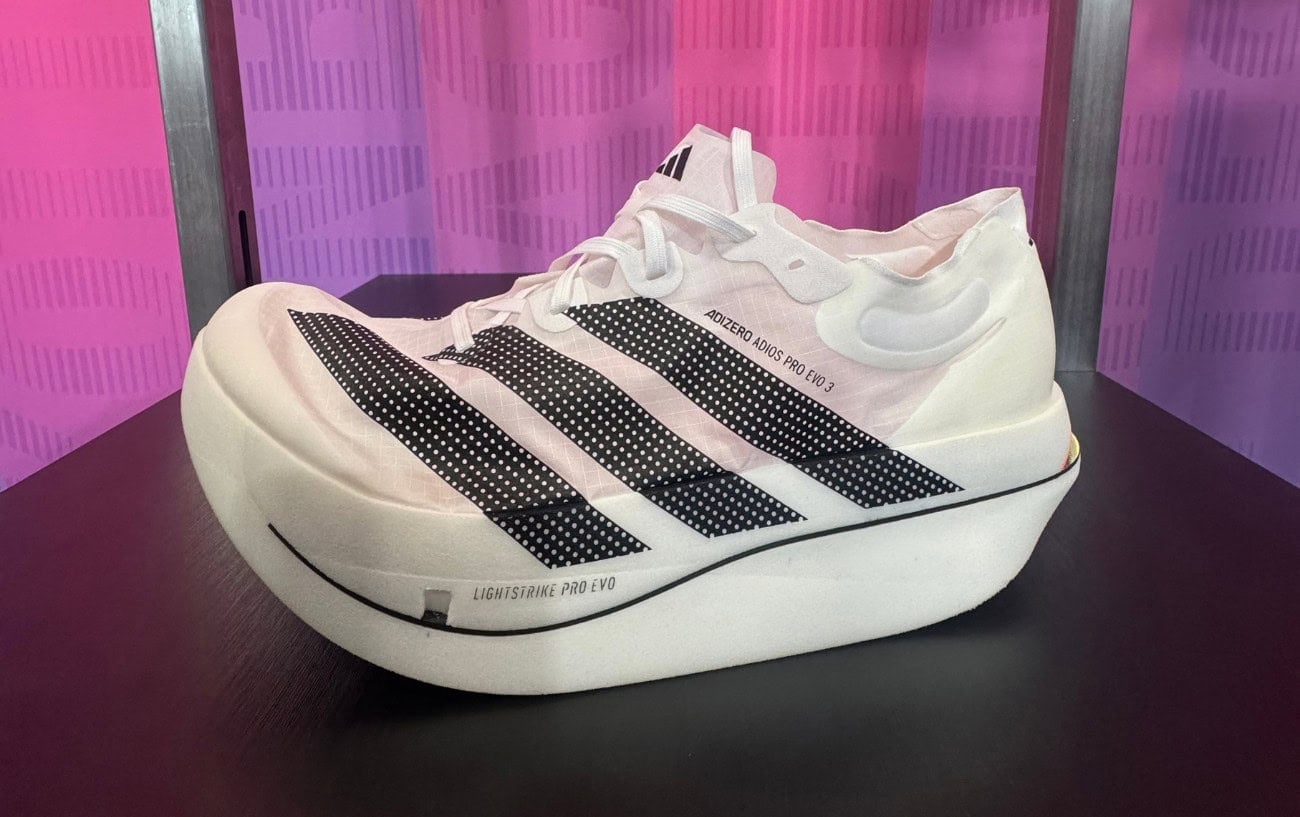
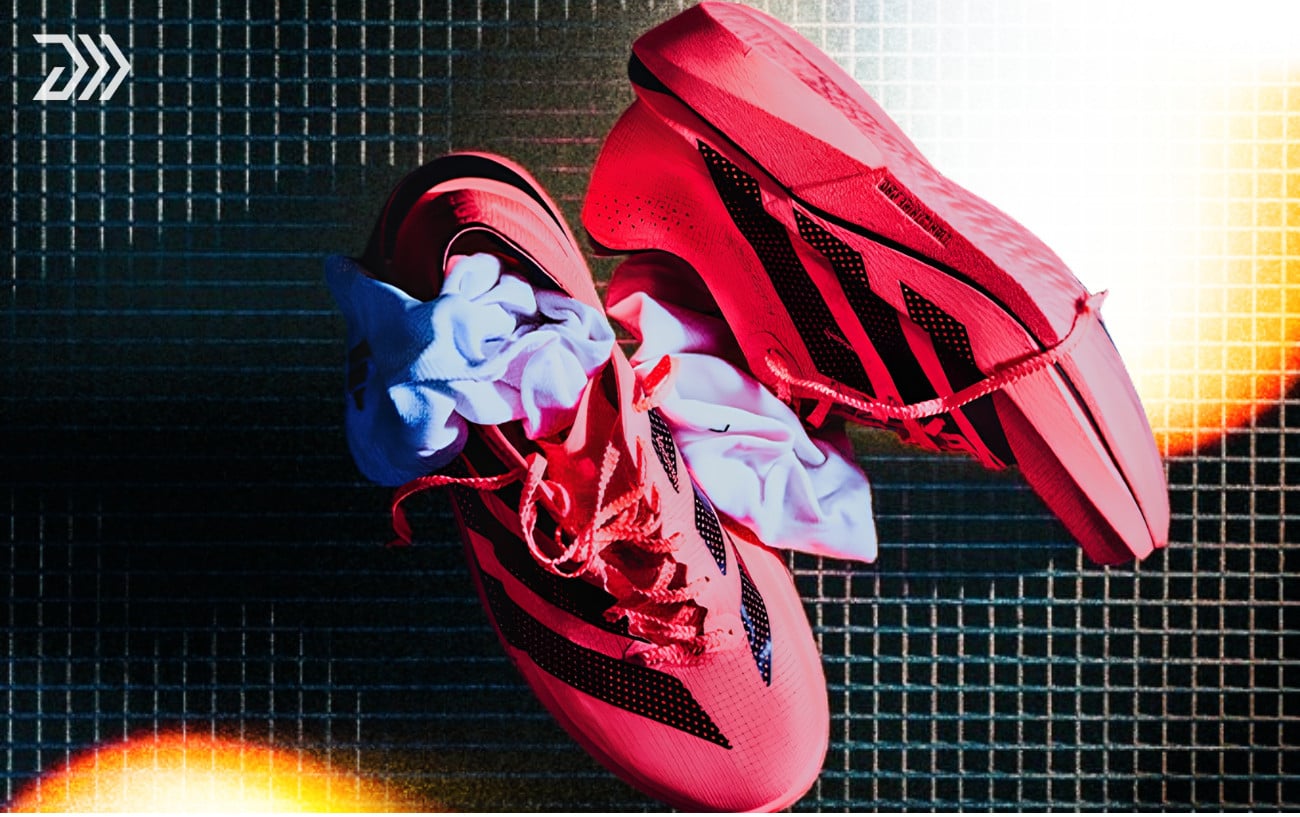
Adidas may be on the verge of unveiling its next generation of ultra-light marathon racing shoes. Images circulating on Instagram this week appear to show the Adizero Adios Pro Evo 3 displayed inside an illuminated acrylic case, sitting on a precision scale that reads 97.27 grams — potentially making it one of the lightest marathon-legal shoes ever produced.
That weight, if accurate, would be extraordinary. A standard egg weighs roughly 50 grams. A single AA battery is about 24 grams. At 97.27g, the apparent Evo 3 would weigh less than many road running shoes weigh after you remove the insole.
The images have not been officially confirmed by Adidas, and no announcement had been made as of publication time. An official reveal, however, appears to be imminent.

A Shoe Line Built on Breaking Limits
To understand why these images are generating so much buzz, it helps to know the lineage. The Adizero Adios Pro line has long been Adidas’s flagship racing shoe — worn by elite marathoners chasing world records and podium finishes at the sport’s biggest races.
The Evo sub-line, introduced as an extreme, stripped-back version of the Pro, pushed the boundaries of what a marathon racing shoe could weigh. The first iteration, the Adizero Adios Pro Evo 1, was worn by Tigst Assefa when she shattered the women’s marathon world record in Berlin in 2023, finishing in 2:11:53. The shoe became a symbol of Adidas’s engineering ambition — and its willingness to strip a racing shoe down to almost nothing in pursuit of speed.
The Evo 2 followed, available for sale from March 26, 2025, and is currently approved for competition by World Athletics across road races, cross country races, and mountain and trail races. Its model number, OPR78, appears on the World Athletics certified list alongside alternative colorway numbers JR7259, JR7260, and KJ7717.
What the Instagram Images Show
The photos show a white and black shoe — clean, minimal, and unmistakably Adidas — displayed inside a glowing acrylic frame with “ADIZERO ADIOS PRO EVO 3” printed across the top. The shoe appears to use the same platform construction as its predecessors, with a thick, sculpted Lightstrike Pro Evo midsole clearly visible and a small red detail at the heel.
The scale beneath the display reads 97.27g. If that reflects the actual weight of the shoe in a standard size, it would represent a meaningful reduction even from the already featherweight Evo 2. For context, the Adizero Adios Pro Evo 1 weighed 138 grams — itself a record-breaker at the time.
A Development Shoe That Raises Questions
Here’s where things get interesting. A search of the World Athletics shoe approval database turns up a listing that may or may not be connected to what’s shown in those Instagram posts.
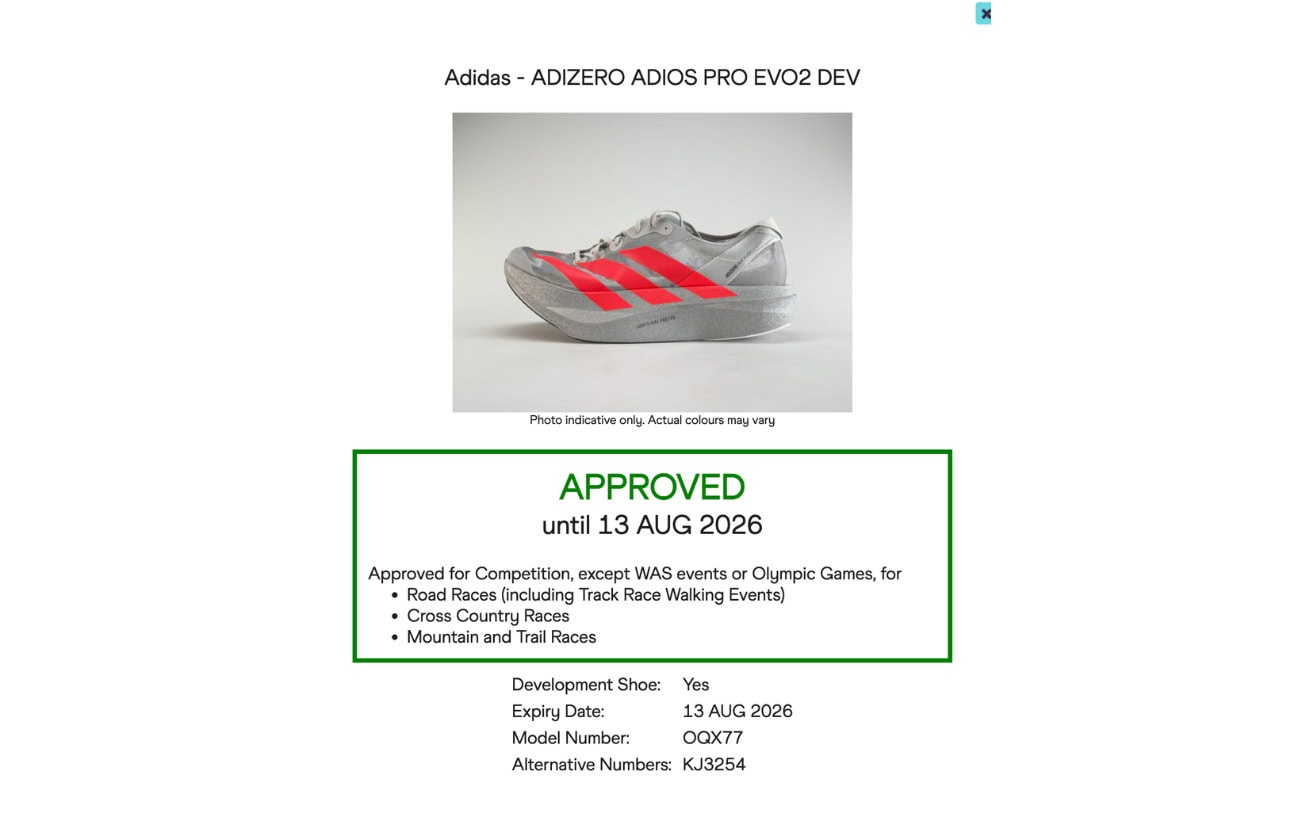
A shoe listed as the “Adidas – ADIZERO ADIOS PRO EVO2 DEV” — designated as a development shoe — has been approved for competition until August 13, 2026, under model number OQX77. The catch: it is not approved for World Athletics Series events or the Olympic Games, a restriction commonly applied to prototype or transitional footwear.
What’s notable is how the development shoe’s appearance appears to diverge from the released Evo 2. It looks visually closer to the shoe shown in the Instagram images than to the Evo 2 currently on the market — raising the possibility that what World Athletics has approved as an “Evo 2 development” shoe may, in fact, be the Evo 3 in its pre-release form. It’s not uncommon for brands to submit next-generation prototypes under a prior model’s name during the approval process.
That said, this is speculation. The naming conventions used in World Athletics submissions don’t always match a shoe’s eventual consumer branding.

Not Yet on the Official List — But Watching Closely
As of now, no shoe explicitly named the Adizero Adios Pro Evo 3 appears on the full World Athletics certified footwear list. That could mean the shoe is still awaiting approval, that it’s been submitted under a different name, or simply that an announcement is being staged around an imminent product reveal.
Adidas has not publicly commented. Marathon Handbook has reached out to Adidas for confirmation and will update this article when more information becomes available.
Why the Weight Matters
For runners, the allure of a sub-100 gram racing shoe isn’t just about gimmickry. Research consistently shows that shoe weight is one of the more meaningful variables in running economy — the efficiency with which a runner uses oxygen. A lighter shoe means less energy spent lifting your foot with every stride, multiplied across tens of thousands of steps in a marathon. Studies suggest that carbon-plated super shoes can improve performance by 2–4% compared to conventional racers.
The question, as always with Evo-level shoes, will be durability and availability. The Evo 1 was widely criticized for wearing out quickly — some runners reported significant midsole compression after just one race. The Evo 1’s reputation for single-use durability was largely overstated, with Adidas staff suggesting it could last 200–250 miles in the right conditions — but the perception stuck. At $500 a pair, the shoes remain positioned as elite race-day-only footwear, not everyday trainers.
Whether the Evo 3 solves those problems — or doubles down on pure performance at the expense of longevity — remains to be seen. If the super shoe arms race between Adidas and its rivals is any guide, expect the engineering to be extraordinary and the price tag to match. The fastest marathon shoes of recent years have all pushed the same boundaries — lighter foam, smarter carbon systems, and less of everything that isn’t essential.
For now, the running world is watching. If those Instagram images are what they appear to be, Adidas is about to make noise again.
RunClub
Get more running stories — join RunClub
Daily running news, a community of 300,000+ runners, free training plans for every distance, and a daily running game. Free to join — no card.
Already a member? Log in →




Start the conversation