


At 40 years old, Keira D’Amato is doing something most elite runners have long since stopped even imagining, she’s getting faster, again.
Nearly a decade after stepping away from professional running entirely, walking into real estate, motherhood, and what she calls an “eight-year halftime show,” D’Amato has become one of the most compelling figures in American distance running.
Her new memoir, Don’t Call It a Comeback, co-written with journalist Evelyn Spence and released this week, tells the story of how she rebuilt her life and running career on her own terms, one brutally honest, often hilarious mile at a time.
In the book, D’Amato shares how, in 2016, after years off from running, her mother-in-law encouraged her to take a break from parenting duties and go for a jog. She set a modest goal, three minutes. Ninety seconds in, she was gasping for air and crying on the side of the road.
“If you just heard, ‘this woman has broken the American record,’ you assume she’s always been at the top,” she told Sports Business Journal. “And I’m not that at all. I started with a 90-second run.”
Since that moment, her trajectory has been anything but typical. In 2022, she shattered the U.S. women’s marathon record in Houston with a 2:19:12 win. She went on to break the national half marathon record in 2023 and recently clocked the fastest 10-mile road time in the world, along with a Masters 10K record.
But what’s more interesting than the records is what D’Amato is doing in between them, and why she’s still at it. After relocating her family to Park City, Utah, she joined the Run Elite Program to train at altitude under Olympic marathoner Ed Eyestone.
Now logging more than 100 miles a week, balancing workouts with school drop-offs, massage therapy, strength training, and, naturally, a few açaí bowls, D’Amato is fully invested in this late-stage racing chapter.
Her coach sees her longevity not as a mystery, but as a matter of mileage, literal and emotional.
“It’s not the age, it’s the mileage,” Eyestone told The New York Times.
Because D’Amato left the sport for so long, he believes she may have avoided the wear-and-tear that burns out many pros by their early 30s.
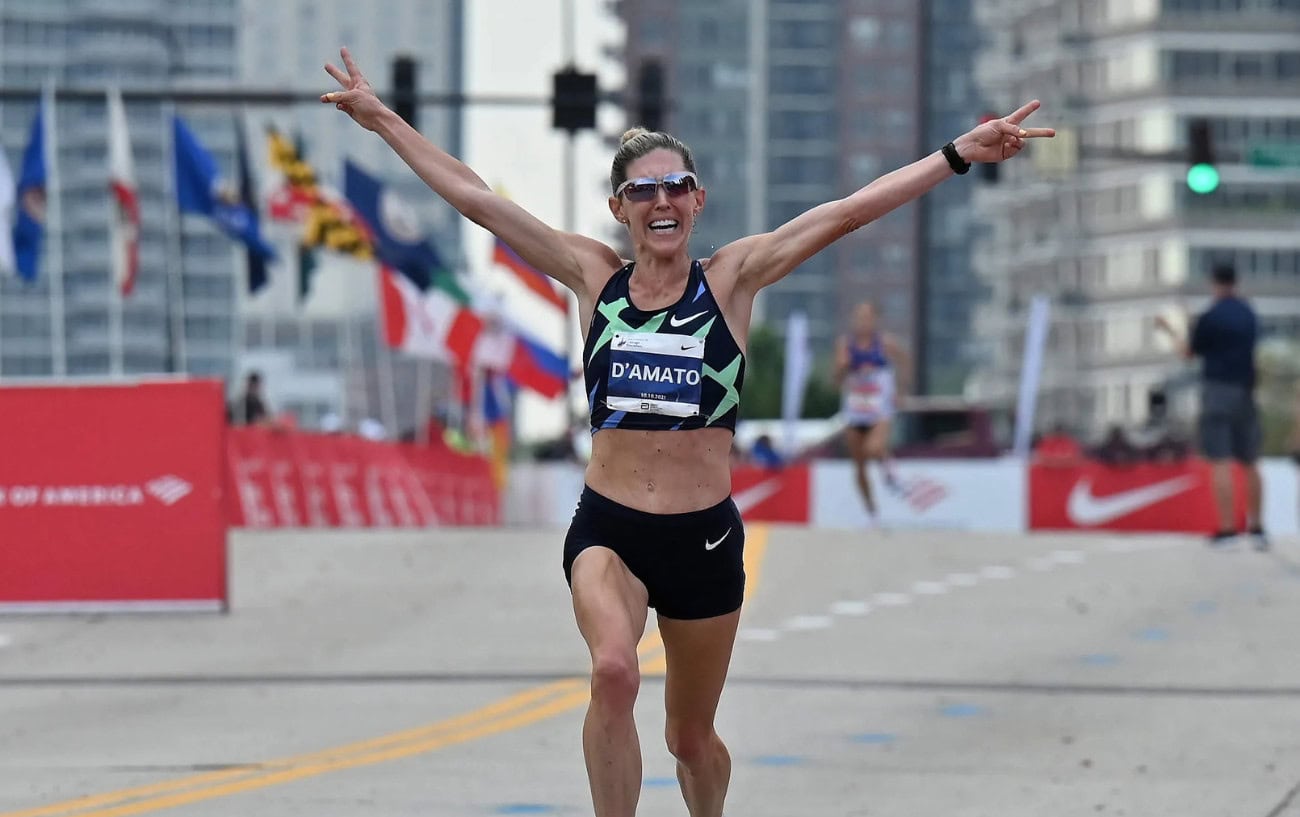
D’Amato doesn’t see herself as an outlier, just as someone who found a new relationship with the sport. What once felt like pressure now feels like purpose. And unlike many pros, she’s not afraid to lose.
“That’s why I felt like a wild card,” she said. “I could totally go big and fail, or not fail, but it can be dangerous to race against someone who’s a little crazy like that, right?”
The memoir, which she describes more as a “rough translation” than a blueprint, is less about glory and more about finding joy after loss, of career, goals, and eventually, her marriage.
After dropping out of the 2024 U.S. Olympic Trials with heatstroke at mile 16, she rewrote the book’s planned ending. The Paris dream didn’t happen. But the running, and the dreaming, hasn’t stopped.
“Real life is full of loose ends,” she said. “I don’t think anyone’s path is perfect or rosy, and I don’t think I’m anything special. But maybe I’ve figured out some special things that can help other people.”
In her memoir, those lessons come in the form of small, stubborn wins.
A local 5K that sparked belief. A root beer float at the end of every long run. A thimble-sized figurine gifted to a strength coach who collects knickknacks. It’s in those details that D’Amato’s story takes flight, not just as a record-setter, but as a reminder that reinvention is rarely neat, and rarely final.
Next up, she’ll race the Copenhagen Half Marathon before heading to Valencia in December. Whether she reclaims her records or not, she’s not done pushing herself, or encouraging others to do the same.
“I’ve reached heights that are higher than I ever thought I could reach,” she said. “So let’s just see how far I can keep going.”
RunClub
Get more running stories — join RunClub
Daily running news, a community of 300,000+ runners, free training plans for every distance, and a daily running game. Free to join — no card.
Already a member? Log in →





Start the conversation