


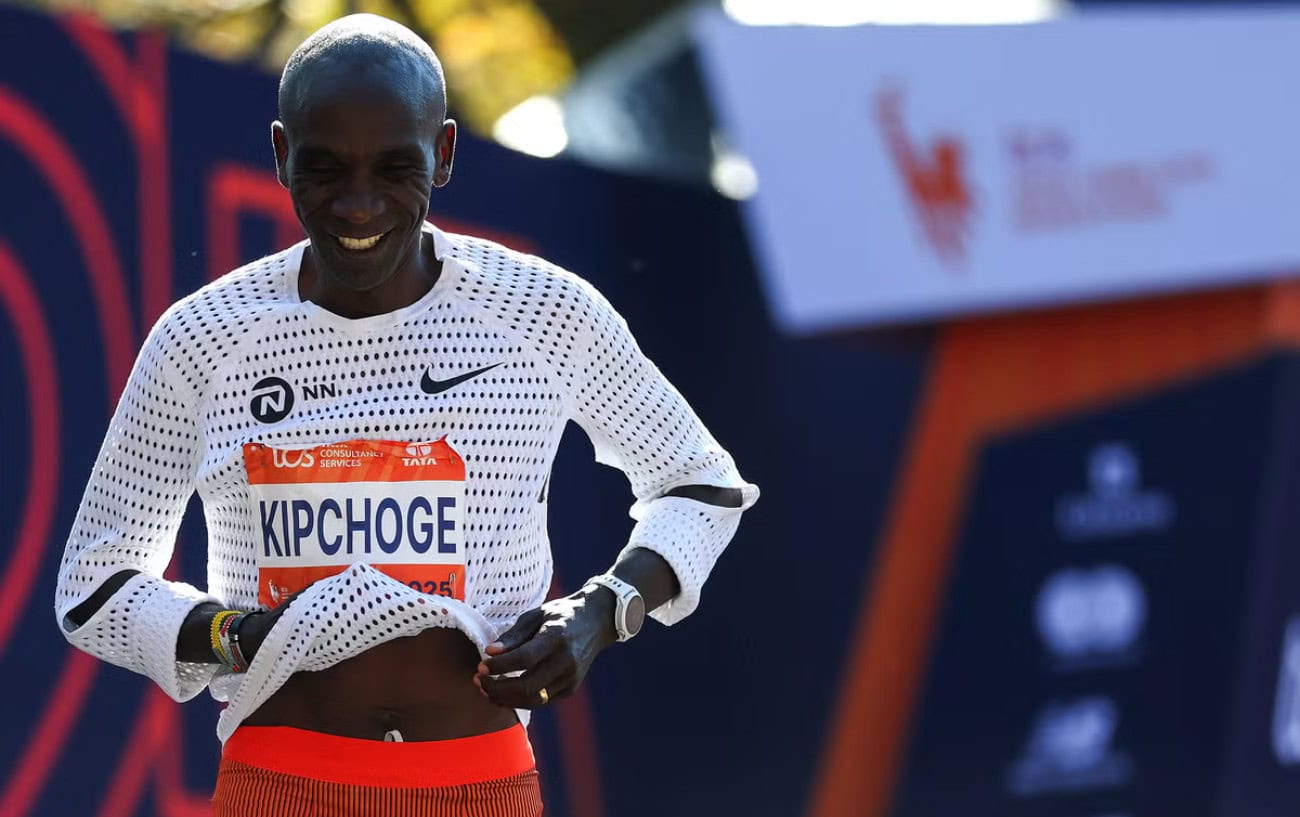
When Eliud Kipchoge came down Fifth Avenue at the 2025 TCS New York City Marathon, the moment wasn’t about splits or finishing place.
His 2:14:36 for 17th was almost incidental. The roar rising through Central Park was for something larger, a farewell to the man who had redefined endurance sport for more than a decade.
For more than twenty years, Kipchoge has been running at the highest level, from teenage prodigy to marathon philosopher, and as his competitive chapter draws to a close, his career reads like a map of the modern marathon itself.
From track talent to marathon philosopher
Born in 1984 in Kapsisiywa, Kenya, Kipchoge’s rise began with the quiet discipline that would define him. In 2003, at just 18, he outkicked Hicham El Guerrouj and Kenenisa Bekele to win the 5,000 meters at the World Championships in Paris, an audacious victory over two of the greatest runners in history.
He went on to win Olympic bronze in Athens (2004) and silver in Beijing (2008), before shifting his focus to the marathon. His debut in Hamburg in 2013, a smooth 2:05:30 victory, was the start of a new era.
Between 2014 and 2019, Kipchoge dominated the marathon like no one before him. He was unbeaten for five straight years, claiming victory after victory in London, Berlin, and Chicago, turning the event from unpredictable battle into a precise, almost meditative art form.
| Year | Race | Time | Position |
|---|---|---|---|
| 2014 | Chicago Marathon | 2:04:11 | 1st |
| 2015 | London Marathon | 2:04:42 | 1st |
| 2015 | Berlin Marathon | 2:04:00 | 1st |
| 2016 | London Marathon | 2:03:05 | 1st |
| 2016 | Rio Olympic Marathon | 2:08:44 | 1st |
| 2017 | Berlin Marathon | 2:03:32 | 1st |
| 2018 | Berlin Marathon | 2:01:39 | 1st |
| 2019 | London Marathon | 2:02:37 | 1st |
The day running broke two hours
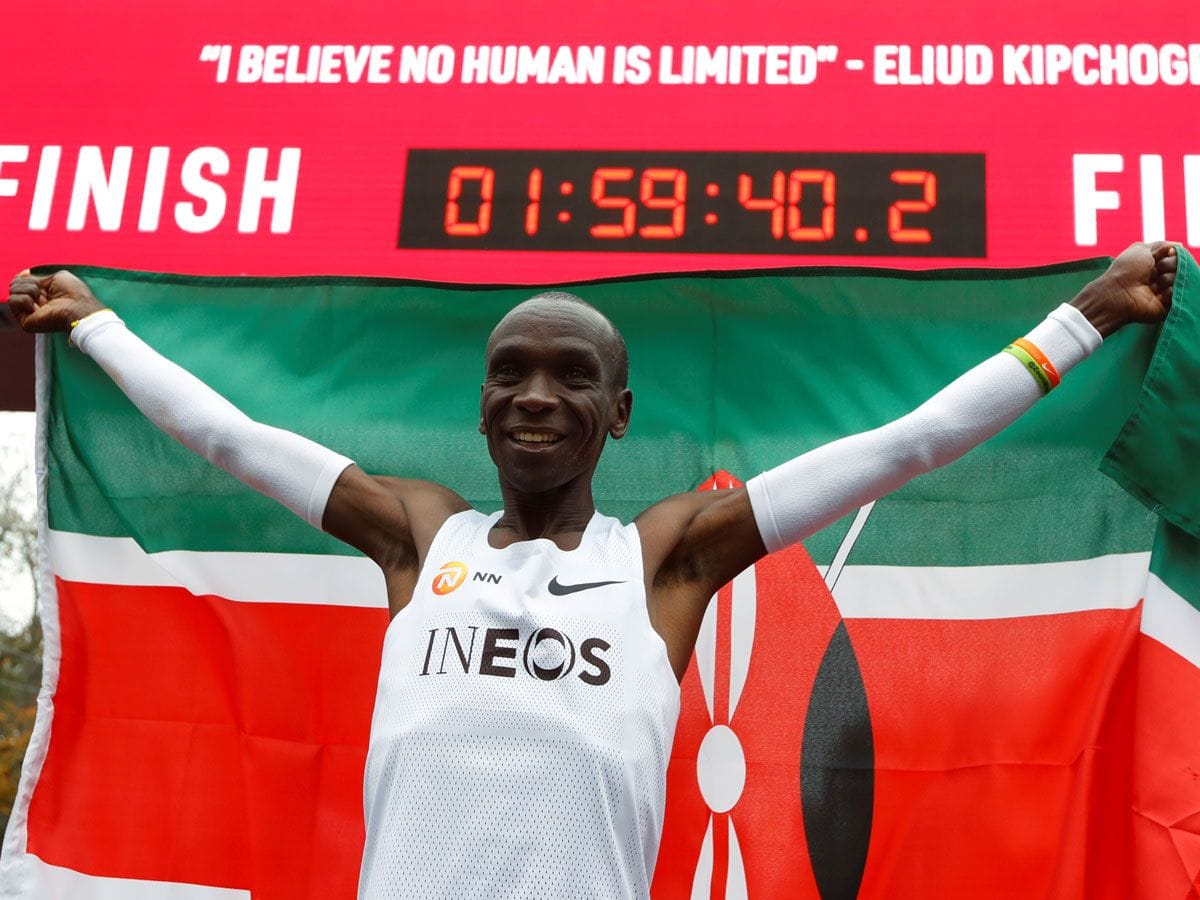
In October 2019, Kipchoge did what had long been thought impossible.
In Vienna, during the INEOS 1:59 Challenge, he covered 42.195 kilometers in 1:59:40.
The event was controlled, the record unofficial, but the meaning was profound: the first human ever to break two hours for the marathon.
“No human is limited,” he said at the finish, a phrase that would define not only the run, but his entire career.
The sub-two was the ultimate demonstration of his philosophy: that mastery comes not from power or ego, but from discipline, teamwork, and belief.
The master of the majors
Kipchoge has won eleven World Marathon Majors and remains the fastest person ever to complete all Majors. His combined best times across the majors total 12:34:36, an average of 2:05:46 per race, compared with roughly four hours for the average Six Star finisher.
| Marathon | Best Time | Year | Position |
|---|---|---|---|
| Berlin | 2:01:09 | 2022 | 1st |
| London | 2:02:37 | 2019 | 1st |
| Tokyo | 2:02:40 | 2022 | 1st |
| Chicago | 2:04:11 | 2014 | 1st |
| Boston | 2:09:23 | 2023 | 6th |
| New York City | 2:14:36 | 2025 | 17th |
| Sydney (Newest Major) | 2:08:31 | 2025 | 9th |
He is the only man to have won Berlin five times and London four. He also became a two-time Olympic champion, winning gold in Rio 2016 and Tokyo 2021.
Across his career, he started 24 competitive marathons, won 16, finished second twice, and failed to finish only once, at the 2024 Paris Olympic Marathon.
| Race | Time | Position |
|---|---|---|
| Hamburg 2013 | 2:05:30 | 1st |
| Berlin 2013 | 2:04:05 | 2nd |
| Rotterdam 2014 | 2:05:00 | 1st |
| Chicago 2014 | 2:04:11 | 1st |
| London 2015 | 2:04:42 | 1st |
| Berlin 2015 | 2:04:00 | 1st |
| London 2016 | 2:03:05 | 1st |
| Rio Olympics 2016 | 2:08:44 | 1st |
| Breaking2 (Monza 2017) | 2:00:25 | — |
| Berlin 2017 | 2:03:32 | 1st |
| London 2018 | 2:04:17 | 1st |
| Berlin 2018 | 2:01:39 (WR) | 1st |
| London 2019 | 2:02:37 | 1st |
| INEOS 1:59 Challenge 2019 | 1:59:40 | — |
| London 2020 | 2:06:49 | 8th |
| NN Mission Marathon 2021 | 2:04:30 | 1st |
| Tokyo Olympics 2021 | 2:08:38 | 1st |
| Tokyo 2022 | 2:02:40 | 1st |
| Berlin 2022 | 2:01:09 (WR) | 1st |
| Boston 2023 | 2:09:23 | 6th |
| Berlin 2023 | 2:02:42 | 1st |
| Tokyo 2024 | 2:06:50 | 10th |
| Paris Olympics 2024 | — | DNF |
| London 2025 | 2:05:25 | 6th |
| Sydney 2025 | 2:08:31 | 9th |
| New York 2025 | 2:14:36 | 17th |
Even late in his career, Kipchoge remained a benchmark. His average finishing time in the World Marathon Majors, 2:05:01, sits in a league of its own.

The man behind the numbers
Despite his achievements, Kipchoge never lived like a superstar. He trained at the same camp in Kaptagat for nearly two decades, sleeping in dorms, washing dishes, and training alongside younger runners. To those who knew him, his humility was as legendary as his pacing.
He spoke about running the way others speak about faith.
“The person who starts the race is not the same person who finishes,” he often said. His approach was monastic, but his message was universal: that consistency, calm, and joy could be a form of greatness.
Even when defeat arrived, London 2020, Boston 2023, Paris 2024, he accepted it with grace. “I don’t celebrate only wins,” he once said. “I celebrate the path.”
The next chapter
After finishing the New York City Marathon in 2025, Kipchoge confirmed that while his competitive days were likely behind him, his running journey was not.
His next project, the Eliud Kipchoge World Tour, will see him run seven marathons on seven continents over the next two years, not to win, but to inspire.
“Running has given me everything,” he told reporters afterward. “Now I want to give running back to the world.”
Whether or not he ever lines up again among the elites, Kipchoge’s career stands alone.
Two world records. Two Olympic golds. Six of the twenty fastest marathons ever run. The only sub-two-hour marathon in history.
More than that, he changed the way people think about endurance. He turned the marathon from an athletic test into a meditation on possibility.
If this was the final major race of his career, then the story of Eliud Kipchoge is not just about what he won, but about what he taught the world: that discipline can be beautiful, and that belief, when practiced daily, can move the limits of what it means to be human.
RunClub
Get more running stories — join RunClub
Daily running news, a community of 300,000+ runners, free training plans for every distance, and a daily running game. Free to join — no card.
Already a member? Log in →



Start the conversation