

2:59:59
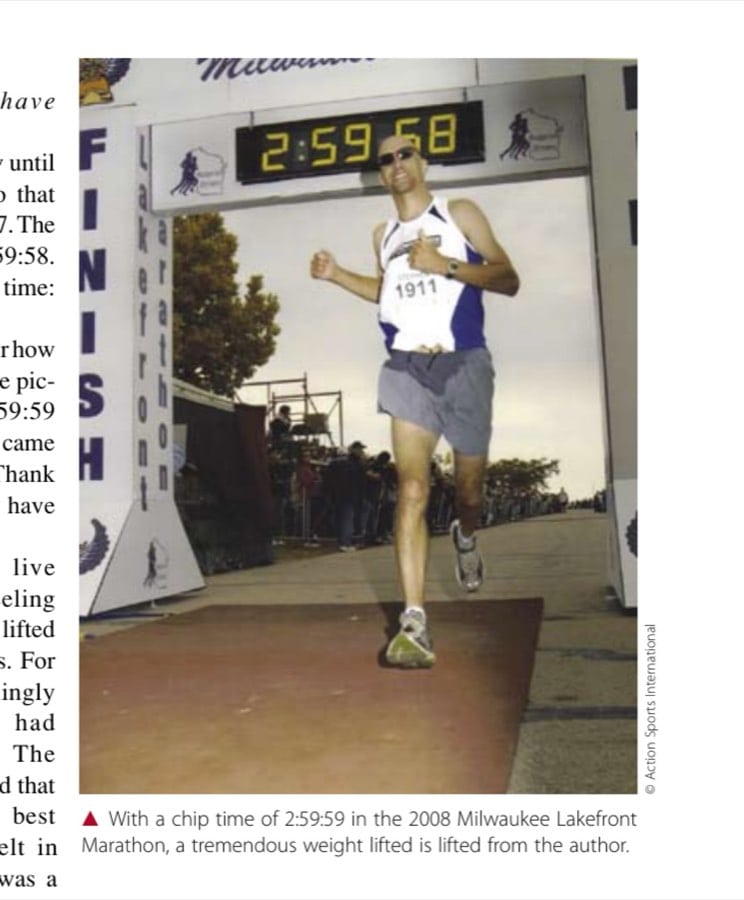
To understand my trepidation as I approached the finish of the 2008 Milwaukee Lakefront Marathon, you have to understand the history. It’s not that with about 75 meters to go, I could see the clock at 2:59:30 and wasn’t sure whether I could cover the ground before the 2 turned to a 3. Nor was it the stress fracture in the cuneiform bone © Action Sports International
in my foot that had elevated from a steady burn at mile 20 to feeling as if it were about to explode. No, to understand the story, you have to rewind four years and four other failed attempts at breaking three hours. To understand the story, you
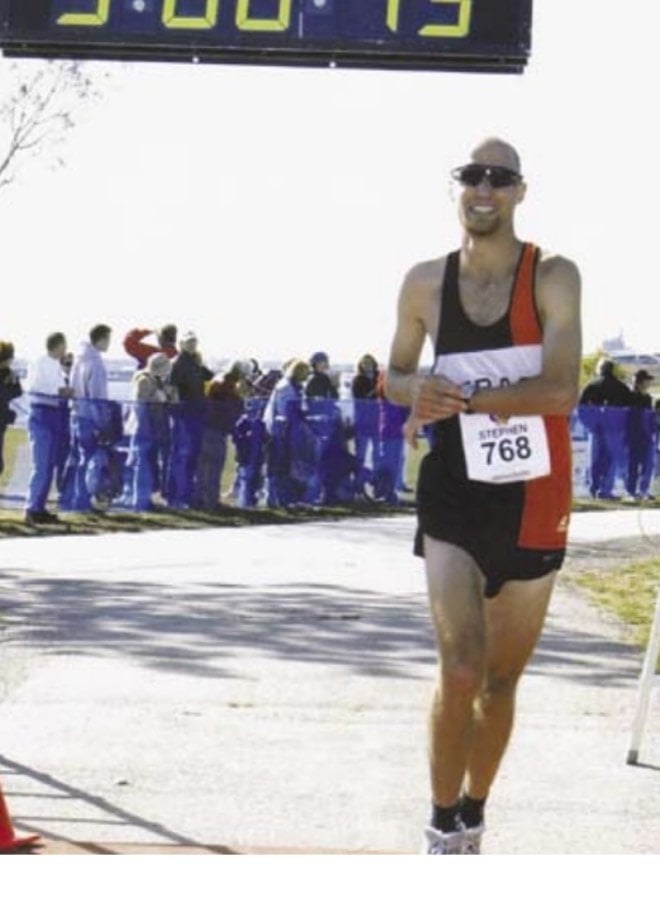
need to know that in 2004 I was in virtually the identical position at the same point in the race. It’s just that at that time, I knew I wouldn’t cover those final meters in time. By virtue of my 3:00:12, I earned
the distinction of being the first person in the marathon not to break three hours. For
▲
The author is the first person not to break three hours in the 2004 Milwaukee Lakefront Marathon.
years this would haunt me. And if I didn’t hurry and get to the finish this time, it might torment me forever. Only 26, I figured that with a solid winter of training I would be a shoo-in to break through the three-hour barrier the next time I raced. Sure, Boston would be a tougher course, but with the crowd support, experience, and a more conservative start, it wouldn’t be a problem to get down to 2:55. However, running has a funny way of teaching you lessons. Mine would be a lesson in patience.
Despite the normal aches and pains associated with the postmarathon battery, I was eager to get back out and train after my 2004 effort. Though I had failed to break three hours and was a full 10 minutes off my original goal of 2:50, I had managed to cut 40 minutes off my disastrous first attempt from the previous June.
By February I was fit and itching for the race to arrive. A scorching 2:03 for a hilly 19.5 miler in 30 degrees and sleet did nothing to hurt my confidence. At the end of that run, I felt far better than I had at the same point in the Milwaukee race. However, I couldn’t help but wonder if that fast effort wasn’t the beginning of a much longer journey than anticipated.
A week later I remember going out for 18 with my roommate in the slushiest conditions I’ve ever encountered. The temperature was about 33, and a sideways sheet of sleet pelted us. For every two steps forward, we must have slid back one, so my hitting a miniwall at 16 shouldn’t have been a surprise. Despite feeling horrible, I didn’t notice anything wrong that night or the next day, conveniently scheduled off. However, one step into my run two days following, pain hit me immediately.
My Achilles tendon burned in a way I had never experienced. That night I muscled through six, but during an interval session the following day I had to shut down after only a mile. The dreaded injury had arrived. Only two months from race day, this was an inopportune time. Nevertheless, experience had taught me to take the necessary time off.
And on the “up” side If there was one benefit to getting hurt, it’s that I didn’t have to run outside in Milwaukee in February. It’s no coincidence that every spring marathon I’ve ever run has been terrible when compared to the counterparts in the fall. Instead of running, I took advantage of the one real perk of being a teacher: a health plan that covers a lot of physical therapy.
A little ultrasound, some massage, iontophoresis: within a week the tendon responded and I was able to get on the treadmill. A week after that, it was back to the pavement. Though I didn’t get back into the 50- to 60-mile-a-week range again before the race, I was able to string together some 45s. With my previous base, I figured I would be just fine. Oh, how wrong I was.
Rule number one of marathoning (aside from Don’t Go Out Too Fast): No matter how fit you think you are, never wear a racing singlet that says, “Failure is not an option.” If things go badly, you’re going to hear it a lot. The debacle that was my Boston effort can’t be overstated. I must have heard that dreaded phrase a thousand times.
Experienced marathoners, my buddy and I didn’t do anything stupid. We took it out in seven-minute miles for the first five. Then the plan was to drop to 6:30s thereafter for as long as we could. For guys with a goal of around 2:50, this should have been a perfect pace. However, by the 10th mile I knew something was amiss. And as any experienced runner knows, if you’re hurting at 10 of a marathon, you’re in trouble.
Perhaps if the screams of Wellesley College had lasted for the entire last 15 miles I would have been OK. Or if Heartbreak Hill were a steady decline, I might have been fine. But they didn’t and it wasn’t. At 14 I was sitting in a medical tent sucking down Gatorade and inquiring about the nearest bus station. Luckily for me, or perhaps not so much, there wasn’t one until mile 16. This made for a very long walk. On the other hand, it let me suck up my pride and decide that I hadn’t traveled all the way out to Boston to drop out after 16 miles.
I finished that race. It took me over four hours, more than an hour slower than I had run in the fall. By the time I was done, my foot throbbed, my muscles felt as though they had been clubbed by a bat, and I tottered across the line as embarrassed by my performance as I had ever been. Nevertheless, I had survived the death march. For 16 miles I had put aside my pride and did everything I could to finish.
As the clock flipped to 2:59:45 during the 2008 Milwaukee race, I kept this pride in mind.
Finally, things get a little weird Now here’s where the story gets a little bit weird. Up to now, this probably isn’t much different from many other running stories you’ve read. Injury, close encounter with a goal—you’ve heard it all before. But how about this? Two months following my Boston effort, my wife and I sold everything we owned and moved to Bolivia to teach.
In and of itself, this wouldn’t seem to put that much of a crimp in a runner’s plans. However, you’ll recall the little bout of tendinitis I had had leading up to the previous race. A week before our departure to South America’s poorest country, the pain in my foot flared up again. This time it was a bit different, shifting slightly left and running up the side of my lower leg. Soon I would learn that medical care in the Third World isn’t exactly on par with our American system. The doctors there were far from able to diagnose and treat my malady.
However, this was the least of my worries one year to the day after my 3:00:12. That day I was in the hospital for a different reason than my foot. Three months into my Bolivian excursion, it seems I had ingested a bit of E. coli. According to the doctors, my intestines were bleeding like crazy and were in danger of rupturing. Tethered to a Metronidazole IV, I had finally found something to take my mind off the fact that I had been unable to run more than a couple of miles at a time for months.
For eight days and nights I lay helpless. Subsisting on a diet of broth, Jello, and an occasional bowl of green-banana soup, my already slight frame shrank from 160 pounds to 145. The only plus side I figured was that if ever my foot malady were to improve, it would be after eight days of placing no weight on it whatsoever. A week following my release, I had gained enough strength to give running another try. As usual, the first mile or two felt OK. But then the pain returned. First it was just a small burn to the left of the Achilles, and then a gnawing, pulling pain halfway up the calf on the left side. At that point I decided to take two months completely off and see what the medical professionals could do. Underpaid, undertrained, and unfamiliar with running as a form of recreation, the answer was not much.
The long and the short is that for the rest of my year down on the other half of the earth, my running ceased. I tried a nutty new-age Californian chiropractor (probably in Bolivia for a reason) and several physical therapists and had enough radioactive diagnostic tests to ensure my death from cancer in my 40s. However, in the end I resigned myself to lots of time swimming and hammering away on the exercise bike. I fell into the typical depression of an athlete unable to do what he loves. It cost me a lot. My marriage would end upon my return to the States. Just before we left, my wife said something that gave me insight about running’s addictive effect on me. “
I hated when you used to go off and spend all that time running, training for marathons,” she said. “But now that you’re not running, I hate that even more.”
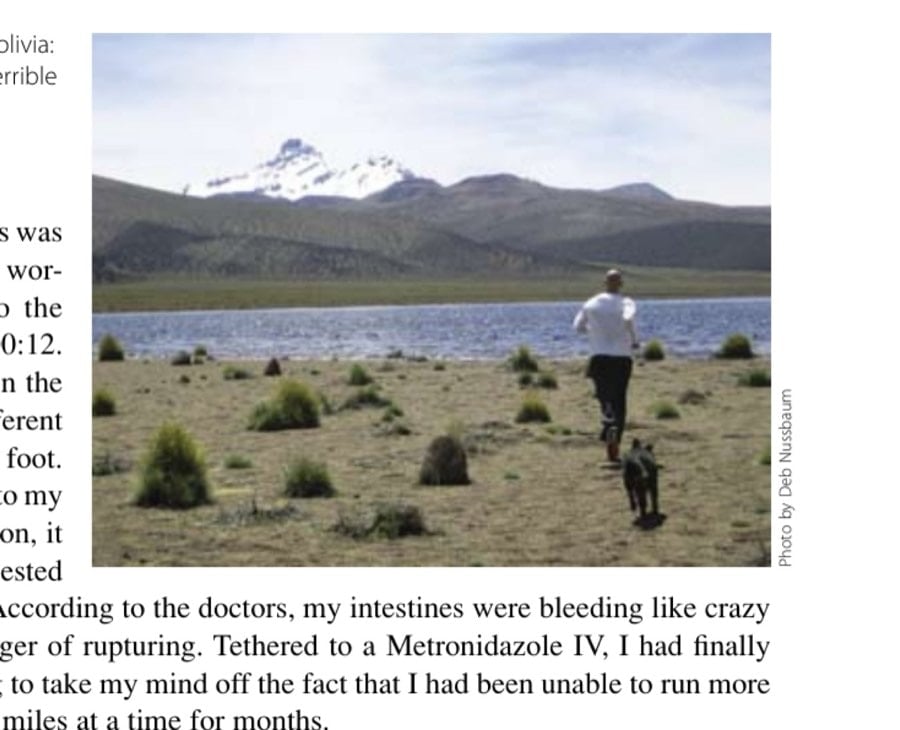
Photo by Deb Nussbaum
▲
The author in Bolivia: fantastic scenery, terrible medical care.
Alone again, naturally Alone, I returned to Milwaukee that July. The change of venue did nothing to help with healing, and I was forced to find solace in buying a new bike. For several months I numbed my pain with three- to four-hour solitary rides. Then in October my medical insurance kicked in. I had set up the appointment two months prior. One referral later I sat in the office of one Dr. England. After over a year of frustration, the man gave me back my life.
The Bolivian diagnosis of Achilles tendinitis had been way off base. What I had was a peroneal tendinopathy. He likened it to tendinitis gone a step further. For all intents and purposes, my running through that original tendinitis had caused the tendon to get so weak that it had basically given up. Forced to compensate, the outer muscles of my leg and foot had been overworked. The resulting strain was the pain I felt. Custom orthotics and physical therapy would likely alleviate a lot of the pain. He was right.
By late December, the arrival of my orthotics coupled with that therapy produced my first pain-free run in over a year. Confident that I was back on track, I signed up for the Madison Marathon in May. Despite my year off, I had only one goal in mind. I needed to break three hours.
My focus leading up to that race was more on getting back the base I had lost in a year than on running fast, high-quality miles. I went from that guy who always timed the loops he ran to not wanting to know anything about the distance I had traveled. A former NCAA Division I runner, I had once thought that anybody running slower than 2:40 for a marathon was a slow plodder. Both time and the distance had humbled me. After all that I had gone through, to break three hours would be a tremendous accomplishment, all the more so when you factor in the other health ailments that started to hit me after years of pounding. The tendon felt 95 percent better, but I developed bursitis in my hip. For several weeks in March, prior to an orthotic adjustment, I had terrible pain in my knee. To cap it off, as I entered the final two weeks before the race, my orthotics had worn down enough that my peroneal pain returned. The doctor provided some temporary relief with a powerful anti-inflammatory, but once this race was done, I didn’t know whether I would have another in me.
As most marathons do, Madison started well enough, but by the halfway mark I was skeptical about my chances. The clock read 1:29:47, and though I felt good for that point in the race, I knew an even split was unlikely. Sure enough, at about 18 things started to get a bit wobbly. Then my stomach went. Any chance of breaking three died in the Madison arboretum as I clung to a tree—ironic that my intestines betrayed me even though I wasn’t in Bolivia anymore. My final time was a heart-wrenching 3:20. It was back to square one.
Fast forward to late September. This time I experimented with a short training cycle. It seemed that every other race I developed some injury at around the 12th week. So why not ramp up in late July and compete at about the 11th week? When I lined up for the Quad Cities Marathon, I had averaged 53 miles a week and had no major pains of any kind. Three weeks prior, I had raced 20K in 78 minutes and change. I was sure to reach my goal. Mother Nature had other ideas. At race time the temperature approached 80 degrees.
Promises, promises Not that I let this get to me early. Now on my fifth marathon attempt, I had enough experience to know enough to take the first three miles slowly. As the race developed, once again things seemed to favor me. The river was beautiful, and for seven miles I distracted myself running just behind an attractive girl who was doing a relay leg. Halfway through, I hit 87 minutes. At 20 I was right at 2:14. This time I felt good. I felt really good. More than two hours into the race, a surge of adrenaline went through me.
At 21 miles I still felt strong. The Quad Cities race is set up so that the last 10K is an out-and-back, and so at 21.5 an elite runner went by the other way. Here arrived the first moments of trepidation. In the searing 80-plus heat he looked miserable. If an elite person running that speed looked that bad, I wondered about what he saw when he looked at me. This may have caused me to make a fatal mistake.
Up to that point I had walked through the water stops to ensure that I got a good drink. However, I had promised myself that after 18 I wouldn’t stop for anything. Seeing the overheated Kenyan really worked up my thirst, though. I felt OK. Why not take 15 seconds to take some Gatorade?
The first problem as I hit the mile-22 aid station was that I stopped. The second was that unlike the previous few stops, the Gatorade wasn’t watered down. I nearly choked on the sweetness. A cramp slammed my left calf. The entire rhythm I had entering the stop ceased to exist. Suddenly I was barely able to move.
A check of the watch and I could see my cushion evaporating rapidly. Unable to rid myself of the cramps, I couldn’t get back on pace. Then something happened that just broke my will. A band was playing on the side of the road. I’ll never forget the lyrics it sang. “
It’s a long, long road,” chimed the country musician. Who the heck hired somebody to sing that at the 23rd mile of a marathon? Another check of the watch and I knew I was destined to run 3:01—if I finished. Rather than complete the death march, I just sat down on the side of the road. Coincidentally, so did the guy 50 meters in front of me. I later learned that he too had a goal of breaking three hours, and I felt better knowing that he had stopped for the same reason.
I had failed again, and another Milwaukee winter approached. Though running under three hours was still a burning desire, I simply didn’t have the will to run 60-mile weeks through January and February. Besides, I didn’t recover too well from Quad Cities. That winter I took a running furlough, getting only enough miles in to keep the wheels from falling off. The shorter training cycle had worked. A plan formed: the 2008 Lakefront Marathon the first weekend of October. I would begin training hard core at the start of summer break.
When June arrived I hit the trails with the highest intensity since college. On a five-day-a-week training cycle, I averaged nearly 55 for 15 weeks. The other days I crosstrained. I found yoga, did core work, and slept nine hours a night. By late August I had chopped off over two minutes from that 20K the previous year. This time nothing would stop me. Only five weeks remained, then four, then three, and then . . .
I noticed it right after a scalding-fast 10-mile tempo run. The top of my left foot felt extremely tender in the metatarsal area. A day off did nothing to cure it. Then next time I ran it got worse. Running on grass felt tolerable, but only for short distances. Running on pavement simply wasn’t an option. When a few days off didn’t produce any relief, I quickly scheduled an appointment with the orthopedic specialist. A week out from the race, I sat in his office. Two days after that I was in the MRI machine, but it was only to confirm what he had already told me. “
Based on what you’re describing, I think you’ve got a stress fracture in the navicular bone of your foot,” he said. “We’ll do the MRI, but I’ve got to warn you . . . if it comes back positive there’s no way you’re running that race.”
Bittersweetness a week before In the weeks leading up to the appointment, I had tried to be positive. I had stuck to the trails and kept up with 30-mile weeks through great pain. This news devastated me. I seem to recall drinking quite a bit that evening—not water or Gatorade. Two days before the race I would get the result. The runs between that MRI and the result were bittersweet. On one hand I knew I was fit, and I savored every mile. On the other, I couldn’t help but feel horribly jaded about what had happened to me. This time my fitness level far surpassed that of any other marathon I had run. Perhaps the three-hour barrier would forever haunt me.
The Friday before the marathon, I sat in the doctor’s office. Not one, but two orthopedic surgeons were there to see me. One was my original doctor. The other was a doctor I had seen many times at the Saturday buildup runs. He was a runner himself, and he did the talking. “
We’ve got good news and bad news,” he started. “Good news is that it’s not your navicular. Bad news is that it does look like something is going on in a bone
called the cuneiform. However, since this bone isn’t really a weight-bearing bone, I think you can give the race a try.” Before I left, they did add some qualifications. First off, I needed to ditch my lightweight trainers and go back to the heavier shoes. Second, if I felt a crescendo of pain during the race, I had to promise them I would stop. “
I don’t want to see you back in here next week and have you say you felt it get worse and then it popped,” he said. “I know how you runners work. If it hurts, you stop. Promise me.” I promised. I didn’t even cross my fingers. And on October 5, I lined up for yet another try at breaking three.
It was a perfect morning: dry with a light cloud cover and no wind. Familiar with the course, I felt confident, even with my diminished training the past few weeks. The gun went off, and I eased out. A lot of people charged out ahead of me. The younger version of me would have gone with them. However, I was older and wiser, and by the halfway point I didn’t regret my decision.
As I crossed that mark the clock read 1:28:25. This little cushion was good because for the past five miles I had needed the bathroom. Just past the timer I took to the trees. After that little excursion, I figured my halfway mark to be right at 1:29:00, too close for comfort, but I definitely felt fit and had a lot of incentive not to disappoint.
By 20 I had gotten in the zone. I distinctly recall from 17 to 18 being a sixminute mile, and I hit this key mark in 2:13:48. For the past six miles my pace had gotten faster. My cushion had grown. It continued to grow until about 22 miles. And then reality hit me.
Fortunately I had an ace in the hole. From 23 to 24, I knew, there was a large downhill. After that several girls from the team I coached would be waiting to run with me. The pain in my foot wasn’t a problem for most of the race, but now it started to manifest itself. “There’s no way I’m stopping.” Promise broken.
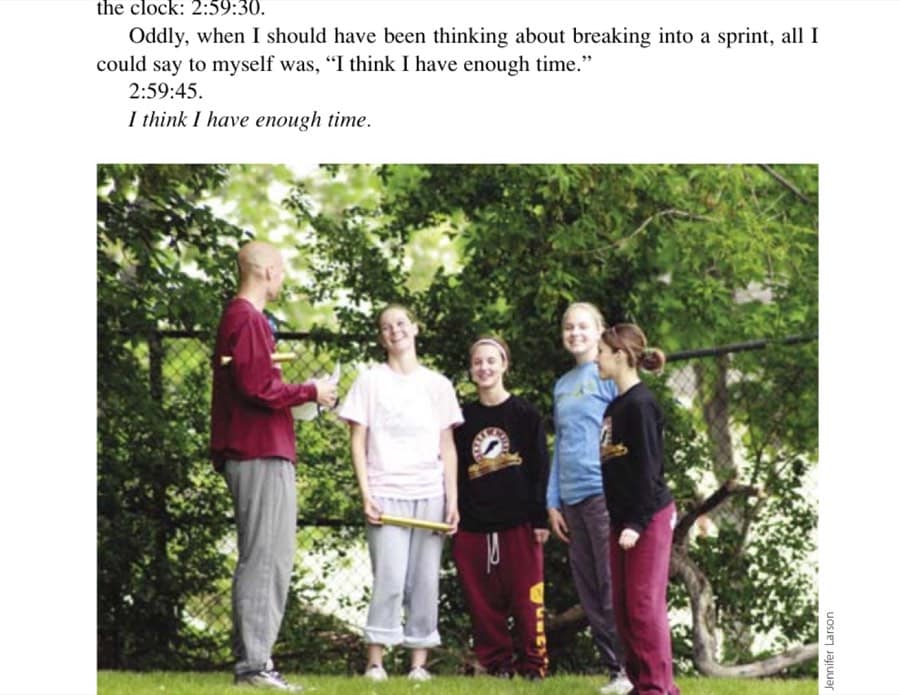
Angels on my shoulders Grit got me to the hill, and gravity got me down it. My foot burned enough that I moved off the faster path and onto the grass next to it. Where were the girls? I had figured they would be there a bit after 23. Right at the 24 mark I saw them. That day they were my angels and as I passed, two of them started to run with me. At first they tried saying some of the things I tell them when I pace them: words of encouragement, advice about how to think. Too pained to respond, I only groaned in return. Eventually they figured out it was best just to run with me. We hit mile 25. I looked at my watch.
Photo by Jennifer Larson
Oh no, I thought. Not again. It was going to be a really close shave. I don’t remember too many details of that final mile, but I do remember these. With half a mile left, an older runner passed me and said, “Come on, you didn’t come not to break three hours.”
This caused the girls to start offering words of encouragement again. I could tell they were dying to say something that would cause me to reach for another gear. It dawned on me how special it was to be in their company. Most days I had to try to inspire them to new heights. Today the roles were reversed, and they did all they could to inspire me.
Just before the final turn, I told them to break off and meet me at the finish. I careened around the final curve and made it past the 26-mile mark. Then I saw the clock: 2:59:30. Oddly, when I should have been thinking about breaking into a sprint, all I could say to myself was, “
I think I have enough time.” 2:59:45. I think I have enough time.
▲ The author with some of the girls he coaches who became angels on his shoulders late in the race.
© Action Sports International
2:59:53. I think I have enough time. I didn’t know until I actually got to that line. I saw 2:59:57. The picture shows 2:59:58. The official chip time: 2:59:59. I often wonder how I would feel if the picture showed 2:59:59 and the chip time came back 3:00:00. Thank heavens I don’t have to live with that.
What I did live through was feeling a sudden weight lifted off my shoulders. For years this seemingly mundane goal had consumed me. The moment I crossed that line wasn’t the best ▲ With a chip time of 2:59:59 in the 2008 Milwaukee Lakefront moment I’ve felt in Marathon, a tremendous weight lifted is lifted from the author. running, but it was a feeling different from any other I’ve had, almost as if somebody had taken a yoke off my neck. With the help of all my training partners, doctors, therapists, and a few girls from the team, I had reached my goal. My sincerest thanks goes out to all of them. After 26.2 miles I had made it by less than a second. Without every single bit of inspiration and assistance, that final time would have been 3:00:00.
This article originally appeared in Marathon & Beyond, Vol. 14, No. 3 (2010).
← Browse the full M&B ArchiveMore like this
1,000+ stories from 19 years of Marathon & Beyond
The complete archive of the legendary long-distance journal — digitized and free to read.
