

26.2, Four Ounces
ACourtesy of Jeff Horowitz
fter 80 marathons, it was easy for me to believe that I pretty much had the marathon experience all figured out. The scenery would vary somewhat, the hills would be steeper or lower or not present at all, and the crowds might differ in size
and enthusiasm, but the overall experience would always basically be the same. There would be an adrenaline rush at the blast of the starting gun. There would be early optimism, shouts of support, and periodic aid stations. There would be
eventual fatigue, perhaps blisters, perhaps a cramp or two. There would inevitably be a moment of truth, accompanied by teeth gritting, and then perseverance, and euphoria at the finish line. This is the beauty of the marathon—its predictability
and its simplicity. You just run 26.2 miles as fast as you can, and if you do it right, there are usually precious few surprises along the way.
Caption to come.
Or so I thought. Then I heard about a marathon that is different from all the others, one whose name brings a smile to the face of those who are in the know: the Marathon des Chateaux du Medoc, or, as it is more commonly and simply called, “Medoc.” If the marathon is the serious-minded older sibling of running, then Medoc is the wild child, looking for the nearest party. In a sport defined by discipline, Medoc is the Dionysian exception, a race that is more revelry than competition.
Created in 1985 as a tour for a group of athletic wine connoisseurs, the race meanders along roads and trails of 59 vineyards in Pauillac, in the Bordeaux region of southern France, by the shores of the river Gironde. To say that it is just a race through wine country, though, is like saying that Mardi Gras is just a celebration of Fat Tuesday, because the organizers have turned the marathon into a uniquely local creation: a celebration of the senses. It has become famous for wine and food stations along the course, for the outlandish costumes worn by its participants, and for music along the route. Even the race materials caution you to think of the race as being more of a tour than a competition. It is truly what Ernest Hemingway named Paris: a moveable feast.
A MOVEABLE FEAST, INDEED I first heard of Medoc almost 10 years ago in a newspaper article that took a “look what those crazy foreigners are up to now” approach to reporting on the race. While most marathons are a 26-mile adventure, Medoc sounded more like it needed a 12-step program. But I was more intrigued than dismayed. It sounded like the Shangri-La of running, and I knew that someday I would have to experience it for myself.
That day took longer to arrive than I would have guessed. Several obstacles became immediately apparent. First, simply getting into the race proved to be difficult. Like most chronic marathoners, I had become accustomed to having to compete with other applicants to get a number in the top races. These races offered enough numbers, though, to give us all hope: 18,000 slots, or 25,000, or 35,000. Not so with Medoc. The narrow lanes make a huge field of marathoners impossible, so the race is limited to only 8,000 participants. To race Medoc, you have to commit early and keep your fingers crossed.
The second issue is one of logistics. I was unable to find any direct flights from the United States to Bordeaux. The best that I could arrange was to fly direct to Paris and then take either a connecting flight or a bullet train to Bordeaux. And on arrival, the difficulties don’t end. Pauillac is far from the Bordeaux city center, and lodging is very limited. The only workable option seemed to be to stay in the city and arrange for a driver to take me for the nearly 90-minute-long ride to the race start.
Surmounting these problems was challenging, and each year there seemed to be some reason why I couldn’t go. Still, I was never put off the scent entirely; I still wanted Medoc, and as the years passed by, I still would not give up hope. And then suddenly, the opportunity arose: a friend with connections was putting together a team and had worked out all the details. She wanted to know whether I would come along. I didn’t want to appear overeager, so I made her sweat for perhaps three or four seconds before I gave my answer: Yes! I would do it!
A LOGICAL TRAINING PLAN. YEAH, RIGHT! Having received a helping hand to get over those logistical hurdles, I now settled into deciding on a training plan. Knowing that Medoc is no ordinary marathon, I wondered whether I needed to alter my usual training routine. Speed work is usually a part of my regular marathon preparation, and speed can pay off handsomely in Medoc, where I had heard rumors that the winners in each age category receive their weight in wine. I’m not an elite runner, though, so a fast marathon would leave me without the winner’s prize and also without full enjoyment of the race’s amenities. And even if I could somehow miraculously take first place, I don’t think I would be able to survive the reward, even with the help of my friends. With this in mind, I decided on a more leisurely approach to the race. I happily crossed speed work off of my to-do list. So far, so good.
The next issue seemed thornier. How does one prepare to drink wine during a race? I considered adding alcohol to my training regimen, but I was unable to find any advice on how to do this. Should I slowly increase my intake week to week, along with my mileage, using the 10 percent rule? Would it matter what kind of wine I trained with? In a moment of clarity and decisiveness, I decided to scrap the whole idea; I would build up a solid running base and let the race-day drinking take care of itself on the assumption that I either would or would not survive it and that no prerace regimen would change that.
Nonetheless, while there was no information I could find on training for Medoc, I did find plenty of advice on how to actually run the race. The first bit of wisdom that I came across was to skip wine altogether for the first half of the race, on the theory that if I should then encounter any ill effects from wine tasting, I would be close enough to the end to successfully make it across the finish line.
The second bit of advice I came across cautioned that I should not actually swallow the wine. Instead, I should swirl the wine in my mouth like a professional taster and then spit it out. This would theoretically give me the pleasure of experiencing the wine without getting drunk, the reasoning being, I presume, that being drunk diminishes the chances of crossing the finish line.
Another bit of strategy that was recommended to me was to simply run the race in a straightforward manner: no funny business, no wine, no food, no
partying. Then, after coming across the finish line, I could make my way back on the course to the aid stations and eat and drink to my heart’s content.
WHEN IN FRANCE, DO . . . WHATEVER
Courtesy of Jeff Horowitz
These all seemed like very well-reasoned strategies. Naturally, I decided to ignore every one of them. I did not plan to run Medoc carefully and strategically; that just didn’t seem to be true to the spirit of the race. Spitting out wine instead of
fully enjoying it seemed like marrying a beautiful woman and sleeping in separate bedrooms. And as for backtracking the course after running hard, well, my legs seem to have some kind of Pavlovian intuition. When they cross a finish line, they
know the race is over, and they don’t like to run after that. No, there would be no wine teasings for me or a breaking apart of the race into two separate events. I wanted to experience the race fully and let the chips fall where they may. Since
the marathon is usually 90 percent preparation and planning, this devil-may-care approach was unfamiliar and even a bit scary. And perhaps because of that, it was also exhilarating. There was, however, one more issue I would have to consider before mak
ing my way to the starting line: what to wear. Usually this is a simple matter of shorts and singlet in warm weather, graduating through different combinations until I come to tights, gloves, and a hat, with a long-sleeve top and jacket in the
coldest weather. However, Medoc, of course, demanded a different approach. The
Caption to come.
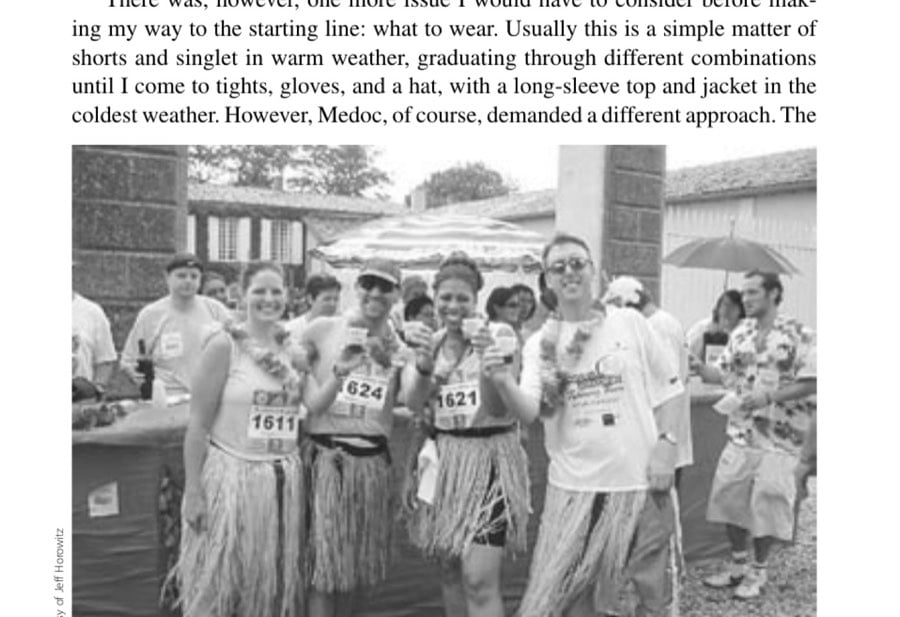
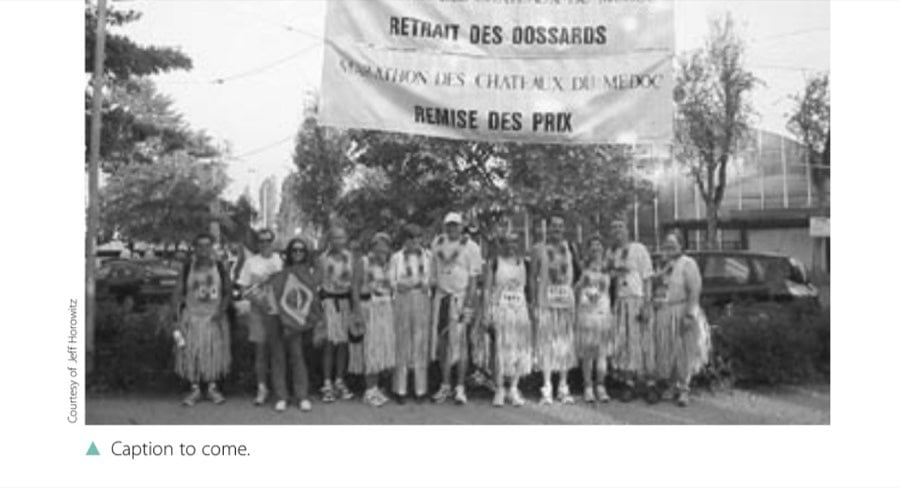
race materials not only mentioned that most participants wear a costume but also promised an extra prize for all participants who did so. What’s that old phrase? In for a penny, in for a pound. Everyone in my group—myself included—decided that we would go the extra mile, so to speak, and wear a costume. But whatever we chose would have to be not only eye-catching but practical as well. After all, this wasn’t just some Halloween bash or a Thanksgiving turkey trot; we would have to wear this costume for 26.2 miles. With that in mind, my group agreed on the perfect outfit: grass skirts and leis over our running duds. I daringly cut the skirt down to make it more suitable for running, almost a grass miniskirt, really. I smiled at the incongruity of seeing it lying next to my usual race gear, but I began to relax. All the big issues were now decided.
Finally, September rolled around, and I found myself boarding a jet for a redeye flight to Paris. I arrived almost too tired to appreciate the gleaming glass and steel of Charles de Gaulle airport as I made my way to my connecting flight. In the months since I had committed to the race, international events had stormed onto the front pages as we moved closer toward war with Iraq. I wondered whether the rift between the United States and French governments would affect my travel and race plans and whether Americans would no longer find themselves welcome in Bordeaux. I’ve long believed in the spiritual healing power of a marathon, but this was a tall order. Could wine, food, and running bring us together? I would soon find out.
My flight landed in Bordeaux without incident, and if I had any doubts about where I was, they were quickly dispelled as giant bottles of cabernet sauvignon stared down at us from atop the baggage carousels. After a short ride to our hotel and a quick check in, several of us went out for a walkabout in downtown Bordeaux. It appeared to be a city in the early stages of a renaissance, with restoration and construction projects ongoing in the city center. Its old-world charm was still evident, though, as cafes, restaurants, and shops lined the streets in centuries-old stone buildings, all leading down to the wide Gironde River. The streets looked impossibly narrow and the traffic was choking, but for a few people strolling about in running shoes, it was a beautiful place. We were even able to find a place that served pizza—or, at least, a version of it—to one teammate with a longing for home. And better still, we easily found a supermarket for loading up on water and fresh fruit.
A PREVIEW OF THINGS TO COME The following morning we piled into our chartered bus for the hour-long drive out to Pauillac for the race expo and number pickup. Upon entering the athletic center that served as race headquarters, we were shown a sample of what to expect the next day as an older gentleman in full American Indian costume stared us down at
the entryway and made unsuspecting folks jump by periodically letting out a short war whoop. Having grown up in New York City, I would have to admit that my firsthand knowledge of American Indians is sketchy at best; but seeing a Frenchman all suited up like he was about to swoop down on Custer himself was a distinctly odd sight. It would prove to be only the first of such moments.
We proceeded to get our numbers, shirts, and race timing chips. Having a chip in a race like this seemed odd, but I guess that was one of the few remaining conceits the organizers have of being a true international competition. We then made our way to the modest Medoc marathon expo. A few other races, including the Chicago Marathon, were represented, and among the race memorabilia that was available for purchase were bottles of wine with the race logo on them. And if that didn’t seem odd enough, there was another uniquely Medoc concession tucked in among the stalls: a costume seller catering to those who hadn’t yet settled on a race-day outfit. As I looked over the racks of Viking, maiden, and clown costumes, I suddenly felt that my Hawaiian ensemble, though strange to me at first, would probably seem very conservative compared with what we were about to encounter.
I mulled that over as we went back to Bordeaux and spent the day lounging around waiting for our pasta feed. The race organizers put on their own prerace dinner—complete with copious amounts of vin, of course—but we opted to be closer to our hotel and an early bedtime. Though the race was scheduled to start at 9:30 A.M., the long drive necessary to get there required a predawn departure. Far from being annoyed at this, I was almost soothed by this return to a slice of my usual prerace regimen.
The next morning I scarfed down a light, high-carb breakfast, then boarded the bus and settled into a light doze as the sun rose over the French countryside. The air was crisp and just a bit cool, with temperatures nudging into the 60s. Step56 l MARATHON & BEYOND l NOV/DEC 2004
Courtesy of Jeff Horowitz
Caption to come.
Courtesy of Jeff Horowitz
Caption to come.
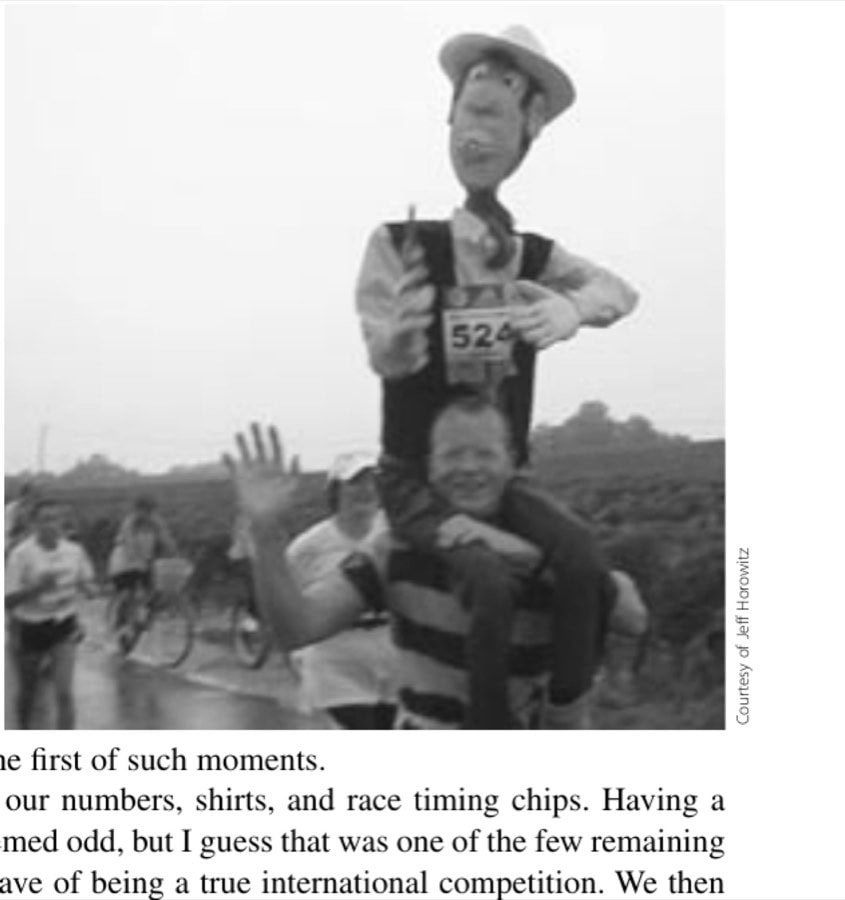
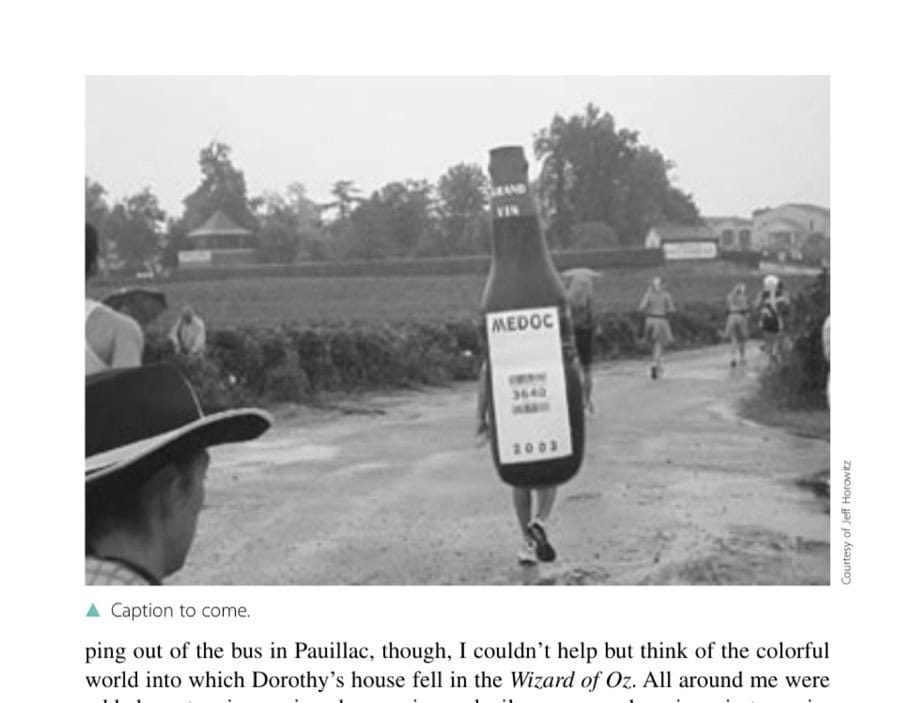
ping out of the bus in Pauillac, though, I couldn’t help but think of the colorful world into which Dorothy’s house fell in the Wizard of Oz. All around me were odd characters in running shoes: mimes, devils, cavemen, bunnies, pirates, prisoners sporting a helium ball and chain, cats and mice, and all manner of cartoon characters. There were face paint galore and even teams of runners pulling theme carts, like mini floats in a Thanksgiving Day parade. I had read that 70 percent of the participants were costumed, but it felt like a much higher percentage. It seemed not just that many people had a costume but that virtually everyone had one. Dressing in a plain running outfit suddenly seemed like a mortal sin, and I was glad that my team had at least made an effort, humble as it was. As I walked past a row of portable potties, though, I wondered how all these odd and otherworldly people would manage the details and necessities of running a race. No matter; we were a colorful group, and we were having a good time.
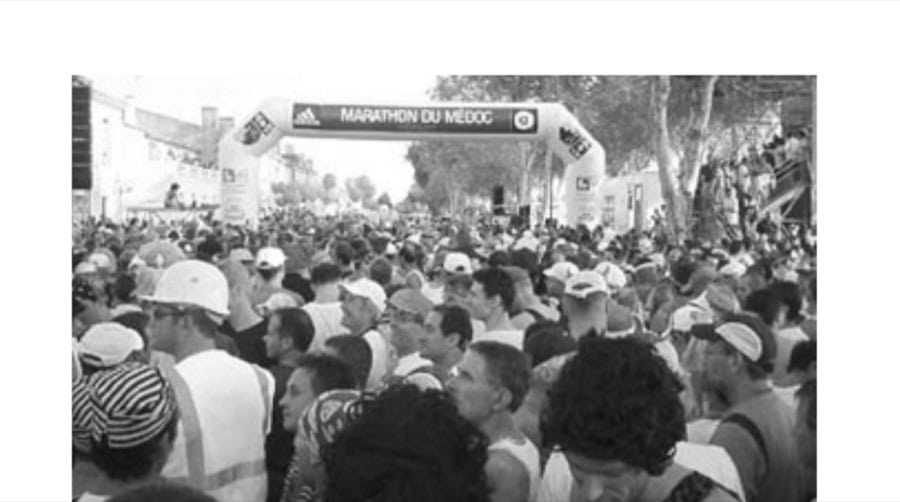
A LOSS OF FOCUS AT THE START In fact, we were the most self-aware race group I had ever seen. In the minutes before most races, runners seem lost in their own thoughts, full of nervous energy about the challenge they would soon face. In Medoc, though, the prerace mood was festive; it was about people watching, preening, and enjoying yourself. Dancers were gyrating on platforms above the crowd, and everybody was posing and snapping photos of those around them. A group of Japanese dressed as samurai even
had their own camera crew following them around the starting line to record their encounters with other outlandish runners. It all reminded me of the crowd I’d seen at Grateful Dead shows years ago, so happy to just be there that watching the band seemed almost like an afterthought. Watching us laugh and point at one another, it was almost easy to forget that we would soon be running a marathon.
But there was a clear starting line, then a gunshot, and we were off. We wound our way out of town, past scenic storefronts and booths offering food and wine tasting and past cheering supporters. We made our way toward the vineyards and soon came upon the first official aid stop, just a few kilometers into the race. It was amply supplied with water, cake, cookies, raisins, dried apricots, and even prunes—prunes, for heaven’s sake!—but no wine. In fact, there was no wine at any of the early aid stops. I wondered whether the race directors thought it best to save us from ourselves. As the sun poked its way through and the temperature began to climb, I began to think this might not have been a bad decision.
Kilometer nine brought our first wine-tasting opportunity. I was treated to the unusual sight of tables lined up with glass after glass of dark red Bordeaux wine. Never has being a runner seemed so rewarding! I slowed to a walk and lifted a glass. As I savored the first sip, I knew that I wouldn’t remember the taste of the wine or even the vineyard, but I was certain that I would remember the sensation. I tossed the glass in a receptacle and began running once again.
As we made our way past the chateaux and back into the fields, I saw a number of runners break out of the pack and head out between the rows of grapes. It took me a moment to realize that they were taking urination breaks. A runner would not be surprised at such behavior, but I bet that wine connoisseurs would certainly be shocked. I guessed that we uncovered the secret behind the unique taste of French wines!
I also made another discovery: while the grass skirt was performing admirable service, the lei just wasn’t cutting it. It whipped around like an annoying pup that refused to be obedient. Finally I hit upon a solution: I attached it to the pins holding down my race number. Thus tamed, my lei and I enjoyed passing other runners who were struggling with their own similar costumes.
A CONSTANTLY CHANGING SCENE We continued through the French countryside, dotted on occasion by imposing stone chateaux and cyclists on holiday. We ran occasionally on paved roads but more frequently on dirt paths alongside the vines, the soft, powdery dirt kicking up into low clouds by the pounding of our feet. We didn’t come across another wine-tasting stop until kilometer 16, but plenty of aid stations along the way offered refreshments and cool, wet sponges. The sun was shining brightly by this time, and I was starting to wonder about how the heat would affect our ragtag group. As if on command, some dark clouds rolled in, bringing along a welcome
temp. until new ad arrives
Printer: Insert Tybee Marathon ad
sprinkle of drizzle that cooled us off and quieted the dust billowing around our feet. The drizzle maintained, however, and grew in strength, and soon became rain. Usually a cause for disgruntlement, the rain instead became a cause for more drinking.
At some point along this part of the marathon, I had the most unusual sensation: I thought I saw flowers blowing around me, as if a herald were scattering petals in my path. Perhaps I was having a bad reaction to the wine. But, no, recognition slowly creased my bewildered brain. My lei had broken and was quickly dispersing itself. I gathered up the loose ends and tied them together tightly. Just as my grass skirt had been shortened, now my lei was a streamlined version of its former self.
We also began to come across bands along the course offering up some musical distractions. Oddly enough, when I passed a couple of them, they were playing old American country and rockabilly tunes like “Blue Moon of Kentucky.” Sometimes, I’ve learned, it’s better to just appreciate a moment than to ask why and how.
After the second wine stop, the tasting came more frequently, and I stuck with my promise to taste each and every wine that was put in our path. Soon I lost count, but I knew that in all, there would be 21 wine-tasting stations. I’ve never been a math whiz, but even I could figure out that with only two wine stops in the first half of the race, there would be quite a bit of catching up to do. I mustered my best bit of marathoner’s determination for the task that lay ahead.
As I continued on my way, I also realized something else about the course: its sheer beauty. I knew that it wasn’t just the alcohol talking as I wondered whether this might be the most beautiful marathon course I had ever run. It wasn’t just the breathtaking sights along the way, although there were plenty of those. It was the absence of something: the inevitable marathon dead zone, the dry spot to be found in all races, where we labor through industrial parks, past train tracks and factories and parking lots, with no supporters to cheer us on and no eye candy to distract us from our boredom and suffering. Boston has such a zone, lined by railroad tracks, and so does the New York City Marathon, in Queens, before hitting the Queensborough Bridge. So do countless other races. But in Medoc, I realized, there was nothing but row after row of grapevines, full with their dark fruit, and beautiful chateaux lording over their fields.
EVIL REALITY SETS IN The beauty of the course and the glory of the wine couldn’t stave off the realities of running a marathon, however, and despite my leisurely early pace, I began to slow in the second part of the race. I decided then that I wouldn’t blame it on the wine, and I won’t break that pledge now. But I’m more than willing to point my finger at some other gastronomic obstacles: the food on the course. At one station I took a bit of unidentified food and shoved it into my mouth. After all,
no one would put out food on a marathon course that would be bad for us, right? Wrong, I realized too late. Wrong, wrong, wrong. What I had in my mouth was some type of liver-based lunchmeat, and it was no friend of mine. The memory of it still haunts me and has led me to instituting a new rule that is elegant in its simplicity and easy to follow: put nothing in your mouth that you can’t identify. My mother insists that she taught me that rule years ago, but I don’t recall that. I’m just glad that now, at last, it’s part of my personal code.
The race continued onward, past markers for kilometers 25, 30, and 35. Then, at kilometer number 38, with just four kilometers to go, the race let loose, like a child who has been quiet too long and needs to scream. First came the oysters, piled ostentatiously on serving tables. A teammate of mine later told me of a writer’s observation: “Oh, the courage of the first brave soul to slurp an oyster!” On that day in Bordeaux, I can tell you, there were plenty of brave men and women; and I struggled mightily to be among the bravest. While I felt as though I had been duped when I encountered my earlier snack problem, I took full responsibility for slurping down those salty wonders at the oyster station, and I never regretted it. At least not at first, and not seriously.
Next up was a steak station, where bits of grilled beef on sticks were served up to runners. I took just a small piece to taste, then moved on to the next station just down the road, the cheese tables! And after that, more wine! I gulped and chewed and gulped some more, and then, as I slowly fell back into an easy running pace, a little voice somewhere deep inside began telling me that such gluttony isn’t really conducive to smooth racing. I slowed down a little more as the oysters began to talk to me, and I reminded myself that I had only a little over one kilometer to go. I also said a little prayer of thanks to the race directors for not putting the oysters in the first half of the race.
One last unexpected race amenity awaited runners who made it this far: face paint. For those who had been too shy to wear a costume or who had somehow lost it along the way, there was a chance for last-minute redemption. A couple of volunteers were quickly dabbing color onto runners on request. I opted for some black-and-red stripes down my nose and across my cheeks. All I can say is that it seemed like a good idea at the time.
A FINISH TO SAVOR And, finally, the finish line was just up ahead. As I crossed through, I was given a backpack with the race logo on it and a bottle of wine to put in it. For my costume-wearing efforts, I was also given a fanny pack bearing the race logo. And last but not least, I was pointed toward the finisher’s tent, where wine and beer were being freely doled out. Perhaps not surprisingly, I had had enough by this point, and as appreciative as I was of the postrace offerings, I decided to head to the bus instead. And probably not in a straight line, despite my best efforts.
The afternoon was spent recovering from the race, followed later by more wine and food. The next day, we all decided to partake of the vineyard walk offered to race participants, featuring—you guessed it—more wine and food. A highlight was the lunch tent set up at the end of the tour, where oysters and other fare were doled out as a French chanteuse belted out old American tunes and various national anthems. Somehow, I wasn’t at all surprised. By this time, I had learned to expect the unexpected.
After the race, we took a bullet train back to Paris, still drinking along the way, of course. We then spent a few days drying out and sightseeing. As I gazed at the Eiffel Tower and wandered the Latin Quarter, I tried to put the race in perspective. It seemed to fit into no readily available category. I finally decided to put it in a category of its own; it’s a category that might never be added to.
The winners of the marathon, incidentally, posted times of 2:32:52 for the men and 2:56:27 for the women, entirely respectable finishing times that seemed incongruous with my own experience. My finishing time was just about the slowest I’ve ever had. Let’s just say it was between four and five hours. Still, it was good enough to put me first in my little group, probably more of a reflection of the party instinct of my group than my own speed. But my slow time seemed to show the truth behind the race’s motto. Below an image of an apparently snockered runner weaving from pillar to post is the phrase “Medoc, Le Marathon Le Plus Du Monde.” That translates as “Medoc, the Longest Marathon in the World.” While it might have felt like an ultramarathon, I knew that Medoc is not really a race to be measured in time or perhaps even by distance. When planning to run Medoc, you should leave your watch at home and come dressed for a party. Anything less would be uncivilized.
This article originally appeared in Marathon & Beyond, Vol. 8, No. 6 (2004).
← Browse the full M&B ArchiveMore like this
1,000+ stories from 19 years of Marathon & Beyond
The complete archive of the legendary long-distance journal — digitized and free to read.
