

A Run Between Two Oceans
MANY PEOPLE consider Cape Town one of the most beautiful and isolated cities in the world. The city sits on a peninsula that extends southward with a mountain ridge on its back that descends sharply to the two oceans that border it: the cold Atlantic and the warm Indian.
Located on the southern tip of the vast continent of Africa, the region is dominated by renowned vineyards and pristine beaches, and is cradled by the steep slopes of the spectacular Table Mountain, Devil’s Peak, Lion’s Head, and Signal Hill. Cape Town is an emerging world playground for adults with youthful inclinations, and the city hosts an exceptional, well-organized ultramarathon.
Cape Town was the first European settlement in South Africa, founded by Jan van Riebeeck in 1652. Van Riebeeck was an official of the Dutch East India Company, and the city he founded is today a major seaport, boasting a warm Mediterranean climate with dry summers and cooler, wet winters. The Cape Peninsula is the convergence point of the two aforementioned wondrous bodies of water: the Atlantic and Indian oceans. From this coincidence of geography, the Two Oceans Marathon was born in 1969.
TO THE ENDS OF THE EARTH: AN AFRICAN ADVENTURE
Our journey began at Miami Airport, where a small group of nine stalwarts met at the South African Airline counter, some for the first time. Thom Gilligan of Marathon Tours had assembled the group and made all the travel arrangements. The ages and experience levels of our group varied greatly. For at least one, it would be a test of stamina and commitments, for this was her first ultramarathon.
For veteran runner Brent Weigner, a 49-year-old teacher from Wyoming, this was old hat: it would be his 89th marathon and make him the first person to run an ultra on every continent in the world—and that in a mere seven-month period.
For Knox White, it would be his 47th marathon and sixth continent. A 61-year-old retired entrepreneur from Arkansas, Knox enjoys collecting antiques with his wife Judi.
For most adventure distance runners, going to a foreign location to run a marathon or an ultra is a social event, like going to summer camp as a kid. Seven members of our group, for example, were “Arctic warriors”—veterans of the Antarctica Marathon, a test of endurance and the inner self against nature’s worst elements. Three of the group were “Polar Pacers” who had completed the famed and now defunct Nanisivik Marathon, considered the toughest marathon in the world. The Two Oceans Marathon would be like a vacation for some of our group; for others, it was the adventure of a lifetime.
We boarded our South African Airline’s nonstop flight from Miami to Cape Town. Our flight would skirt the Caribbean Islands along the eastern seaboard of South America to Ponta do Calcanhar, Brazil, and then over the South Atlantic Ocean to Cape Town. Total flight time would be just under 14 hours. In our more global world, we needed only a passport—no visas for American citizens.
Penthouse Tours, a South African travel company, met us at the airport and would serve as our liaison while we were in their country. Our first indication we were in a foreign country came as soon as we left the airport as we drove past road signs written in both English and Afrikaans.
Our hotel was a short hop from the airport. It was impossible to miss the contrasting residences along the road: modern residential areas contrasted to shanties made even more incongruous by high-rise buildings silhouetting the skyline.
Cape Town also serves as the legislative capital of the country and features a diversity of cultures, mixing Europeans, Indians, and Africans. In nearby Langebaan Lagoon, fossilized footsteps dating back 117,000 years have been discovered.
The Hotel Commodore, a four-star hotel built in 1997, is situated in a lovely area by the Victoria and Alfred Waterfront, overlooking Table Bay. The hotel is priced reasonably, due to the strong dollar against the rand (the South African currency), which during our visit was at a rate of six rands to one U.S. dollar.
The hotel doormen and bellboys wear traditional, blue naval-style uniforms. The view from our balcony was a panorama of Table Bay Harbour and ominous Table Mountain itself.
We spent the afternoon in a leisurely run and then a walk down to the Victoria and Alfred Waterfront, where Knox and Judi and I had a beer at Mitchell’s Brewery and Scottish Ale House. It was a delightful introduction to the treasures of Cape Town. The Victoria and Alfred Waterfront consists of museums, boat rides, an Imax Theater, shopping, and restaurants with meals from traditional to exotic fare such as ostrich, emu, and impala.
Later, Penthouse Tours drove us to the marathon expo at the University of Cape Town’s Indoor Expo Complex, where we picked up our marathon packets and ChampionChips. The expo was very well organized—a professional showcase of running clothing, health and fitness equipment, and memorabilia. The enormity of the expo gave us an indication of the enormity of the race: more than 8,000 athletes, with participants from 36 countries, including 22 Americans. If the expo was a preview to the race, it was going to be exciting. We learned that 28 runners would celebrate their birthday on the course. This was also the 10th anniversary of the Good Friday Marathon, a special Friday running of the race for those who, because of religious convictions, could not compete in the Two Oceans Marathon on Saturday.
When we returned to our hotel, we were pleasantly surprised to find from our balcony an excellent view of Chinese fireworks. We were in town during a two-week pyrotechnic competition between nine countries, and tonight was China’s chance to shine.
SALUBRIOUS MEDITERRANEAN CLIMATE
The next day, April Fool’s Day, was our first full day in Cape Town. We were greeted by a welcoming sun and a dry breeze blowing gently off Table Bay. We would spend the next several days touring Cape Town and the Western Province. The city tour included a visit to 3,280-foot Table Mountain. For a fee of R60, you ascend by gondola to the mountain, enjoying breathtaking views of the city below. Once on top, you can stroll timeworn paths while examining unique flora and the cuddly rock dassie, a member of the hyrux family. The tour also includes the Kirstenbosh Botanical Gardens, Signal Hill, Bay Malay Quarter, and the Castle of Good Hope.
Our next stop was Robben (which means “seals”) Island, which can be reached by boat from the waterfront: price of R100. Formerly a high-security prison, which until recently included political prisoners, the island held many of the leaders of the African National Congress Party (ANC), including Nelson Mandela. It has now been decommissioned and serves as a national museum. Dubbed the “University” by the ANC prisoners, it is now one of the major historical sites in South Africa.
It was election time in South Africa and signs were posted on walls, buses, and telephone poles. The political climate had changed since the election of Nelson Mandela as president in 1994. Mandela has brought freedom to the people and an equitable economic system. South Africa had just held its second free presidential election in June. The ANC, the dominant political party, elected Thabo Mbeki, 56, to replace Mandela, now 80. Mbeki’s focus will be on the economy and crime; the former is low and the latter is high. No one in South Africa is immune to crime, although by exercising reasonable judgment in Cape Town, we felt safe. We checked on places to avoid and thus were saved from any situations that might have placed us in harm’s way. Our group did not at any time feel threatened. Also, it is not necessary to take along large sums of money, as ATMs are plentiful, and credit cards are widely accepted.
We soon learned that South Africa is rich in history. It was first settled by the Bantu around A.D. 300, then the Portuguese arrived in 1498, followed by the British in 1814. The Dutch arrived in Cape Town in 1652. Diamonds were discovered around 1867, and the war for domination was ordained.
APPARITIONS OF WAGNER’S FLYING DUTCHMAN
On Friday, most of our group took a full-day tour of the peninsula, Hout Bay, Mariner’s Wharf Harbour, with a boat trip to Seal Island thrown in.
The driver, a very likable fellow whose father has run 10 Two Oceans Marathons, adopted our group and added a drive over most of the race course.
Getting There
Many international carriers serve Cape Town. South African Airlines flies from Toronto, New York, and Miami directly to Cape Town. For folks on the West Coast, flying some of the Asian routes may be even less expensive than flying from the East Coast.
Visas
Visas are not required for U.S. citizens visiting South Africa for less than 90 days. You do need a valid U.S. passport. For longer stays, consult the South African Embassy at 3051 Massachusetts Ave. NW, Washington, DC 20008, 202/232-4400 or fax 202/265-1607.
Guidebooks
Lonely Planet offers two great books packed with vital information: Cape Town is one and the other is South Africa, Lesotho and Swaziland. Lonely Planet can be reached at 150 Linden St., Oakland, CA 94607, 510/893-8555 or fax 510/893-8563.
Tour Operators
We used Thom Gilligan’s Marathon Tours & Travel (108 Main St., Boston, MA 02129, 800/444-4097, fax 617/242-7686) and were quite satisfied; the package tour was economical, and Marathon Tours can take care of extended needs inside South Africa or to neighboring countries.
Travel Agents in South Africa
Annelene Aucamp at Penthouse Tours was excellent. The address is P.O. Box 193, Cape Town, South Africa 8000, phone: 011-27-21-4215670, fax 011-27-21-4182333.
Important Web Sites
Some helpful Web sites include . . .
- www.marathontour.com
- www.twooceansmarathon.org.za
- www.ilink.co.za/travpent
- www.lonelyplanet.com
It gave us a preview of what was yet to come and a heads-up on the course’s characteristics. We cheered on the Friday marathon runners as they struggled up the long, hot, dry climb to the top of Constantia Nek. Our tour then proceeded to Boulders (near Simonstad), where there is a colony of Jackass penguins. Then it was on to the Cape of Good Hope, a nature reserve flush with baboons intent on grabbing at your pants pockets, looking for food. We walked out to the lighthouse and gazed southward over the ocean, hoping for a glimpse of the legendary Flying Dutchman.
Brent, on the other hand, took the opportunity to travel to False Bay to go sharking, a relatively new sporting event in South Africa. Shark Alley is where the world’s great sea predators can be experienced up close. For a mere R100, a thrill seeker is placed in a steel cage and lowered into the shark-infested waters. Brent survived the razor-sharp teeth, single dorsal fins, and the dead stare of the marauding sharks and notched one more incredible memory for his scrapbook.
Adrenalized Marathon Junkies Take On 56K
On race day, more than 8,000 hardy souls lined up at 6:00 A.M. on the main road in Newlands near the rugby grounds for the 30th Two Oceans Marathon. In the sultry air, the television cameras peered like roving sharks, lights burned away the darkness, and spectators wished the best to their running heroes. The adrenaline made the air seem even closer and heavier.
The runners and spectators began counting down to the start, and the excitement rose like a rocket. The swiftest were no doubt already looking toward the finish at the University of Cape Town and perhaps one of the gold medals awarded to the first 10 finishers. Some were probably thinking of the possibility of breaking Thompson Magawana’s 1988 course record of 3:03:44. The rest of us were content to think in terms of more modest medals: silver, bronze, or blue. Entrants had had to run a marathon in under 4:30 to qualify. A roar from the crowd accompanied the start, and the front of the pack rushed off.
The first segment of the race is flat as the course heads toward the first ocean (the Indian) at False Bay, some 15K away. It cuts across the Cape Peninsula and leads toward Neptune’s Corner and the first sight of the Indian Ocean.
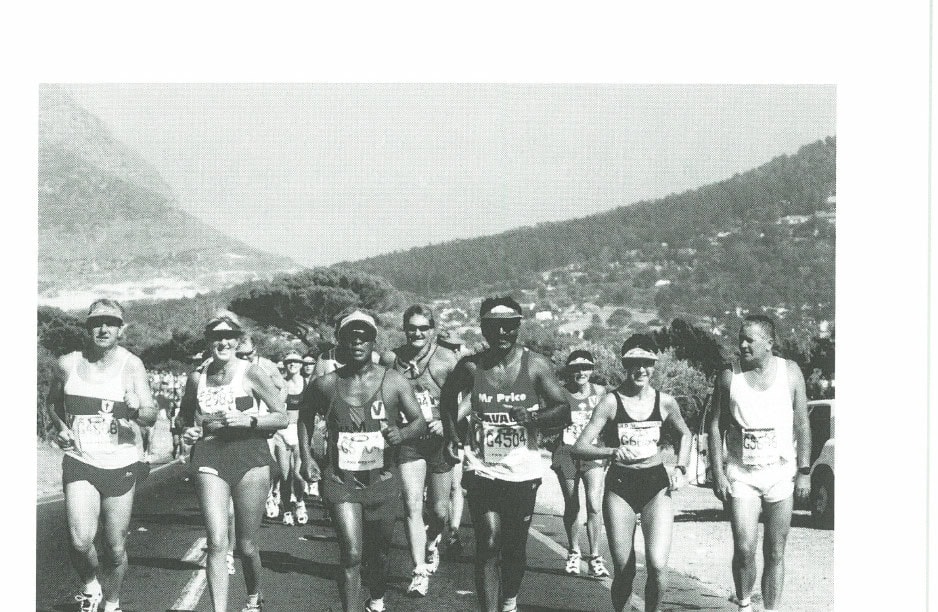
As the sun crested the eastern horizon, runners in the pack chatted about the weather as they rolled along. The local runners took pains to talk to and encourage the foreign runners, easily identified by the word “overseas” on their bib.
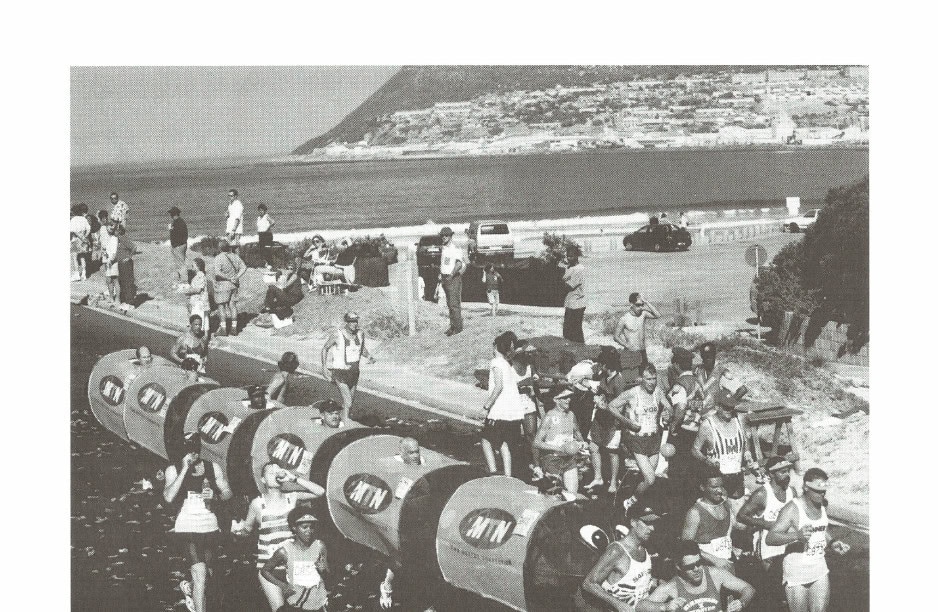
The course skirted the Indian Ocean before turning inland at Fish Hoek Bay. The local citizens really get into the race, lining most of the course, where they pass out water, PowerAde, and Coca Cola (one of the major sponsors of the race).
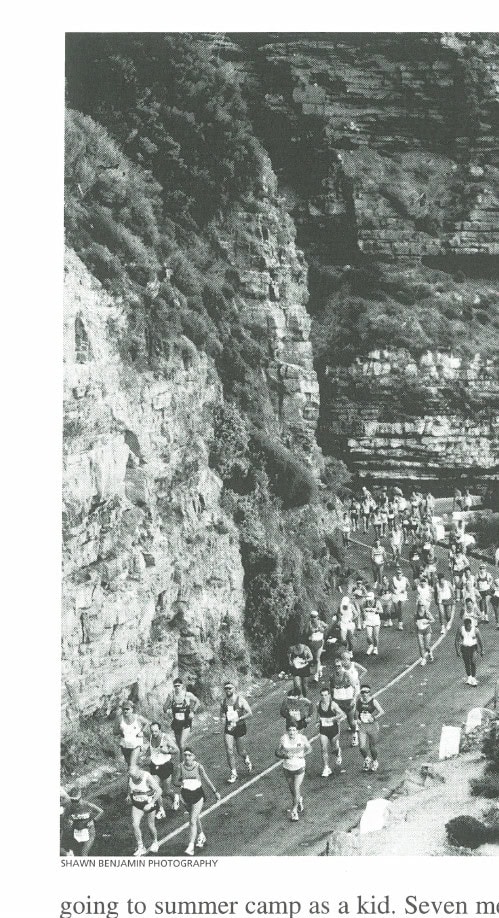
As the rolling mob of runners crossed the peninsula toward Noordhook, the halfway point, the temperature continued to rise. Conversations, which had been animated, muted now with the rising temperature and the 9K uphill to Chapman’s Peak. Once up the hill, runners were greeted by the scenic turquoise waters of the little village of Hout Bay below, the Atlantic Ocean gently lapping the shore. After peaking, the course drops to Hout Bay and turns inland, coursing between Tokai Forest and a mountain range known as Twelve Apostles.
This is followed by the steepest portion of the course, Constantia Nek, which is four kilometers long. The cruel uphill managed to take its toll on the tiring runners as they entered an exercise-induced daze. Fortunately, a reward waits at the end of the uphill, as the course enters the loveliest sections of Cape Town. Then it runs past the Kirstenbosh Botanical Gardens to Rhodes Drive and the final climb up Union Avenue to the finish at the main sports field of the University of Cape Town.
Although portions of the course are physically and mentally grueling, the race itself is extremely well organized and incredibly scenic. On a 10-point scale, our group rated the course a 9.7.
The winning time was a remarkable 3:11:20, nearly eight minutes off the course record, but still quite impressive. On the women’s side, Angelina Sephooa won, in 3:38:09, for her third consecutive win. The winners received R60,000 each.
Agony the Feet—and the Heat
More than 2,000 runners dropped out of the race because of the heat, which soared into the 90s—extreme for the time of year. Similar to Comrades (which has an 11-hour cutoff), the Two Oceans has a cutoff of 6:30. In the wake of the report of the gun signaling the cutoff came a deafening silence. The clock had stopped. Many of the runners approaching the finish area experienced a moment of profound disappointment. One South African runner, a mere 100 feet from the finish when the gun sounded, stopped in total dismay, dazed and staring, fixed, at the now immobile clock. He sat down, took off his shoes, and collapsed back onto the grass.
The Day After: Whine and Wine
We spent the next several days resting and recovering. We needed no rationalizing to convince ourselves we deserved it. Everyone wore some badge of
Like the famous Comrades Marathon, Two Oceans has a strict time cutoff: 6 hours and 30 minutes, leaving some runners out of time just feet from the finish line.
courage from the race, be it blisters, blackened toenails, sore muscles, or simply screaming quads.
We took the opportunity to tour South Africa’s wine country, where quaint villages dotted the gently rolling hills and lush green valleys were covered by undulant vineyards. The Stellenbosh and Paarl wine regions were originally founded in the late 1600s. The region was settled by French Huguenots, and many of the little towns maintain the old-style Dutch-French architecture. We visited as many wineries as we could fit into the day and found most of the wines reasonably priced. Not unlike Northern California’s wine country, the South African wine region features excellent restaurants, art galleries, and bed and breakfast inns.
When our time ran out, we were reluctant to leave the beauty and hospitality of Cape Town. As our plane rose above Cape Town, we agreed that although we’d left some of ourselves there, we’d brought away much more than we’d come with.
This article originally appeared in Marathon & Beyond, Vol. 4, No. 3 (2000).
← Browse the full M&B Archive1,000+ stories from 19 years of Marathon & Beyond
The complete archive of the legendary long-distance journal — digitized and free to read.
