

My Most Unforgettable Ultramarathon
SILVERTON, COLORADO, July 9–11, 1999—I can tell you why I’ll never forget this ultramarathon in three little letters: DNF. Yes, that stands for Did Not Finish, and no, I didn’t. What makes this race so memorable is that I’d never not finished a race in my life, dating back to 1988 with my first 10K.
Let me put it into perspective: The Hardrock 100-Mile Endurance Run (HRH) held each July (snow permitting) at Silverton, Colorado, is regarded by most ultramarathoners as the toughest 100-mile trail race in North America, if not the whole world. HRH might be the toughest footrace period, were it not for such other well-known tortures as the Hi-Tec Badwater-to-Mt. Whitney summertime desert run or that silly impossible thing held every spring in Tennessee known as “The Barkley Marathons.” But Badwater (on roads) is more than a 100-mile race, and Barkley (one 100-mile finisher in its entire history) in effect has no trail. I’m told you need navigational instruments just to find the Barkley course and then a machete to bushwhack through it. There was also that bit of whimsy and nonsense called the “Nolan’s 14” inaugurated this past August, where competitors climb 14 of Colorado’s peaks over 14,000 feet in 60 hours—not surprisingly, this race had three starters and zero finishers.
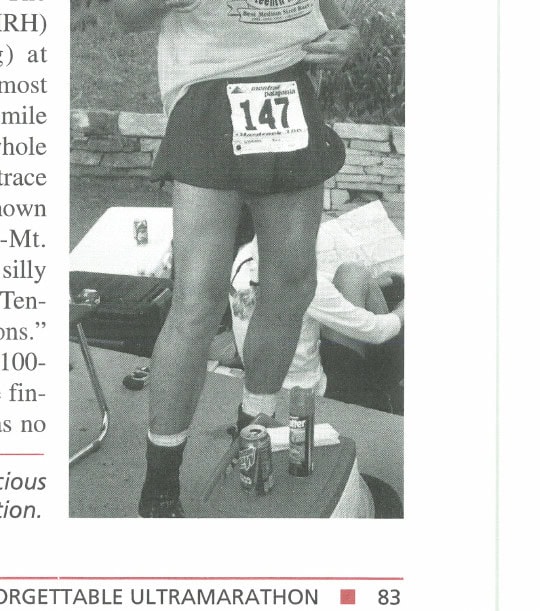
Still, you’ve got to give pause to an ultramarathon that sends you a prerace booklet in which all of the finishers in its seven-year history are listed on just four pages, and many names appear more than once. The Hardrock Hundred began in 1992. My assault occurred in 1999. The 1995 race was canceled because of too much snow (remember, this is July). So mine was the seventh Hardrock actually run, meaning its history when I got the booklet covered six years. At that time HRH boasted only 200 finishers. Pulling out the duplicates, the number of individuals dropped to 118. I, then, aspired to be Mr. 119.
A DIFFERENT BEAST ENTIRELY
More importantly, perhaps, I wanted to be the first person from Illinois to finish the Hardrock Hundred. Overshadowed as I am by all the fabulous runners from Chicago and downstate, not one of them had ever finished this race. Certainly there had been attempts. In fact, the reason I tried it at all was to follow in the footsteps of my coach and mentor, Chuck Bundy, who made his first assault at the 1997 race. Chuck couldn’t finish because of a rather severe leg nerve injury he’d sustained just days before while helping to mark the course.
Two things sobered me up about that injury: (1) What kind of a race are we talking about where you can hurt yourself that badly just by walking and planting little flags? (2) Chuck’s injury was so bad that it also prevented him from entering the race the following year—and the year after that! His injury, by the way, did not come from anything he’d done on his legs. No, he got hurt while sliding down snow on his rear end!
So, besides aiming for some distinction as the first Illinoisan to finish Hardrock, I also wanted to earn the respect of my coach, who is some 18 years my senior and with whom, during normal training, I can hardly keep up. And it was during our abnormal training this past year that he told me time and again, “Hardrock is a different beast entirely.”
A BUNCH OF CRAZIES RUNNING AROUND IN THEIR UNDERWEAR
My first encounter with this beast came a week before race day. Driving south from Ouray (pronounced yur-RAY), you begin immediately to climb what is known as the “Million Dollar Highway,” so named because of its incredible cost per mile when it was built, which was back in the days, I suppose, when the average cost per mile was a couple hundred bucks. U.S. Route 550 seems to be an alpine trail all by itself, carved into the edges of incredibly steep mountainsides and rising with amazing twists and turns to a high point of 11,000+ feet halfway to Silverton. And it gave me my first big clue. These were the cliffs I’d be climbing on foot.
My mission to Silverton that Saturday was to volunteer for Charlie Thorn’s fine army of course markers. Chuck Bundy had recommended this emphatically as one of the very best ways to prepare for the race. Charlie’s schedule that day, as published in the prerace booklet, called for marking the sections before and after Virginius Pass.
When I arrived at Charlie’s headquarters, I sadly discovered most of those sections had already been marked and the army had the day off. But Charlie himself, perhaps happy to find fresh blood on his doorstep, suggested we could do other trail work if I was willing, which I was, but first we had to go for breakfast. I was willing to do that, too.
Sometime during breakfast Charlie looked around the café at all the sedentary, overweight locals and commented on what he believed their opinion was of the Hardrock Hundred. “They think,” he said, “we’re just a bunch of crazies running around all night in our underwear.”
We spent the rest of the day clearing the Ice Lake and Hardrock trails north of town. I found myself trying very hard just to keep up with this man hiking up mountains and carrying a chainsaw. He spent the day cutting paths through all the “blow downs” (fallen trees blocking the trail), and I spent the day out of breath.
WHAT’S SO ATTRACTIVE ABOUT GRANT-SWAMP PASS?
Not that weeks and months before Hardrock aren’t sobering enough already, but this year two days prior was especially so. In the Silverton High School gym on Wednesday morning before runners’ check-in, race director Dale Garland and Charlie Thorn’s wife, Andi Kron, held a special memorial service for multiyear finisher Joel Zucker, formerly of New York. Two days after finishing Hardrock his last time, in 1998, Joel died.
The memorial invitation in everyone’s packet told us he died “from an aneurysm that occurred just 36 hours after he completed his third straight Hardrock Hundred run.” Other reports I’d read noted previous medical conditions and high blood pressure—and not the race itself—as major contributors to his untimely death. Any way you viewed it, the presenters at Joel’s memorial service regarded him as a hero. And so did I. He had, after all, finished this monster three times.
After the ceremony, we were all invited to hike up Grant-Swamp Pass to view the memorial plaque enshrined there by Charlie, Andrea Feucht, and two other mountaineers. I quickly observed how most of the runners immediately disappeared. Not knowing any better, and thinking this hike would help acquaint me with the course, I stuck around for the climb.
Grant-Swamp Pass, let me tell you, is some 13,000 feet straight up. You start out climbing the Ice Lake Trail to the point where all sane backpackers veer off to camp at Ice Lake, and then follow the Hardrock Trail up from there. You end up looking down, far down, at Ice Lake. (So named, I suppose, because it never melts?) Then you turn around and look up, far up, at Grant-Swamp’s peak. That peak is exactly where Joel’s monument has been cemented for all time—at least all time we mortal folk are likely to know. We stalwart climbers were told this was Joel’s favorite spot on the course. We were also told that this monument is truly fitting, because to view it you have to work at it, and Joel presumably would have liked it that way.
One thing I’ll tell you: It’s vandal-proof.
And yes, naturally, the spot is gorgeous: breathtakingly beautiful, in fact, if not deathly hazardous enough to take away your breath permanently. I suddenly knew why most of the other runners remained in town. I was totally
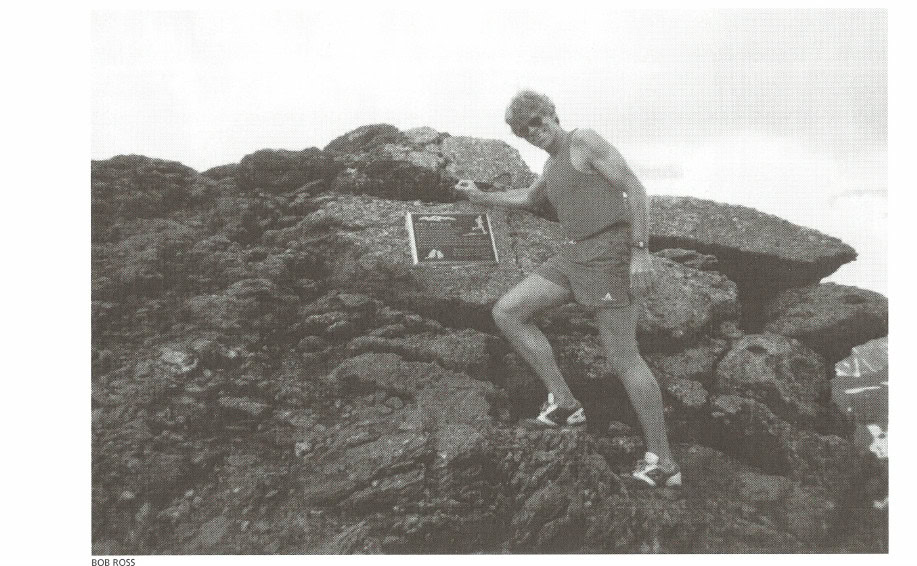
trashed! And I never did see any swamp. (Ironically, isn’t General Grant buried in New York City? Do you suppose that’s why Joel liked this place—for its name?)
STARVING IS NOT A STRATEGY
I didn’t see Joel’s monument again, of course, until well into race day. But what happened after that most memorable mountain climb was, for me, every runner’s nightmare: I got sick! All of a sudden I came down with chills and fever the night before “the night before.” This was terrible, but I ignored it.
Only much later did I realize I had probably made a tactical mistake. I hadn’t eaten anything during the entire climb, mostly because of a coaching tip to avoid eating as long as you can before weigh-in. The idea is to be as light as possible when the medical people write your weight on the wristband you’ll wear until you either finish the race or drop. Then, after weighing in, you eat! The idea there is to weigh more than the wristband says you do, so that when you do lose weight during the race, they won’t pull you for losing too much. In many 100-milers a seven percent loss from what it says on your wrist disqualifies you from continuing.
So why did this strategy backfire? At the gym when I reported for runner weigh-in, they didn’t weigh me! When I asked how they determine all the runners’ weights, the nurse smiled sweetly and said, “We take your word for it.”
So now we have a new term: Grant-Swamp Pass-Out. And I practically fainted when I realized I hadn’t had to starve myself all day, two days before the race.
RATIONING AT AID STATIONS? YOU GOTTA BE KIDDING ME!
Sick Wednesday night, screwing around with drop bags Thursday, and, believe me, not sleeping a wink on Thursday night, I was well prepared to “race” on Friday morning, eh? No, I guess not.
Standing with other runners outside the gym before 6:00 A.M., I started to worry. One of the surefire ways I’d discovered to finish a 100-mile race—where you’re guaranteed no sleep for the night—is to sleep extra well the night before that. During the Hardrock race, however, you face the very real, and very grim, prospect of not sleeping for two nights. So not having slept at all, I was standing at the start contemplating no sleep for three!
Another observation caused more pause. As I looked up and down 12th Street, I noticed a lot of runners carrying equipment I’d never seen at the start of a race: ski poles and ice axes! I was also suddenly terrified at the thought of “crampons,” which of course I didn’t have and had never heard of until Charlie Thorn told me that’s what he uses. He said they clamp onto your shoes and help you climb things like sheer cliffs and walls of ice. Things like, you know, Hardrock has.
After a few remarks, race director Dale started the race at straight-up 6:00 A.M. All of us took off running, but I suspected the running wouldn’t last long, and I was right. There is a religious shrine on the hillside just north of town, and the course follows the road up the hill which, believe me, most of us walked. Someone commented how this feature makes a much better finish than start. The course changes direction every year. In 2000 this will again be a downhill finish coming into Silverton from the north. Upon hearing this I thought, Just my luck. I’m here the wrong year.
We turned left, however, before reaching the shrine, which I figured must be something like “Our Lady of the Lost Souls in Purgatory” or otherwise spiritually akin to my current condition. Shortly after turning, we picked up a rather rocky trail, known as Nute’s Chute, hugging the hillside. A runner named Chris Nute discovered this former ore cart track, or whatever it was, so we could avoid the smooth asphalt of U.S. 550, so safely paved and so far below us.
But, I thought, this is the way for us Hardrockers. Where there’s a road, we take the trail. Where there’s a bridge, we go through the water. Where there’s a tunnel, we climb over the top. And, of course, where there’s a valley, we take the mountain.
In the clockwise direction, the first of the five or so million major obstacles to hit you is Mineral Creek. This crossing occurs about three miles into the race after you climb down from Nute’s Chute, and everyone from town turns out to watch you attempt not to drown.
Creek? Did I say creek? Oh, no. This is a raging river. It contains the snowmelt of a hundred thousand acres of San Juan mountains. It is ice cold. Its current is moving at 40 mph. But, hey, they give you a rope to hang on to, and your fans and friends along the very dry highway cheer you wildly.
Larry Ridgeway and Heidi Schutt of Running Delights were there, cheering me wildly. Larry had agreed to be my pacer the following morning. Larry was also destined to receive a call of panic later that night.
The next order of business was Bear Creek Trail and the long ascent through Putnam Basin. I had the good fortune to fall in line (a lot of these trails dictate single file) behind Eric Robinson, an incredible runner and climber I’d first met during the hike to Joel’s memorial. Eric paid me the ultimate compliment, saying that two years ago whenever I’d post to the Internet another chapter of my adventures at the Western States 100-miler, his productivity at work would stop while he read it. I thanked Eric for putting my pleasure before his business.
The man was the very picture of relaxation and poise. He wrapped his jacket around his waist and set his arms akimbo. He walked up mountains as easily as my Uncle Bud walked upstairs. He never slowed or stumbled or threw out his hands or broke his stride or stopped. You’d think he was strolling up a Chattanooga sidewalk checking out cannons from the Civil War. I kept expecting him to pull out a pamphlet and peer at a plaque to check the date. Except, of course, he never did. He just kept hiking as smooth as can be and putting more and more yards between us. By the time I got to the top of Putnam-Cataract Ridge, Eric was nowhere to be seen.
Meeting Ulrich (“call me Uli”) Kamm was memorable atop that first peak on the way to the first aid station because it (“KT”) was named for him. I asked him about that very thing, and he owned up to it. He also said something about not hating him because his Kamm Traverse added about an hour to the course. (No surprise there, huh?) Uli’s one of the original Hardrockers.
He needn’t have worried. Since this was my first HRH, I didn’t know any different, but I will say that it took an awful long time (over four hours) to get there. And when I got there, I couldn’t believe what the volunteers were telling me. “We have to ration the water,” they said. “You can’t fill your bottles all the way to the top.”
Did I mention how tough this race is? Not only is its average elevation over 11,000 feet and its total distance 101.7 miles covering 10 major climbs with 12 peaks over 12,000 feet (one of them over 14,000 feet, Handies, which is among the 54 highest in Colorado, if not North America), and not only does the course give you over 33,000 feet of total climb, but the race also requires you, roughly, to last as long between aid stations as most folks take to do a full marathon! I don’t care what anybody says, that is tough. And I thought Leadville’s aid stations were far apart!
But then to be told, after both your water bottles have been empty for over an hour, that you can’t fill them—wow! I wanted to scream! (Or yodel!) But, in the race’s defense, there was other fluid. So I filled up with Coke.
HOW CAN YOU SKI WITHOUT SKIS?
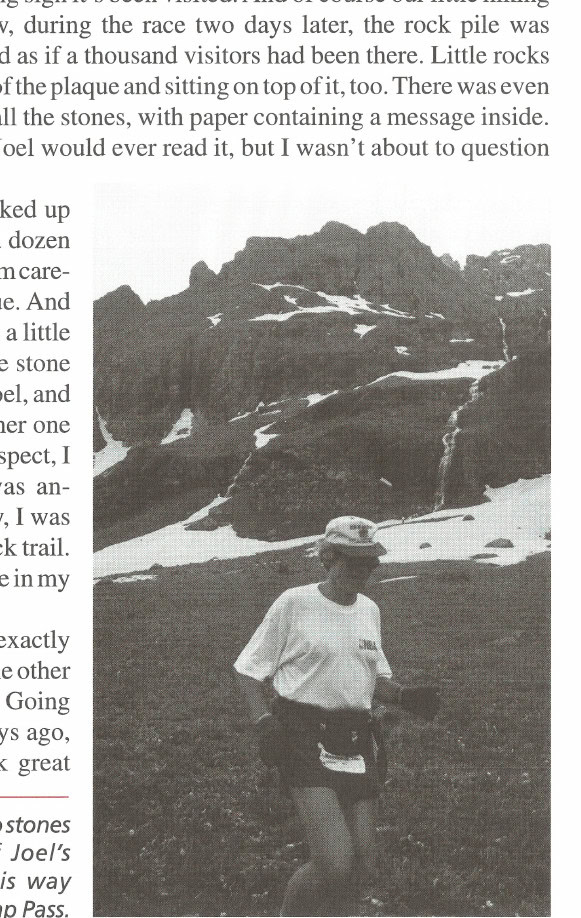
Our next objective was Grant-Swamp Pass. Boy, I knew the way and did quite well, too, passing a bunch of people on my way up. At the top, though, I was practically blown away. Not by the wind but by what I saw at Joel’s memorial. We’d all been told Wednesday that it’s Jewish custom to place a small stone on a grave marker as a loving sign it’s been visited. And of course our little hiking group did that; but now, during the race two days later, the rock pile was overwhelming! It looked as if a thousand visitors had been there. Little rocks were piled high in front of the plaque and sitting on top of it, too. There was even a little glass jar among all the stones, with paper containing a message inside. Imagine! I wasn’t sure Joel would ever read it, but I wasn’t about to question its rationale.
I bent down and picked up two more stones from a dozen feet away and placed them carefully on top of the plaque. And I invoked Joel’s spirit in a little prayer of my own: “One stone to keep me safe today, Joel, and if you don’t mind, another one for tomorrow.” (In retrospect, I feel sure my prayer was answered. For the first day, I was kept safe on the Hardrock trail. For the second, I was safe in my hotel room.)
I was curious to see exactly how I would get down the other side of Joel’s mountain. Going up the first time two days ago, Eric and company took great
delight in pointing out the straight-up-and-down nature of that side of the pass. Someone said, “Imagine trying to climb up here from that direction!” Well, I couldn’t. So I decided to try instead to inch my way down.
It worked well enough going feet first with my back to the wall, and digging in my heels for all they were worth. But that’s when I had a revelation—when I got my first clue that I was in way over my head. A man behind me, one of many I’d worked so hard to pass climbing up, suddenly appeared several feet to my right, balanced precariously on top of the huge snow slope I was being so careful to avoid. Just like that, he tucked back his hiking poles, assumed the downhill racer position, and disappeared like a skier down the side of the mountain. In seconds he was gone, and I was still digging in my heels and inching down the gravel. I may have struggled down that whole slope for most of an hour. My skier friend probably did it in less than five minutes. And of course he did it skiing on his shoes!
I must confess, for most of that hour I felt cheated. I imagined I’d been told we’d be playing sandlot softball, but now when I get to the park suddenly everyone’s in uniform playing hardball. Nobody said anything about skiing! I thought they were talking about glissading (which is what Chuck Bundy had done.) Yes, I thought we’d be sliding down snow slopes on our butts. But au contrare! The first definition of glissade (pronounced gliss-SOD by the veterans) as found in the prerace booklet is: “Intentionally sliding down a steep snow field standing. Using your feet like skis.” If you keep reading, however, the definition does allow for sliding “on your butt,” but that’s not what the veterans do. I guess I failed to read a lot of this booklet before the race.
NOT THE NATURAL ORDER OF THE UNIVERSE
When I finally did get all the way down the other side of Joel’s mountain, I felt like the very last person still in the race. I was met by a cheering multitude of exactly two people, and one of them took my picture. I remembered to turn right at “the coffee can on the fence post” and head into the woods to the Chapman Gulch aid station which, of course, was miles down the 4WD road. On that road it was revealed to me that I wasn’t dead last—not yet. No, a very elderly gentleman wearing a bib number passed me. After that I decided I must be dead last.
At the aid station, however, I found a surprise. All the volunteers were still there, and there was cheering going on! I wasn’t last, after all. In fact, I was at least an hour ahead of cutoff. And none other than Jose Wilkie was sitting in a chair! (A note about Jose: I met him at the Kettle Moraine 100-miler. He was on a personal quest to finish at least a dozen 100-milers this year. I’d told him he was crazy for including Hardrock in that total.)
“What happened to you?” I wanted to know.
“Oh, mon,” he said (I love his accent.), “dees first climb keeled me!”
Jose is a powerful runner. He “keeled” me at Kettle Moraine. To see him sitting here at Hardrock this early was quite a surprise. I grabbed more Coke, stuffed in more food, and this time filled my bottles completely. I left that station with a new cap on my head, so to speak. But Jose was still in the chair, which bothered me. I hate to be in front of runners better than I am. This is not the natural order of the universe. Such things always portend disaster.
The next little 13,000-foot “hill” was Oscar’s Pass. On the way up I again passed people and met a few new folks. Most notable were Margaret and Mark Heaphy. Margaret’s maiden name was Smith, and she had won this race two years in a row. In the men’s division, Mark had always finished ahead of her.
I thought, What is wrong with this picture? How am I keeping up with champions from previous years? Not to worry. Again, I struggled mighty hard to beat everyone to the top of Oscar’s, only to watch, with tears in my eyes, as everybody tucked back their hiking poles and morphed into downhill skiers. Bye-bye! Whoosh!
Before Mark and Margaret took off, however, I happened to look and catch them kissing on the mountaintop. And it warmed my heart. Mark had explained to me on the way up that Margaret had just had knee surgery, which was why they were so far back in the pack. I knew he could easily be in front of it, but to see him hold back to help his wife, kiss her, and then (as I found out later) DNF with her—well, it continues still to warm my heart.
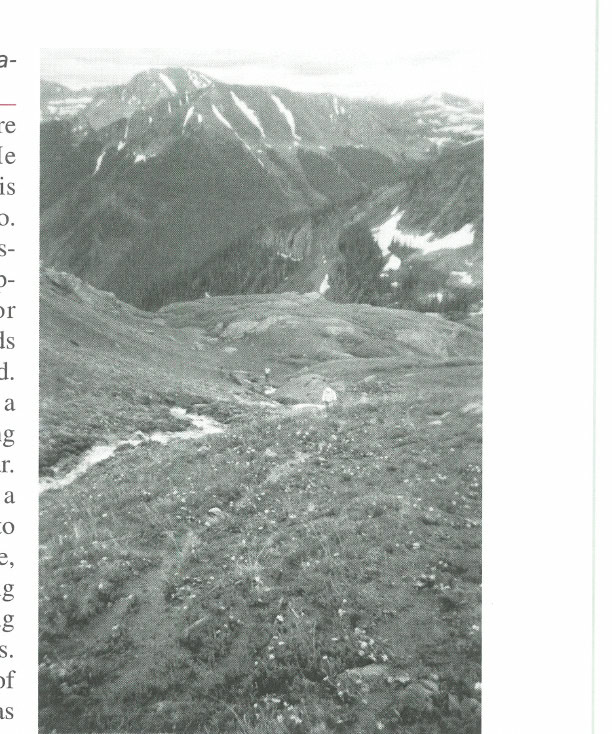
As you might expect, my descent into Telluride took forever. Again I had the sinking feeling of being dead last. But the scenery was spectacular, and I was buoyed by the thought that nobody else on earth could, or would, ever see this unless they were entrants in the HRH. I paused to whip out my camera. So naturally it began to rain.
At the Telluride aid station there was again a whole lotta shakin’ goin’ on. Here volunteers were actually taking your food order! A very nice lady made me a most delicious ham ‘n’ Swiss. My Beth was there to meet me as well, and it was certainly good to see her. She had gotten a ride with other wives, one whose husband had blown me away on the way down from Oscar’s and the other whose husband was behind me. At this point, surprisingly, I was still well ahead of cutoff, and it was nice to learn at last that I was not last. I left the station and immediately took a wrong turn downtown.
SLEDDING WITHOUT THE SLED
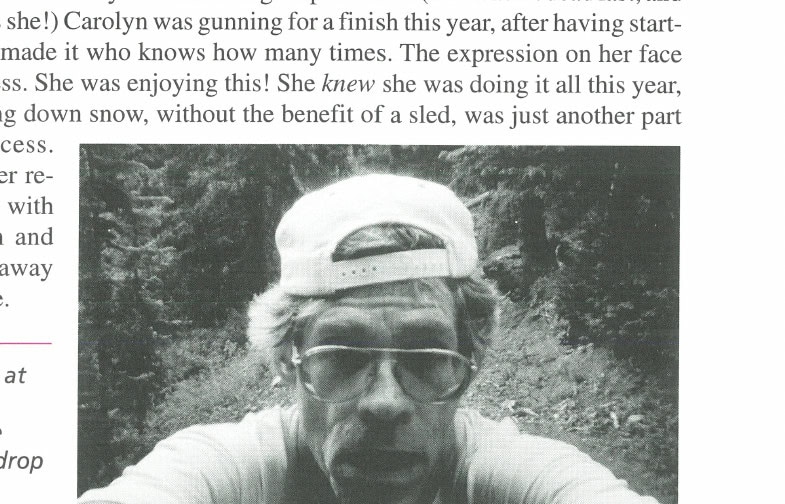
What you do when you eventually find the right street out of Telluride is climb and climb and climb forever to reach Mendota Ridge and, after that, Virginius Pass. Somewhere on the endless climb up, up, and still up, and still below timberline in the woods above Telluride, I lost heart. It was still comparatively early in the race, still daylight on the first day, and, I thought, much too early to be thinking thoughts like this. I whipped out my camera again, extended my arms, and tried a self-portrait. I wanted to see what I looked like at the exact moment I decided to quit a race for the very first time in my life.
I needn’t have been so melodramatic. The climb was doable, after all; I did it by pushing down with my hands on each knee with each step up, and then resting every 50 yards or so. This race was so far over my head it wasn’t even funny. I was just on my fourth mountain. There were six more to go.
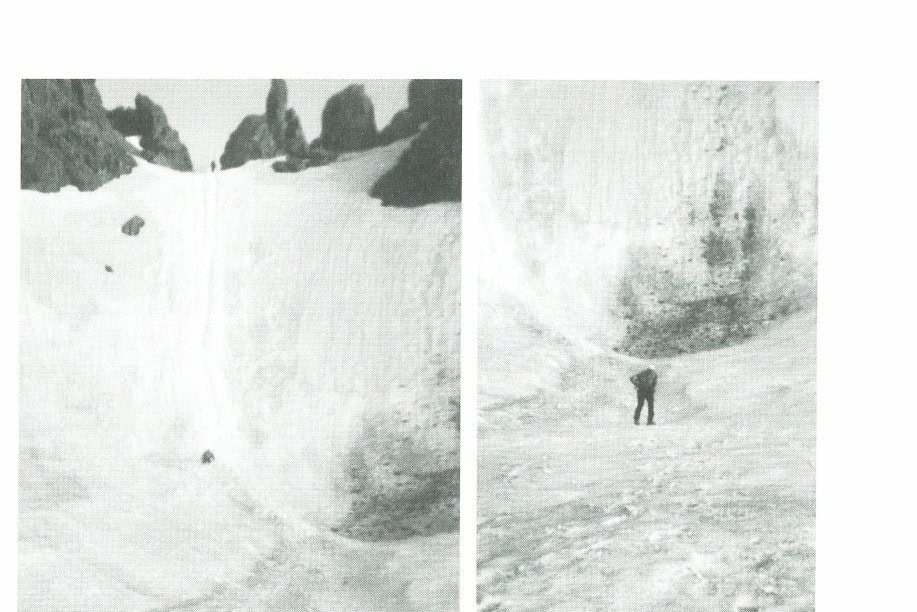
Funny got positively hysterical when I finally arrived at Virginius Pass. My mentor Chuck had told me endless times about the brave volunteers who actually hike up there every year to camp overnight on a mountain ridge within a space smaller than most walk-in closets. They set up, if you can believe this, a complete aid station, and then fix up a rope to help you slide down the other side.
“Of course,” Chuck had laughed, “the rope runs out after a hundred feet, but the slope goes on for eight hundred feet!”
He wasn’t lying. There were several absolutely wonderful, helping, and cheerful backpacking volunteers manning gear and supplies, dressed in parkas and mittens, and stirring chicken soup and hot chocolate on a camp stove. It was all positively delicious. I drank probably two cups of each. Then I looked over the side at the snow and the slide and the rope and the ice—and decided to drink three of each.
That’s when Carolyn Erdman caught up with me. (So I wasn’t dead last, and neither was she!) Carolyn was gunning for a finish this year, after having started and not made it who knows how many times. The expression on her face was priceless. She was enjoying this! She knew she was doing it all this year, and sledding down snow, without the benefit of a sled, was just another part of the process. She took her refreshments with enthusiasm and went right away for the rope.
“Carolyn,” I said. “Show me how to do this. You go first.”
“This is fun,” she beamed. “Just watch!”
“Yiiiiiiiiiiieeeeeeeeee!!!” And down she went.
I gazed for a short time, and then she disappeared somewhere down that remaining 800 feet.
What I had watched for specifically was what she would do with that rope. She had simply tucked it under her left arm, outside her jacket, of course, but inside her armpit. In front of her she held the rope loosely in her gloves. I decided to do exactly the same thing. I grabbed the rope like that and hollered something inane for the benefit of the volunteers. They cheered back, and I was off.
At the start, the whole thing seemed kind of fun. There was a trough straight down in front of me, obviously made by other runners’ butts (not shoes), and the whole thing reminded me of—and was just as incongruous as—the Jamaican Olympic bobsled team.
But about halfway down, I began to notice yards and yards of snow in the trough that had turned red. I knew this wasn’t food coloring. There were no dyes or pigments flowing freely here. This came from the bottoms of runners who sledded before me. This was human blood.
Nobody had ever said anything about this before! And seeing it and thinking that I had six more butt-slides to go, I knew once again that I was in over my head. I’d make it to Ouray, but that was it!
The rope ran out from under my arm and I kept going, sliding about 50 mph on bare skin. Of course, I’d been warned by everybody to wear long pants for this, but how was I going to carry long pants? I’m a big guy. My pants are long. They take up a lot of room even in a suitcase. Besides, I had my camera to carry. There are priorities.
When the snowdrift at the bottom stopped me cold, literally, I stood up, took inventory, and called for damage control. I was okay, but one of my plastic tent stakes was missing. (Chuck had suggested I carry two, one for each hand, if necessary, for ice climbing.) I decided then and there that the lost stake should remain as my contribution to future campers who might be one short.
Suddenly, I heard hollering.
“YyyyyiiiiiiiiiiiiiEEEEEEEEEEE-YIIIIIIIIIIII!!!”
It was another runner-turned-bobsledder about to go down. I whipped out my camera. He pushed off, hollered again, and continued hollering the whole way to Jamaica. When the joyride was done, I waited to see if I knew who it was. It was Jose.
“Hey, mon! Wot kinda boosheet eez dees ova here?”
“I thought we were runners,” I said, “not skiers!”
“Yoo dom right abot dot sheet!”
Jose and I had a great time going down the rest of the snow slopes together, and then, when we hit bottom, trying to find the trail again. We couldn’t see any markers! So together we went crazy over all this boosheet.
UNCONDITIONAL SURRENDER AT OURAY
Eventually we found footprints leading off in some unlikely direction—lots of footprints—and decided to follow them. Shortly afterward we picked up the trail markers again and were on our way. I told Jose to go on ahead because I was stopping at Ouray, and he did. Only much later did I learn that, of all the 100-milers he had so far attempted this year, Hardrock turned out to be the only one he didn’t finish. (By year’s end Jose actually finished 14 100-milers, a new record.)
Did I tell you how hard this race is?
Very sadly, I also learned later that my friend Carolyn didn’t make it this time either. But she hugged me anyway, as though she did.
I walked the rest of the way to Ouray by myself in the dark, and presented (perhaps gladly) my right wrist to the aid station captain. He cut off the shackle with my weight on it, and I was a free man. I knew Beth would be there, along with her two lady friends in one of their camper trucks, and of course they were. It turns out that both their husbands had passed me (somewhere) and so now I really felt like I was the last runner out there.
Ah, but amazing fact: I wasn’t. There were three more people behind me, and I was even still some 50 minutes ahead of cutoff. I could have continued!
No, I couldn’t. Let me review my mental state with you. When I started, I figured: three nights without sleep? What the heck. Let’s give it a shot. (Thinking that I might actually have a shot.) Going up Oscar’s Pass, I figured: if I can do this, I won’t ever have to come back. Going up Virginius, I figured: well, if I don’t do this now, I will have to come back. Coming down to Ouray at midnight, I figured: I ain’t never coming back! And furthermore, I’m giving up running completely and devoting all my time to my home and my loved ones. I’m going to rearrange my entire life’s priorities. And I’m giving up all this boosheet forever!
Months later, I’ve already sent in my entry for next year. I can still be the first finisher from Illinois.
And What I Learned From It
TOP 10 LESSONS
- 10. You are never so successful that you cannot ever fail.
- 9. Being coached is a lot different from being there.
- 8. The best people can be found in the worst situations.
- 7. Before you shoot yourself in despair, consult those people.
- 6. The Hardrock 100 is not a running race.
- 5. You don’t have to kill yourself climbing on this course if you can make up time by skiing on your shoes.
- 4. Skiing on our shoes might be the only way some of us will ever beat the cutoff.
- 3. Wait till winter, lace up the trail shoes, go to the playground, climb up the ladder, and practice skiing down the slide.
- 2. Buy poles and crampons!
- 1. Don’t kill yourself before next July.
This article originally appeared in Marathon & Beyond, Vol. 4, No. 3 (2000).
← Browse the full M&B ArchiveMore like this
1,000+ stories from 19 years of Marathon & Beyond
The complete archive of the legendary long-distance journal — digitized and free to read.
