

A Tree Grows in Myrtle Beach
If a picture paints a thousand words, then a marathon must truly create a thousand pictures. The 26.2 miles of canvas unfolds just a little bit differently for every running artist, and each portrait painted ends up as distinct as the runner who draws it. Colors vary widely from one rendition to the next.
I have been invited to pick up my writing palette and create a color story on the Myrtle Beach Marathon, which is once again rapidly approaching. As I stare at the blank canvas and ponder what colors to select, all I see is pink. I can’t think of the Myrtle Beach Marathon without seeing pink around every corner.
* * *
As the cross streets started climbing through the 40s to the low 50s, I felt a lump in my throat and a tear in my eye as I encountered my most emotional feelings of the race. I knew I’d soon be passing Caroline’s tree at 56th and Ocean Boulevard. Caroline was the wife of a friend of ours who had lost her long and painful battle with cancer just before the holidays. Her husband Doug is a local Atlanta runner and a member of the international running group known as The Penguin Brigade. My wife Harriet and I see him often at local races and have always enjoyed our visits. We had met Caroline only once, at the Atlanta Marathon expo about a month before her death. We are both very thankful for that meeting.
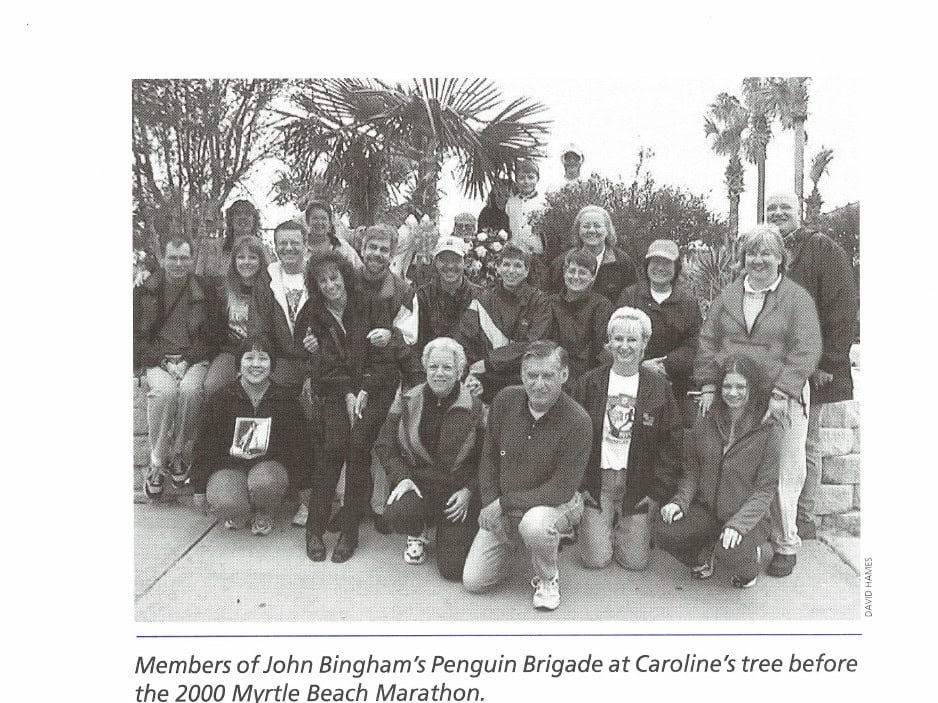
On Friday, the day before the race, a large gathering from The Penguin Brigade had gone down to Caroline’s tree and decorated it in pink. One of the newer members, Michael Spring, had made a lovely wreath, which was placed at the base of the tree. As we remembered her, we covered the young and sturdy palm tree with bright pink ribbons. Race director Nancy O’Connor and the City of Myrtle Beach were very kind to have honored Caroline with this tree. We cried, we hugged, and in a special way, we knew she was with us.
As I turned down 56th Street and then north on Ocean Boulevard—somewhere between miles 16 and 17, if I remember correctly—I could see the tree, still adorned with a swarm of pink ribbons, and I knew that Caroline was urging me on. As I ran by, I said a short prayer and said to myself, “Caroline, same time, next year.”
* * *
I wrote the above excerpt as part of my race report after a very emotional Myrtle Beach Marathon two years ago. Every runner who ran the full Myrtle Beach Marathon in 2000, as those who ran it earlier this year, passed Caroline’s tree, which was decked out in pink ribbons. Most runners probably never even noticed it as they struggled by, and others who may have noticed the ribbons no doubt quickly turned their thoughts back to how much farther up Ocean Boulevard the next water stop would be. In the midst of a marathon, small details along the course quickly fade into obscurity. But for those who actually placed the ribbons on the tree the previous day, many stopped to touch it and say a prayer as they ran by. Very few outside of the Brigade have known the story behind the pink ribbons until now.
But to fully understand the tree and the ribbons, it helps to understand some of the early evolution of this race and the groundwork that had been laid even before that first Myrtle Beach Marathon, as this was when the seed of Caroline’s tree was planted.
THE BIRTH OF THE RACE
The Myrtle Beach celebration of running is truly within reach of just about anyone who runs. It features a generous eight-hour cutoff time for the marathon, as well as a concurrently run five-person marathon relay event. This makes marathon participation as easily accessible as the city itself to almost anyone who wants to be a part of the festivities. This is by design, not by accident, says Nancy O’Connor, who along with Shaun Walsh, founded the race and then directed the first Myrtle Beach Marathon.
Nancy, who is a parks superintendent for the city of Myrtle Beach and a 4:00-to-4:30 marathoner herself, set out with the intention of creating the type of race that she would personally be attracted to. She wanted to create a race that could showcase the city to a more “nontraditional” clientele than the usual golfer/beach-bum variety. At the same time, she wanted to showcase the running community to the people of Myrtle Beach.
The local Myrtle Beach community can be a tough critic. “What a lot of people don’t know about Myrtle Beach,” says O’Connor, “is that you have to prove yourself here before you’ll be welcomed back.” With that in mind, she set off to create a race that was friendly to the community as well as to the runners.
In November 1997, three months before the inaugural Myrtle Beach Marathon, while attending the Marine Corps Marathon, Nancy and Shaun discussed their Myrtle Beach vision with John Bingham, a.k.a. the “Penguin,” of Runner’s World fame. Nancy knew she could count on John to give her some good insights on how to cater a race with an emphasis on accommodating middle-to back-of-the-pack runners, as well as first-time marathoners.
Several years earlier, John had founded an Internet e-mail group known as “The Penguin Brigade.” The group was made up largely of slower runners who had no excuses or apologies for their slowness and who shared a strong determination to participate no matter how slowly they progressed.
The Brigade had chosen Marine Corps as a place to establish their initial “encounter,” mainly because Marine Corps was a people’s race with a very generous time limit and marathon support specifically designed to accommodate slower runners.
The members of the Brigade were easily identifiable by their supportive and outgoing personalities. But since this was an Internet group, they needed a more physical way to recognize each other in a maze of 20,000 other runners. For this, they relied on their bright pink Penguin Brigade hats.
John, along with his wife Karen, listened to Nancy’s ideas for Myrtle Beach and agreed to become involved in the inaugural event. Before the Marine Corps encounter adjourned, John bounced some thoughts off some of the Brigade members and asked for ideas for a Penguin presence at Myrtle Beach. Before leaving D.C. to head back to their home in Robards, Kentucky, two members of the Brigade, Dave and Andrea Hames, took immediate charge, volunteering to be the first official Penguin hosts of the Myrtle Beach Marathon encounter.
Due to the considerable chatter and promotion within the group list, in mid-February 1998, upward of 50 pink-hatted Penguins “stormed the beach” in what has become the Myrtle Beach battle cry. This swarming of Penguins included several relay teams, as well as a few first-time marathoners. Pink hats were everywhere. Many Penguins had never met others from the group before this meeting, and all left the beach after the weekend with many new friends. The encounter was a resounding success and had a long-lasting effect on many from the group—but it had a very special meaning for one couple in particular.
Doug Reineke had learned of the group through exploring the Internet, and he knew right away that this was a group he could feel at home with. They were slow, they enjoyed having a good time, and they were unusually supportive of each other. Many seemed to relish others’ victories even more than their own. So he took the chance and headed down to Myrtle Beach, accompanied by his wife Caroline, to run the marathon relay and meet an entire on-line community for the first time.
Caroline was not a runner. She was, in fact, quite ill. She had been battling various forms of cancer for nearly 20 years, and with the exception of a five-year period of remission, she was in severe and constant pain as the disease ravaged her body. But she never allowed her condition to defeat her spirit. In 1977, her doctors had told her she only had a 10 percent chance of surviving the year. She proved them wrong then and many times over.
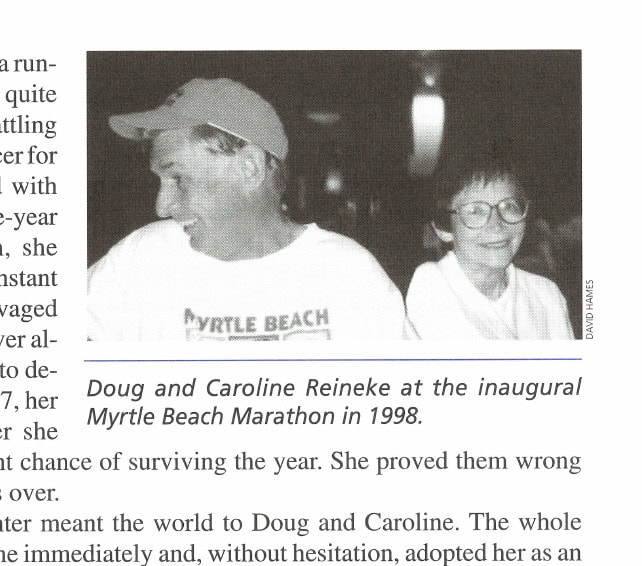
That first encounter meant the world to Doug and Caroline. The whole group took to Caroline immediately and, without hesitation, adopted her as an honorary Penguin. It was an unusual feeling for Caroline to feel such an accepted part of a group she figured to have nothing in common with, and she appreciated the warmth of this special group of runners.
The weekend helped her understand Doug’s gratitude toward the group, too. And this understanding helped Doug feel better about going for his daily runs. He felt less guilty about leaving Caroline at home while he did what he needed to do to refresh his soul so that he could be better for her. They left Myrtle Beach changed people.
THE BIRTH OF THE CUP
At some point between the first and second year, John Bingham came up with the idea of a Penguin Cup specifically for those penguins wishing to run the marathon relay. He and Karen discussed the idea with O’Connor and Walsh, who readily agreed to add a separate “Penguin” relay category to the race in 1999, complete with special awards, and to introduce the Penguin Cup Challenge, a special event within the event for Penguin relay teams only. This was not a race to see who was fleetest of foot; rather, it was a “prediction run,” where each team had to guesstimate their cumulative marathon time, and then run, or waddle—as the case may be—the marathon relay without a watch.
My wife Harriet and I were recruited by a group member living in Arizona, Liz Itter, to join forces with her, Mary DeMattia, and Corey Waters. Together, the five of us became Team Go Amy, one of at least 10 relay teams who took part in the inaugural event. We boldly predicted that we could run the relay in
3:48:50. That was a pretty aggressive Penguin time, but we felt it was within our grasp.
The cup, in principle, was similar to hockey’s Stanley Cup. Each year, all the members of the winning team would have their names inscribed on a tile, which would then be affixed to the base of the cup, and each new year, an additional tile would be added with the new winning team members’ names. During the year, the cup would rotate among the winning team’s members.
Although there was a lot of e-mail trash talking within the Penguin camp leading up to the first Penguin Cup Challenge, it was all in good-natured fun. Have a look at the “official” rules for the inaugural event, which were posted by Karen Bingham:
- Teams must be registered in the Penguin category of the relay.
- The Team Captain must submit time predictions for EACH leg and for the TOTAL time. A form for this may be picked up in the Team Penguin booth in the marathon expo and must be submitted to Karen Bingham no later than 8:00 P.M. on Friday, February 26, 1999.
- Relay runners must run WITHOUT their watches. Judges disguised as ordinary runners will be on the course to enforce this. Should watches be discovered, they will be confiscated on the spot and given to Head Judge Ma Bingham (John’s mother). (Thereafter, it will be up to you to see if you can get your watch back from Ma B.)
- In addition, runners must not alter their stride while approaching their relay handoff point or the finish. Anyone judged as having artificially adjusted stride will receive a one-minute penalty. The ruling of Head Judge Ma Bingham will be final in such cases. (Trust me, you’re not going to want to argue with her, anyway.)
- In the event of a tie, the winning team will be determined by the leg time predictions for the first leg, then the second, and so on.
- The Penguin Cup will be presented at the Marathon awards ceremony. The winning team is expected to defend their title and return the Cup at next year’s Myrtle Beach Marathon on February 19, 2000.
MEET THE CHALLENGE!!!
As it turned out, we ran the race slightly quicker than we’d projected, finishing in 3:48:48. I thought that missing a marathon prediction time by a mere two seconds was pretty darn good, and the judges agreed. Team Go Amy won the inaugural Penguin Cup Challenge. And the bond between the Penguin Brigade and the Myrtle Beach Marathon grew even tighter.
Harriet and I decided to return to Myrtle Beach the following year. We loved the atmosphere of the race and had been pleasantly surprised by how desirable it was to spend time in Myrtle Beach in February. This may be one of the best-kept secrets in vacation travel, but Myrtle Beach in February is fantastic. The crowds are down, the weather is good, and just about every restaurant has an all-you-can-eat buffet. What more could you want? It was initially the pull of the Calabash seafood buffet that had us salivating to return to the Grand Strand.
Late that November, while Harriet and I were manning the booth for the Chattahoochee Road Runners Club at the Atlanta Marathon expo, we saw Doug and Caroline passing through with some of their friends and family, and they stopped to chat. We had never met Caroline, but she instantly struck us as a gentle and sweet yet strong and determined person. She also was looking very frail.
We talked eagerly about Myrtle Beach and how much we were looking forward to stormin’ the beach again in mid-February. It was less than three months away. As we finished our visit, we bid our farewells, agreeing to visit again at Myrtle Beach.
THE BIRTH OF CAROLINE’S TREE
But in late December, Doug sent a brief and heartbreaking e-mail to the Penguin Brigade: “Caroline has crossed that final finish line. I miss her already.”
Doug felt it was important to tell the brigade of Caroline’s death immediately, and so he sent his message on the same day she passed away. The poignant message had an immediate impact on the hundreds of us who received it.
Caroline loved the Brigade, and the Brigade loved Caroline. Doug saw this massive Internet group as family. Within a week of sending the message, he had received over 100 e-mail responses and over 100 cards of sympathy. For many of us, losing Caroline was truly like losing a member of the family.
Many in the group wanted to honor Caroline and keep her memory alive, but initially no one was quite sure how. What they did know was that Myrtle Beach was where she needed to be honored. This was the event where Doug and Caroline had first met other members of the group, and the experience had touched their lives. The event was again rapidly approaching. As usual, a large army of pink hats would be stormin’ the beach just a couple of short months later.
John and Karen Bingham once again got in touch with Nancy O’Connor, this time to discuss a way of honoring Caroline at Myrtle Beach. As had always been the case in the past, Nancy worked her magic. She shared with the Binghams that there was a memorial park located right along the race course. A tree could be planted in a location that would place it in view of all the runners as they passed.
Karen and John were elated with the idea but wanted to clear it with Doug. Karen sent him an e-mail to be sure he had no objections to the idea. Doug read the e-mail and was moved to tears. He could not believe that a group of people he had only met once or twice in his life would rally behind him with such force. Without hesitation, he gave his unconditional approval of the idea.
A short time later, Nancy O’Connor contacted Doug to discuss specifics of the tree. Doug thought of Caroline and how she had defied her death sentence for close to 20 years. He thought of how, despite perpetual pain, she always had a smile and a positive attitude. He said not to plant anything willowy or easily bent. She was tough, and her tree needed to be tough. A palm tree represented Caroline’s attributes well. The tree was planted a short time later.
So on February 18, 2000, a flock of Penguins once again stormed the beach, this time with a special focus. We wound our way north on Ocean Boulevard and found the tree that the city of Myrtle Beach had graciously planted in honor of Caroline. We all locked arms and remembered her. In a special way, we knew she was with us.
Early the next morning, we ran. Team Go Amy did not defend their Penguin Cup Challenge that year. But the new keepers of the cup were proud members of Team Penguin Brigade—Charlie Company. And the proudest member of that team had to be Doug Reineke.
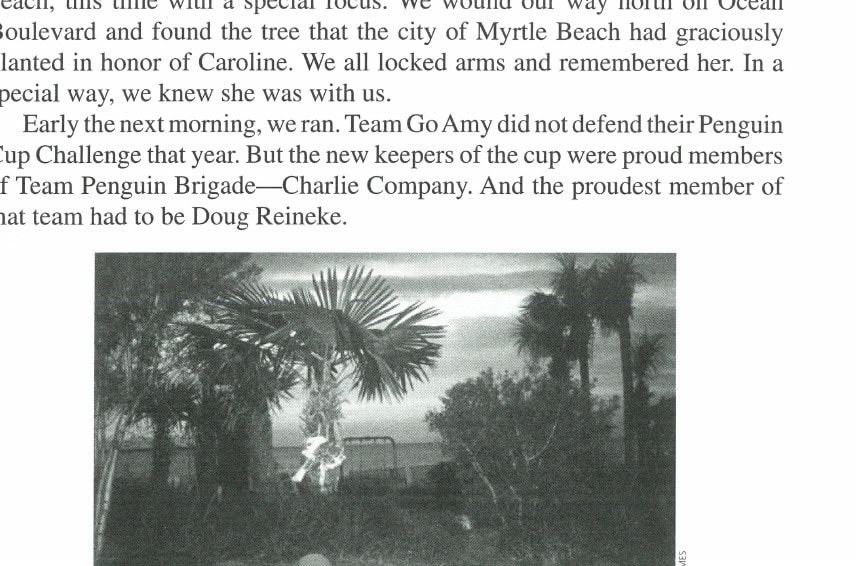
If you ever find your way to Myrtle Beach to run the marathon (and I would strongly recommend it), keep your eyes open as you make a right turn onto 56th Street and then turn north on Ocean. As you pass the sturdy palm tree covered with little pink ribbons to your right, know that Caroline is right there, cheering you on.
Thanks, Caroline. Same time, next year.
This article originally appeared in Marathon & Beyond, Vol. 5, No. 6 (2001).
← Browse the full M&B Archive1,000+ stories from 19 years of Marathon & Beyond
The complete archive of the legendary long-distance journal — digitized and free to read.
