

Matters of the Sole
WANT TO cut way down on your running injuries while saving money and maybe even going faster?
Sounds great, eh? A bit too good to be true? Maybe you’re thinking I’m going to offer you some cold nuclear fusion in a jar at the same time? Sorry, I can’t help you with that, but easier, healthier, and faster running may be just one step—one big step—away.
My suggestion will require you to rethink your relationship to your running shoes. Fact is, if you’re chronically injured, it may be your shoes that are getting you. That’s right: those Gel Grid Omni Max Beasts, the pair of shoes you took out a second mortgage to buy and which supposedly cushion, support, and correct pronation and supination while doing your taxes and children’s homework—well, it could be those beasts are doing none of those things. What they might be doing is contributing to your injury problems and slowing you down.
Impossible, you say. Modern running shoes allow more people to run more injury-free miles than ever before. It says so in all the big running magazines. The owner of your local running specialty shop says so, too, as do all the shoe companies.
But ask yourself what evidence the companies and shop proprietors offer. They’re making a health claim. And makers of products that claim to improve your health and well-being, from aromatherapy to zinc, love showing hard data that validate their claims.
Ever see a shoe ad that quotes a study showing that the Gel Omni Etcs. really do reduce injuries and improve performance? Not likely. If such studies exist, they’re well hidden. But there are studies that show the opposite . . . but, wait, I’m getting ahead of myself.
SOME HISTORY
As runners go, I’m big: 5’11”, 185ish. I’ve also run over 135,000 miles, with only one really serious “overuse” injury. At least 134,000 of those miles were run in shoes that by contemporary standards are inadequate. I began running in 1967 as a member of my high school track team. “Running shoes” in those days were whatever shoes you happened to run in—usually a pair of sneakers that were also your baseball/basketball/football/mowing-the-lawn/roaming-around-the-neighborhood shoes. They worked okay but wore out quickly.
I was given my first “real” running shoes when I joined my college cross-country team: a model from Converse with a hard rubber sole and a black canvas upper. Durability was the shoe’s middle name—probably its first and last names, too. “Rockfinder” should have been its nickname.
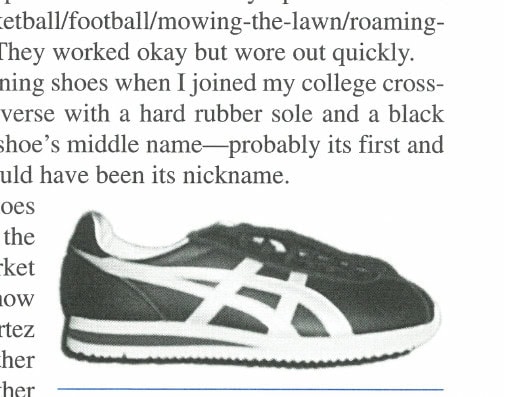
Eventually I moved along to shoes from Puma and Adidas. Then came the Cortez, perhaps the first mass-market running shoe. Made by both Tiger (now Asics) and Nike (now Nike), the Cortez had a lighter, spongier sole than other running shoes and either a white leather or blue nylon upper. I recall paying $19.95 for them. The Cortez’s selling points were durability, improved cushioning, and low price. A Tiger ad claimed that a pair could take you from New York to Los Angeles.
Few claims were made for injury prevention. Most runners in those days ran for high school or college teams and were young and resilient. A couple days off usually cleared up any running injury. Training largely consisted of interval sessions on the track. I recall a stretch of time when we did 10 or 11 such sessions a week. Injuries were somewhat coveted, providing a respite from the drudgery of endless interval work.
Eventually, this changed. Older runners took up the sport. College runners continued running after graduation, but on their own terms, mostly away from the track.
“Stop running” was the standard medical advice given to injured runners, and it was met with increasing dissatisfaction. As the number of people who ran increased, medical people took up the sport. Many of them looked for ways to reduce the downtime injured runners suffered. George Sheehan, in his medical advice column in Runner’s World, claimed that injuries to the back, knee, shin, and so on were the result of stresses caused by improper foot placement. He advised runners to find “sports podiatrists” who generally made inserts—orthotics—that were supposed to force the feet into proper placement.
Runners flocked to podiatrists who showed some interest in the sport. The office visits were usually covered by health insurance, but the orthotics, costing between $150 and $300 at a time when an expensive pair of running shoes cost $30, were paid for out of pocket. (Just a guess, but the modern running shoe industry was likely born on the day that a shoe company executive decided that runners who’d pay $300 for orthotics might pay $80 for a shoe that did what the orthotics did.)
No longer was a running shoe an implement that provided some cushioning while preventing lost blood if you ran over a nail or bits of broken glass. The shoe became a corrective device, and companies competed to develop the most corrective and protective shoes possible as a means of supremacy. Nike ran an ad showing a semi-crazed character in a white coat standing in a Frankensteinish-looking laboratory. On the wall behind him dangled skeletons in running shoes. The caption read: “Our Lab is Bigger than their Lab.”
Etonic hired a sports podiatrist to design their line of running shoes. Soles filled up with gel, air, grids, Flubber™, and who knows what else.
The message from almost all shoe companies was that your feet and lower legs are fragile and unlikely to hold up under the stress of distance running, so we’ll make shoes that will provide the protection that evolution didn’t.
BUT I WAS MOSTLY OBLIVIOUS
I spent the 1970s ignoring the wave of protection that was breaking out all around me. Injuries had never been a problem. The ones I suffered followed times when I decided to get serious about stretching, and they went away when I stopped stretching.
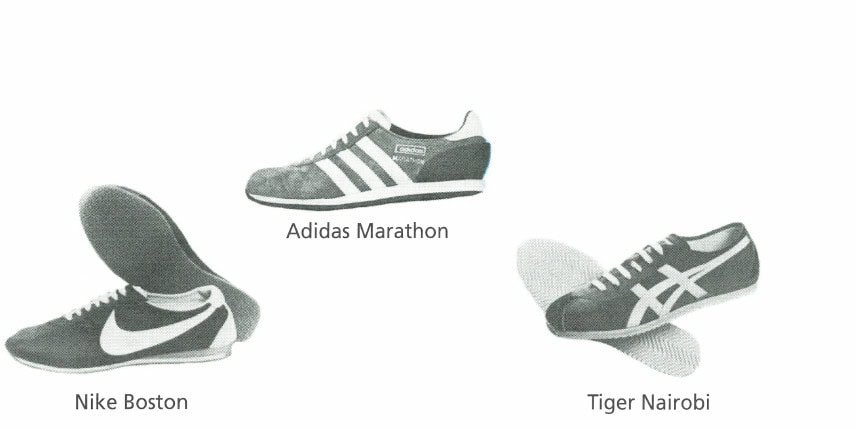
I trained in Cortez-like shoes for the whole decade and raced in the racing flats of the time: the Marathon from Tiger and Nike or its slightly (and I do mean slightly) beefier cousin, the Boston. The Marathon had a blue nylon upper and a sole consisting of about a half inch of rubber. It put the “flat” into racing flat. The Boston looked similar but had a tiny piece of extra cushioning under the heel.
The only shoe-related problem I had was a deadness in my legs in the late stages of long races, which I attributed to a poor adjustment to the switch from training flats to racing flats. So when racer/trainer hybrids came out, I ran in those. Or I’d buy “entry level” shoes at discount stores. Marketed for low-mileage runners, I was a bit self-conscious about using them to run 80 to 110 miles a week, but they reminded me of the old Cortez, a piece of spongy rubber attached to an upper. I ran happily in such shoes, oblivious to the warnings of impending disaster that I received from shoe experts who claimed that someone as big as I am, running as many miles as I did in light, cheap shoes, was courting disaster.
MY LUCK SEEMS TO RUN OUT
By 1993 I had passed 40 and decided that because I was old I should pay more attention to flexibility. So I began another try at stretching; my right knee started to hurt and continued to for months. This time the pain didn’t go away when I stopped stretching, and it got worse at the midpoint of a summer 10-mile race.
I decided that my luck with light, cheap shoes had run out. I bought a good, protective, high-tech model. I got immediate results. The pain intensified so much that I went to a doctor. He diagnosed a bad case of runner’s knee and told me I’d need a couple months off.
Naturally I ignored him and hobbled on for a painful 10 or 15 minutes each day, wondering how much worse the pain would be if I hadn’t switched to the high-tech shoes. Then it dawned on me that I was being really stupid. If the pain got worse when I switched to heavier, more protective shoes, then it must be the weight or protection that was causing the trouble.
So I looked for the least protective footwear I could find. I dragged a generic “aqua-sock” out of the closet and ran three pain-free miles in them, stopping only because I didn’t want to press my luck.
A few more runs in the aqua-socks were problem-free, though my feet bottoms were getting sore. I moved into racing flats. There was some tenderness, but I managed six to eight miles a day, and the tenderness went away. By mid-October I was back to my usual 85 miles a week with no pain.
Still believing that racing flats were inadequate for daily runs over the long haul, I switched back to my hybrids. Over the next few years the problem would return periodically, and I’d switch to racing flats until it went away. Finally, it made no sense to switch from shoes that solved the problem to shoes that caused the problem. I decided to run in racing shoes all the time until there was a good reason not to. That was over four years ago.
THEY’D AGREE
For a time I thought that my shoe reaction was just a personal quirk, but I learned there were others like myself. Joe Henderson was once editor of Runner’s World (1970-77), then of Running (long since defunct), and he is now editor and publisher of Running Commentary and a columnist for Runner’s World. He has also written 22 books on running. But perhaps the best term to describe Joe is the one he most cherishes: “running survivor.” He’s run continuously since the 1950s, though it’s not always easy for him. His feet and lower legs are sometimes problematic and limit the amount of running he can do.
This should make him a devoted customer of high-tech, protective footwear. But running in such shoes feels “awkward, bulky, and stiff” to Joe. He can list a long injury history but has found that protective shoes have aggravated his problems far more often than they’ve alleviated them. Now he buys the lightest all-purpose models he can find, using the same shoes for races and daily runs. He looks for “plenty of forefoot flexibility; heels of single-density material; and a quiet, rather than a slapping, run . . . my preference has always been to run as close to naked as possible, to feel in touch with the ground.”
But Joe will admit that he doesn’t do a lot of distance. Perhaps he’s able to get by in “low-mileage” shoes. The same can’t be said of Gordon Pirie.
Pirie, an Englishman, was the silver medalist at 5000 meters in the 1956 Olympic Games. He “retired” from high-level competition in 1961, but he never really left the sport or developed a career. Instead, he continued to train seriously for the rest of his life, coaching other runners and taking whatever jobs he could find until he’d saved enough money to race on the summer track season in both the Northern and Southern hemispheres.
Before his death in 1991 he ran well over 200,000 miles, which according to Guinness is the world record. Near the end of his life Pirie wrote Running Fast and Injury Free, a how-to manual for runners at all levels.
In the book, Pirie is very critical of modern running shoes, claiming that they increase the likelihood of injuries by promoting improper technique and that they slow runners down. He claims to have coached a 58-year-old marathoner whose best time improved from 3:28 to 2:58 simply by getting the runner into proper shoes. He advised runners to run in the lightest shoes they could find.
The end of Pirie’s international career came at the time that Arthur Lydiard’s New Zealanders began to dominate the running world. The two men were evidently not fans of one another. Lydiard frequently remarked that Pirie was an athlete who usually failed in major competitions because he didn’t know how to bring himself to a peak.
THE BEST OF ENEMIES
One day Pirie was running through a park with a friend who said he’d been reading and enjoying Lydiard’s book. “You know where you can put that,” Pirie replied, pointing opportunistically at a trash can they were passing.
But the two adversaries have similar opinions about running shoes.
In Running to the Top, Lydiard, once a shoemaker, argues that modern, high-tech running shoes are too bulky and inflexible. The shoes are “more like gumboots and you might as well run in gumboots as in some of these high-tech monsters.”
And the pronation and supination that the shoes are built to prevent, Lydiard says, actually cause the problem. Have someone run down the hall in bare feet, he claims, and you’ll never see them pronate or supinate. That happens when they put on shoes. The ideal running shoe should be “light and flexible, more like a slipper,” Lydiard concludes.
Anne Audain of New Zealand won the gold medal at 3000 meters at the 1982 British Commonwealth Games. She was silver medalist at the 10,000 meters at the 1986 Commonwealth Games and was one-time world record-holder at 5,000 meters and a 2:32 marathoner. She has won more road races than any other woman in history. Originally coached by Gordon Pirie, she switched to John Davies, one of Lydiard’s athletes, when she concluded that Pirie’s coaching was not working.
She began running “on my toes in bare feet,” as therapy, on doctor’s orders, to strengthen her feet. Anne was born with severely deformed feet and endured a series of painful surgeries to correct them. Conventional thinking would have her running in the most protective shoes she could find. But she always trained in her racing flats. Conventional training flats made running more difficult, slowing her by “as much as a minute per mile,” a figure that roughly matches the improvement made by Gordon Pirie’s shoe-changing marathoner. “I was with Nike for 14 years,” Anne said. “I always ran in my racing shoes and had no problems until they started putting air in the shoes.” Then the shoes became ” . . . too soft. I had them continue making my old racers. I need to feel the ground under my feet.”
Yet another Kiwi, Jack Foster, agrees. Foster, a silver medalist at the Commonwealth Games and a 2:11 marathoner at age 41, began running before there were running shoes available. He ran over the sheeplands near his home in Rotorua in light, flexible shoes that he says helped develop a proper stride. The foot, not the shoe, provided protection and shock absorption. Later, as a world-class marathoner and something of a phenomenon because of what he calls “the age thing,” he began receiving shoes for free. He did all of his running in racers and amassed such a stockpile of shoes that even today, 19 years after his last serious race, he’s still running in the old Tiger Marathon. He repeats a familiar refrain: “I need to feel the ground when I run.”
“That comment, ‘feel the surface,’ is exactly what Japanese runners and coaches say,” says Nobby Hashizume. Once a coach for a corporate running team in Japan, Nobby now lives in Minnesota and keeps a sharp eye on our sport.
“In a long race like the marathon, you want to conserve energy. The best way is to ‘glide,’ not ‘bounce,'” he adds. He says that some top American runners bounce too much and would likely be comfortable in cushioned shoes. But they tire by the end of the race. “There’s action and reaction,” Nobby argues. “If the shoe has enough cushion to alleviate the shock of landing, it must also be alleviating the ‘push’ when your foot is taking off.”
He mentions Yoshio Kiode, coach of Olympic marathon champion Naoko Takahashi, who believes that running on trails in racing flats serves as a foot massage. Then he quotes Arthur Lydiard: “If you have weak spots you’ve got to strengthen them, not support them, or they’ll get weaker.”
Another Lydiard protégé and Olympic marathoner, the late Ron Daws, was a shoe-tinkerer. In his book The Self-Made Olympian, he writes, “Many shoes have too much cushioning, and this causes injuries for the same reason that training in sand or loose snow does. When the foot lands and drives off, it needs something to push against to be effective. . . . Trying to run fast off mush is like trying to dribble a basketball on a mattress. All the energy is absorbed.”
SOME RESEARCH FINDINGS
As mentioned earlier, running shoe ads tend to describe what shoes are designed to do, rather than what they’re shown to do. It’s difficult to find independent studies corroborating the injury-reducing benefits of modern running shoes.
Ask Dr. Steve Robbins of Montreal why that is and he tells you unhesitatingly: “They don’t exist.” About 20 years ago, Robbins, an internist, was working at a Montreal sportsmedicine clinic frequented by runners. “A lot of them were having what came to be called ‘overuse injuries,'” Robbins reports. “But you couldn’t really call them that because the people with them weren’t really doing much.”
So Dr. Robbins began studying feet, running shoes, and what happens when you combine the two. Writing with Gerard Couw in Medicine and Science in Sports and Exercise in 1991, he wrote: “Wearers of expensive running shoes that are promoted as having additional features that protect (e.g., more cushioning, pronation correction) are injured significantly more frequently than runners employing inexpensive shoes (costing less than US$40).”
Robbins argues that the best way to run is in bare feet. He disagrees completely with the notion that the feet and lower leg are fragile and require a great deal of protection. Instead, he argues, feet have evolved for eons to do the jobs of running and walking and have a great deal of inborn protection. But for this protective system to work, the foot needs feedback; it needs to “feel the ground.” Inserting thick layers of protection between the foot bottom and the ground blocks this feedback and neutralizes our natural injury-prevention mechanisms. The cushioned shoe “feels great” and creates the illusion of protection, but it actually increases the amount of impact the runner generates with each stride.
At one time Robbins attached impact sensors to the bottoms of the feet of a group of runners and a group of gymnasts. Then he measured the impact each group experienced when running in cushioned shoes or performing on thickly cushioned mats and compared it with the impact experienced when running in or performing on less cushioning. With more cushioning, he found, came more impact.
“What your foot needs is balance and stability,” Robbins explains. Add a lot of cushioning and you’ll slam your foot into the ground harder as you try to generate that stability.
But if you run barefoot, you’ll quickly develop an efficient, low-impact stride, because if you don’t “it’ll hurt like hell.” Many runners from Africa, notes Robbins, begin their careers running barefoot because they grow up in warm climates and often can’t afford shoes. Barefoot running restricts the sort of running Africans can do in their developmental years, says Robbins. Necessarily, the Africans initially run easy and develop a low-impact stride that later on allows them to run high mileage.
“You’ve got to run at least a hundred miles a week to get really good,” notes Dr. Robbins, “but in the West when we find a kid with running potential, what do we do? We put him in well-cushioned shoes and make him run fast. Then when these kids try to do big mileage, they get injured.” The few who don’t are exceptional. “The decline of western running,” he says, “parallels the development of the modern running shoe.”
Though he recommends barefoot running, Dr. Robbins recognizes that it’s not possible for everyone. Asked what is available on the market that the general running public should use, he answers quickly: “Racing shoes.” But, he goes on: “Not all racing shoes are good. Many of them now are made more like trainers and incorporate a lot of resilient materials. They have a lot of ‘boing.’ Boing is what you want to avoid.”
Oh, and what about pronation and supination and the need to correct them? “That’s bullshit,” Robbins answers. “The shoes cause those things.”
SO WHAT’S GOING ON HERE?
There are many others I could quote who would agree with the ideas expressed above, but enough is enough. Interestingly, when I’ve mentioned to running friends that I’m writing an article suggesting that simple, light, running shoes are better than expensive high-tech ones, they have said they found the same thing to be true. Anne Audain read me a Nike ad from a women’s fashion magazine. The ad describes the advantages of Nike’s latest high-tech shoe but also mentioned that the Pegasus is being reintroduced because Nike received thousands of messages of protest when it was discontinued.
“The point,” Anne goes on, “is that people loved the Pegasus. And there’s nothing to it.”
Indeed, the Pegasus is perhaps the high-profile trainer that comes closest to meeting Arthur Lydiard’s criteria for a good running shoe: a piece of rubber attached to an upper. But if simple light shoes are so much better, why do so few companies sell and promote them?
It’s easy to think conspiratorially and conclude that we’re being sold expensive shoes because they turn a higher profit than cheaper shoes, so let’s start with that premise. If the old Cortez were still on the market, its price having tripled over time, and giving people the promised 3000 miles before it met its Cobbler, most modern runners would need a new pair every year or two. If you owned a running shoe company or a specialty shop, wouldn’t you rather sell a customer three to six pairs of $90 shoes in a year than one $60 pair? And the research and development departments at shoe companies can’t simply trot out new color schemes for existing models and expect to earn their keep. They need to show that they’re improving the product.
Can you be confident that you’re getting honest, unbiased information about running shoes when the greatest source of product information, the running magazines, get most of their advertising revenue from the shoe companies? It’s a tricky situation. J.D. Denton, the “Shoe Guy” for Running Times, owns a specialty shop. In a way, that makes him the ideal person to write a monthly column about shoes. He works with them every day. He knows the product and the market. But I’m never surprised when he writes that runners shouldn’t let price be a factor in shoe selection and should be sure to replace shoes fairly frequently.
IS SIMPLE BETTER?
But even if a company or specialty shop commits to producing and marketing a line of simple, light shoes, there’s a good chance they’d take a financial beating. “More is better” has been an integral part of our running shoe landscape for a long time. Tell gimpy-legged runners to get rid of as much shoe cushioning as possible, and they’ll tell you you’re crazy. In fact, I suspect that my entire audience has dismissed this article as the work of a crackpot and stopped reading it pages ago, which means that, uh . . . no, never mind. Joe Henderson, who meets more runners than most of us, finds that runners generally won’t believe a simpler shoe can be better.
Many products, after all, improve with research and development. Your car is better in almost every quantitative way than your old 1962 VW Beetle or 1971 Chevy Nova. You wouldn’t buy a TV that required you to get up and walk to it to change the volume or channels. Why wouldn’t newer shoe models reflect this same level of improvement?
The anthropologist Gregory Bateson once described a “set of unstated presuppositions,” an assembly of memories and beliefs that everyone develops, as an almost instantaneous way of making sense of new information.
This cognitive structure, Bateson pointed out, is self-reinforcing, admitting information consistent with itself and filtering a large amount of contradictory information. Once the set of presuppositions is in place, people tend to interpret new information in a way that confirms the set of assumptions, regardless of what that information is. For example, parents who believe that spanking is a necessary response to an unruly child will likely attribute decreased unruliness to the effects of spanking, thus confirming their beliefs. But if the unruliness persists despite the spanking, the parents are likely to conclude that the child is terribly unruly and would be unbearably so if not for the mitigating effects of the spankings.
Injured runners who find pain reduced after using a high-tech shoe will likely attribute the improvement to the shoe. But if the pain is unaffected or aggravated, they’ll likely believe that they have a serious problem, that without the high-tech shoe things would be even worse, and that they need to keep looking for the high-tech shoe that will solve the problem.
But sometimes someone gets a product right the first time and there is no need, or way, to improve it. Rubber bands and shoelaces come to mind. Perhaps running shoes belong on this list, or on a list of things that were gotten right in one of the earlier tries.
For the consumer of light, flexible running shoes, the market is not a total wasteland. Everyone mentioned in this article has found satisfactory shoes, produced by the mainstream shoe manufacturers. But the shoes we wear are not the ones that get the most promotion and marketing. If you buy them from a specialty shop, you’ll eventually be told that you’re making a mistake.
Buy the shoes anyway. You’ll save some money, and you might run faster. As you learn to run in the shoes, your risk of injury will decrease even if the shoes don’t feel as wonderful as your usual high-tech model does. And if it turns out I’m wrong and you go back to your usual expensive shoes, you’ll at least have proved to yourself that all the money you’ve spent on shoes hasn’t been wasted.
This article originally appeared in Marathon & Beyond, Vol. 5, No. 6 (2001).
← Browse the full M&B ArchiveMore like this
1,000+ stories from 19 years of Marathon & Beyond
The complete archive of the legendary long-distance journal — digitized and free to read.
