

An L.A. Story
Iwas supposed to be done with this marathon stuff. In 2008 I decided that I was officially retired from competitive running. No more beating myself up in the pursuit of PRs and the like. I would continue to run and sometimes race but with a ratcheted-down, less-demanding approach. There might be a low-key 5K or 10K here or there—maybe even an occasional half. My body applauded. My wife, who doesn’t enjoy seeing her guy so achy all the time, whistled and whooped.
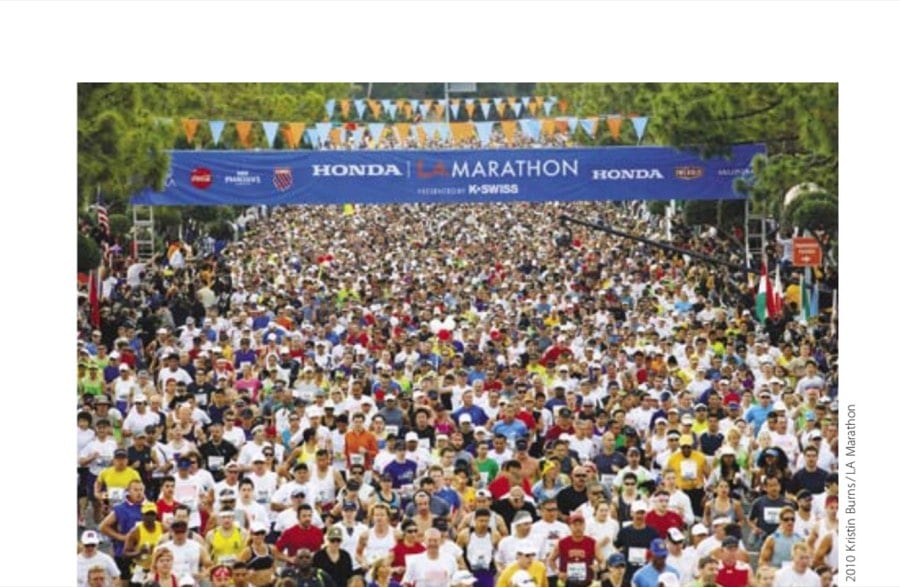
But then the LA Marathon went and did it. On November 9, 2009, race organizers unveiled a new point-to-point course dubbed the “Stadium to the Sea.” The gun would go off at Dodger Stadium. Participants would wend their way through parts of downtown, Silver Lake, Hollywood, Beverly Hills, Westwood, Brentwood, and Santa Monica. Along the way they would run past such iconic landmarks as the Disney Concert Hall, Grauman’s Chinese Theatre, and Whiskey A Go Go before finishing a stone’s throw away from the Santa Monica Pier. For someone whose entire running career has been based here in the City of Angels and whose opinion of his hometown marathon has until now bordered on the unprintable, the new layout—well, much to my wife’s exasperation—it was far too enticing for me to pass up.
An auspicious beginning After years of fits and starts, it appears as if the Honda LA Marathon, formerly known as the City of Los Angeles Marathon, is finally ready for its close-up. The 2010 edition marked the silver anniversary of a race whose lineage can be traced directly back to the success of the 1984 Olympic Games. The XXIII Olympiad was filled with highlight reel footage—from decathlete legend Rafer Johnson igniting the cauldron high above the Memorial Coliseum, to Carl Lewis matching Jesse Owens’s feat of four gold medals on the track, to Mary Lou Retton’s spunky performances in the gymnastics competition. But for fans of distance
© 2010 Kristin Burns / LA Marathon
▲ Over 25,000 runners set off to experience L.A.’s picturesque new point-to-point course.
running, the one image that glows brighter than all others is that of Joan Benoit Samuelson racing along sun-splashed streets on her way to a gold medal in the first women’s Olympic Marathon. By 1986, the year of LA’s debut, the marathon movement was in full bloom. In 1976 there were an estimated 25,000 finishers in U.S. marathons, and by 1980 that number had skyrocketed to 143,000. The upward trajectory in growth was just as evident in Europe, too, where marathons being staged in London, Paris, and Berlin were well on their way to becoming civic happenings. So when the Los Angeles City Council rubber-stamped the idea of giving the city its own namesake event, it wasn’t exactly going out on a limb. With a huge population base among the most health conscious in the world, the promise of good weather, and a reputation as a can’t-miss tourist destination, it seemed a given that any marathon staged here would become a smash hit.
The inaugural edition of the race drew 10,787 registrants, the most ever for a first-time marathon on U.S. soil. And, predictably, that number grew in the early days: year 2: 14,697; year 3: 17,040; year 4: 18,918. But then things plateaued. The marathon stalled at 19,843 registrants in 1992, and while Chicago and New York’s field sizes were zooming past the 30,000 mark, LA wouldn’t crack the 20,000 barrier until seven years later. Some blamed an unattractive course, which was tethered to the drab environs of downtown. Others blamed poor management and the feeling that race organizers were more interested in staging a three-ring circus
than a top-notch running event. There was the marathon, yes, but on race day there were also attempts to feature such add-ons as in-line skating and a bicycle tour.
Tipping the lid off the box—finally Epiphany #1: According to MapQuest.com, the quickest driving route from Chavez Ravine to Santa Monica is 19.49 miles, and the trip should take precisely 25 minutes. As any Angeleno can readily attest, however, getting snared in Los Angeles’s notorious traffic congestion can make that distance feel like 194 miles and the travel time more like 25 hours. But on the morning of March 21, 2010, the streets have been cleared for marathoning and there, in the shadow of Dodger Stadium, my fellow distance hounds and I are rubbing our hands together in anticipation of 26.2 miles of vehicle-less sightseeing.
The LA Marathon hit the wall in 2009. Original ownership sold the race rights to Chicago-based Devine Racing in 2004. On September 25, 2008, financially strapped Devine, in turn, sold those rights to Los Angeles Dodgers baseball team owner Frank McCourt, through his affiliate, LA Marathon LLC. But the McCourt team, which would soon include then-President Russ Pillar, Race Director Nick Curl, and Creative Director Peter Abraham, quickly found itself in a bind: the date for the fast-approaching race had yet to be finalized. “
I don’t think the previous owners did a stellar job of community outreach,” says Curl, who has been involved with the race off and on for many years and who has recently taken over the title of chief operating officer with the retirement of Pillar.
Religious leaders of churches near the route had for years complained about how street closures associated with the event affected their parishioners’ ability to attend Sunday service. Although Devine had already announced a traditional Sunday race date in March, the City Council acquiesced to the churches’ concerns and, after much negotiation, the McCourt team reluctantly agreed to change the upcoming race date to Memorial Day, Monday, May 25, 2009. To many running observers, the move was just the latest in a long series of head‑scratching missteps that have plagued the marathon since its inception. To no one’s surprise, the 2009 race saw a dramatic 17 percent drop in participation.
In terms of the number of finishers, Los Angeles had slipped to the 13thranked international marathon, sandwiched between Singapore and Hamburg. New York, London, Berlin, Chicago, Paris, and Tokyo each drew well over twice as many runners. “
When I left the company in 2006, just three years earlier, we were over 25,000,” says Curl. That number had eroded to less than 15,000. “You talk about an asset getting tarnished . . . ” The idea that the second-most-populous city in the country could draw so few marathoners during the heart of a distance-running boom says more about the
© 2010 Kristin Burns / LA Marathon
previous ownership’s stubborn unwillingness to change direction than about Los Angeles itself. And what made that mind-set even more perplexing is that this is a city that celebrates reinvention like no other. “
In 1992, I ran the LA Marathon on the old course,” says Abraham. “I’ve always been an outdoor athlete and a runner, so I’ve always followed the race. You could see that it never really got past the B level. I didn’t think there was a big vision to make it a world-class, fantastic experience. I didn’t see that in the execution of the event, either as a runner or as a spectator.” “
It was held in parts of the city that I wouldn’t have necessarily gone to on my own, so that was kind of interesting,” says Chris Johnson, a seasoned Santa Monica-based runner who estimates that she has run close to 10 Los Angeles Marathons since its inception. “But it was certainly ugly. The only reason why I kept signing up for the race was because I like to run marathons and it was in my backyard.” “
You knew that you had the potential to be something cool,” says Curl, who explains that McCourt’s interest in buying the rights to the race was contingent upon a complete course makeover. “He was most concerned about bringing the communities together. [A point-to-point course] was not an original idea. But he had the strength, desire, and wherewithal to make it happen.” “
My philosophy is that you can’t have a great running event without a great course,” says Abraham. “If you think of the really great running events—New York, Big Sur, London—those are all great courses.”
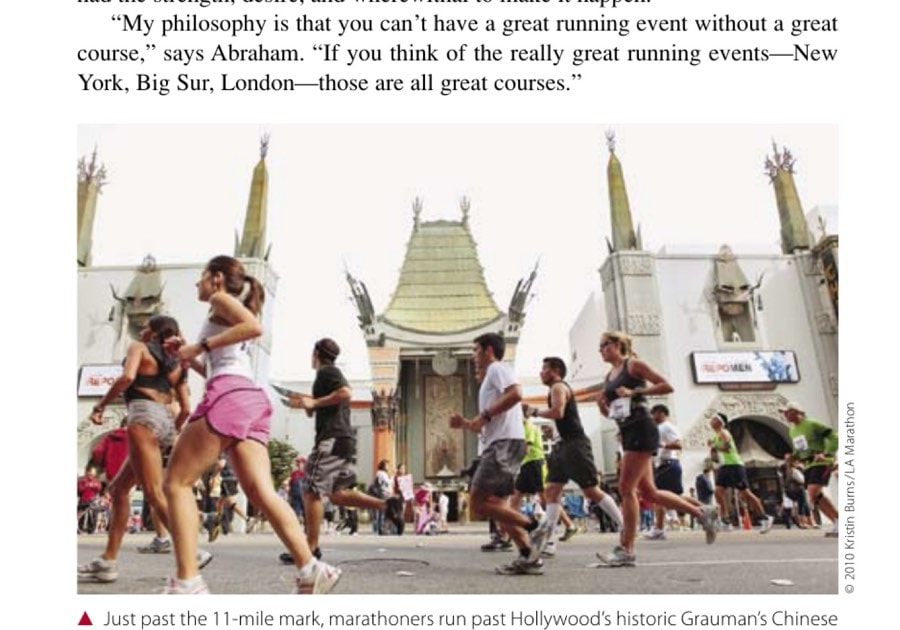
▲ Just past the 11-mile mark, marathoners run past Hollywood’s historic Grauman’s Chinese Theatre.
Tipping the lid off the existing box, Curl says, was the most exciting part of the process. “We had a bunch of people sitting around in a room saying, ‘Hey, why don’t we go down this street or that street,’” says Curl, explaining how the new course went through some 50 different variations. “It was exciting as heck. The concept was simple: make it emblematic of Los Angeles.”
The year of planning dangerously Epiphany #2: I’m running west down Sunset Boulevard, after having settled into a pace I feel reasonably confident I can sustain, and suddenly there it is—the Hollywood sign—on a hillside in the distance, majestically framed by structures on either side of the street. It winks at me just like the Emerald City winks at Dorothy and her huggable pals once they finally emerge from that spooky forest in The Wizard of Oz. And all I can think is, wow, now that is pretty cool.
Though the “Stadium to the Sea” concept was born early on, the McCourt team’s goal was to do more than just design a memorable, scenic racecourse. “We wanted to bring everyone together to celebrate Southern California,” says Curl. “
Russ Pillar talks a lot about the transformational power of sport,” says Abraham. “That’s what’s exciting about the marathon and this route and the way it traverses the city. You’re transforming charities, spectators, runners, and city government. It’s an uplifting civic experience.”
It’s clear from sitting across from these guys that they are passionate about what they’re doing. When constructing the new LA Marathon, Pillar, Curl, and Abraham were fixtures at marathon expos across the country. They not only wanted to share their ideas about the future of the event, but they also wanted to hear feedback from past participants and potential registrants.
But Los Angeles has always been a magnet for dreamers. Drawing up a course wish list that finally affords marathoners the opportunity to run past and through Chinatown, the Sunset Strip, Rodeo Drive, Route 66, and Ocean Avenue is one thing. Making such a list a reality is an entirely different matter.
Angelenos are notorious for never wanting to be inconvenienced. They bemoan the lack of a robust public-transportation system, but whenever the powers that be float plans about tunneling beneath the city’s eclectic mix of neighborhoods to implement an underground rail system, the citizenry quickly and vociferously puts up resistance. The region hasn’t had a professional football team since the Raiders took their show back to Northern California in 1994, and though everyone agrees that, yes, maybe a city this populous should have an NFL franchise, ironing out the details to make it happen ranks pretty darn low on the communal bucket list.
“You were literally running down the street,” says Curl, recalling how the entire McCourt team was trying to put the pieces together on the fly. “We were working with the five different jurisdictions and at the same time designing the route. It was all happening in real time. Think about it: there are five police departments that are involved, five transportation departments, five city managers, and five city councils. The meetings are rather extensive.”
Most marathons grow from seedlings. Boston’s inaugural field included just 15 athletes and New York’s, in 1970, consisted of 127 runners doing a few loops through Central Park. “This is not a race like Boston that has been around for over a hundred years,” says Curl. “They evolved into it. This is a race that for 24 years was in one jurisdiction and never really had to shuttle runners. There are complexities. How do you go from zero to 60 mph?”
LA, in a sense, was trying to replant a 24-year-old grove of maturing trees with scant time for it to take root. There were also cost considerations to take into account. Creating a bigger race footprint doesn’t come cheap, especially when it entails crisscrossing wellheeled communities. And what would happen if one of the jurisdictions refused to open its doors? Would the entire “Stadium to the Sea” concept come tumbling down like a house of cards? “
The biggest thing was getting the course,” says Abraham. “That was the linchpin to the whole plan, and that was nine months of nonstop work.” Fortunately all of the pieces came together. “It was unanimous from all of the municipalities to allow us to come through their city—unanimous,” says Curl, who credits not only the Herculean efforts of McCourt but also those of Howard Sunkin, at that time the Dodgers’ senior vice president of public affairs.
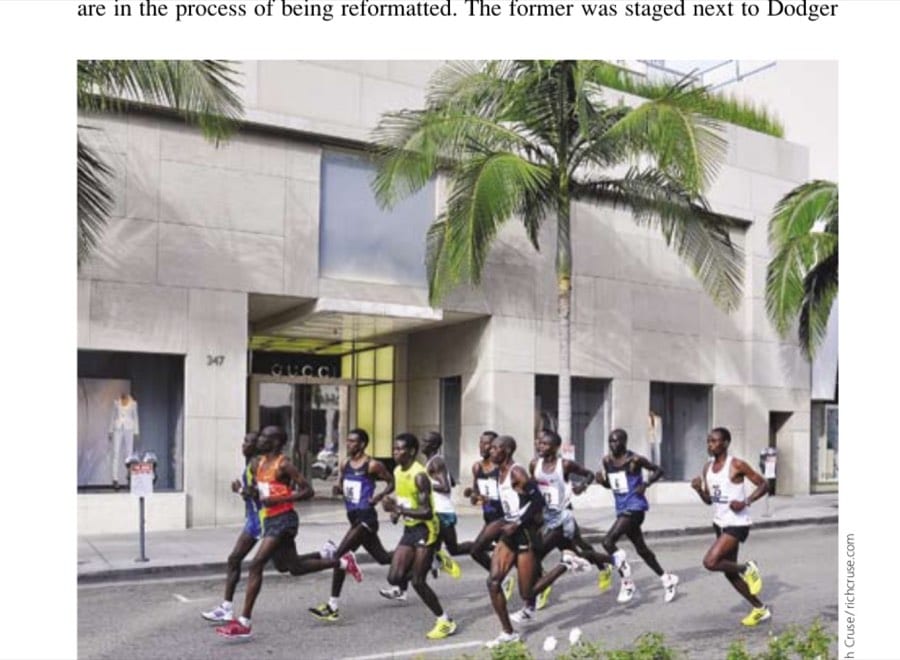
The honeymoon blessing Epiphany #3: We turn off Santa Monica Boulevard in Beverly Hills and find ourselves running straight down Rodeo Drive, one of the most affluent retail corridors on the planet. Today there is not a freshly minted Rolls Royce, Maybach, or Lamborghini in sight, but what I do see completely takes my breath away. Throngs of spectators line both sides of the tony little street, and an even bigger crowd awaits straight ahead near the majestic Beverly Wilshire Hotel. And it occurs to me that the last time I remember this city of mine demonstrating this type of civic pride and support for an athletic event was way back in 1984.
For all intents and purposes, the 2010 edition of the race was a second inauguration of sorts. Race organizers had to contend with a delicate balance—how to keep the marathon’s loyalists happy while trying to completely overhaul the vibe of the race. Los Angeles is made up of so many diverse neighborhoods that
it’s impossible to design a course that will please everyone. But what the McCourt team has managed to do is incorporate an alluring combination of visual nuggets that will appeal to both natives and out-of-towners who are visiting the city for the first time. “
If any marathoner looks at that route, they’ll want to run it,” says Abraham. “The last 3 1/2 miles are downhill. You finish at the beach. I challenge any runner to look at this course and say they don’t want to run it.” “
No matter what it took, I was going to do that race the first year,” says Johnson, describing her initial reaction when she heard of the new layout. “There’s no way I wanted to miss out.” One of the first hurdles the McCourt team had to overcome was the reluctance of many in the local running community to fully embrace the race. Although the LA Marathon has always been on the cutting edge of innovation—for instance, it was the first major U.S. marathon to adopt field‑wide chip timing, water stations at every mile, personalized bib numbers, and a battle of the sexes challenge, among other things—many veteran runners felt that the race was geared more toward novices than themselves. “
It wasn’t particularly runner friendly,” says Johnson of the old race. “Some of the logistics were good, but I think some of it was cruel—especially the way they always had the late start.” To address that perception, one of the McCourt team’s first decisions was to eliminate the bike tour. This allowed the marathon start time, which has always been a bone of contention for runners because midday weather in Los Angeles even in March can get toasty, to be pulled in an hour earlier, to 7:20 a.m. Part of the brilliance in the new course design, too, is that temperatures toward the coast will always be cooler than temperatures downtown, which is ideal for longdistance running.
To be sure, the 2010 race was far from perfect. There was bedlam at the start, which featured a poorly conceived lap around the baseball stadium. “The loop—it was my idea,” Curl confesses. “I did triathlons back in the early ’80s, and back then the question was always how can you make an event so that the participants, spectators, and sponsors can see more of the event?”
The concept was a noble one: allow the tail of the field an opportunity to see the head. The runners in the rear of the pack could watch the wheelchair athletes, then the elite women, and so on. What race organizers failed to anticipate, though, was how race-day traffic would affect the participants’ ability to reach the staging area. “
What I didn’t realize was that 90 percent of the traffic on race day would come in on the Harbor Freeway,” says Curl. While one route to the stadium, the Golden State Freeway, was wide open, the second major artery, the Harbor, was completely clogged. Even runners who
© 2010 Rich Cruse / richcruse.com
had obediently boarded shuttle buses in Santa Monica to be transported to Dodger Stadium found themselves helplessly mired in standstill traffic as the clock kept ticking toward race time. It was a classic L.A. snafu, and the start, much to everyone’s chagrin, had to be delayed. “
I couldn’t start any race because then I would have a condition where I had runners crossing the live course,” says Curl. The McCourt team has spent months trying to iron out the kinks associated with the start. Gone is the loop around Dodger Stadium. Greatly diminished is the runner’s ability to be dropped off by personal vehicle virtually adjacent to the staging area. Curl is quick to point out that transportation schemes that might work in, say, New York, simply won’t work in Los Angeles, a vehicle‑dependent region. “Yeah, we’d all like to see the subway and transit system get better and more extensive and less people driving in cars, but for the foreseeable future the LA Marathon is going to have to have 10,000 available car spaces.”
Curl also cites the marathon expo and finish line festival as other areas that are in the process of being reformatted. The former was staged next to Dodger
▲ The elite men’s field sweeps down world-famous Rodeo Drive in Beverly Hills.
Stadium. Yes, this made for a unique venue, but the design was cramped and poorly executed. “The layout for the expo was horrible,” Curl admits. “It just wasn’t done right.” And as for the latter, the vast majority of finishers were uninterested in undertaking the downhill/uphill out-and-back required to get close to the festival near the ocean. “We were hoping that the runners would really dig being on the beach,” Curl says. “They didn’t.” “
Last year was a huge experiment,” says Abraham. “It was the first time on this course, the first time we finished at the beach, the first time we had to shuttle tens of thousands of runners . . . It was a big experiment.”
Marathoners who understand and appreciate the monumental effort it took to pull off L.A.’s first citywide point-to-point affair are more than happy to give organizers a mulligan—at least this time around. “
Most of the runners have given us the honeymoon blessing,” Curl says. “They’ll give us a pass this year, but not next year.”
Something to build upon Epiphany #4: We emerge from the grounds of the sprawling Veterans Affairs hospital and make a quick right-hand turn onto San Vicente Boulevard. With its grassy islands and striking coral trees, every runner who has ever lived in the vicinity of L.A.’s Westside has at some point or another trained along this picturesque thoroughfare. But my fellow marathoners and I have never experienced San Vicente like this before. Never. Legions of cheerleaders and spectators will us toward the finish line. And I tell myself that this is our reward for all of those predawn miles and ice pack treatments—to be feted like parade heroes on a beautiful Southern California morning.
For the first time in its 25-year history, the LA Marathon sold out in 2010, reaching its cap of 25,000 on March 12. While it remains to be seen where the race will go from here, the McCourt team is united in its belief that growth is not the primary objective. “
Whether we have 25,000 runners, like we had this year, or we have 35,000 runners, that’s not the important thing,” says Curl. “First and foremost, the runner experience has got to consistently be the best that it can possibly be.” “
It was a really cool course,” enthuses Johnson of the 2010 race. “You saw so many different parts of Los Angeles, and it was well run once it got started. I think it has great potential.” One thing organizers will implement for the first time in 2011 is a wave start, which addresses another concern that fell on deaf ears in years past. “
I think the event should grow, and it can grow,” says Abraham. “It could be a really big marathon. But the minute the runner experience starts being compromised because of the size of the race, it’s time to stop growing.”
It’s a given that as awareness of the spectacular course spreads, marathoners will start writing LA on their to-run list. Historically, most of the previous fields have been made up of Southern California runners. But Abraham, for one, has already begun to see a shift in that demographic. “
We’re now a destination marathon,” says Abraham. “There will still be a large number of runners from the region, and that’s great because we want to be relevant here, but I’m excited that people will be coming in from all over the world to do this event.”
Curl and Abraham are also united in their commitment to make the LA Marathon part of the fabric of Southern California, just as other big-city marathons have taken hold of their communities. “All of these different communities in Los Angeles haven’t worked together in the way they have for the marathon since the 1984 Olympics,” says Abraham, who admits that he was as taken aback as anyone by the number of spectators who lined the new course. “I didn’t expect that level of crowd support. It was fantastic, and it will be even bigger next year. To be around that energy—that’s inspiring to me and something that’s unique to major big-city marathons.” “
Do I want to be like Carey’s [Pinkowski] race in Chicago or Mary’s [Wittenberg] race in New York?” says Curl. “No. Why would the L.A. Lakers want to be like the Boston Celtics? Even if you wanted to, you couldn’t.”
Dodger faithful, of whom there are many, have been on edge ever since Frank and Jamie McCourt became embroiled in a bitter, highly publicized divorce that will determine which of them, if either, will assume control of the major league franchise. A court ruling is imminent. How that decision will affect the future of the LA Marathon is anyone’s guess. It would certainly be a shame if a race that has progressed so far in the last 30 months finds itself again thrown for a loop.
But Curl is convinced that there is no turning back. The course has been set, the excitement has been ignited, the momentum is unstoppable, and there are even greater things in store for the future of the race. “
We just want to get better,” says Curl. “We want to raise more money. We want to have a better experience for the runners, and we want to have a better experience for the cities.” * * * Epiphany #5: We’re moving along Ocean Avenue in Santa Monica with whatever energy we haven’t yet expended, and I realize as we make our way along the bluffs overlooking the beautiful Pacific Ocean that we’re now virtually running in Joanie’s footsteps. The Santa Monica Pier, with its famous solar-powered Ferris wheel, is right there, like a hazy mirage. We all feel as if we’ve come a long way, and so has this race. The finish line moves into sight and I’m beaming, beaming, because I realize that this, finally, is an accurate reflection of my city, warts and all. This is the Los Angeles I’ve always wanted my marathon brethren to experience.
This article originally appeared in Marathon & Beyond, Vol. 15, No. 2 (2011).
← Browse the full M&B ArchiveMore like this
1,000+ stories from 19 years of Marathon & Beyond
The complete archive of the legendary long-distance journal — digitized and free to read.
