

Is Supplementary Aerobic Training Necessary for the Marathon?
Oh, if I only knew back then what I know now, I sure would have changed a few things about my training. My running career began in the heart of Lydiard country, in Auckland, New Zealand, at a time when droves of New Zealanders turned to running. We came out in the thousands to run on the track, road, and cross-country. The Round the Bays Run started up in 1972 with 1,200 runners and within a few years had built up to 40,000 registered runners, with an additional 30,000 joggers who didn’t bother to sign up and just turned up and ran anyway. Elite runners such as John Walker, Dick Quax, Rod Dixon, Lorraine Moller, Anne Audain, and Allison Roe set the track and roads on fire and inspired the rest of us to train harder. Even recreational club runners were running Lydiard’s (in)famous hilly 22-mile Waiatarua run through Auckland’s Waitakere mountain ranges on Sunday mornings!
The point of mentioning all this is that I was deeply schooled in the mileage mania of most Kiwi runners of that era. We never questioned it—that would have been heresy. Not that all the high mileage did me any harm. When I was 19 years old, I trotted through my first marathon in 2:42:28, which at that time was the fastest for an under-20-year-old in the country, and it still ranks, I believe, in the top five marathon times in New Zealand for juniors.
As any runner who has studied the history and evolution of training since 1960 knows, Lydiard’s influence and doctrine of high mileage have well and truly spread around the world. But the more I learn about new training techniques and exercise science, the more I find myself thinking how I would have done things differently back in the day. And I am absolutely convinced that I would have squeezed much faster times out of myself.
To this day most marathoners are still too busy pounding the roads to concern themselves with such frivolities as supplementary training. Marathoners are slaves to high mileage. For most of them, the sole objective is to get as many miles as they can handle under their belt without breaking down and getting sick or injured. After all, their racing distance is 26.2 miles at a fast clip, so mileage appears to be the answer. But, sadly, 65 percent of runners find out every year that their body can tolerate only so much training before it reaches its limits—they get injured.
When we run for miles and miles on concrete sidewalks or asphalt roads, we continuously put our legs through the same repetitive contractions with hardly any variation in the movement, on an unyielding surface. By constantly stressing the same muscles, ligaments, and tendons, eventually any weak spots we have will revolt in the form of tendinitis or muscle strain. Our muscles are not made of titanium, and something will give under these repetitive conditions.
The end result of just plain mileage
Sports medicine physicians and physical therapists call these leg problems overuse injuries. They go by various names such as chondromalacia, patellar tendinitis, iliotibial band syndrome, shin splints, stress fractures, and plantar fasciitis, but they all mean the same thing—one link in the chain of our lower-extremity movement has broken down. And it seems to start happening at around 50 miles per week. This seems to be the breakdown point for many marathoners, although this self-destruct point is relative to many variables, including the number of years we’ve been running, our age and sex, our experience, and our natural biomechanics, to name just a few. What we do know is that when we flirt with this much mileage, injuries are likely to follow.
But what if there is a way to maintain the high volume of training necessary to be successful in the marathon without having to endure all of that pounding and strain on our running muscles and joints? Is there some other type of extra training we could do when we are maxed out on our mileage and know that, based on past experience, further running would be likely to put us over the edge?
Research in the past decade or so has provided us with strong evidence that there are indeed other activities we can do, either in place of some running workouts or as adjunct training. Some of these activities (if done the right way) allow us to get in more endurance training without compromising the running muscles and joints.
The research points to several specific nonrunning activities actually improving our running performance and that, at the very least, will maintain our hard-earned aerobic fitness (V̇O₂max, or the oxygen-processing ability of the body). The key is that although these activities use the same muscle groups as running, they do so in a different way. And by doing extra endurance work in other low-impact or low-weight-bearing aerobic activities, you get an “active rest,” with virtually no stress on your joints, and you will recover from any postexercise muscular soreness far faster than just by rest alone.
Consider runners who are already performing two to three high-intensity workouts each week—they risk injury or overtraining syndrome by adding further running workouts at this level. But there is no reason why they cannot add an extra non-weight-bearing high-intensity workout each week. A high-intensity cycling session, for example, would improve our lactate tolerance, buffering capacity, and fuel resynthesis, all without suffering through the high-impact stress of an interval-training workout. If done weekly, this additional fast workout could be enough to take the marathon runner to a new level without the added trauma of high-intensity running.
Another major advantage of adding a variety of other activities into your program is avoiding burnout—one of the most appealing aspects of supplementary training to the serious marathon runner. Anything we can do to reduce the boredom and monotony of constant long running will be beneficial to our mental health and longevity in the sport.
Many coaches also believe that the reduced impact and stress on the lower extremities from doing alternative activities results in less injury than a program solely of running. Although this has yet to be proven conclusively by research, thus far the anecdotal evidence, such as it is, would seem to validate this idea. Often, coaches come up with new techniques that meet with resounding success, and it is only later that we figure out why they work.
What are the alternative activities?
What activities, then, has research shown to be complementary to running? So far the most promising alternative exercises are cycling, deep-water running, stair climbing, the elliptical trainer, cross-country skiing, and snowshoeing. You might notice that swimming is not mentioned in this list—it has proven to be somewhat of a dud in terms of benefiting the runner (Foster et al. 1995, Millet et al. 2002), but I still recommend the occasional swim for a complete change of medium.
A promising study by Mutton et al. (1993) got us thinking that there might be other ways to train runners. It looked at the effects of running four days a week compared with a combined cycling (two days a week) and running (two days a week) schedule, for a total of four days a week over a five-week training program.
The results for both groups were almost identical; both improved V̇O₂max significantly and reduced their 5K run times by 7 percent (running only) and 8 percent (running/cycling). This showed that augmenting a running program with cycling showed no decrease in performance over a running-only program and that, in fact, replacing two days of running with cycling improved running performance just as much as did running only.
Another study by my colleague Dr. Brent Ruby et al. at the University of Montana in 1996 further validated cross-training. Dr. Ruby had three groups of exercisers do a 10-week training program of running or cycling or a mixture of both. All groups improved their V̇O₂max similarly, so this study showed that a combined cross-training program achieves similar fitness to sports-specific training.
Another study (Millet et al. 2002) looked at the cross-transference effects of running, cycling, and swimming in elite triathletes. It concluded that training benefits transfer between cycling and running but not between swimming and running.
Another cycling/running study (Hill et al. 1987) at the University of Toledo found similar results, when 10 well-trained runners (who averaged 30–35 miles per week) added three cycling workouts per week to their existing training schedules for six weeks. The cycling workouts were all high intensity, such as five-minute-intervals, 150-second and 75-second high-intensity bursts, plus a longer-duration workout of 50 minutes at 80 percent of maximal heart rate. Another group of runners added three similar running workouts to their training schedule.
Success with cycling
After six weeks, the 5K times for the running/cycling groups came down by almost 30 seconds, from 18:16 to 17:48, or 3 percent, which was almost the same as the running-only group’s average. The conclusions were that adding extra running sessions had no advantage over adding extra cycling sessions.
California State University researchers (Hoffman et al. 1993) also used two groups of runners for a study on cross-training. A running-only group and a cycling-only group performed a nine-week training program. At the end of the training, both groups performed the same in running tests.
A comprehensive review by Tanaka (1994) clearly concluded that there is a significant transfer of training effects (V̇O₂max) from cycling to running. Now, all this research flies in the face of an age-old principle of training that we exercise scientists have held as sacred, at least until this research challenged it. The principle of specificity states that if you want to improve your running, for example, you should do lots of running. Other activities were considered a waste of time. Now it appears that if alternative activities (such as cycling) are close enough to the prime action (running), some of your prime activity workouts can be substituted with a secondary activity with equally good results. This does not mean that you can skip your Sunday-morning 20-miler, though. Your marathon training should
still be based on a foundation of two solid, long runs each week—and you should still be tossing one or two higher-intensity running workouts into the mix, too. It’s what you surround these workouts with that is negotiable.
Most of the research puts cycling at the top of the supplementary activities list for running. At the very least, cycling appears to preserve and maintain running fitness when the runner does fewer running workouts or ceases running for a while (such as when injured). Even more exciting is that several research papers show that the right type of cycling (that is, higher intensity) actually improves our running. Cycling also enables runners to increase their workout intensity without causing the muscle and joint damage that can occur with running.
To gain these effects, cycling should be done at a fast cadence—similar to your running cadence, with the resistance set to one that you can handle for intense five- to 20-minute workouts. An interesting study by Gottschall and Palmer (2002) found that triathletes who cycled at a fast cadence reduced their two-mile times by 7 percent on average. The implications are that cycling at a faster cadence similar to running improves running performance. Researchers theorize that the neuromuscular effects of a fast cycling cadence transfers well to running performance. Just make sure you are correctly positioned when doing cycling workouts. Ensure that you are correctly aligned on the stationary bike by adjusting the seat height so your legs are almost straight at the farthest point of extension.
My strong recommendation is that you do your supplementary cycling workouts indoors at your local fitness club, versus outdoors on the roads on a racing bike. Outdoor cycling is an entirely different activity, is very costly, and involves a whole time-consuming learning curve. It can also be very dangerous. It’s much easier to work out on a stationary bike indoors, where you don’t have to deal with the extra expense, increased risk, and foul weather. Plus, you can control the speed, intensity, and cadence by using the controls right in front of you.
Stair stepping
Use the Stair Master for a no-impact workout. One study (Loy et al. 1993) found that people who did stair-climbing workouts for nine weeks improved their running performances. This is not surprising, as the Stair Master machine simulates uphill walking or jogging, which consistently rates near the top in terms of improving V̇O2max. One criticism by runners is that it’s hard to set a fast step cadence on this machine, but my personal experience indicates that you can create an intense workout by manipulating the speed and workload.
Elliptical trainers
Dr. Emily Cooper, of Seattle Performance Medicine, conducted a case study (1993) that found the Precor EFX Elliptical Fitness Crosstrainer© improves V̇O2max and other endurance parameters. In this case study, Dr. Cooper found that an injured runner who could train only on the elliptical trainer was actually running faster on the treadmill than she was before her injury.
“Because elliptical trainers effectively mimic the motions of running, they offer real potential for improving running fitness,” says Dr. Cooper. The elliptical trainer offers a high-intensity workout whose heart rate demands and oxygen consumption is virtually identical to those of running, but without the impact. In fact, Dr. Cooper has noticed that many people subjectively do not think they are getting a similar workout on the elliptical trainer compared with the treadmill, but the quality of the workout is the same when measured using objective lab tests. “This discrepancy may be explained by the fact that runners may feel like they are working harder when there is impact involved, such as on the treadmill,” Dr. Cooper says.
“To improve leg speed on the elliptical trainer,” Dr. Cooper adds, “use a moderate ramp, low resistance, and fast stride rates.” Shoot for 20 to 30 minutes per workout, and in the middle, do four to eight very fast reps of 30 seconds followed by 60 to 90 seconds of slower recovery striding. Dr. Cooper adds, “Make sure you use a moderate ramp angle because one that is too high can result in Achilles tendon strain.”
Another advantage of this device is that the elliptical or oval movement can be done backward or forward, encouraging balance between the opposing muscle groups (gluteals/hamstrings and quadriceps).
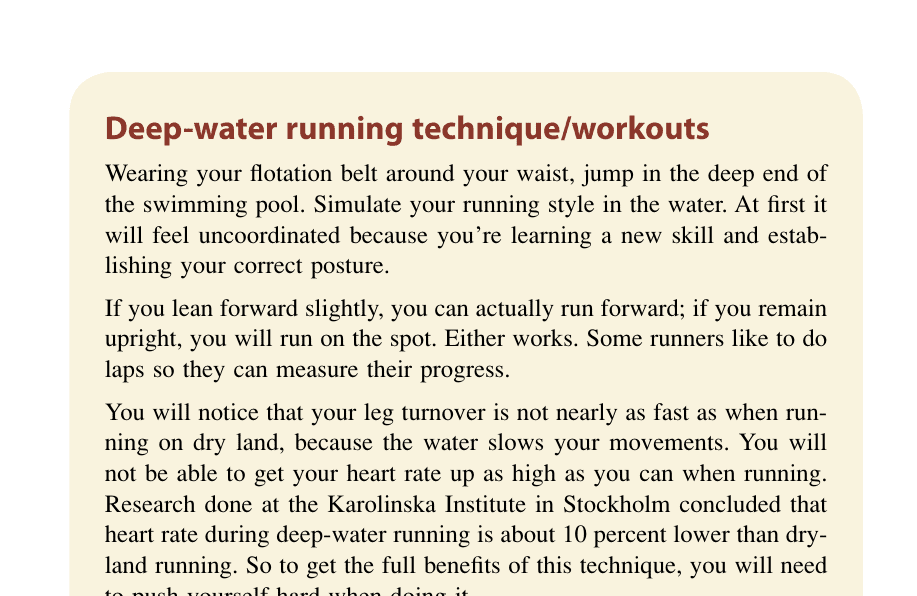
Deep-water running (aka aqua running)
If you want to try an interesting activity that simulates running (and is ideal for injury rehab), try deep-water running in your local swimming pool. It is especially helpful for runners suffering from stress fractures where most activities tend to aggravate the symptoms. Deep-water running is done wearing a flotation vest or special belt and works your legs, trunk, arms, and cardiovascular system very well. You can simulate interval workouts, long steady workouts, and everything in between with deep-water running.
Research on this nonimpact activity is very promising. Several studies have shown that runners can use deep-water running to maintain their fitness. Florida State University researchers (Wilber et al. 1996) had a group of well-trained male runners do deep-water running for six weeks while another group continued with its regular running program. The deep-water running group maintained its V̇O2max, lactate threshold, and running economy for the six weeks of water running.
Another study at Brigham Young University (Eyestone et al. 1993) found that two-mile-run times were maintained after six weeks of deep-water running. This was confirmed by yet another study at the University of Toledo, where trained runners did five to six sessions of deep-water running for four weeks. There was no change in their 5K times, V̇O2max, lactate threshold, or running economy, indicating that deep-water running is an excellent supplementary activity for running.
Deep-water running should be added on an easy training day or rest day in your running schedule. The main criticism of this method is that it can get boring, so short bursts of five to 15 minutes are recommended.
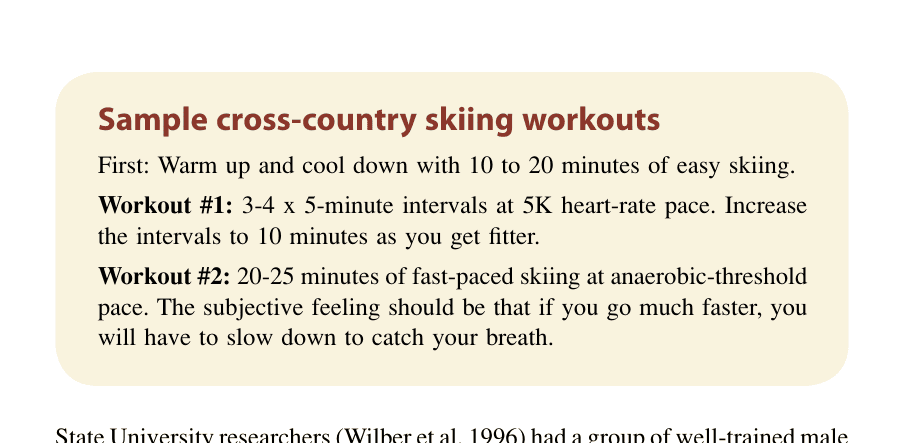
Cross-country skiing
Cross-country (or Nordic) skiing is very much like running but without the hard impact. It’s ideal for high-intensity training and increasing muscle strength around the hip areas. Since Nordic skiing engages the upper body as well as the legs, you get a terrific whole-body workout. Generally, cross-country skiers have the highest oxygen uptakes of all endurance athletes (yes, that’s right—even higher than runners).
Biomechanically, the gliding motion of cross-country skiing differs considerably from the running motion and doesn’t teach you to bounce explosively from foot to foot, which is the essence of running. However, the point of this article is to provide you with some interesting activities that can be done as adjunct training to running, and cross-country skiing certainly meets that requirement. You get a terrific cardiovascular workout, making it an ideal activity for runners.
Snowshoeing
Snowshoeing gives you a true running workout with the added benefits of being very low impact and more strenuous. With five minutes of basic instruction on
snowshoeing technique, you’re ready to roll. You will find that a six-minute-mile running workout will take you seven or eight minutes to snowshoe. Your heart rate gets up very high, so pace yourself in your first few workouts. It’s hard work! Modern snowshoes are lightweight aluminum frames, which you strap your running shoes into.
General advice for adding supplementary activities to your training program
- Try several of these alternative training modes, then decide whether you are going to substitute cross-training activities for any of your training runs or whether you’re adding in one or two each week. Cross-training is best added to your training program on your easy-running or rest days. Always allow at least one complete rest day each week.
- If you’re a semiserious runner doing three to five days of running each week, you can add in one or two days of cross training or substitute two to three days with cross-training activities. If you’re a competitive runner doing six to seven days of running a week, you can substitute one or two workouts each week with cross-training.
- Keep your workout at high intensity to achieve improvement. And make sure you keep up your weekly long run—it should not be replaced by other activities. Gradually add in your nonrunning workouts instead of adding two or three in one week. Ask your fitness trainer to show you how to operate each piece of equipment before you use it.
- As a general rule, you can have as much as 50 percent of your total volume (in minutes of exercise) from alternative exercise in your off-season and up to 25 percent in your competitive season.
- If your running schedule calls for a 30-minute run, attempt to exercise for 30 minutes on other equipment. While you’re adjusting to the machines early in your workouts, you may not be able to complete a full 30-minute workout, so gradually build up your time on each machine or in the pool. Start at 10 to 15 minutes and add five minutes on to each workout.
- It’s a good idea to use a heart rate monitor to ensure you are getting full benefit from your cross-training workout. Try to get your heart rate within 10 beats per minute of your running rate. You may not be able to get your heart rate right up to running levels because non- or low-weight-bearing exercises do not use the legs as much for antigravity work or to support your body mass.
- Many studies on cross-training indicate it is possible to improve your running performance by incorporating or substituting other aerobic activities into your training program. In addition, you should be able to squeeze in one or two high-intensity workouts on top of your regular running workouts without the added impact trauma to muscles and joints. This should lead to reduced injury rates, improved lactate threshold, and less boredom. But the devil’s in the details—make sure you do high-intensity cross-training rather than “junk” time on the cross-training equipment.
Summary
These are the adjunct activities that research has shown to be beneficial to runners. Try integrating some of them using the advice in the sidebars on pages 39 and 40. Do only the activities that you enjoy—there is no point in forcing yourself to do an activity that you hate. Persevere with your new chosen activity, and you may find that your marathon times will come down and you may suffer from fewer injuries. Good luck!
References
- Cooper, MD, Emily. Scientific abstract case study prepared for Precor on evaluating the effectiveness of the elliptical trainer. Unpublished paper.
- Eyestone E., G. Fellingham, J. George, and A. Fisher. 1993. Effect of water running and cycling on maximum oxygen consumption and 2-mile run performance. American Journal of Sports Medicine 21(1):41-44.
- Foster, C., L. Hector, R. Welsh, M. Schrager, M. Green, and A. Snyder. 1995. Effects of specific versus cross-training on running performance. European Journal of Applied Physiology 70(4):367-372.
- Gottschall J., and B. Palmer. 2002. The acute effects of prior cycling cadence on running performance and kinematics. Medicine & Science in Sports & Exercise 34(9):1518-1522.
- Hill D., K. Cureton, C. Grisham, and M. Collins. 1987. Effect of training on the rating of perceived exertion at the ventilatory threshold. European Journal of Applied Physiology and Occupational Physiology. 56(2):206-211.
- Hoffman, J., S. Loy, B. Shapiro, G. Holland, W. Vincent, S. Shaw, and D. Thompson. 1993. Specificity effects of run versus cycle training on ventilatory threshold. European Journal of Applied Physiology and Occupational Physiology. 67(1): 43-47.
- Loy, S., G. Holland, D. Mutton, J. Snow, J. Hoffman, and S. Shaw. 1993. Effects of stair-climbing vs. run training on treadmill and track running performance. Medicine and Science in Sports & Exercise. November: 25(11): 1275-8.
- Millet, G., R. Candau, B. Barbier, T. Busso, J. Rouillon, and J. Chatard. 2002. Modelling the transfers of training effects on performance in elite triathletes. International Journal of Sports Medicine 23(1):55-63.
- Mutton, D., S. Loy, D. Rogers, G. Holland, W. Vincent, and M. Heng. 1993. Effect of run vs. combined cycle/run training on V̇O₂max and running performance. Medicine & Science in Sports & Exercise 25(12):1393-1397.
- Ruby, B., R. Robergs, G. Leadbetter, C. Mermier, T. Chick, and D. Stark. 1996. Cross-training between cycling and running in untrained females. Journal of Sports Medicine and Physical Fitness 36(4):246-254.
- Tanaka, H. 1994. Effects of cross-training. Transfer of training effects on V̇O₂max between cycling, running and swimming. Sports Medicine 18(5):330-339.
- Wilber R., R. Moffatt, B. Scott, D. Lee, and N. Cucuzzo. 1996. Influence of water run training on the maintenance of aerobic performance. Medicine & Science in Sports & Exercise 28(8):1056-1062.
This article originally appeared in Marathon & Beyond, Vol. 15, No. 2 (2011).
← Browse the full M&B ArchiveMore like this
1,000+ stories from 19 years of Marathon & Beyond
The complete archive of the legendary long-distance journal — digitized and free to read.
