

My Most Unforgettable Marathon (Vol. 13, No. 3)
Cleveland, Ohio, May 18, 2008, 6:58 a.m.—It’s raining. A chilly rain, the
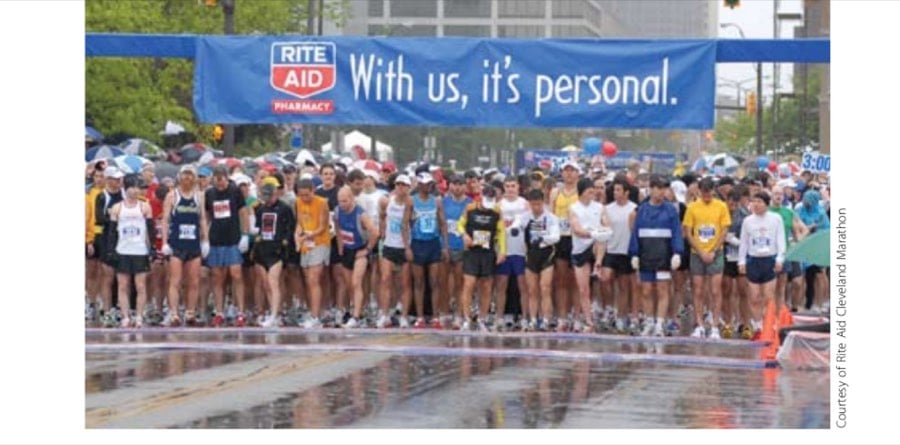
Courtesy of Rite Aid Cleveland Marathon
type in which winter tries to keep its grip on the weather until giving up for another year. In a couple of minutes, the Rite Aid Cleveland Marathon will begin. I am next to the fence that separates runners from spectators, standing under a large umbrella that a 50ish couple is graciously sharing with me. (I think my exact words as I approached them were, “Hi, my name’s John; mind if I join your family for a few minutes?”) Part of my brain is making small talk with my new
▲ Runners line up and try to stay dry just prior to the start of the 2008 Rite Aid Cleveland Marathon.
best friends, but another part is thinking about the imminent race and everything it took to make it to the starting line … Wait a minute. Why am I starting the story here? It really begins six weeks earlier.
© Kelly Lautzenheiser
Athens, Ohio, April 6, 2008—The Athens (Ohio) Marathon wasn’t a race that I had planned on running. I didn’t have anything against it, but I didn’t have anything for it either. It was a sop to my training partner, Matt Lautzenheiser, who has a goal of running every marathon in the state of Ohio. (The heart wants what it wants, I suppose.)
As it turned out, it was a race that I would not run. Not in its entirety, anyway. The race (held on a beautiful, sunny spring morning) started well enough. The course features a large downhill right after the start, so my first mile was a fast (for me) 7:14. (I wanted to finish somewhere between 3:15 and 3:20, which would have meant a pace of 7:27 to 7:38 per mile.) The next few miles were all right around my target: 7:18, 7:29, 7:26, 7:26, and 7:29.
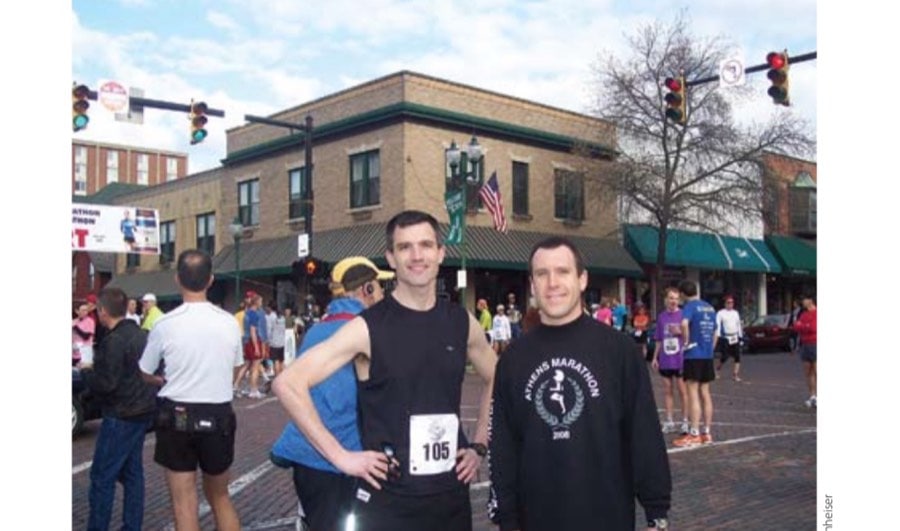
▲ The author and Matt Lautzenheiser prior to the start of the 2008 Athens (OH) Marathon.
I should have been thinking, Great start—you’re right where you want to be! Instead, my thoughts ran to Twenty more miles to go? How in the world am I going to make it? Somewhere around the fifth or sixth mile, I noticed that my energy was unusually low. My legs felt like they had been dipped in concrete. I was much more tired than I had any business being at this point—especially as a veteran of 16 marathons, any number of half-marathons, and more long training runs than I can count.
Maybe it’s just one of those valleys, I told myself. Every race has them. Keep moving and you’ll be fine. But fine was nowhere to be found. Midway through mile seven, I passed the cone that marked the turnaround point for the half-marathon (the Athens racecourse is mostly an out-and-back along a bike path). I had a very strong feeling that I should turn there, but I kept going.
What’s so fine about fine? And fine continued to recede further and further into the distance. The mile splits showed that I was struggling: 7:30, 7:41, 7:35, and then a 7:58 for mile 10. By then, I had decided that I was going to drop out at the next aid station. I was still feeling exhausted and sluggish, and now I was also lightheaded and dizzy and noticing a very rapid heartbeat. I knew that something was seriously wrong and that continuing the race was not a bright idea. For whatever reason, the running gods had said, “Not today, John.”
Matt, who had been trailing me to that point (he was targeting a 3:20 finish), caught up to me around the mile-10 marker. He didn’t bother with any of the “You’re looking great!” or “Keep moving!” type platitudes that struggling runners hear so often. Instead, he was blunt: “You’re in trouble, aren’t you?” I told him that I was, that I was going to drop out, and that I would see him at the finish. He wished me well and continued on.
After an 8:35 mile 11, I finally made it to the next aid station. I collapsed in a chair and was immediately surrounded by volunteers offering me water, sports drink, and bananas. I wanted none of those. What I really wanted was to lie down and fall asleep for about a week—that’s how tired I felt. Two of the station’s volunteers were kind enough to drive me back to my hotel, located near the start/ finish. After returning to the hotel, taking a long shower, and lying on the bed for a while, I finally felt better. I returned to the finish area in time to see Matt finish.
More than anything, I was disappointed. I had no idea why I had gotten so sick during the race, and I especially did not like having to DNF. I wondered what could have gone so wrong. The only cause I could imagine was the leftover effects of a bout with the flu a little over two weeks past. But those symptoms had long since passed, and I had registered several strong (albeit short) runs in the days leading up to the marathon, so that explanation did not quite fit. For the
time being, I put it on my mental list of life’s unexplained mysteries and hoped that whatever had happened would never resurface again.
We have an answer! But it wasn’t the question you expected I took the following Monday off, then went for a training run on Tuesday. I ran a path near my work that is slightly less than eight miles long. By the third mile, I was feeling Athens all over again—fatigue, dizziness, and concrete shoes. Come on, you wimp. Keep going. I forced myself to complete the run, but it was much tougher than it should have been.
On Wednesday, I planned an hour-long run at the gym; I had to stop after 40 minutes. On Thursday, I planned another hour-long run; this time, I cut it short after 25 minutes. And unlike the previous days, my symptoms persisted long after I stopped running. I distinctly remember taking my children to the local mall later that evening and thinking, I want to sit down. Now. I don’t care if I get trampled by a gaggle of teens here in front of Abercrombie & Fitch. I knew that it was time to call my doctor, and that feeling was only amplified the next morning when I woke with pains in my side, pains that were especially bad whenever I tried to take a deep breath.
Fortunately, I was able to see my doctor (David Stone, whom I mention by name because he is the best doctor in the world) around lunchtime that day. I told him about my symptoms, much as I’ve done here. He listened, and then asked what would have ranked somewhere around dead last on the list of questions I would have thought he would ask: Have you had any pains in your legs in the past week or two?
Funny you should ask, Doc. The Thursday before the race, I had awakened with a significant pain in my left calf—almost as though somebody had smacked it with a sledgehammer. Although it felt like a bruise, I had no marks, and though it was sore, I was still able to run/walk without limping. So I dismissed it as nothing significant—just one of those often-psychosomatic ailments that we all get in the days before a big race. The leg had continued to be sore through race day, but after the race, I noticed that the pain had stopped.
Upon hearing that answer, Dr. Stone told me to get ready for a few days in the hospital. He suspected that the pain in the leg had actually been a deep vein thrombosis (DVT)—a blood clot—and that during the race, the clot had broken loose and had become lodged in my lungs. It is also known as a pulmonary embolism (PE). He wanted me to go to the hospital immediately for tests and observation.
PEs are serious: quite often, they result in sudden death. That threat is rather like a game of Russian roulette—either there is a bullet in the chamber, or there
isn’t. Think back to eighth grade health class, when we learned about the structure of the heart and lungs. Blood enters the heart’s right atrium, travels to the right ventricle, and then enters the pulmonary artery, which is the highway to the lungs. The pulmonary artery is where that chance of sudden death arises. If the blood clot travels through your heart into the pulmonary artery, then blocks off that artery, the blood flow is cut off to the rest of your body. Within minutes, you’re toast (the technical medical term). You could be on the steps of the Mayo Clinic when it happens, and you would probably be toast. And if it happens to you on a secluded bike path in rural southern Ohio, then you’re burnt toast. The DVT that becomes a PE can leave you DOA, and then you’re really SOL.
If the clot makes it through the pulmonary artery and becomes lodged in the lungs (a PE, in other words), you probably will not die from it, but you will have significant symptoms. Shortness of breath, chest pain, dizziness, and an elevated pulse are common. If left untreated, the PE can cause death of lung tissue and decreased lung capacity. So even though a PE (once it passes through the pulmonary artery) may not be as potentially fatal, it is not something that you want to ignore.
An expected question, an unexpected answer I was admitted into a hospital later that afternoon. A CT scan performed later that day confirmed the diagnosis—I had two PEs in my right lung. If I had to DNF, at least I had one hell of a reason, I thought.
Ultimately, I was in the hospital for five days. My doctors started me on a course of blood-thinning medications consisting of twice-daily injections and pills. As Dr. Stone had predicted, I felt frustrated for most of the hospital stay because I was feeling quite healthy. But the stay was necessary in order to try to determine the cause of the clot and to make sure that the treatments were thinning my blood enough to eliminate the possibility of other clots being present (clots are apparently notorious for breaking into several pieces). He was exactly right—for most of the stay, I felt like the healthiest person in the hospital, doctors and nurses included.
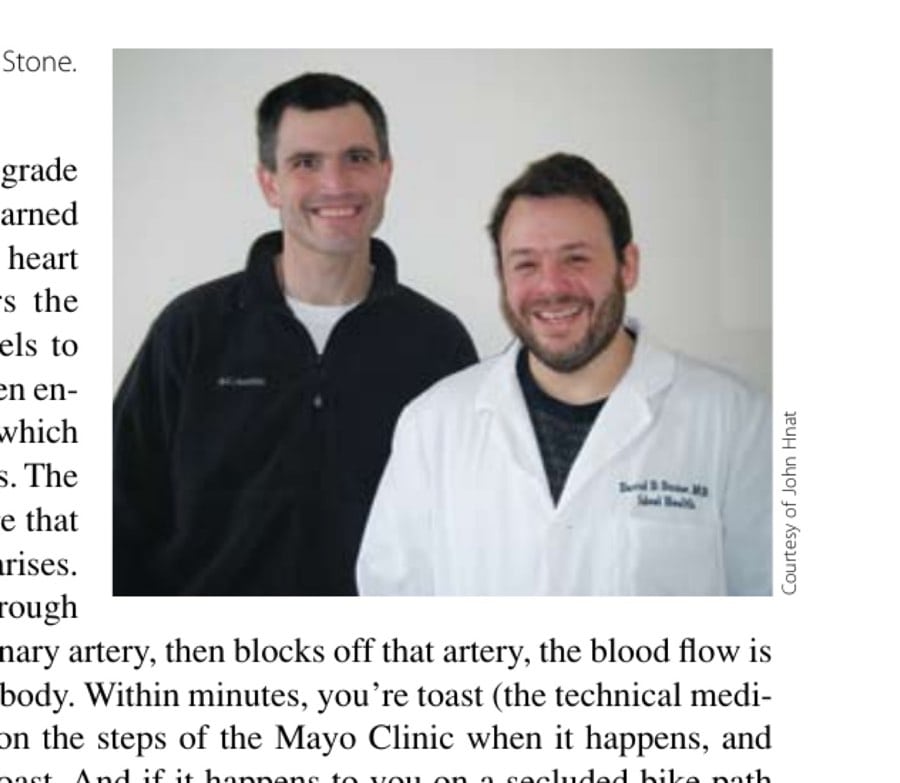
Courtesy of John Hnat
▲
The author and Dr. David Stone.
The morning after I was discharged, I met with Dr. Stone at his office. We discussed the results of the tests that had been completed, the prognosis, and what I would have to do. Near the end of the conversation, the giant pink elephant was still in the room. Dr. Stone knew that I am an avid distance runner, so he knew I was going to ask the question: when can I return to running?
Before getting to his answer, let me say that I was already registered for the 2008 Rite Aid Cleveland Marathon. The Cleveland Marathon was my first marathon, back in 2002, and I have run it every year since. Although it is often maligned by local runners, it is actually a very good race, and I enjoy it. The 2008 edition was now four and a half weeks away. I had just spent the past five days in a hospital bed, wearing leave-little-to-the-imagination gowns and resting when I should have been reaching a peak in my training. More important, I had two clots in my lung. I had no illusions of running Cleveland; the streak was over. I just wanted to know when it would be OK to lace up my running shoes again.
Remember that I said that Dr. Stone is the best doctor in the world? I think that is because his answer to my question was, “It’s OK, as long as you take it easy and don’t push yourself too hard.” That was all I needed to hear. Later that day, I ran six miles and felt terrific. (I don’t think that’s exactly what Dr. Stone had in mind; when he called me the next day to check on me and I told him about the six-mile run, he responded with “Thanks for that heart attack you just gave me.”) I had none of the sluggishness, fatigue, or shortness of breath that had plagued me before my hospital stay. The next day, I stretched it to eight miles; I still felt fine. The next day, it was 10 miles. And that Sunday, I ran 15 miles without any pain, dizziness, shortness of breath, or exhaustion.
After that 15-miler, I began thinking that Cleveland (now four weeks away) was possible. After a 20-miler with Matt the following Sunday went reasonably well, I was more determined than ever to run the race. I wanted to prove that it was possible—that you can go from hospital bed to marathon finisher’s medal in a little over a month.
More than that, the scare with the PE had taught me that we should never take anything for granted. Up until this episode, I had never seriously considered the possibility of dying. Sure, I knew that I was going to die, but someday, certainly not anytime soon. That day was far off in the distance, the kind of thing that a healthy 38-year-old would not think about. Now, however, death felt much more real. Death had come into my living room, plopped down on my favorite spot on the couch, and kicked his feet up on my coffee table. He probably wasn’t going to get me today, and he probably wasn’t going to get me tomorrow, but that day is out there. As I had discovered on a wooded bike path in southern Ohio, that day could come at any time, without warning. That’s really why I wanted to run Cleveland—because we pass this way only once, and we may not get a tomorrow to do the things that we put off today.
I think this is where we came in Cleveland, Ohio, May 18, 2008, 7:05 a.m.—It’s still raining, the gun is about to go off, and I’m happy. No matter what happens in the next few hours, I’ve already won. Just making it to the starting line is a victory.
I had no expectations going into this race. No goals (other than “just finish”), no aspirations of a personal record, no illusions of continuing a three-year streak of 3:20 finishes at Cleveland. I just wanted to start running, see how I felt, and keep my legs moving until I crossed the finish line. And though I would not have admitted it that morning, that doubt was in the back of my mind. What if I get sick again? What if I have to drop out? I was scared of feeling as I had felt in Athens, and let’s face it, that had been only six weeks before.
As it happened, I felt good, really good. “Tony Robbins good,” as John Cusack said in Grosse Pointe Blank. I ran alongside Matt (we will typically run a race together as long as possible, until one of us—usually Matt—pulls away), and we settled right into a rhythm. The first mile of the course is mostly flat and conducive to a strong start; we hit the mile marker in 7:33. The first one’s out of the way, I thought. So far, so good. I was feeling very strong and ready to keep going—which we did.
We ran the second mile (which includes a pretty steep downhill leading to the Rock and Roll Hall of Fame and the Great Lakes Science Center) in 7:20—a little faster than pace, but not surprising considering the downhill. We continued around Cleveland Browns Stadium, up the West Third Street hill (the site of many a “walk of shame” back to the car after a Browns or Indians loss, alas), and eventually to the Shoreway, which parallels the Lake Erie shoreline and provides the backdrop through mile five. With each step, I searched for any sign of unusual fatigue and was happy that there was none. I was now almost one-fifth of the way through the race—yes, it was the easiest one-fifth of the race, but still—and was feeling as strong as I ever had. So strong, in fact, that I passed the five-mile marker in 36:56, a personal record pace. Maybe those blood clots made me stronger! (Or maybe they made me delirious!)
The sixth mile of the course follows Edgewater Drive, one of the more established neighborhoods (read: homes I’ll never be able to afford) in the city. After turning at West 117th Street (right on the Cleveland-Lakewood border), we headed back to downtown via Detroit Avenue, one of the more economically diverse areas (read: you could buy a home with the change you find between your couch cushions) in the city. For the first time, Matt and I exchanged a few words, placing a bet on how many spectators would have open 40-ouncers at that hour. (He said three; I took the over, which won; I should note that he has yet to pay me.)
Why do I go into that much detail of my thoughts? Because by this time, I was no longer worried about my health. Sure, there were 18 miles to go. But I had
ad
already passed the point in the race when I had started feeling sick at Athens. Step by step, I realized that what had happened to me in my last race was not going to be repeated today. Indeed, as the miles continued to pass (7:30 for mile nine, 7:42 for mile 10, 7:29 for mile 11, 7:23 for mile 12), I not only lost that lingering concern about getting sick again, but I started to race, to think about beating my time from the previous year and perhaps (gulp) even setting a PR—thoughts that would have seemed like wild fantasies an hour and a half earlier.
The tipping point Like many other marathons, Cleveland features a concurrent half-marathon race. Like many of those other races, the Cleveland marathon and half-marathon courses are identical most of the way, with the half-marathoners splitting off from the marathoners near the end of their run. I have always found that point of the race very challenging mentally. Continuing straight, when so many other runners are turning left and are five minutes away from the end, always causes a letdown.
Not coincidentally, mile 13 was the first mile in which I started to feel a touch of fatigue. The doubts that had disappeared started to creep back into the picture. The 7:30ish pace was now starting to feel challenging. Matt and I crossed the halfway marker at just under 1:38—still on PR pace.
That’s when a funny thing happened. I got a second wind. During mile 14, I actually picked up my pace. I pulled away from Matt (who had mentioned that he was having stomach cramps; I was concerned that he was in for a difficult second half of the race) and breezed to a 7:34 split. Miles 15 and 16 were more of the same. I passed a couple of other runners, generally felt strong, and felt that the pace was sustainable.
Miles 17 through 19 represent my favorite stretch of the Cleveland course. You pass by Severance Hall (home of the Cleveland Orchestra, or the world-famous Cleveland Orchestra, as most Cleveland tourism literature would describe it); the Cleveland Museum of Art (a treasure of the area and one of the few museums of its kind offering free admission); Case Western Reserve University, which was a part of my life for seven years as I collected undergraduate and graduate degrees; and University Circle. The course continues through Rockefeller Park, a serpentine route with a high canopy of trees. The stretch is one of the prettiest in the Cleveland city limits, and it always rejuvenates me. To top it off, these miles have a slight downhill grade. I ran mile 17 in 7:31 (and was pleasantly surprised to have Matt rejoin me), then posted a pair of 7:36s for miles 18 and 19. That left me at 2:22:33 through 19 miles—still on 7:30-per-mile pace.
Unfortunately, I was done. Whatever I had, I used it to get to this point. I had to concede that maybe I was not completely past the PEs. As the miles entered the later teens, I simply was not able to get in as much air as I needed. By the mile-19 marker, I felt as though I were breathing through a straw.
Understand: I am a veteran of crashing in the marathon’s final miles, though I’ve gotten better with experience. More than once, I’ve burned through the opening miles just a bit faster than advisable, convinced that this is the time that I’ve turned the corner to a new level of performance. In other words, I know what it is like to crash. This one was different. It was not a case of hitting The Wall or of becoming too sore to continue. My legs still felt quite strong. This feeling was different—of not being able to bring in enough oxygen to pay the bills that my legs were piling up. As most of us know firsthand, the body is a pretty unforgiving debt collector. I felt that I simply could not breathe in enough air.
Down to the very bitter end You can see where this is going—my minutes-per-mile times slowed to the eights and then to the nines. The twentieth through twenty-third miles of the Cleveland course are a largely solitary trudge along the Lake Erie shore. (As an added bonus, you are usually running into the teeth of the wind whipping off the lake.) It’s not the easiest stretch of the race. On this day, it would not have mattered if it were a downhill with the wind at my back—my best miles for the day were in the past. Around mile 23, the 3:20 pacing team passed me as though I were standing still.
The twenty-fourth mile features a return trip up West Third Street, the same hill that we encountered way back in mile three. Amazingly, the hill had become much longer and steeper during the previous three hours: my confident stride when I stormed up the hill at mile 3 was now a survival shuffle.
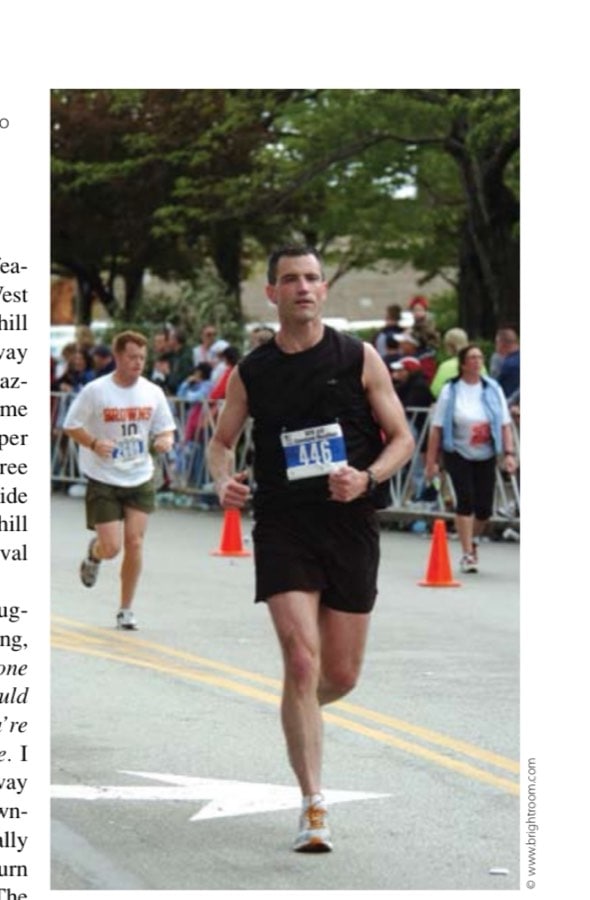
Although I was struggling, part of me was saying, This is gravy. You’ve done much better than you could have expected, and you’re going to finish this race. I continued shuffling my way through the streets of downtown Cleveland, eventually making the last right turn onto St. Clair Avenue. The finish line was finally in sight. I pushed a little harder, the finish line got closer, and the crowds got larger and louder: just a few hundred feet to go. I crossed the finish line in 3:25:51. It was almost six minutes slower than my time on the same course the previous year. It was the slowest time I had posted in over four years. It featured a huge crash and burn in the final miles.
I could not have been happier. I found Matt (who smashed his previous personal best by running a 3:15) and his family. Both he and his wife remarked that my lips looked purple (I suspect that it was a symptom of not getting enough air in those final miles), and I was definitely tired, but I had done it. Five weeks prior, I was in the hospital, not sure when I would run again. Today, I had a marathon finisher’s medal around my neck. And of all the ones I’ve received over the years, this one meant the most.
© www.brightroom.com
▲
One step closer to the finish line, one step closer to overcoming an obstacle.
Aftermath In the months since that race, I’ve continued to run and am back to my typical weekly mileage. I can tell that the PEs did some damage—a feeling confirmed by a recent CT scan, which showed the presence of scarring in the lung. As I write this, the cause of the clots has yet to be discovered, and it may never be known.
Runningwise, my endurance and speed are not quite what they used to be. The Boston qualifier that seemed to finally be coming within my reach (God bless the relaxed qualifying standards as you get older) may have to wait a little longer. It may take a year or two to fully recover from what happened. But if that’s the worst thing to come out of this experience, then I’m pretty lucky. And realizing that my distance-running habit (addiction?) probably lessened the damage from the PEs has made me truly appreciate the health benefits it provides.
One last thing. For years, when people have asked me about my running, I would remark that it “got into my blood” after my first marathon. I don’t say that anymore.
And What I Learned From It We all have dreams, goals, things to cross off our big to-do list of life. Are we getting there, or are we putting them off until tomorrow? And when tomorrow gets here, will we put them off again until another tomorrow?
Life was meant to be lived—today. It has to be lived as though there may be no tomorrow, because there very well may not be. No, I don’t mean that in a “cash out your 401(k) and blow it on a sports car” sense—the
odds are good that you’ll be here a while longer. But there is no guarantee. Look at me—relatively young, in excellent condition, low pulse, low blood pressure, low cholesterol; you name the medical bar, and I clear it
with room to spare—and I ended up with a potentially fatal condition. If it can happen to me, it can happen to anybody, including you. If it’s not a blood clot, it could be a heart attack, an accident on the highway,
or the proverbial bus that approaches as you step off the curb. So whatever it is that you really want to do—taking that trip to Italy, going back to school to get your degree, calling the estranged brother
whom you haven’t spoken to in three years, or whatever else is on your personal bucket list—set it in motion today. Don’t wait for a tomorrow that may never arrive.
This article originally appeared in Marathon & Beyond, Vol. 13, No. 3 (2009).
← Browse the full M&B ArchiveMore like this
1,000+ stories from 19 years of Marathon & Beyond
The complete archive of the legendary long-distance journal — digitized and free to read.
