

Best of Times, Worst of Times
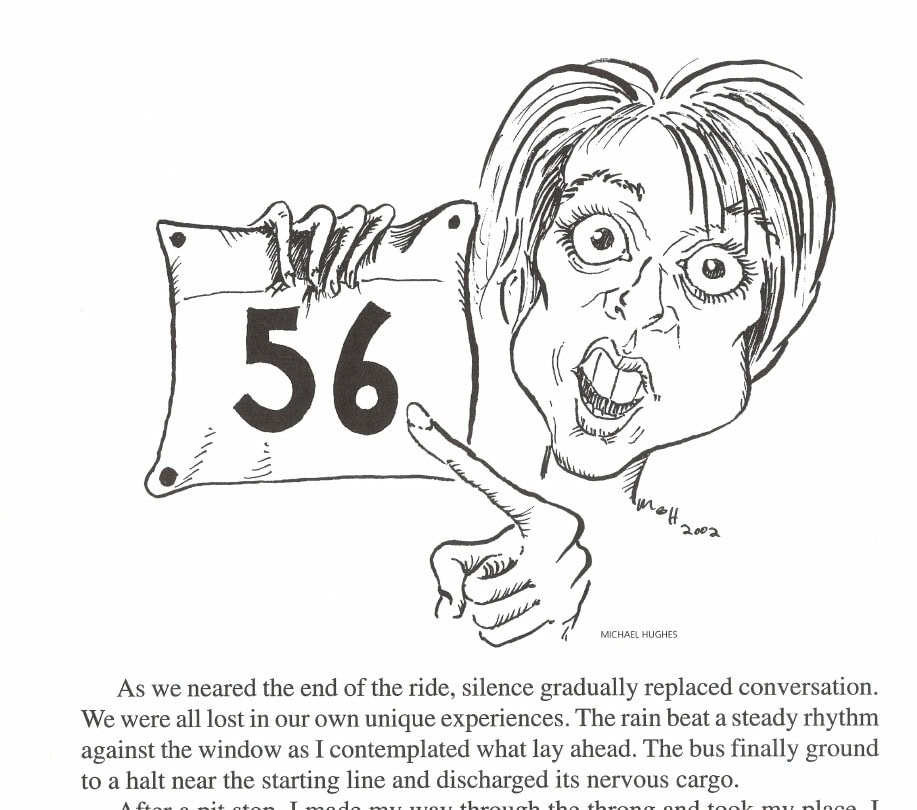
MORE THAN 2,000 runners were signed up for this early October marathon in Scranton, Pennsylvania. The day before the Steamtown Marathon was to be run, I picked up my race packet and bib number. My number was 56. I stared at the number, puzzled.
“The first 100 numbers are set aside for the very best of the best, the elite runners,” the volunteer said as she thrust the sign-in sheet at me. As I bent over the form, I asked whether a mistake had been made in assigning me this number. She conferred with several officials. One turned to me and said, “No mistake. That’s the number you should have.” Odd! I was certainly not an elite runner. Yet it was certainly a good omen for tomorrow’s race.
Race morning arrived in a blast of cold air and a steady rain when I left the hotel at 6:30. Close by the entrance stood a small white bus. The driver looked out and glanced at my bib number. The door opened. I stepped up into the bus and out of the pouring rain. As I stared into the sea of tense faces, I realized my mistake. Each face was attached to an elite runner’s body. The driver must have assumed I was an elite runner based on my low bib number. I smiled as he asked me, almost as an afterthought, “Are you one of the elite runners?” I broke the awkward silence with an embarrassed, “Oh no. Not me!” I turned, a little red faced, to leave the bus. One of the elite runners gave me an encouraging smile. He knew we both had dreams this chilly morning.
A moment later I was back where I belonged, in the familiar throng of nonelite runners. I walked a few blocks to where the yellow school buses waited. Once on board, I settled down, lost in my thoughts. As soon as the bus jerked into motion, conversations sprang up all around me. I joined the nervous jumble of comments ricocheting around the bus as we rumbled through the dark toward the dawn—and the starting line.
As we neared the end of the ride, silence gradually replaced conversation. We were all lost in our own unique experiences. The rain beat a steady rhythm against the window as I contemplated what lay ahead. The bus finally ground to a halt near the starting line and discharged its nervous cargo.
After a pit stop, I made my way through the throng and took my place. I waited nervously, shifting from one foot to the other. My heart pounded as the last seconds ticked away. A cannon was to start the race.
BOOM!
I was off! We were all off! I was running my first marathon! I fought back unexpected tears as I took my first few steps. Two years of anticipation and hard work, and I was finally here. Two years had passed since my back surgery. Two years since I had been told I would never run again. I had had many failed attempts at training for a marathon during the past two years and many reasons to give up, but I hadn’t. Now, after overcoming all the problems and pain, and battling asthma, I was finally here.
I was soon into a pace that felt comfortable. I had the sure and certain knowledge that I was going to do well today. The rain still came down in buckets, but unlike some runners around me, I didn’t care. My heart was filled with joy as the enthusiastic—and brave—crowds cheered us on. In spite of the bad weather, they jammed the sidewalks and porches. I smiled and waved back as I ran.
By mile 10 I still had plenty of energy, although I did start to notice some discomfort on the bottom of my right foot. I thought that was strange, but I dismissed it. I was still safely in the middle of the pack. All my training was paying off. I was on schedule to finish with a time of 4:30, and despite the fact that I had somehow managed to lose my inhaler, I had no breathing problems.
But soon after mile 10 the bottoms of both feet began to bother me more with every step. I had run races as well as trained in the rain and had never, ever had problems with my feet. Today was different.
I continued and by the 11th mile I realized what was happening. I was developing huge blisters on the very bottoms of both feet. How could this be happening? If the blisters had been on the heel or on the toes, I could have stopped to bandage them. But I had no experience with something like this. This had not happened during any of my 24-mile training runs. As the blisters on each foot increased in size and volume, the pain reached an almost intolerable level. I had to change my stride to an awkward gait just to keep going. This created a new problem. My knees began to ache.
By mile 13 I was running alone in an odd, clumsy shuffle. Not a very pretty sight, yet it kept me running. My T-shirt was soaked and heavy from the rain. My feet were wet and the shoes soaked through. The pain was so bad that I didn’t see how I could go one more step. My leg muscles tightened up and my stride shortened to about 12 inches. Humor had helped me get through difficult times in the past, and it would help me now. I decided to name my awkward stride “the Steamtown shuffle.”
A sag bus that picks up runners who need to drop out of the race came by and slowed down. Gee, it looked inviting! But wait! I couldn’t afford to think like that. So I started talking, not caring what the people on the bus thought. I looked down at my knees and feet, then shouted, “No! Quitting is not an option. Deal with it!” One runner on the bus gave me a weak smile and a thumbs up as the bus slowly drifted away.
ONWARD IN SPITE OF IT ALL
I made it to mile 15 still running slowly in my awkward shuffle. I glanced at my watch often and I tried to figure out how many miles I had left and how long it would take me to finish. I couldn’t quite put the information together in my head. I had passed the point where a drop in carbohydrates equals a lack of mathematical skills.
I was at mile 20 when I began to believe that I could make it to the finish. For some reason my math-deprived mind began to tell me I had only 5 more miles to go. I knew in one moment that the marathon has 26.2 miles. Yet somehow 26.2 minus 20 began to equal 5.
The rain had finally worn itself out and the weather turned much warmer, to the point where the humidity had to be nearly 100 percent. No breeze moved the oppressive air. My breathing gradually became more labored, as though I were trying to breathe under water. I kept moving, placing one burning foot in front of the other. My mantra kept time with each step. “Don’t-quit. Keep-going. You-can-do-it.” I tried to imagine how far away the finish line was but still couldn’t make the numbers come out right. My mind wasn’t working clearly. I had been running for hours. How many? I wondered.
It was around 22 miles that things suddenly took a turn for the worse. I suffered an asthma attack. For a moment I panicked as I realized that I didn’t have my inhaler with me. My throat closed and for a moment I could not inhale. I stopped moving, stood completely still for the first time in hours, and willed myself to be calm. I tried inhaling just a tiny amount of air. It worked. Gradually, over the next few minutes, my throat reopened and I was able to regulate my breathing, though it was labored. I was able to run again, though I had to move even slower than before. I crested a hill and encountered a race official. He looked concerned as I shuffled past. He called out, “Do you want to stop? Are you having any trouble?”
I answered over my shoulder. “No thanks. I had a problem with asthma a little while ago, but I’m OK now.” I knew my body. My breathing was getting easier with each step. The worst was over. I knew from experience that I would not have another asthma attack.
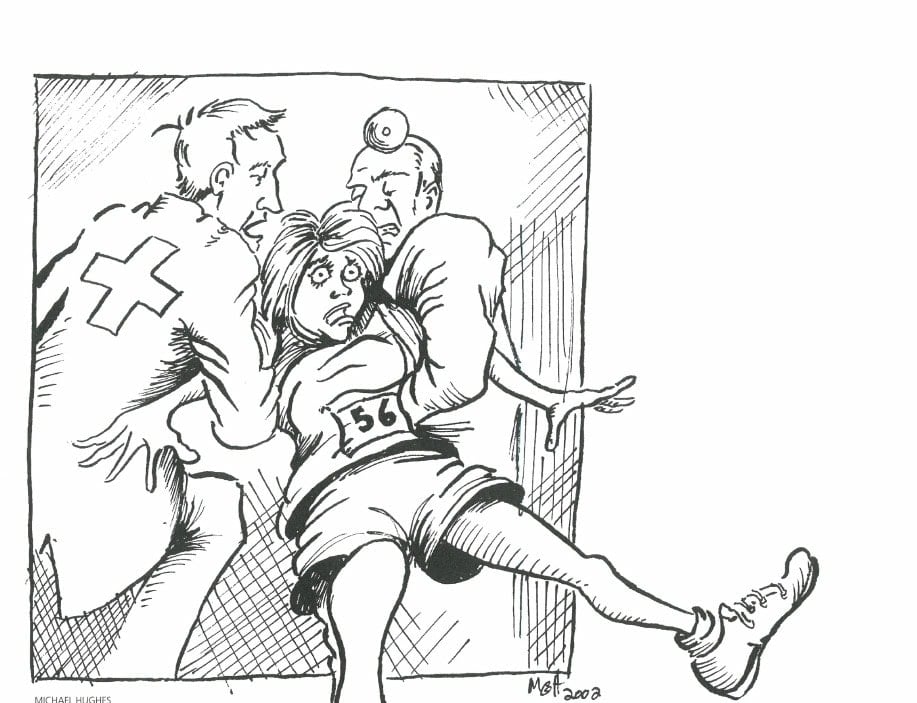
A few minutes later I was startled as I first heard, then saw, an ambulance. It raced up behind me as the siren proclaimed an emergency. It sped past me a short distance, then skidded to a stop. Two medics jumped out and ran to the back of the ambulance, then flung open the back doors. Very dramatic. One medic stepped up inside the ambulance’s yawning rear while the other spoke in my direction. “Ms. Seely, you need to get into the vehicle, so we can evaluate you.” I was confused by this turn of events. How did they know my name? Oh, yeah. The race official had seen my number. “Uh . . . wait a minute,” I muttered. “I’m not stopping! Why would I want to do that?”
That remark made perfect sense to me. However, they looked dumbfounded upon hearing it. They explained that someone had called 911 and reported my location, name, and number. Furthermore, I needed to get inside the ambulance, so they could assess my condition. From their viewpoint, it was a reasonable request. I stopped near the back of the ambulance and stared in.
AN AWFULLY TEMPTING OFFER
One medic had already untied the gurney and pulled back a sheet. Oh, that gurney! That lovely gurney! A wonderful, comfy-looking haven of rest was
only a few inches away. I stared at it longingly. There was a big fluffy pillow, clean, white inviting sheets. Ah. Beautiful, dry white sheets! Warm blankets!
Gazing at the gurney, I envisioned myself crawling up and getting into that waiting bed. Pulling up the ever-so-warm blankets where I would receive sweet rest, oxygen, and relief from the pain of burning feet and sore knees. No more struggling, just blissful, heavenly rest and a ride all the way to the finish line.
Whoa! Wait just a minute!
I snapped out of my daze. No way!
I politely refused to get in and stood on the road as I signed papers stating that they had advised me to stop and to get in but I refused their service.
The medics had delayed me for only three or four minutes, but it seemed like a lifetime. I’m sure they thought I was nuts. But I know my body, and I was confident at that point that I could finish the race. I restarted my patented “Steamtown shuffle” and watched as they drove away and faded from view. Riding across the finish line was not an option.
My mind cleared long enough for me to realize I was four and one-half miles from the finish. My breathing was improving. I certainly was not going to quit now. No way! I looked at my watch. As things now stood, it was questionable whether I would make the finish line in six hours, the time the finish line was scheduled to close. My hopes of finishing in under four and one-half hours were long since dashed. But my hope of finishing was not diminished.
I came to the steepest hill on the course. Each step was an experiment in willpower. Each step caused me to wince in pain. But I made it and crested the top. I knew then that I would certainly finish. And then I was a mere mile from the finish line. I increased my painful, awkward shuffle.
When I was only blocks away from the end and could see the finish line, I still was uncertain whether I would make it in time. Didn’t they close the gate to the stadium in the Comrades ultra in South Africa? I began looking for sinister gates. Now I could see the clock. It indicated that I had been running for five hours, 52 minutes. But my mind was fuzzy and I wasn’t able to calculate how much time those last two blocks would take. Would I make it across the finish line before the big “6” came up on the clock?
FRIENDS AT THE END
At that point I saw a few familiar faces and heard one voice cheering louder than all the others. It was my husband, “All right, Lynn, you did it! You did it!” I picked up my shuffling pace as my burning feet screamed at me. I ignored the stiff legs and painful knees and finally crossed the finish line!
I immediately bent my head down as the beautiful, hard-earned finisher’s medal was placed over my head and settled around my neck. A silver space blanket was placed over my sagging but proud shoulders. I had done it! It had taken me five hours, 53 minutes, and it wasn’t the 4:30 time I had planned. But it was a finish, nonetheless. I had done it!
Running has taught me a lot about myself. I have learned plenty about determination and the true nature of my character. Frankly, I like what I see. I use running as a method of exploring my character and testing the parameters of my life. I go on when I want to quit and go faster when I want to stop. I have learned how to exert my considerable will over obstacles and roadblocks in my life and to win against formidable odds. I have tested my belief system about my limitations, and I have learned a great deal about human nature—my own and others’. There is great satisfaction in giving my all, trying my best, and succeeding by my own standard. Sometimes failure happens to be part of an experience, but it’s no matter as long as the effort was genuine. I do not run for approval, nor for the time posted at the end of the race. I run for myself. I run to embrace life. I run with a grateful heart because for now, for this moment, I can run. It’s a gift I do not take lightly. Make no mistake, it is not always easy. Yet in my opinion, easy does not build character—challenge does.
This article originally appeared in Marathon & Beyond, Vol. 6, No. 6 (2002).
← Browse the full M&B ArchiveMore like this
1,000+ stories from 19 years of Marathon & Beyond
The complete archive of the legendary long-distance journal — digitized and free to read.
