

My Most Unforgettable Ultramarathon
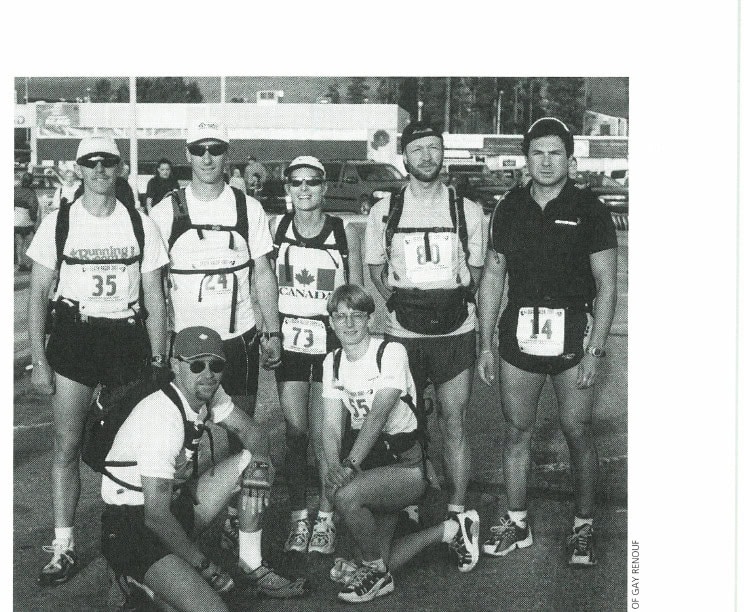
GRANDE CACHE, ALBERTA, CANADA, August 4, 2001—Are you tough enough? That’s the question posed by the Canadian Death Race, an event that bills itself as Canada’s toughest endurance run. And that’s the question I set out to answer, along with six other members of my running club.
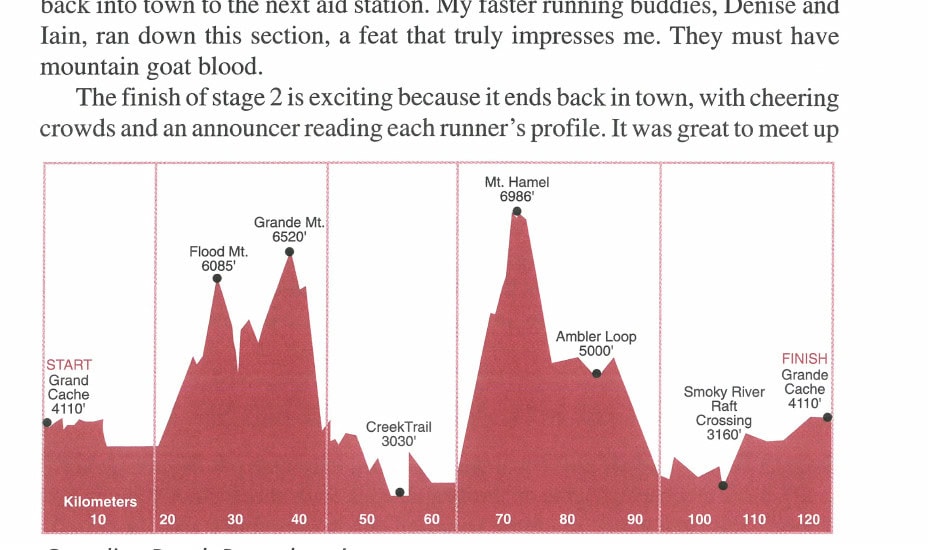
The race covers 78 miles of mountain trails, climbing and descending 17,000 feet and summiting three mountains. It’s more commonly done as a five-member relay. Only 73 of the roughly 500 participants in 2001 were solo runners, myself included. All teams and soloists have 24 hours to complete the course, a time limit that seemed generous four months before the race when I signed up.
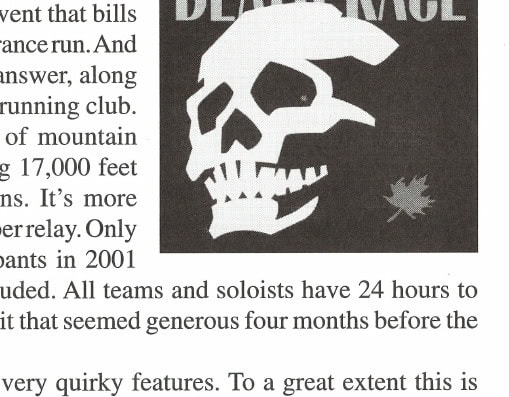
The Death Race has some very quirky features. To a great extent this is because it’s not a race, it’s an event, and some original—and devious—minds are behind it. Race directors Paul Bailey and Dale Tuck sent out mesmerizing pamphlets emphasizing its challenge, promoted it at the Boston Marathon, and developed one of the best Web sites I’ve seen, with its revolving skull and embrace of the cult of “Death.”
Dale Tuck, the course creator, answers e-mails as “Dr. Death” and signs off with “Train hard, train very hard.” The Death Race skull is everywhere in town: on posters and signs and tattooed onto most of the runners. Another of the quirky features is a raft crossing of the Smoky River at the 68-mile mark. The “Ferryman” will take you across the river (alias the River Styx on race day) at Hell’s Gate, provided that you have the proper coin. That’s right. All runners must carry a Death Race coin—no coin, no raft ride.
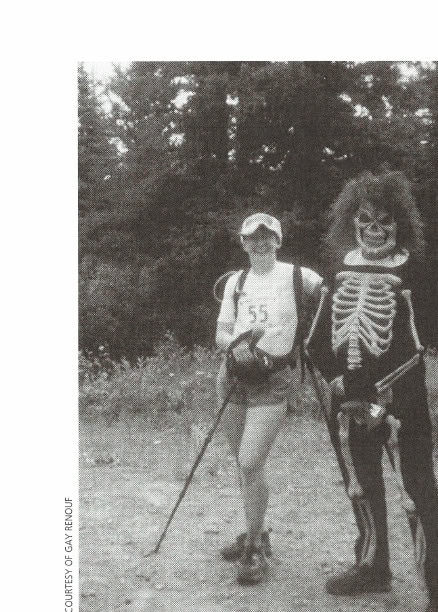
My friends and I arrived from Regina, Saskatchewan—heart of the flatlands of Canada—hoping that our repeats of a local 200-foot hill would be enough to get us through the race. The night before the run, we were to attend a mandatory prerace meeting. I had expected some dry discourse on which sections of the trail were wet and whether bears had been sighted, along with the usual advice to exercise caution working your way through traffic on the eight miles of paved road. The meeting was a bit of a surprise. The race directors, along with many volunteers, dressed up as skeletons or ghouls and exhorted us to scream our lungs out, yelling over and over, “I am a Death Racer!”
STAGE 1, DOWNTOWN JAUNT, 12 MILES, 2:10
The morning dawned bright but cold—about 50 degrees. Thank God for no more rain. Grande Cache had had steady rain the month before the race, and we were promised muddy trails. The race started at 8:00 A.M. with a procession through town led by the Royal Canadian Mounted Police, flags and banners, and a local musket regiment. Something I had dreamed about, feared and worried about, kept myself awake at night obsessively thinking about, had begun.
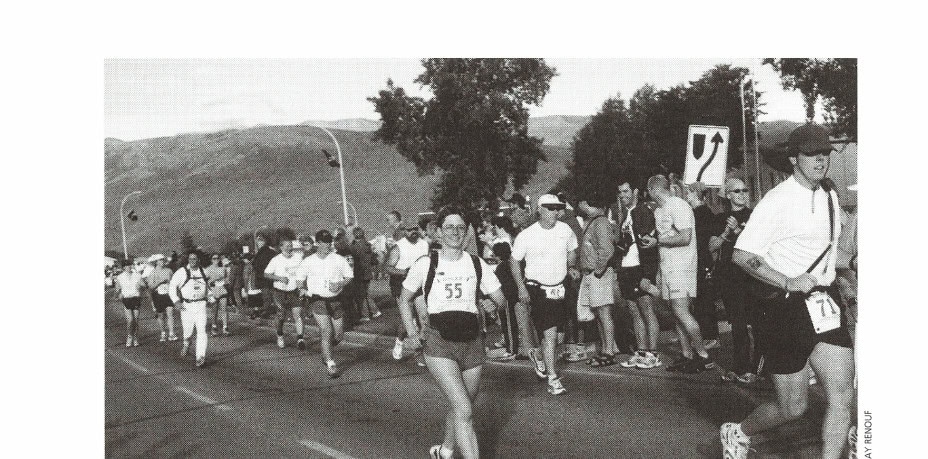
We had about three miles on the road through town and on the highway before we reached the trail. Not so bad. The trail was wide enough for two side-by-side runners at times, and the muddy spots could mostly be avoided by running at the very edge of the trail. Then we got to the first mud pit. There was no way to avoid mud here, so we splashed through, shrieking like 10-year-old kids.
Signs posted on the trees proclaimed, “Normal is boring.” Too right, I thought happily. At the end of the 12 miles, I could hear whooping and clapping—the noise of the first relay exchange station. Crowds had formed a gauntlet just after the final mud pit of this stage. With everyone watching and cheering, I wasn’t about to pussyfoot my way along the edge of the mud pit. And besides, this was a little one, only about four feet wide and long. I plowed right through and was shocked to sink up to my chest. The crowd cheered again. “Got another one! You should have practiced your swimming.” Hmmm. It was then I began to appreciate just how devious the minds were behind this event. I imagined Dale Tuck chortling as he dug a deep hole right before the exchange station. Dr. Death is evil!
STAGE 2, FLOOD AND GRANDE MOUNTAIN SLUGFEST, 17 MILES, 5:20
One of the challenges of the Death Race is the need to carry all food and equipment between aid stations. We would reach two emergency stations stocked with snacks on stage 2, but I wouldn’t see my crew: husband, Mike; and son Conor for another six hours. So I changed my shoes and socks and loaded up with six hours’ worth of pretzels, Gatorade, and PowerGels; my emergency supplies; camera; and trekking poles, and was off.
Perhaps I should rephrase that. I was more “up” than “off.” Almost immediately the trail began to climb, and like most of the soloists around me I changed from jog/walk mode to a fast hike. Surprisingly, the trail was still muddy even though we were clearly gaining elevation. We were on a well-tread trail, so the view wasn’t anything special until we reached the summit of each of the two mountains.
The meadows surrounding the trail were vibrant with many varieties of wildflowers. However, the trail between Flood and Grande mountains was especially rugged. It was sort of a goat path, about the width of a sneaker, that disappeared and reappeared at will.
Fortunately, the trail was well marked with orange flagging tape, but I still couldn’t believe it was really a trail. “Curse Dale Tuck,” I thought. “No one in his right mind would consider this a potential race course.” I knew that in a month’s time mountain bikers would challenge this same course in the Canadian Death Ride, and to be honest I thought it would be impossible to take a bike through this stage. Rocks, roots, cliffs of 10 to 15 feet. I heard later that only 12 of 80 solo cyclists finished the course.
Finally I made it to the Cut Line—a 14 percent descent along the power line back into town to the next aid station. My faster running buddies, Denise and Iain, ran down this section, a feat that truly impresses me. They must have mountain goat blood.
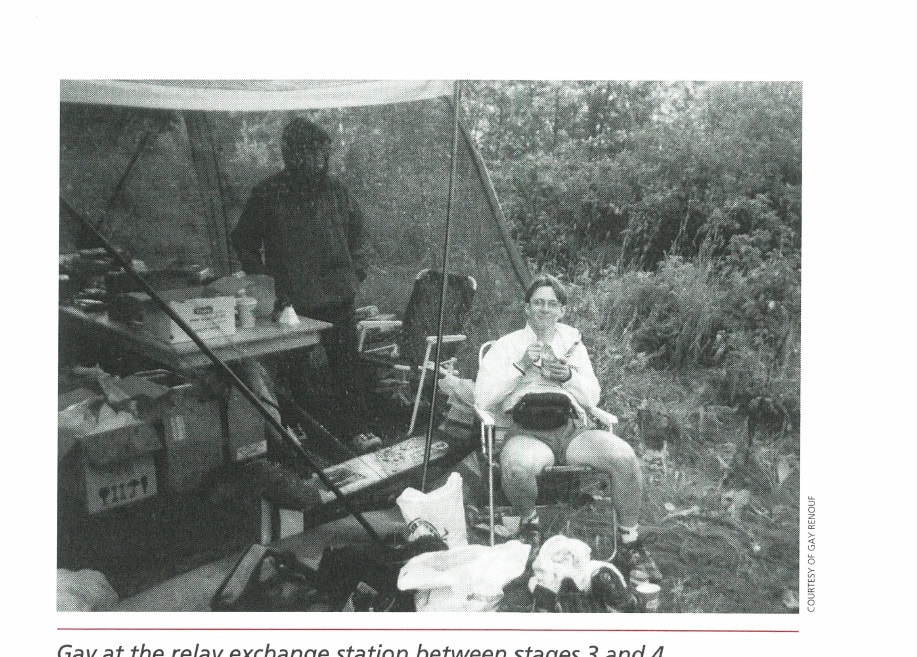
The finish of stage 2 is exciting because it ends back in town, with cheering crowds and an announcer reading each runner’s profile. It was great to meet up
with Mike and Conor again. Mike brought me sandwiches, helped me tape my feet and change shoes, and resupplied me for the next stage. Mike reported that my faster running friends, Stefano, Darryl, Denise, and Iain, were looking strong and running well. Rick, who always runs as “Johnny Venture,” had more troubles. He had injured his knee a month before the race but decided to start anyway and see how far he could get. Knowing that he couldn’t run a step two weeks before the race, I was amazed that he had gotten this far. Gary, a very experienced ultrarunner, was taking his time and was behind me somewhere.
STAGE 3, OLD MINE ROAD AND CITY SLICKER VALLEY, 13 MILES, 3:05
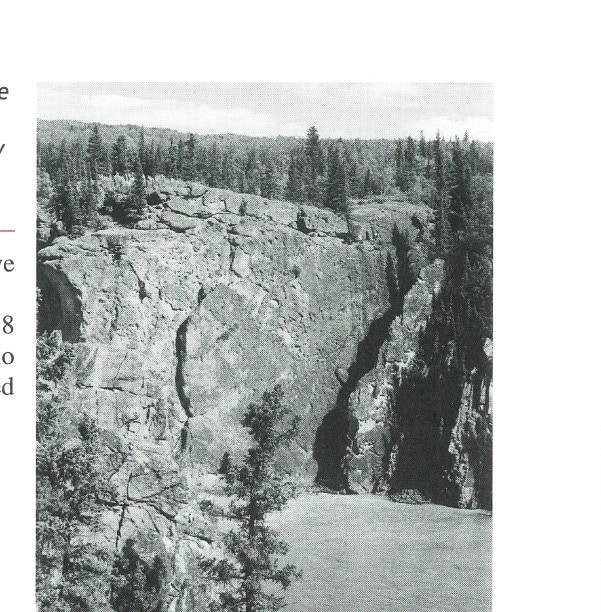
Stage 3 was supposed to be the easiest stage, so I tried to run as much as possible. The trail was wide and mostly downhill and I began to enjoy myself. I even stopped cursing Dale Tuck. To my left, the view was incredible. Far below was the Smoky River, which I hoped to cross by raft much later in the day. The last part of the trail is basically a creek flowing against the runners — 30 yards long and it was bloody cold! Stage 3 ends with two and one-half miles of highway running on a gentle downhill stretch. It should have been great, but it wasn’t because a storm blew in and the wind pelted us in the face with rain and sleet.
STAGE 4, HAMEL ASSAULT, 20 MILES, 7:37
Stage 3 finally ended, and I warmed up with soup and put on my jacket. I waffled about wearing tights or shorts and stuck with shorts since the rain had stopped and I knew that the three hours of steady climbing I was about to do would warm me plenty.
Big mistake. What I hadn’t counted on was the weather at the top of Mount Hamel. You know those films taken on Mount Everest. It was similar, with the wind blowing so hard you have to lean into it and prayer flags are flapping so hard you can’t hear anything else. I stumbled into the weather station hut at the top, and it was like arriving at a M*A*S*H scene. Stunned, hypothermic runners huddled and shivered, with three medics rushing around checking each new patient.
I was one of them. I shivered uncontrollably as my hands thawed painfully. The only good part was that I finally got to see my faster friends. Denise and Iain looked cold but still determined and in control. Johnny Venture, amazingly, was still hanging in there. I heard later that Stefano, Darryl, and Gary suffered the worst from the cold at the top of Mount Hamel. Like a dozen other soloists including the two leaders, Gary was pulled from the race here with hypothermia. Stef, wearing only shorts and a T-shirt, and Darryl reached the top at the same time as the sleet storm. Hypothermia shut down so much of Stef’s thought processes that he was left with what we all called “the lizard brain.”
The worst of the race is an out-and-back half mile along the ridge of the summit of Mount Hamel. You have to pick up a flag at the endpoint and return it to the weather station to prove that you made it. The wind was blowing at least 40 miles per hour, and at only three degrees it meant another 15 minutes warming up in the hut on the return. I think I really, truly hated Dale Tuck at this point.
Coming down Mount Hamel was treacherous, with lots of rocks and ruts. A sign said “Boulder Garden” but I didn’t feel like smiling at the signs now. I passed Johnny at the last emergency station. After running 56 miles and summiting three mountains, he was quitting. I exchanged a quick hug and some tears with him and kept going.
The sun sets late in northern Grande Cache, about 10:30 or 11:00 P.M. For me the darkness arrived as I came down from Mount Hamel. I had worried and fretted about this aspect for months before the race. I was terrified of bears and was worried about running in the darkness by myself. I had planned to find others running about the same speed and just stick to them during the dark stages. No one was there, and I was running by myself down the mountain in almost pitch black. Somehow, I wasn’t scared. I think I was too busy to be scared. The nighttime portion of the trail was exceptionally well marked with fluorescent dots every 10 to 20 feet, so I was too busy trying to keep on the trail to worry much about the bears that I never met.
STAGE 5, THE TUNNEL AND RAFT RIDE HOME, 16 MILES, 4:45
At last, lights and rock music emerged from the darkness, signaling the last relay exchange station. I began to dream that I might indeed finish this thing. Stage 5 is labeled the third hardest or third easiest stage, but there was nothing middling about it.
Two very steep climbs, a rock-strewn trail and another called the “Root Route,” made it mentally the toughest stage. It also had about two or three miles of running on a wide gravel road. No one was about and I hadn’t seen any orange flagging tape for at least a mile. Convinced I was lost, I started to sob and thought murderous thoughts about Dale Tuck.
Eventually a truck passed and reassured me that I was almost at the raft-launching point. Yippee! It lasted only a few minutes, but the raft ride across the rapids of the Smoky River was incredible. At the time I crossed, the full moon was perfectly framed between the two stone pillars of Hell’s Gate, with the clouds uncovering it at that instant. It was a perfect moment, and I stopped wishing I was finished and was just happy to be there and running.
Coming into town, I promised myself I would run the last mile. My pride demanded it. However, as soon as the road reached Grande Cache it started uphill, so I let myself off the hook. With the few last flat blocks I began to run again. Twenty-two hours and 57 minutes since the start, no cheering crowds awake at this time, with only Mike running beside me, I passed through the finishing gates. Exultantly, I said the words I had wanted to say for months: “I am a Death Racer.”
P.S. Did I mention that I love Dale Tuck?
P.P.S. Finish time: 22:56:38 (5th of 8 women, 36th of 73 solo runners, 51 of whom finished the course).
And What I Learned From It
You can’t judge a racecourse just by distance and elevation gain and loss. What makes the Death Race so tough is the trail surface.
Be prepared for very changeable weather in mountain regions. I returned as a relay runner for the 2002 Death Race. There was a heavy snowstorm the day before the race (August 2), and race organizers reported three-foot snow drifts at the top of Mount Hamel. I learned to be prepared for really unexpected weather.
Running by myself in the dark in a wilderness was much easier than I thought. The anticipating and fretting were worse than the thing I feared in the first place.
This article originally appeared in Marathon & Beyond, Vol. 6, No. 6 (2002).
← Browse the full M&B ArchiveMore like this
1,000+ stories from 19 years of Marathon & Beyond
The complete archive of the legendary long-distance journal — digitized and free to read.
