

The Secret of the Shoe
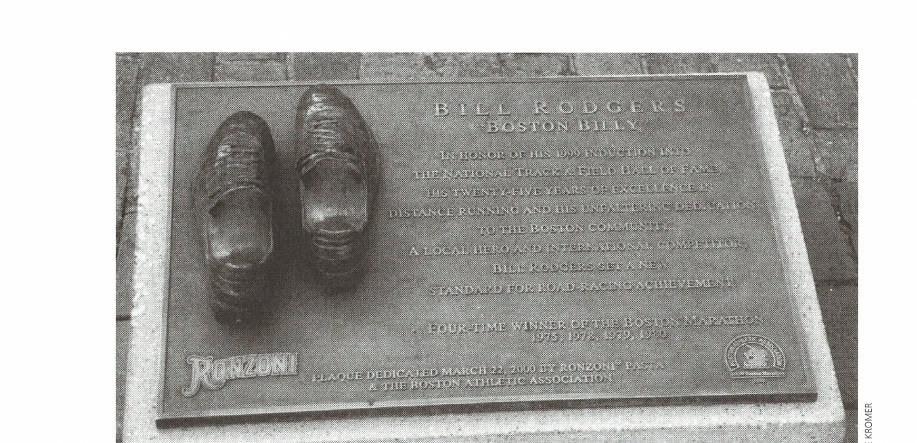
FOR NEARLY a quarter of a century, I’ve been fortunate enough to have matured—as a person and as a runner—among a handful of fellow running mates at the Bill Rodgers Running Center, a specialty running shop in Boston. The store was opened in 1977 by Bill and his brother, Charlie, along with a cast of friends and associates; the original store was in Brookline along the famed Boston Marathon course, not far from mile 21.
We were unique at that time. The term “specialty running store” had not yet come into existence. Nike, which had recently released its new “waffle sole” shoe, was still years away from its awesome growth and New Balance was being operated out of a suburban garage here in New England.
We were pretty confident that nobody was going to make it rich in this newfangled business, but our love of the sport seemed to make it all worthwhile. We all worked long, hard hours; we put in a lot of road miles together; and we certainly made sure that we had a lot of fun along the way. The store also served as a haven for many of the talented runners of that period who lived in the area, including Greg Meyer, who won Boston in 1983 with a 2:09:00.
When the store first opened, running was a whole different animal. Footwear has changed dramatically over the years, as has running clothing. Much research has been done in sports medicine, which was in its infancy in those days. Training methods evolved (not always for the better), the running magazines drew more subscribers, and the charity running movement was birthed and grew. Naturally, to survive and meet the needs of the running community, the Bill Rodgers Running Center has had to evolve along with the sport and lifestyle of running. In this article, I will tell you some of the things I’ve learned over the years about running shoes, while also touching on how the store has evolved over the past 25 years.
WHEN YOU NEED SHOES
Let’s start with a simple question. Where do you buy your running shoes? They are the primary tool a runner needs to practice the sport, so even an experienced runner often puts in a lot of time and effort to find just the right shoe in a world where the makers are always changing, redesigning, and tweaking their shoes. Runners have far more options these days, including footwear stores in the malls, chain stores (such as Niketown), factory outlet stores, and even mail-order catalogs. These options may work for some people, but they certainly aren’t ideal for runners who don’t know exactly what they need.
Because every runner’s feet are different and every runner’s needs are different (most of our shoes can be used for any mileage surface, or goal), the purchase of running shoes should not be undertaken haphazardly.
You will frequently be on your own when shopping for a new pair of running shoes, since most high-volume stores seldom employ well-qualified, experienced runners as staff. And if you have a particular biomechanical problem, shopping on your own can have its pitfalls.
As an experienced runner, you’re probably aware that various running shoes are designed not only for different purposes but also for different foot types. Shoe sizes are no longer standardized, so your size may vary not only from one brand to another but also from one company’s model to the next—and even, sometimes, in different shipments of the same model.
Will there be someone to educate you regarding new models or the effect of revisions to an existing shoe model? In many high-volume or high-discount stores, you may be picking from defective shoes, discontinued models, only one particular brand, or only low-end (inexpensive) models.
Because of the limited choices, you may not even be exposed to some of the more successful shoes currently on the market. Having reviewed those tired mail-order catalogs from time to time, I’ve noticed that their prices don’t seem to be any cheaper than the same models sold at our store. At a specialty running shop you get a warm body to assist you, someone with experience based upon sometimes decades of miles in a multitude of different shoes. And, of course, you can walk out of the store with the shoes under your arm—or on your feet.
The Bill Rodgers Running Center is now located in Faneuil Hall Marketplace. Like other specialty running stores in the United States and Canada, we provide a number of services, from assistance in identifying your foot type to suggesting appropriate footwear. We also advise on treating common running injuries and provide a wide assortment of literature on running, races, and local clubs. We carry numerous brands and models of running shoes, including training flats, racing flats, spikes, and walking shoes, along with an assortment of other sports shoes.
We have a seasoned staff with a wealth of practical knowledge about running in high school, college, and beyond. Although we don’t claim to be doctors, with many years of experience behind us we see many similar problems over and over, and as a result are familiar with some of the likely solutions. In fact, a number of podiatrists, sports medicine clinics, and physical therapists routinely send their patients to our store for proper footwear and guidance consistent with the treatment plans prescribed by their medical professionals. Naturally, we do not charge for our hard-won advice on preventing or getting through injuries. And if we can’t help you resolve your problems, we can refer you to any number of successful sports medicine resources in the Boston area, with which we have developed a working relationship over the past several decades.
OUR CUSTOMERS
The profile of our customer base has changed dramatically in the past 20 years. During the days of the initial running boom, it seemed like everyone was doing 70 miles a week. For many of our customers at that time, weekends were for racing, and they had loads of options in that regard. Many of our customers were serious, competitive runners, so we kept a wide variety of both training and racing flats on hand at all times.
In today’s world, moderation and low mileage seem to be the current trend. As a result, we now sell many more stability and motion-control shoes and fewer lightweight trainers and racing shoes. The majority of our customers
today are not hardcore runners who ran competitively in high school and college. Instead, they are beginning runners who are seeking a moderate level of physical fitness through running as well as other forms of exercise. We see many people who are new to the sport and are connected to a charity that is helping them prepare for their first marathon.
Fewer customers today are familiar with the kinds of shoes that are available or know their specific needs. When it comes to success with their running programs, many customers have greater expectations about what shoes will do for them. The advice that we provide concerning training methods and injuries is now more frequently directed toward the novice runner. As a result, our role seems to have become more motivational and educational. This substantiates the need for buyers, particularly beginning runners, to get experienced, expert advice. The running world is still booming, it’s just the profile of the average runner that has changed.
I should mention that not all of our customers are runners. A fair number of senior citizens come to our store sporting various foot problems. They are referred to us by podiatrists and physical therapists with whom we’ve worked over the years. These seniors want to be able to take a leisurely, pain-free walk around their neighborhood. Although there are some decent walking shoes on the market (the Brooks Addiction walker comes to mind), the technology of walking shoes hasn’t kept pace with running shoes. If you have a problem with bunions combined with a bulky orthotic that takes up a lot of space inside the shoe, you may have few options for a good, comfortable fit among the walking shoes. Yet many options are available on the running side of the aisle.
THE SHOES OF YESTERDAY AND TODAY
The characteristics of running footwear have also changed dramatically. Back in the ’70s, running shoes were more performance oriented; many were designed with the efficient, competitive runner in mind. The features on these models included minimal weight, low heel lift, curved narrow lasting, and moderate arch support. Shoes seemed to be contoured to the feet, thus allowing one to become one with the shoes. The shoe models were oriented toward making it easier to run faster. When I pull out some of my old, worn-out Japanese-made Tiger running shoes from the ’70s, I feel almost like I’m viewing a piece of art.
Nowadays, those straightforward, high-performance shoes have been virtually eliminated by models that place a priority on support and protection. Interestingly enough, in spite of the design changes and the fact that today’s runners are running fewer miles at slower speeds, I haven’t noticed a dramatic reduction in running injuries. What was state of the art back then seemed to work out well for most runners. Some runners who enjoyed the classic shoes would agree with me when I say that “less is more.” (That’s pretty much in keeping with Rich Englehart’s piece on running shoes in the November/December 2001 issue of M&B.)
Shoe manufacturers today seem to be focusing the majority of their efforts on trying to meet what they see as the needs of the “average runner.” While some of the shoemakers still carry a token lightweight trainer, the vast majority of shoes on the market today are broad based in the forefoot, have lots of heel lift, are primarily straight lasted with exaggerated flared heels, and possess an abundance of antipronation technology. We’ve seen the sales of lightweight trainers, such as the excellent Asics Gel Lyte, virtually dry up in the last few years.
Almost a decade ago, I used to train in the Asics GT2000, the first edition of what is undoubtedly one of the bestselling designs in running shoe history. (The shoe is now known as the “2070.”) The shoe was basically a supportive, fairly heavyweight trainer. As I examine its structure next to the latest edition of the Asics Gel Lyte (the company’s current offering in the lightweight trainer category), the differences between the two shoes are clear.
Although the new Gel Lyte is aimed at the biomechanically efficient, nonpronating, faster runner, it has a much broader heel base and a far straighter last than the older GT2000, which was an everyday training shoe for the moderate pronator. Support and stability features have now even been added to lightweight trainer models that had never had—or needed—them.
Back in the ’70s the arch support systems were more minimal and less complicated than they are today. Many shoes of that era contained a spongy arch cookie that was tucked inside the liner at the arch point. If you had very flat feet or a severe overpronation problem and the then-available shoes weren’t working for you, the Spenco company made an arch support that could be inserted into the shoe. The high-tech solution at the time, of course, was the introduction by podiatrists of orthotics, to the tune of several hundred dollars per set. Unfortunately, not every podiatrist was adept at fitting and designing orthotics, and some runners found they were better off discarding the orthotics and going back to a more moderate solution.
The past 5 or 10 years have seen a revolution in over-the-counter arch supports, such as the Power Step and Rigid Arch. For the high percentage of runners who overpronate, these products have been a lifesaver. Today, podiatrists routinely send their patients to us to be fitted with stability or motion-control shoes along with one of these products to determine whether orthotics can safely be avoided. If you have very flat feet, pain in the bottom of your feet, or shin splints, you might want to try one of these products. We have seen numerous success stories in this regard.
TOO MUCH CUSHIONING
We frequently get customers who complain that they bought the most expensive, cushiony shoes on the market elsewhere, six weeks ago, and yet their feet are still killing them. With the emergence of various revolutionary cushioning technologies, many runners seem to have been brainwashed into an obsession with cushioning in the belief that it will miraculously solve many of their running problems. The theory that the more expensive a shoe is, the better it must be plays a role here, too. In these cases we frequently find that the problem relates to the runner’s foot type and lack of adequate support, and that it may be exacerbated by excessive cushioning. The solution may be a shoe that is less expensive and less cushioned, and the runner may be feeling better even as they’re walking out the door of the store. Although adequate cushioning may be very important for a heavier runner or for someone with a supinating rigid foot, too much of a good thing can cause its own problems.
When it comes to overpronation, Achilles tendon problems, chondromalacia, and various hip and back problems, instability is one of the most common culprits. Cushioning, by its very nature, breeds instability. As a result, finding just the right mix of adequate cushioning and support should be the goal. When I see those old black-and-white slow-motion films that follow a drop of milk as it falls onto a smooth surface, the impact spreading out across the pool, it reminds me of the sole of a highly cushioned shoe when a runner’s foot hits the ground. Wasn’t it Sir Isaac Newton who said, “For every action, there is an equal and opposite reaction”? Some biomechanical energy must be lost and extra effort required from the time that it takes the highly cushioned shoe to hit the ground, spread out, and allow a runner to move on to the next stride. Personally, I’ve always found it easier to run efficiently in a responsive, moderately cushioned shoe.
SHOE SURVEYS
Although shoe surveys published by running magazines may be viewed as a means of assisting runners with their selection of shoes, they must be kept in perspective. The reality is that they are a form of promotional advertising. The instant these surveys appear in print, we get a flurry of knowledgeable experts who flood the store without realizing that the new revolution in footwear will not be available for another six months. More important, you can’t always believe what you read. On numerous occasions, models that were given high ratings as the latest, greatest, new best thing in the world of running don’t measure up to the hype.
In other instances, models that were described as having specific features don’t quite end up the way they were described. This is where your local running specialty store can really help you out. Our store is almost like a laboratory. We see the trends and receive feedback about shoes from our customers on a daily basis, and we can pass this information along to you. Frequently, our feedback does not jibe with the promotional hype. While shoe surveys may be somewhat helpful and often provide entertaining reading, keep them in perspective, as it’s a lot wiser to deal with what’s going on in the real world than with what is touted on the printed page.
WHEN “IMPROVEMENTS” ARE MADE
Shoe companies may introduce what they consider slight modifications to existing models or may discontinue or replace models with, for the model’s fans, horrendous consequences. In some instances, a shoe manufacturer may affect the performance of an existing model by, for example, altering the cushioning or changing the height or position of the arch support. What the maker considers a minor alteration can hurt a runner whose biomechanical needs were met by the original model. For a number of years, Nike’s Air Structure was among our bestselling motion-control shoes. This was the shoe for customers with severe overpronation problems; few others worked as well. Nike eventually replaced this model with the Air Equilibrium, which was a disaster for these runners. When this change was made, a gigantic base of satisfied customers was completely obliterated. We sold only a few pairs of the new model and returned or gave away the remaining inventory.
One of the most common laments we hear at the store is “They discontinued my shoe!” After many years of frustration, I reached the point where, sometimes when I find a shoe that works for me, I buy 15 pairs and stockpile them against the day I would be forced to lament, “They discontinued my shoe!”
CONSULTANTS, NOT SALES PEOPLE
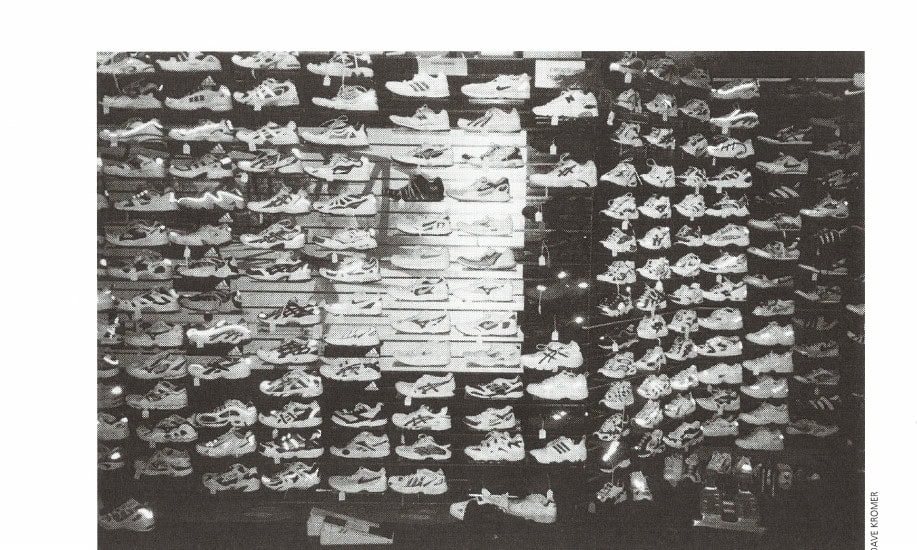
An individual who walks into a running specialty shop like ours finds that the shoe display wall has literally hundreds of models, including men’s and women’s training shoes, walking shoes, racing shoes, and trail shoes. That Wall of Shoes can be just as intimidating as The Wall that many ill-prepared marathoners know. Frequently, customers will say, “I’m taking up running and I’m here for some help in choosing some shoes.”
What follows is a brief discussion of what kind of running they intend to do, a look at their feet, and an educated consensus of where on the Wall of Shoes we’re headed. It is important to be armed with the basics of runners’ feet. Some runners have a neutral foot strike, a significant number overpronate (foot collapses excessively to the inside), and a small number are supinators (outside
foot strike). All shoe companies have specific models for each particular foot type.
If an individual does not clearly fit a particular category of shoe, moderation is the key. A person who appears to have slight pronation should go with a moderate solution instead of an extreme measure. For instance, some runners with significant overpronation who wear orthotics have great success with the top-of-the-line motion-control shoes such as the Asics MC Plus or the Brooks Beast. Others with the same condition find it easier to run in a lighter, less restrictive shoe since they feel that their orthotic is solving their overpronation problem. They don’t need a shoe that is going to do the same thing, so they take a moderate approach with the Asics 2070 or the Brooks Adrenaline GT.
As mentioned before, there are definite trends regarding which shoes are bestsellers. But good specialty running shops carry models from every reputable manufacturer and have no bias regarding manufacturers; they can help the runner by citing some of the pros and cons of various models. Most people who walk through our doors are already committed to making a purchase, so we are not technically sales people but rather serve as consultants who guide our customers through the maze of options that confront them. It is to the benefit of the customers and the consultants to find the right shoe because we want customers to run well and to run back to us when they wear out that pair of shoes.
If I’m dealing with an experienced runner, the first question I ask is “What shoes have you been running in and how have you been doing with them?” If the customer is certain about making a change, we continue from there, but I always advise that changing to another shoe may open up a whole new world or it may result in an expensive and frustrating nightmare.
NOT AN EXACT SCIENCE
Although foot assessment and gait analysis may be excellent tools for selecting an appropriate shoe, they should never be viewed as an exact science or in absolute terms. Many runners have one foot that is larger than the other, one leg that is longer than the other, or one foot that pronates and one that does not. Nevertheless, they do quite well without significant intervention. Although one might think that 120-pound Kenyans are the only people who can run in lightweight, unsupportive shoes, I’ve met senior division runners who have been doing quite nicely shuffling along at a 10-minute mile in their Nike Pegasus for years. Even in instances where imbalances do exist, the body finds a way to compensate and make the biomechanics work.
Although from a biomechanical standpoint Bill Rodgers is one of the smoothest runners who ever lived, one of his trademarks is that one of his arms swings out to the side. Some have theorized that this motion helped him to compensate for a leg-length discrepancy. During the height of his competitive career, Bill’s running biomechanics were studied at the Human Performance Lab at Pennsylvania State University. His swinging arm was plotted, and the scientists concluded that—considering his success—it would be foolish to mess with what worked. While foot or gait analysis may be helpful, the bottom line is that it should never be considered as absolute, only as a piece of the process. Don’t fix it if it isn’t broken.
Jason, our assistant store manager, is an overpronator who wears orthotics; he is a good example of an individual engaging in problem solving. Over the past 20 years or so, he has tried many of the bestselling motion-control shoes on the market. Although there have been pros and cons to every option, he has not been particularly ecstatic about any particular model, having found most to be heavy, clunky, and overly controlling.
In the past 5 years he has had the best success with two shoes. One was a pair of old Tiger Alliances, which had been sitting in his closet for about 20 years. The other was the Asics Gel Freak, a retro shoe that came out a couple of years ago. These shoes offer only moderate support, yet the added biomechanical efficiency they provided gave him a better result than the hardcore heavy-duty, motion-control shoes that are typically recommended. Naturally, the Freak was shortly thereafter discontinued. But being a veteran of such moves, Jason had stockpiled enough to last him for a couple of years. Once again, we had a situation of less being more.
FINAL THOUGHTS
The owners of many running specialty shops like the Bill Rodgers Running Center are not major corporations; they are runners just like you and me. They know they are probably not going to get rich in this line of work, but they draw satisfaction from working within the sport of running. Such specialty shops are usually actively involved in the local running community and provide financial assistance to local charities. The Bill Rodgers Running Center, for example, held its 25th annual Jingle Bell Run this past year, the proceeds of which go to CASA, a children’s advocacy program.
Unlike many professional athletes who charge large fees for their autographs, Bill Rodgers can be found in our store every year on the day after the Boston Marathon signing various items and encouraging runners to pursue their goals. With obesity and heart disease two of the major health problems in America today, stores like ours provide a valuable public service by encouraging people to take up running as a means to a healthy lifestyle.
With a knowledgeable staff that can assist you through the footwear selection process; advise you on medical and training problems; and provide you with superior product selection and literature on running, clubs, and racing, along with a good dose of motivation, how can you go wrong? Don’t overlook your local running specialty shop as one of the most accessible resources in your running arsenal. And next time you’re in Boston, stop by and we’ll swap running stories.
These pages consist entirely of race advertisements and contain no article content to extract.
This article originally appeared in Marathon & Beyond, Vol. 6, No. 6 (2002).
← Browse the full M&B ArchiveMore like this
1,000+ stories from 19 years of Marathon & Beyond
The complete archive of the legendary long-distance journal — digitized and free to read.
