

Boulder to Petoskey, One Step at a Time, Part 1
Let me start with this warning: reading books is a dangerous activity. A book about a transcontinental run, which I read almost three decades ago, planted the original seed for my cross-country run. “Oh, that sounds like fun” (or some such thought) was my reaction. The seed lay quietly dormant . . . until I began thinking about retirement. Then the little bugger started to sprout. A big dose of fertilizer came during a run a few years ago when one of my
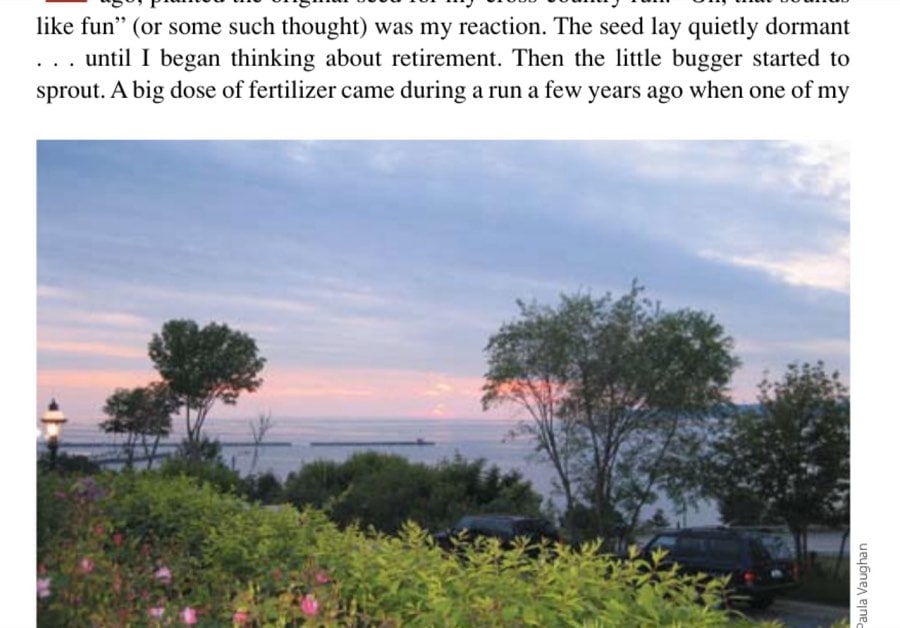
▲ The Petoskey breakwater in Little Traverse Bay—a destination well worth training for through blizzards and 1,400 miles of summer running in America’s heartland.
▲
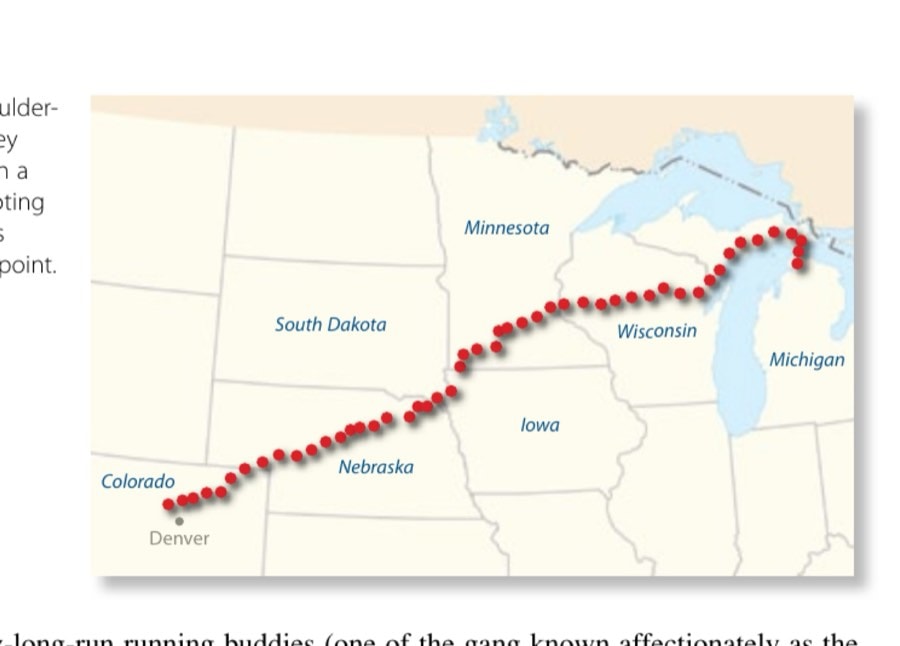
The Boulderto-Petoskey route, with a marker noting each day’s stopping point.
Minnesota
South Dakota
Wisconsin
Michigan Iowa Colorado
Nebraska
Denver
Saturday-long-run running buddies (one of the gang known affectionately as the “satboys”), Andy Edmondson, mentioned that a couple of female friends in San Francisco (Caroline Merrill and Annabel Marsh) had run from Boston to Los Angeles in 1984 when Annabel was 60. I, of course, piped up with “I’ve always wanted to run across the country; I just don’t know where from and to.” I started tossing out ideas when Ding! Ding! Ding! the light went on: Boulder, Colorado, where I’ve lived since 1973, to Petoskey, Michigan, where I grew up. Perfect! I make the trip back and forth at least once a year; I’ve driven it, flown it, taken a train, run bits of it whenever we’ve gone by automobile. . . . Why not go via my favorite form of transportation: perambulation? And thus the little seed began to grow.
Training and preparation Training and preparation for the run began with talking. If you tell someone about something you want to do, you’re much more likely to actually do it—or so the theory goes. In my case, it worked. First, I told my running buddies. Oh, and I mentioned it to my family. My husband’s steady refrain right up until we bought our support vehicle was “Don’t encourage her.” (Lost cause; the dam had broken.) Then, somehow, the person who was organizing my university retirement party found out about my plans and announced them in the campuswide invitation for my retirement party. No backing out now!
Next: a stroke of luck. I ran into Mark and Shirley Plaatjes one day, and they asked about my upcoming running plans. I told them about the run to Michigan. Mark asked, “Why would you want to do that?” After doing my best to explain, I asked if he would like to coach me through the training. He invited me to stop by his shop, I did, and we drew up a training plan. Mark’s advice and encouragement throughout the year were key to the success of the run.
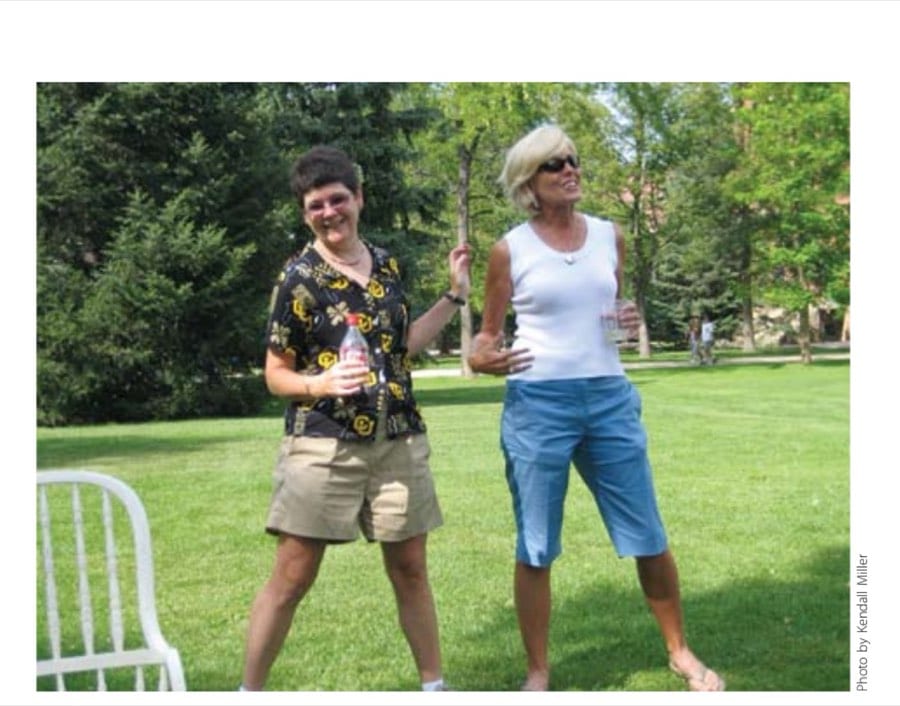
Photo by Kendall Miller
▲ Author Paula Vaughan (left) and her logistics wizard, Deb Mooney, celebrating at Paula’s University of Colorado retirement party—when training and planning began in earnest.
The training was centered around a gradual buildup of mileage on a four-week cycle (increase mileage for three weeks, then cut back to 50 to 75 percent of the high mileage on the fourth week). I also experimented with 30-mile days since the run was going to consist of 30 miles per day, broken into two runs, six days per week, for roughly eight weeks. I used these experimental long runs to help work out run/walk patterns and to figure out what and when to eat and drink during the run. I settled on running 37 minutes, walking three minutes, walking steep uphills, drinking at least every 20 minutes, and eating at least every 40 minutes. Gatorade, GU, spice gumdrops, and, if hot, Clif Shot Bloks became my staples during those training runs.
During the spring of 2006 (while I was still working), my mileage was at my traditional marathon levels of 40 to 55 miles per week. In June, I picked it up to 60 to 70 miles per week (still working, but now nodding off at my desk). After my July 28th retirement, the mileage grew. Excluding cutback weeks, my weekly mileage increased over the months roughly as follows:
August: 70-75 miles/week September: 70-75 miles/week (and a marathon) October: 80-85 miles/week (and a marathon)
November: 80-85 miles/week December: 90-95 miles/week January: 95-100 miles/week February: 100-110 miles/week March: 100-157 miles/week (one week with four consecutive 30-mile days) April: 100-120 miles/week (with one 30-mile day and two 30-mile runs)
May: 110-120 miles/week (with two 30-mile days and the first taper week) June 6: The Run starts! For the most part, my body seemed to adapt to the increased mileage— probably because I’ve maintained a 40- to 50-mile-per-week base for almost as long as I’ve been running (excluding two pregnancies and two broken arms), and the gradual increase gave the step-ups to higher mileage time to settle in on my aging joints and bones.
However, there were a few distinct instances of concern. The week of four consecutive 30-mile days was supposed to be a week of six consecutive 30-mile days to mimic what I would be doing over the summer. On the fifth day, I decided to bag the experiment; I was simply too exhausted. It was abundantly clear to me that you cannot run 180 miles per week (as slowly as I run) and also have a life. It just so happened that the week of this particular experiment was the week that my sons were home from college for spring break—which meant lots of going out and about loaded on top of the running and general day-to-day “stuff.” An April 30-mile run was also worrisome. The last 10 miles of the run were hot and on concrete, my legs were totally trashed, and my stomach was crying out for anything but the triple Gs (GU, Gatorade, and gumdrops). It made me wonder what I was getting myself into. Fortunately, I rebounded fairly well and blithely decided to keep on keeping on. As it turned out, the attitude of blithely going forward got me through many a mile during The Run.
Throughout the training period, running was my number one activity. I did participate in core training sessions for a few months during the summer and early fall of 2006, and I did try to stretch more regularly than I have in the past (though no one would ever mistake me for a stretching maven). But most of my day, almost every day, I ran. The weather gods added some significant challenges during the winter of 2006-2007: 61 consecutive days of snow cover, weekly blizzards, and hundreds of inches of snow made many a run less than pleasant. However, between my retirement day and the day I began The Run, I had only seven zero-mile days. Two of those were during the first month after retirement, most were due to travel, a couple were due to other commitments that filled up the day, and one was the planned day off during my 30 miles/day experiment week. None was due to weather. Although I didn’t expect to encounter snow
on The Run, I did figure there would be a lot of days when my head would be questioning why the heck I was out there. I wanted all the practice I could get convincing myself that running was just the thing I should be doing despite all indications to the contrary.
Training also included some essential nonrunning aspects. For example, ice: ice baths, cold water hose downs, and ice foot soaks. My muscles and feet thanked me a thousand times over when I iced them and screamed at me when I didn’t. Another crucial part of the year’s preparations: figuring out how much to eat and what to eat—particularly between two-a-day runs. I never completely mastered the eating conundrum but certainly became much more aware of what kinds of food worked, what didn’t work, and the necessity of consuming calories during and immediately after a run. My tummy found that oatmeal, eggs, soup, toast, avocado, and almond butter worked very well prior to running. Fish, grilled turkey, carrots, sweet peppers, and fruit were mighty tasty at the end of the day. Fruit smoothies or chocolate milk, oatmeal cookies, or fig bars were fantastic immediately after the last run of the day.
On top of the training, there was a boatload of logistical work, including • mapping the route; • contacting chambers of commerce in towns along the way to find out more about the town and to get advice about the route, places to stay, sights to
see, and so forth; • contacting running clubs along the way—particularly for areas where I had questions about the best running route to follow; • tracking down trail information and maps so that I could get some off-road time; •
contacting departments of transportation to verify that the route was acceptable (they were tremendously helpful, offering information about traffic levels, construction, and alternative routes); • trying to find sponsors (not my strong suit); •
creating a day-by-day book of the route with a page for each day’s map, directions and pickup points, then making three copies: one bound copy for the support crew, one for me to carry (carrying one page per day), and
one for my mom so she could follow along from Petoskey (in an attempt to allay her fears about her baby girl’s crazy adventure); • setting up a Web site including an online map to track my progress along the way; •
gathering running supplies (GU, Gatorade, shoes, and enough running gear to last between weekly laundromat visits);
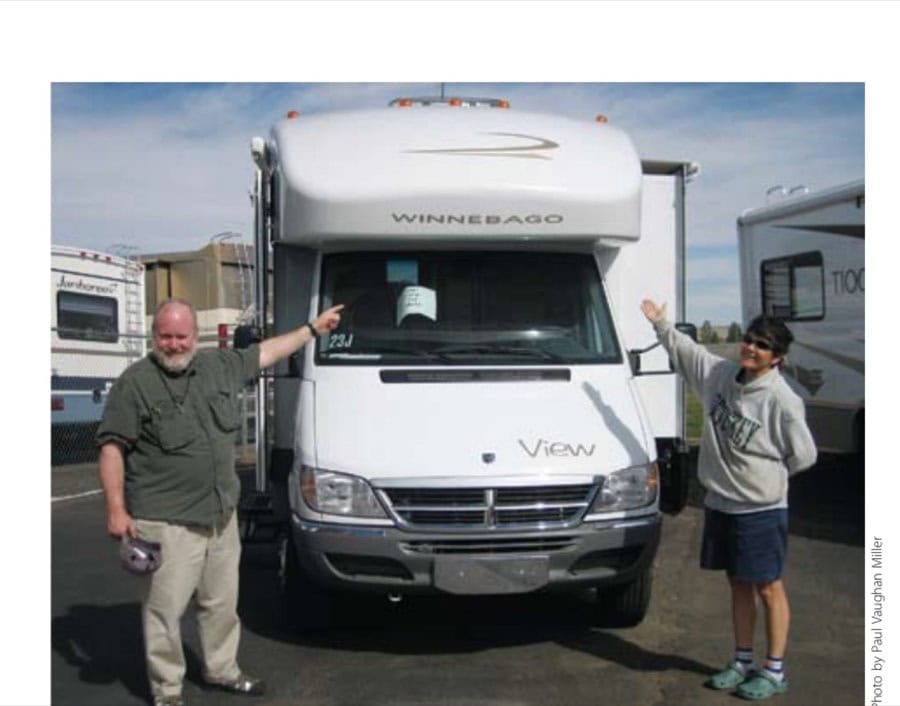
Photo by Paul Vaughan Miller
▲ Kendall Miller (Paula’s husband) and Paula and their brand new support vehicle. The run has to start now!
• getting our support vehicle, which turned out to be a really nifty 23-foot Winnebago View motor home; • supplying the View (almost like setting up a second home); • getting our Boulder home and household items (like bill paying) in order; and •
setting up rendezvous points along the way with folks who wanted to meet up with me. A fellow retired University of Colorado project manager and good friend, Deb Mooney, got together with me almost weekly throughout the year to help with the logistics—and to keep me on track. I truly don’t know if I would have finished everything on time or been so thorough without her extra brain power and encouragement.
The nitty-gritty of all the preparations is a blur now, but everything that really needed to be done must have gotten done since the house, the dog, the family, the runner, and the crew all lived through the grand adventure! Stay tuned for part 2 in our March/April issue: “Commence Running!”
This article originally appeared in Marathon & Beyond, Vol. 13, No. 1 (2009).
← Browse the full M&B ArchiveMore like this
1,000+ stories from 19 years of Marathon & Beyond
The complete archive of the legendary long-distance journal — digitized and free to read.
