

Ocean State Marathon
Entry Cost for 2001
$40 before 05JULY01; $50 until 24SEPT01; $60 after 24SEPT01
Area Hotels
The race starts in Warwick, Rhode Island, and finishes 26.2 miles north in Capital City Providence. When making your hotel reservations, decide whether you want to roll out of bed for the start at the Community College of Rhode Island in Warwick and then find your way back there after the race or stay in Providence and take advantage of free bus transportation to the start. Either way, there are many hotels to choose from, although they are on the pricey side. To receive preferred rates on airline tickets, hotels, and car rentals, you MUST make arrangements with Carlson Wagonlit/Donovan Travel: 401/885-3500 or 800/252-2660. A $10 service fee will be applied to your reservation.
Providence/Warwick Information
Rhode Island in general and Providence in particular are enjoying robust and spirited growth, and the proud CVBs do a great job of promoting the smallest state in the Union. For more information, contact the Providence/Warwick Convention & Visitors Bureau, 401/274-1636, www.providencecvb.com; the Warwick Economic Development Department of Tourism, 800/4-Warwick; or the Cranston Chamber of Commerce, 401/785-3780.
Getting There
Rhode Island is very accessible by plane, train, or auto, making this one of the easiest marathons to get to. Interstate 95 and 195 bisect Providence, which is 185 miles from New York and only 45 miles from Boston. Save time and money by flying right to the new T. F. Green Airport, only 12 minutes from downtown Providence. It is one of the most pleasant and hassle-free urban airports around, and the airfares should beat anything you could get to Logan Airport in Boston. The Amtrak station is five minutes from all the downtown hotels.
the last to ratify the Constitution (holding out until the Bill of Rights was added), Rhode Island has always been a little bit feisty. And its lone marathon appears to be cut from the same cloth.
Third Time’s a Charm
At 48 miles long and 37 miles wide (“before lunch” runs for some of our readers!), Rhode Island is the smallest state in the Union and has a rich and colorful past. Capital City Providence was established by clergyman Roger Williams, who took refuge there in 1636 after Massachusetts banished him for being too liberal. Once a powerful shipping and shipbuilding town, today Providence is the medical, cultural, educational, and artistic hub of the state and one of the few places in the United States where artists can live and work without paying income taxes.
Although Rhode Island has just one marathon, that one race carries on a tradition dating back 25 years to 1976, when the first 26-miler debuted in the state. “Little Rhody’s” current marathon is actually the state’s third attempt at a marathon—but it looks like the race has the staying power this time. Mansion-lined Newport, Rhode Island, was the site of the original Ocean State Marathon held from 1976 to 1986 and featuring a three-loop course. The race was successful, with 2,500 runners at its height in 1979, but was canceled in 1987 when it lost its primary sponsor. Next up was the Rhode Island Marathon (RIM), reincarnated in 1988. During its six-year run, the race was held on several courses in and around Newport, with portions in Middleton and a bit of Portsmouth, before moving to a point-to-point, Warwick-to-Providence route in 1992.
About this time, a group of local long-distance runners grew discontent with the direction RIM was heading and began plans to resurrect the Ocean State Marathon. Rallying around three key organizers, the Ocean State Marathon was reborn in 1993 with a point-to-point course along Rhode Island’s coast from Narragansett to Warwick.
In 1997, the affable and hardworking Gerry Beagan, a member of the Tuesday Night Turtles, one of several running clubs supporting the event, emerged from the three original directors to become the sole director.
In its inaugural year, the revived OSM held its race one week before RIM and very close to the RIM course. Under head-to-head competition, RIM folded the next year. By 1994, OSM entries had more than doubled to 1,100. In 1999, with entries nearing 2,000, Beagan unveiled the current Warwick-to-Providence course. The new route does not feature all that’s beautiful about Rhode Island nor take in many of the state’s 400 coastal miles, but it is flat, fast—definitely a Boston qualifier—and includes an exciting downtown finish, right in front of the new Convention Center, where the postrace festivities take place.
From the start, Beagan’s vision was to develop a first-rate, national-class marathon for the state and people of Rhode Island to take pride in. Beagan and his race committee are steadfastly determined to give every runner, from first to last, a prime-time marathon experience. By and large, they are succeeding. One of the few U.S. marathons to offer age-group prize money and course record bonuses, this is by no means a regional marathon. The 2000 race included participants from 42 states and 17 nations.
The total purse continues to climb, resting currently at a guaranteed $112,000 plus bonuses and time incentives. Each year Beagan brings in a good crop of elite male and female marathoners to duke it out at the front of the pack. The winning times are fast—Igor Osmak of the Ukraine broke the course record with his strong 2:14:24 in the 2000 event; masters runner Tetyana Pozdnyakova, also of the Ukraine, holds the women’s record of 2:31:52. As the race pours time, money, and energy into its elite program, its challenge will be to make sure the rest of their field gets first-class treatment, too.
Beagan and his race committee tweak the event each year, always eager to add new wrinkles. Take their race medals, for instance: gold medallions to the top 500 finishers, silver for finishers 501–1,000, and bronze to finishers 1,001 and above. Although a challenge to administer, the main concept is to give the entrants one more incentive to compete against themselves and other runners in the race. Most runners we spoke to liked the idea of the colored medals.
Double Change
In one of the gutsier moves we’ve seen on the marathon scene in recent years, Beagan has changed both the month and day of his event. The already short list of November marathons just got shorter. And the list of great October marathons— including several in New England alone—just got longer. Starting this year, the Brooks Pharmacy Ocean State Marathon will
Must See/Must Avoid
Tiny Rhode Island, nicknamed the Ocean State, lays claim to over 400 miles of coastline, over 100 beaches, and 2,300 park acres on six islands. Even more impressive is that more than 20 percent of the nation’s registered historical landmarks reside in the state. Capital City Providence was tapped by the editors of Money magazine as the “Best Place to Live in the Eastern U.S.” for the year 2000. Given the state’s size, nothing is very far from anything else, so your real dilemma will be deciding what to see while you’re there. Here’s our take on some sites to visit while you’re in the State of Rhode Island and Providence Plantations. What, you didn’t know that was the state’s official name? It has the longest official name of any state.
Go See It
Newport mansions. Home to many yacht clubs and the America’s Cup Race from 1930 to 1983, by the late 1800s, Newport was where ultrarich Americans built their summer “cottages.” The two main drags, Bellevue and Ocean avenues, provide views of the mansions, the most ornate of which is The Breakers, an eye-popping 70-room estate built in 1895 for Cornelius Vanderbilt, II. An audiotape tour of Newport is available through the Convention and Visitors Bureau. Mansion visits are not free but worth the money. Consider purchasing combination tickets, which allow you to visit more than one. 401/847-1000. The perfect postmarathon leg stretch would be the gorgeous 3-mile Cliff Walk, which hugs the bluffs around Rhode Island Sound between Easton’s Beach and Bailey’s Beach on Newport’s east side.
Block Island, once called the “Bermuda Triangle of the East” because of its dense fog and ship-ensnaring shoals, is accessible by ferry year-round from Point Judith (ferries also run from Providence and Newport, mid-June through Labor Day). 401/783-4613. A popular summer vacation resort due south of the state’s mainland, the island should be peaceful in October. You’ll find hiking and biking trails as well as wildlife sanctuaries. Be sure to head to Mohegan Bluffs, on the island’s southeastern shore. Scale the 200-foot-high cliffs and you’ll have a spectacular view of the restored Victorian-style lighthouse, Southeast Light, built in 1875. Boats 35 miles out to sea can see the beacon cast by the lighthouse lantern, perched 240 feet above sea level.
Benefit Street-College Hill. The arts thrive in Providence, and nowhere is that celebration more evident than along Benefit Street-College Hill in Providence. Dotting what locals call the “Mile of History” are more than 200 restored buildings from the 18th and 19th century—houses, taverns, schools, and shops, originally built by sea captains and shipbuilders during the city’s prominence as a shipping and shipbuilding center.
Museums. If you dig museums, check out these two located in Providence: Museum of Art—Rhode Island School of Design, 224 Benefit Street. The museum features a diverse collection of over 80,000 works, from Greek and Roman art to contemporary pieces and American furniture. 401/454-6500. Culinary Archives & Museum, 315 Harborside Boulevard at the Harborside campus of Johnson & Wales University, one of the top cooking schools in the United States. 401/598-2805. The museum houses over 400,000 cooking and food-related artifacts dating back to ancient times. Admission charged at both museums.
Fine dining. If you just gotta go to the race’s pasta feed, fine, but do save at least one meal for one of the impressive restaurants in Providence. Al Forno on South Main Street earned a “Best Casual Restaurant in the World” distinction several years ago. The Federal Hill area, with its concentration of Italian restaurants, is a good bet for a pre- or postrace meal and is within easy walking distance of downtown. The locals are proud that their city is such a hot food destination, and they are happy to recommend their favorite places to eat, so do ask.
Avoid It
As with any urban environment, it is best to stay in populated, high-activity areas of the city.
move from its mid-November date to Columbus Day—not Columbus Day weekend, mind you, but Columbus Day, as in Monday. This year that falls on October 8, the day after the Chicago and Twin Cities marathons. According to Beagan, the main reason for the change was significant conflicts with churches along the course. “The congregations were severely inconvenienced, or so they petitioned,” notes Beagan, “and we knew race growth would only worsen the condition.” The new date also minimizes the chance of horrendous weather. Says Beagan, “Obviously, any date move impacts our race as well as other races in the time frame. We will see how the decision shakes out. We hope for growth, but we are guaranteed nothing.”
COURSE HIGHLIGHTS
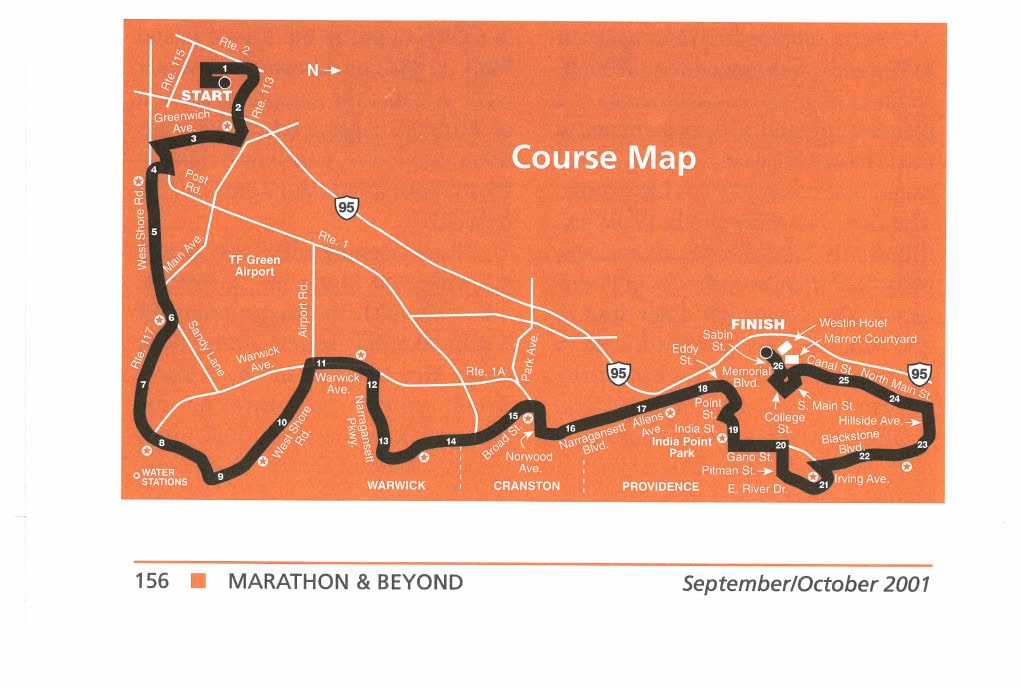
The old course for the new Ocean State Marathon, running from Narragansett to Warwick, was moderately difficult, subject either to nasty headwinds or a pleasant tailwind, and not particularly fast. The new Warwick-to-Providence route, first run in 1999, is PR worthy. The first 14+ miles are in Warwick, followed by 2 quick miles in Cranston, and a final 10 miles in the city of Providence. The course has a net drop of 150 feet, only one noteworthy hill in the first 19.5 miles, a few hills in the last 6 miles, and an extremely fast final 3 miles, including a two-tenths of a mile downhill right after mile 25. Runners share the road with traffic much of the time, sometimes funneling down to a very narrow lane along busy streets. Police escorts abound, however, so traffic is always under control. Parts of the course are residential and scenic, while other miles are drearily urban and industrial. The section along Point Street in Providence is especially raw, but East Providence is stately and inspiring.
COURSE IN DETAIL
A nice, wide starting berth welcomes you outside the CCRI fieldhouse in Warwick. The start is smooth and efficient. Your chip time and watch time won’t differ much. After a loop around the campus, you’ll move onto Commonwealth Avenue and then East Avenue (known locally as Route 113). The roads are narrow, residential, very “New England,” and clear of traffic. Spectator visibility is ideal, especially as the route passes the main entrance to CCRI, opposite the Rhode Island Mall. A right onto Greenwich Avenue takes you into the Apponaug section of Warwick. After a left on Veterans Memorial Drive, you’ll turn right on West Shore Road (aka Route 117) at mile 4.1.
These opening miles are gentle, allowing you to get into a rhythm, which should help you run strong for 7 pancake-flat miles along West Shore Road. While on West Shore Road, you’ll pass through the Warwick communities of Buttonwoods, Oakland Beach, Conimicut, and Hoxsie 4-Corners at the 11-mile mark. This section is a mix of light commercial and residential. If you get hungry for a burger along the route, you could certainly find a place to buy one. As the course hits mile 10, you’ll have only a narrow lane to stay in, as traffic runs both ways there. The corner of West Shore Road and Warwick Avenue is a good spectator spot—and one of the few places on the course where you’ll actually see some.
Turning right at Hoxsie 4-Corners onto Warwick Avenue, you’ll run about a mile before turning right onto the beautiful residential Narragansett Parkway. With just 2.4 miles left in Warwick, you’re now in the Gaspee section. The 20K split coincides with the start of the annual Gaspee Days Parade. You’ll also have your first look (off to your right) at Narragansett Bay, the large finger of water that runs between the east and west portions of the state. There is a modest, 250-yard climb by the Narragansett Village Condos. Look for bagpipers at the halfway point. After a short downhill and a straight shot to the Pawtuxet Bridge at mile 14.2, you begin to log your only miles in Cranston before crossing the Providence line at mile 16.2.
The Providence skyline in distant view, you’ve got exactly 10 miles to go. The first 3 miles of Providence are exceptionally fast, especially Allens Avenue, which, along with Point Street, are the scenic low points of the course. When you reach Gano Street at 19.4 miles, you’ve reached stately but challenging East Side. Over the next mile, you’ll have an equal uphill/downhill combination. At mile 21.1 along Irving Avenue, you’ll have another hill—this time a quarter-mile climb, Ocean State’s version of Heartbreak Hill—before moving onto the prettiest section of the course. You’ll hardly know you’re in the city: the area is wooded with large, magnificent houses and bagpipers providing the soundtrack. Wide Blackstone Boulevard with its grassy, tree-lined median strip will feel like Commonwealth Avenue on the Boston Marathon course. (Hey, these Boston similarities are starting to add up, especially with the Monday start!). Enjoy this rolling to flat 1.6-mile stretch. Only 3 miles to go and one final hill at mile 24.4 on Hillside Avenue.
The only course change in 2001 involves the finish, which has moved one block from Kennedy Plaza, which is undergoing construction changes and cannot support a finish. The new finish at the Convention Center will be more convenient for the participants, some of whom complained in past years about—get this—the block-long walk from the old finish line to the CC for the postrace festivities! So, the final mile will continue to offer you the swooping downhill drop to Canal Street at mile 25, but then you’ll make a left, three rights, and another left before a straight away finish on Exchange Terrace.
As one veteran entrant put it, “Ocean State is a great race for marathoners who just want to go out and have a good, fast run. They don’t want to be elbowing their way through the crowds, tripping over anyone. And they don’t want to party along the way or have to register six months in advance.”
TOP-NOTCH VENUES
Runner’s High/Runner’s Low
| HIGHS | LOWS |
|---|---|
|
|
This marathon has terrific venues, starting with the new, state-of-the-art Rhode Island Convention Center in downtown Providence. This bright, airy facility hosts the small but cozy six-hour expo, the elite runner panel, as well as the prerace pasta feed and the postrace party and awards ceremony, held in a beautiful rotunda with a gorgeous view of the Providence skyline. Cheerful and plentiful Brooks Pharmacy staff, dressed in signature red jackets, dot every corner of the building, directing lost or tired runners to where they need to go. About the only complaint we heard about the facility, and Providence in general, is that you’ve got to pay to park—all weekend. A generous gesture on the part of the city, which hangs bright red “Welcome Ocean State Marathoner” banners all over the city, would be to waive parking fees in designated garages. Other marathon host cities do this, and it’s a big hit with participants. Count on Beagan to work on this.
If you do fly to the race, don’t even bother renting a car. Take a taxi from the airport and stay in downtown Providence. Everything’s within walking distance, and you can take the free shuttle to the start in Warwick.
Equally terrific is the Community College of Rhode Island (CCRI), the race-morning staging venue. The race provides transportation from the Convention Center to CCRI (a 20-minute ride), where you can sprawl out inside the school’s enormous fieldhouse, which comfortably holds 2,000-plus runners spread out all over the gym floor and bleachers. There are tons of porta-johns, and the excellent sound system they’ve got set up allows you to hear all the announcements whether you’re inside or outside of the building. You’ll feel like you’re at a race in any small-town USA. You can even wait until race morning to pick up your race bag and chip, if you’d like, another way the race tries to accommodate the entrants (although exhibitors would rather everyone have to come to the six-hour expo). And, even though the stated policy is “no raceday registration,” we did, ah-hem, see a good handful of local folks registering that morning (but don’t tell anyone).
ELITE RUNNER PANEL
Ocean State highlights the presence of their elite runners by presenting an “Elite Runner Panel,” featuring three or four of the top male and female competitors. Bill Rodgers is also a guest. Having the panel after the expo allows even intrigued exhibitors to attend. While the concept is novel and has great potential, the format is disorganized and lacks structure. In addition, few of the runners on the panel speak English, so much gets lost in translation. Even the first-timers in the audience hunger for some last-minute advice and can learn from the elite runners present, but the panel doesn’t take advantage of this opportunity. Much to the disappointment of the panel attendees, the most popular guy in the room, Billy Rodgers, got barely five minutes of airtime. Look for Beagan and his committee to overhaul this aspect of the race.
At last there’s a marathon in Rhode Island that will survive the test of time. Expect this event to keep getting better and better each year. From the chock-full of goodies goodie bags to the organized and efficient finish line,
smooth sweatbag retrieval system, and plentiful food at the finish line and at the Convention Center, the Brooks Pharmacy Ocean State Marathon gives you a great value for your entrant dollar. For a tiny state, Rhode Island does marathoning BIG!
The Bottom Line
We have weighed various aspects of a marathon within a 1,000-point scoring grid. Besides the author of the article, two dozen runners at the race were randomly chosen to score the race for us (OSM = Ocean State Marathon). The results follow:
1. HISTORY/TRADITION
Evaluate the race’s sense of history and tradition.
[Possible points: 30 OSM score: 26]
2. ENTRY FORM
Is the race entry form clear, concise, attractive, complete, and easy to fill out?
[Possible points: 20 OSM score: 20]
3. ENTRY COST
For most races, the entry fee covers between 30 and 50 percent of the cost of putting on the event. Rate the value of your dollar relative to this race.
[Possible points: 30 OSM score: 29]
4. LOCALE/SCENICS
Is the race held in an area that is easy to get to and scenic and offers adequate food and housing services and nonrace activities for family and friends?
[Possible points: 50 OSM score: 46]
5. REGISTRATION
Is registration well organized and efficient? Does it bog down unnecessarily?
[Possible points: 20 OSM score: 20]
6. PRERACE ACTIVITIES
Evaluate activities such as pasta feeds, parties, and so on, during the days before the race.
[Possible points: 50 OSM score: 35]
7. EXPO
Does the expo offer a fair number and variety of booths relative to the race’s size? Are there quality exhibitors and good guest speakers?
[Possible points: 50 OSM score: 25]
8. COURSE
Take into consideration the following: degree of difficulty, certified, sanctioned, quality of road or trail surface, adequate mileage and directional markers, aid stations, medical coverage, race communications, accessibility to course for friends and family, typical weather, and so on.
[Possible points: 400 OSM score: 350]
9. RACE AMENITIES
This category includes race T-shirt, finisher’s medal, finisher’s certificate, adequate and efficient finish area, ease of sweatbag retrieval, showers, postrace refreshments, awards ceremony, raffles, results postcard, results book, and so on.
[Possible points: 250 OSM score: 240]
10. VOLUNTEERS
Are the volunteers experienced and adequate in number?
[Possible points: 100 OSM score: 95]
TOTAL SCORE FOR OCEAN STATE MARATHON
886 points
This article originally appeared in Marathon & Beyond, Vol. 5, No. 5 (2001).
← Browse the full M&B ArchiveMore like this
1,000+ stories from 19 years of Marathon & Beyond
The complete archive of the legendary long-distance journal — digitized and free to read.
