

THE MARATHON had reached its moment of truth. The lakefront course turned northward and I could see the lead runner, a Canadian, silhouetted against the skyscrapers of downtown Chicago. At 22 miles I checked my watch and estimated he had a 30-second lead. Accelerating, I passed him in another mile and a half and didn’t look back. In a dozen tries, it was my first victory in a marathon. The fact that the win came in my hometown made it doubly delicious.
Alas, the year was 1964, well before the current LaSalle Bank Chicago Marathon got its start. My victory came in the Windy City Marathon, which might be considered a precursor to the race that will celebrate its 25th anniversary this fall with a field, mind you, limited to 37,500 runners. The race I won attracted, at best, a few dozen, although we were relatively fast. Three other runners finished within five minutes of my winning time (2:35:04) and most of the rest probably broke three hours. But there was no prize money or appearance fee. No Khalid Khannouchi. No Catherine Ndereba. In fact, not a single female ran Windy City since women did not run marathons in that distant and unenlightened era.
No police were out to stop traffic for us, nor did volunteers offer water. No charity runners. No pacing teams. The race was timed with a stopwatch. Our back-and-forth course along the South Side lakefront was run on sidewalks and an abandoned strip of the old Lake Shore Drive to minimize traffic conflict. We probably failed to inform the park district about the race for fear that it would either tell us not to run or charge a fee for our doing so.
The Windy City Marathon remained on the Chicago race calendar for several years and then vanished for lack of a clear purpose. A dozen years passed before the current Chicago Marathon got its start on September 24, 1977, as the Mayor Daley Marathon. By then I was no longer capable of challenging younger (and faster) runners for the lead.
THE BEGINNING OF THE BOOM
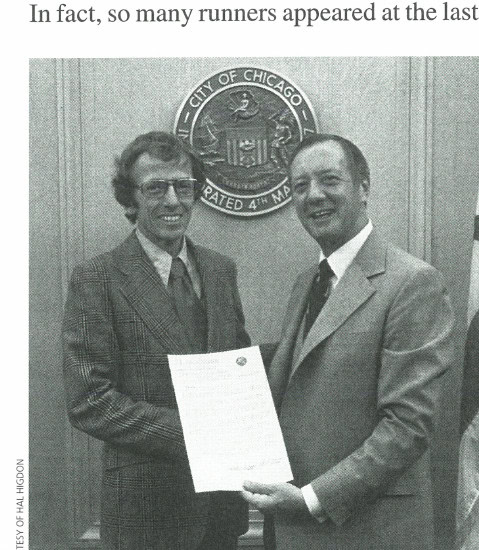
That was the beginning of my involvement with variously named marathons in Chicago. Indirectly, I deserve some credit for the founding in 1977 of the event that is now The LaSalle Bank Chicago Marathon. The previous fall, I had been among several individuals approached by the First National Bank of Chicago, which was interested in sponsoring a running race. This was at the beginning of the first running boom, inspired by Frank Shorter’s victory in the 1972 Olympic Games Marathon. The bank saw race sponsorship as part public service and part public relations (the same causes that motivate the LaSalle Bank today). Investment counselor Wendell Miller, cardiologist Noel Nequin, and University of Chicago track coach Ted Haydon were among those serving on our race-planning committee.
Originally, the plan was to run a marathon. Street savvy, I told the bank, “Nobody’s going to run 26 miles. You’d be lucky to get a few dozen runners.” I talked the organizers into a 20K race instead, particularly since they wanted the race on the Fourth of July.
The First Chicago Distance Classic, as it was called, did prove to be a success, attracting approximately 5,000 runners including Shorter, who won. In fact, so many runners appeared at the last minute that the organizers ran out of numbers and told late entrants to simply run unregistered. Meanwhile, a second group proceeded with plans for a fall marathon. The group included several of the 20K organizers plus Wayne Goeldner, physical education director of the Hyde Park YMCA; Bill Robinson, executive director of Friends of the Parks; and Sharon Mier, director of women’s sports at the Loop Center YMCA. Many of those who ran the Classic decided that, with a little more training, they might be able to run the marathon. More than 4,000 entered the race, although only 2,128 succeeded in finishing the first Mayor Daley Marathon. (Runners had been urged to participate even if they planned to run only a few miles.) It was one of six marathons I ran that year and the only one I dropped out of. Dan Cloeter won in 2:17:52 with Dorothy Dolittle running 2:50:47 to lead all women.
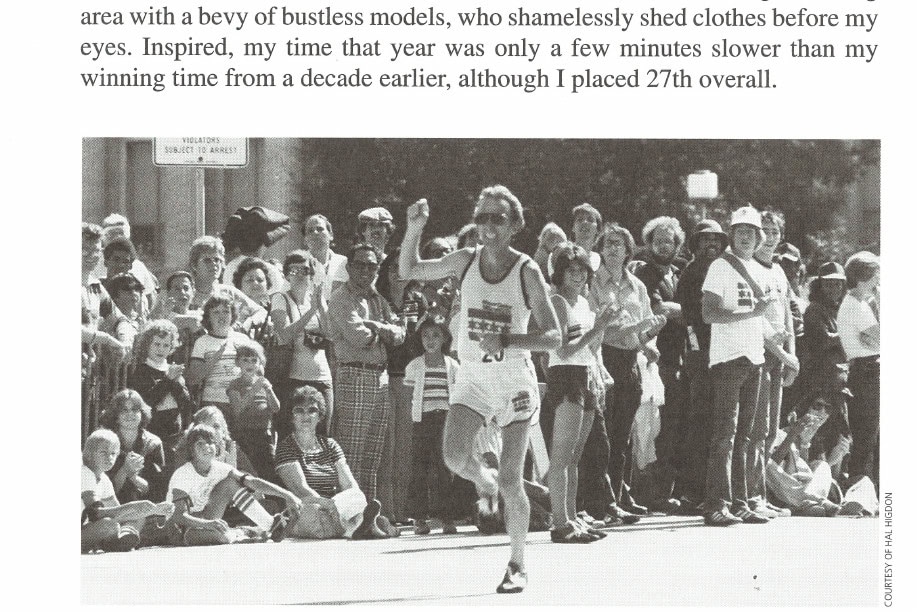
Staging a race that large cost much more money than its organizers had anticipated. When cash ran short, Miller sought support from Lee Flaherty, a businessman and 3:14 marathoner. Flaherty owned Flair Communications, a design company, and saw the marathon as an opportunity both to do some good and promote his business, but he absorbed a $70,000 loss that first year. To limit losses the second year, he began to offer an impressive array of clothing items. He also enlisted Chicago’s glitterati to add class to this sweaty running event. “We set the standard for taste in marathons,” Flaherty would claim. My peak experience was participating in a marathon fashion show and sharing a dressing area with a bevy of bustless models, who shamelessly shed clothes before my eyes. Inspired, my time that year was only a few minutes slower than my winning time from a decade earlier, although I placed 27th overall.
TOO MUCH, TOO LATE
Not everybody in Chicago, however, appreciated Flaherty’s high-society approach to race organization, nor the fact that he doubled the entry fee from $5 to $10 and moved the starting time from 8:00 A.M. to 10:30 A.M. to make the event more attractive to spectators and sponsors. Dr. Nequin argued that the late start meant that slower runners would be forced to run in increasingly warmer weather, a threat to their safety. Protesters on race day wore black armbands and hoisted signs saying, “$10 Too Much. 10:30 Too Late.” This irritated the Daley family, who had not forgotten how protests marred the 1968 Democratic Convention in Chicago. The family asked that the late mayor’s name be removed from the marathon’s title. (Tyvek jackets with “Mayor Daley Marathon” on them would probably now sell well on eBay.)
The protest temporarily fractured the Chicago running community, but it would have a long-range positive effect. Among those wearing black armbands was Erma Tranter, who had served as race coordinator for the first marathon. When a group of the protestors founded the Chicago Area Running Association (CARA), she became its first executive director. Tranter went on to occupy the same position with the Friends of the Parks. Anyone who follows Chicago politics knows that she has not abandoned her early militancy, much to the city’s benefit.
By the marathon’s third year, I moved from the course to a TV camera beside the course, becoming color commentator for the telecast of what had been renamed “America’s Marathon/Chicago.” The entry fee was lowered to $8 and the race date was moved four weeks back to October to still critics, but unseasonably warm weather still slowed runners. Dan Cloeter won for the second time in three years but in a 2:23:20, 10 minutes slower than his best. The women’s runner, Laura Michalek, ran 3:15:45. Fifteen years old, she trained with the boys’ cross-country team at suburban Morton West High School.
In an article in The Runner magazine, I wrote, “Superbly organized, run on Chicago’s magnificent lake front, America’s Marathon/Chicago suffers only in comparison with the more lavish New York race on the same day. Even Bill Robinson, one of last year’s dissidents, conceded that this year’s race was an improvement: ‘I think they’ve finally gotten it turned around.'”
I probably should have stopped at that point, but I couldn’t resist complaining about the new name, “America’s Marathon.” This was at a time when the Dallas Cowboys were promoting themselves as “America’s Team,” and the name made me wince. I wrote, “How about just calling (the race) the Chicago Marathon next year?”
My outspokenness both in print and during telecasts didn’t always endear me to Lee Flaherty. Lee and I always had a love/hate relationship, still do.
Minutes before I took my seat as color commentator several years later, Flaherty pulled me aside and complained, “You’ve never said anything good about the marathon!” Not entirely true, but the following year when I warned against hiring Bob Bright as race director, a flamboyant promoter with a shady background, Flaherty chose not to listen.
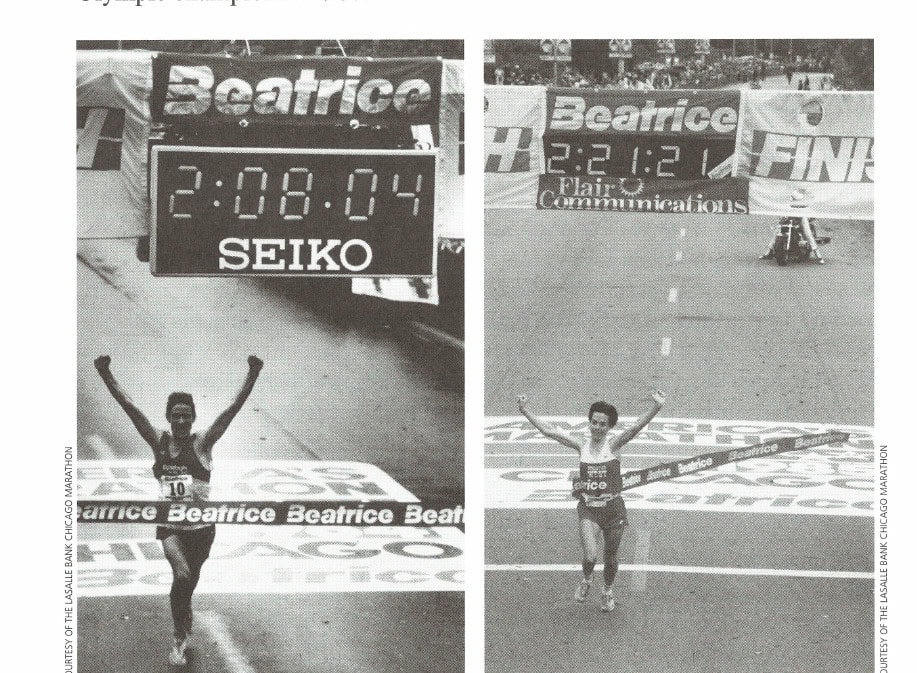
Bankrolled by a conglomerate giant, Beatrice Foods, Bright soon entered into a bidding war with the New York City Marathon. Beatrice, a Flair client, provided as much as $3.2 million in sponsorship funds annually. Bright proved adept at spending that money, and soon the world’s best runners were flying past New York en route to Chicago. Steve Jones set a world record of 2:08:05 in 1984, then returned the following year and ran 2:07:13, missing by one second the world record that Olympic champion Carlos Lopes had set elsewhere during the interim. That same year of 1985, Olympic champion Joan Benoit set the women’s world record of 2:21:21 in a stunning duel with Norway’s Ingrid Christiansen and Portugal’s Rosa Mota, who would succeed Benoit as Olympic champion in 1988.
Jones said after his first victory, “I had no idea what kind of pace I was running and no idea how fast they were running. I got to 25 and the press truck left to go to the Finish Line. A writer from London shouted that if I kept it under the five-minute pace, I had a chance for the record. I was confused and thought he meant a course record!” The fast performances attracted increasing numbers of slower runners, who hoped to use Chicago’s quick course to qualify for the Boston Marathon or set personal records. In 1986 a record number of 8,173 runners finished.
A SKYBOX APPROACH TO SPONSORSHIP
Standing on the sidelines, I had to applaud the athletes’ performances, even though I winced at the “skybox” approach to sponsorship. Bright flew first class, stayed in the best hotels, used his expense account to dress like he was part of the Royal Family and rented stretch limousines while attending marathons all over the world to recruit runners. Those who later examined the marathon’s books said money flowed down the drain like dirty dishwater. “We were hemorrhaging cash,” recalls Miller. “We lost enough in T-shirts alone to bankroll most road races.” Basking in success, the Beatrice executives cared little how their money was being spent. While $3 million for a marathon sounds like a lot, the conglomerate’s annual marketing budget was more than $100 million. Beatrice spent $13 million a year on its auto racing sponsorship so that executives could hang out in style at the Indianapolis Motor Speedway.
The moral level of Chicago’s marathon would improve, though not overnight. In 1983 Carey Pinkowski ran his first and only marathon in Chicago. Pinkowski was a cross-country and track state champion from Hammond (Indiana) High School, one of three runners at that school to break 9:00 for the two-mile run in the same year. Pinkowski recalls, “In one day I went from the fastest kid in the country to third fastest in my high school.” The other two runners were Rudy Chapa and Tim Keogh; the trio’s coach was Dan Candiano. In the quarter century since, no other high school has had three distance runners that fast.
Pinkowski attended Villanova University and continued to compete after graduation but proved to be a better miler than marathoner. “I trained for four marathons, but only started one because of injuries caused by overtraining,” he admits. His time in Chicago was 2:20:48, good enough for 26th place. “I used to brag about the time until the women started running faster,” laughs Pinkowski.
Pinkowski’s time would come, although not in competition. Despite its successes, the Chicago Marathon soon faced hard times. Conglomeration might have seemed the business wave of the future in the 1970s but not in the 1980s. Beatrice Foods had gotten too big and spent too much money getting there. The conglomerate went belly up, its executives riding their golden parachutes into retirement. In 1987, because of reduced sponsorship, America’s Marathon/Chicago was cancelled and a half-marathon was run in its place. (That’s one reason why this year’s race is the 25th anniversary and not the 26th.)
The following year, the marathon returned with a new sponsor, Old Style Beer, and a new name, The Old Style Marathon. I ran the marathon in 1988 with my daughter, Laura, who was then publicity director for Carson Pirie Scott. Unlike her older brother Kevin, who once qualified for the Olympic Trials, Laura was mostly a recreational runner, when business duties didn’t get in the way. Laura tripped and fell while passing McCormick Place (then the nine-mile point) but got up and finished in 5:37:55 for her first marathon.
This was before the boom in even slower charity runners, so we were near the back of the pack. The course in 1988 ran clockwise around the city rather than its current counterclockwise route. As we ran through the North Side, I ducked frequently into bars to check the Chicago Bears score. Soon I began to hear the loudspeaker of a police car several blocks back asking trailing runners to move onto the sidewalks. When we reached Lake Shore Drive with about five miles to go, we were diverted onto lakefront paths instead of the drive. Laura and I found ourselves running in step with former Mayor Michael Bilandic, an early supporter of the marathon, who showed no embarrassment about being so far behind. We spent most of the last miles in conversation. My daughter and the former mayor didn’t realize it, but they were the wave of the future in running as more and more “nonrunners” took to the sport.
The Old Style sponsorship lasted only three years. For the 1991 race the winner’s prize money was reduced from $30,000 to $7,500. Winning times of 2:14:33 and 2:36:21 by Brazil’s Joseildo Rocha and Sweden’s Midde Hamrin-Senorski paled in comparison with times posted in the previous decade. Numbers of competitors also were down. Only 5,908 runners finished. Bright had departed the year before to be replaced by Carey Pinkowski, at age 32, the youngest director of a major world marathon. At that time the marathon reportedly was $1.4 million in debt. Flaherty later confessed to me that, world records aside, he probably should have listened when I advised him not to hire Bright.
As for Pinkowski, he admits, “I got the top job partly because nobody else wanted it.”
Despite its prominence on the world scene during the 1980s, the variously named Chicago marathons lacked one essential item other than money: the respect of the local running community. A residue of ill will still remained from the black armband days. With no budget for jetting around the world, Pinkowski focused his attention within the city, talking to Chicago runners, appearing at their club meetings, enlisting them as race-day volunteers, encouraging them to enter their local marathon rather than run out of town.
Pinkowski also mended fences with CARA. In 1989 CARA board member Brian Piper had started a marathon class that in its first year attracted 35 runners. I spoke at the group’s postrace banquet at the Como Inn in a very small room. Piper enlisted me to help design a training program for class members. Over the next several years, with the help of many volunteer coaches, we fine-tuned an 18-week training program for novice, intermediate, and advanced runners that now is used by runners all over the world preparing for Chicago and other marathons. (The training schedules are available online at www.halhigdon.com or in an interactive “Virtual Training” format through www.chicagomarathon.com.) Within the next decade, the CARA Marathon Training Class would blossom to more than 2,000 runners with clinics in five areas of the city and 13 separate weekend workouts. The class provided CARA with an enormous cash cow, allowing the organization to professionalize its office and staff, the better to serve area runners. The protesters from 1978 have long since removed their black armbands.
BRINGING THE RECORD BACK TO CHICAGO
Success did not come overnight, however. Lee Flaherty, whose Flair Communications had provided the organizational base for the marathon through the good years and the bad, sold his ownership in 1993, with Pinkowski remaining as an equity partner. The LaSalle Bank became title sponsor in 1994 and three years later purchased the race. This was the first time that a marathon race sponsor became the owner of the race it sponsored. “The bank wanted a long-term relationship,” says Pinkowski. “Buying the race, though unique, seemed to be their best option.”
With its solid community-based support, the numbers of runners began to gradually increase from 7,513 in 1991 to 10,925 in 1996 to 20,063 in 1998 to
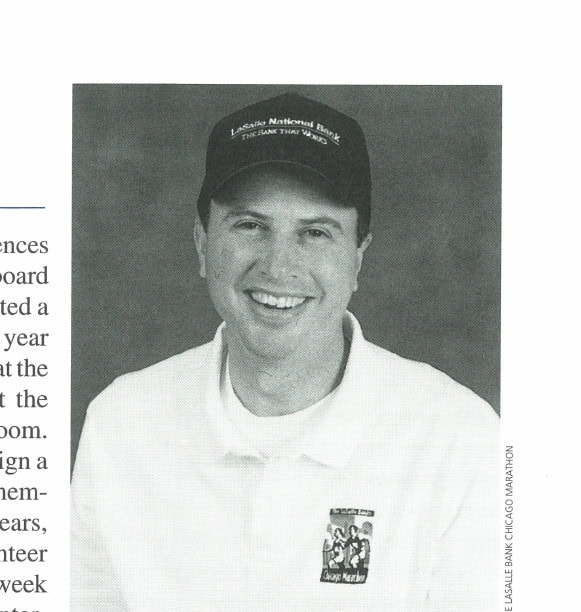
33,171 in 2000, until finally for 2001, the marathon office placed a limit on the number of entrants at 37,500. Few races handle large numbers as well as Chicago. “With our wide starting area on Columbus Drive, we can accommodate more runners than most marathons,” says Mike Nishi, the race’s general manager. “Use of the Champion Chip also helps relieve pressure on the starting line, but we recognize that there’s a point when you can become too big and too successful.”
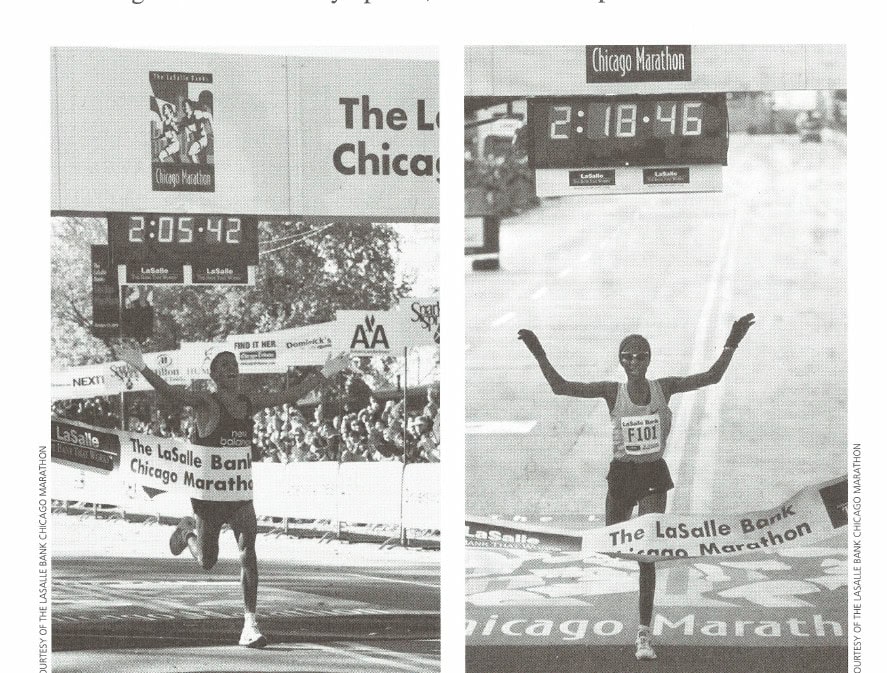
The numbers posted by the elite runners also improved. As more talented marathoners began to pick Chicago as their fall racing destination, Pinkowski frequently stated his goal as bringing the world record back to Chicago. He achieved that goal in 1999 when Khalid Khannouchi, a Moroccan soon to become an American citizen, ran 2:05:42 and again in 2001, when Kenya’s Catherine Ndereba ran 2:18:54. For a moment in time, Chicago held both the men’s and the women’s world records. Then, in April of this year at the London Marathon, Khannouchi lowered his record by five seconds in beating Kenya’s Paul Tergat and two-time Olympic 10,000-meter champion Haile Gebrselassie.
“That just raises the challenge to get the men’s world record back,” says Pinkowski.
But the important numbers don’t appear on the finish line clock. According to the Regional Economic Application Laboratory, The LaSalle Bank Chicago Marathon now brings $90 million into the city each year. During the down years, the mayor’s office rarely paid much attention to ceremonies surrounding the race. Finally, in the mid-1990s, Mayor Richard M. Daley showed up at a press conference to say a few words before departing. Within a few years, he started to stay for the entire conference, seated next to and chatting with bank chief executive Norman Bobins. Lately, Mayor Daley has begun to hang around afterwards to chat with anyone who wants to talk, his aides gently tugging at his sleeve. Chicagoans have a word for what their marathon now possesses: “clout.”
It has been my pleasure over a quarter century to watch from both the inside and outside as Chicago has become perhaps the world’s best destination marathon. It’s more than just the world records or a chance for runners of all abilities to seek their personal bests. Never has the city looked better, particularly in October. The Loop is awash with flowers. The lake sparkles. The weather is generally mild, ideal for running. Chicago has become a great destination city for travelers from all over the world, not just for runners. Add to that an expo unmatched in running, a gala prerace pasta party, and a postrace celebration at Navy Pier that ends with fireworks over the lake. Little wonder that runners from all over the world now want to come to Chicago, the Windy City.
I can’t help looking back at the Windy City Marathon in 1964 when only a few dozen runners appeared, allowing me to claim my first victory at 26 miles, 385 yards. I continue to savor that win, but I appreciate even more what The LaSalle Bank Chicago Marathon has become.
This article originally appeared in Marathon & Beyond, Vol. 6, No. 5 (2002).
← Browse the full M&B ArchiveMore like this
1,000+ stories from 19 years of Marathon & Beyond
The complete archive of the legendary long-distance journal — digitized and free to read.
