

Classic Mistakes Even Experienced Marathoners Make
10 Classic Mistakes Even Experienced Marathoners Make Rid yourself of potential mistakes and your marathon career will begin to prosper. by Kevin Polin
With experience usually comes knowledge. This should be the case with running marathons, but in many instances it is not. Perhaps it is complacency, perhaps arrogance, perhaps even laziness. Whatever it is, many marathon performances are dulled by easily avoided mistakes.
The distance itself of a marathon leads to many more variables and unknowns that a runner has to take into account compared with other distances. The challenges are much more numerous than in shorter distances simply because it is over four times longer than the nearest popular race distance—the 10K. With the 10K and shorter distances, mistakes are easily dealt with—but with the marathon, mistakes can cause not just discomfort but also complete failure for the runner. For example, a poorly fitting piece of clothing or forgetting to carboload and/ or to hydrate are problems that can be glossed over in a 10K, but extended out over several hours of running in a marathon, these mistakes can prove menacing. Training mistakes can also deliver a runner to the start in a suboptimal state. This suboptimal state will be compounded over the course of the 26.2-mile course, further draining already lowered bodily resources.
Running a marathon requires a huge commitment to training. Because of this, it’s probably a good idea from time to time to review the common mistakes that we all make in preparing for and running a marathon in the hope that we won’t repeat those mistakes. Here is my stab at the top 10 mistakes (in no particular order) that even experienced marathoners make.
1 Setting an incorrect time goal or no goal at all For experienced marathoners, this mistake is caused more by complacency than by ignorance. During the Atlanta Half-Marathon recently, a runner suddenly edged up close to me at around five miles and asked if he could “tag along” with me to help keep him up to speed. I said “sure” but pulled away from him up the famous “Cardiac Hill.” During my brief discussion with him, I learned that he had run Boston several times as well as several sub-three-hour marathons. However, he had run only a couple of times a week during the last few months but was still shooting for a sub-1:30 time. Of course, he didn’t achieve his goal. This runner clearly was far too confident and relied too much on past accomplishments without putting in the training for his current goal.
Another problem for some runners is going into the race with no plan at all. In the weeks and months prior to the marathon, you should have a clear idea of what you expect to accomplish in the marathon. Also, you should formulate a plan for prerace logistics as well as a plan for the race itself. Visualization can help here, especially during the last hour before the start where you should mentally go through performance expectations from the moment the gun goes off through all the major sections of the course (for example, major hills and exposed long stretches), as well as the last mile.
2
Failing to incorporate goal-pace runs into a training plan
Related to point 1 and as astonishing as it may seem, many marathoners neglect to add race-pace runs into their training. Long runs are crucial for success at completing the marathon, but to successfully accomplish a time goal, specific runs at goal pace should be performed to distances upward of 10 miles—usually every two weeks. Another approach is to run the first half of a long run at an easy pace and the second half at race pace, thereby benefiting from both distance and pace.
Going into a marathon with only sustained long runs one to two minutes slower than goal pace will invite failure. Being able to run a 20-mile long run at eightminute pace will in no way prepare you to run 26 miles at seven-minute-per-mile pace. In the same manner, tempo and interval runs, while great for increasing VO2max, will not train the body to become accustomed to sustained race speed. I have heard many runners talk about “pulling out a good performance on race day” when it will “all come together”—but it hardly ever does.
3
Trying something new on race day
After I finished the Myrtle Beach Marathon several years ago and was walking back to the hotel, my wife told me that she had seen something quite distressing a few minutes earlier. She explained that about 10 minutes before I had finished,
a woman runner had been helped across the line by a fellow runner. “So what?” I asked. “Well, the woman had a long line of excrement down the back of her leg,” replied my wife. “The entire crowd at the finishing line went quiet when they saw her.”
A few weeks later I learned that this particular runner, who was an accomplished marathoner, had eaten an “exotic” meal the night before the race, and it did not sit well in her during the marathon. Common sense would tell you that spicy or hot food (especially of the Indian or Thai variety) is not a good idea the night before a marathon. Perhaps that is why we have no world-class Indian or Thai runners.
This may be an extreme example, but it can be applied to anything involved in the race, including clothing, shoes, food, drink, and hydration. It is always best to stick with what you know even if something new seems like a good idea. Experiment with new items or techniques during your training runs leading up to the marathon. A seemingly small change to clothing, food, or drink can be multiplied to a very uncomfortable situation over the course of 26 miles.
I made the same mistake myself when, in a 100-mile race, I bought a new (lighter) flashlight for the nighttime portion of the run, without fully testing it. After just two hours, the batteries in the flashlight were depleted and I was faced with over six hours of running through the trails with little moonlight to help me stay on course. It became very tiring trying to keep my eyes on the course markers, and inevitably I ran off course. This little mistake cost me nearly two hours in extra running time.
4
Emphasizing the number of training miles rather than the quality of the training miles
Many a top-level marathoner can easily exceed 100 miles per week, and many a casual runner will run 70-mile weeks. But for a solid marathon performance, I have seen many training programs that never top 50-mile weeks. Unless a runner is in honest contention to win a marathon race outright, it makes much more sense to cut down the miles and focus on quality. With quality in mind, it’s possible to put in a very reasonable marathon performance with a 35-mile-per-week training plan.
At the end of the day, miles in a logbook mean nothing compared to race results. And the best predictor of success is not high mileage but overall fitness. . VO2max, lactate threshold, economy, running strength, and power are the key indicators for marathon success. These result from various specific workouts: interval training, repeats, hill work, tempo runs, and long runs. If these factors are addressed, then total mileage becomes less important.
5 Slowing down in the race during tough periods It is inevitable that there will be periods of discomfort, possibly even extreme discomfort, if you are running at goal pace from the start of the marathon. Most likely the onset of pain will occur shortly after the longest distance you’ve run at race pace (probably about 10 miles), when the body enters a new area of stress and strain. At this point, or farther down the line, there will certainly come a time when you will contemplate slowing down or even stopping. The thing to do at this point is to keep relaxed and focus on the plan for the rest of the race. Try to loosen up by shaking out your arms and shoulders. Focus on maintaining a smooth stride and keeping a decent turnover rate. Focus on breathing, too, making sure (as silly as it sounds) to inhale enough oxygen to fuel your body. By focusing on the body, correcting any problems, concentrating on the rest of the race, and keeping on the race plan, you likely will be able to run through this bad patch. On the other hand, slowing down will make it difficult to get back to race speed and will most likely end in failure due to the inability to make up for lost time.
6 Starting the race too fast
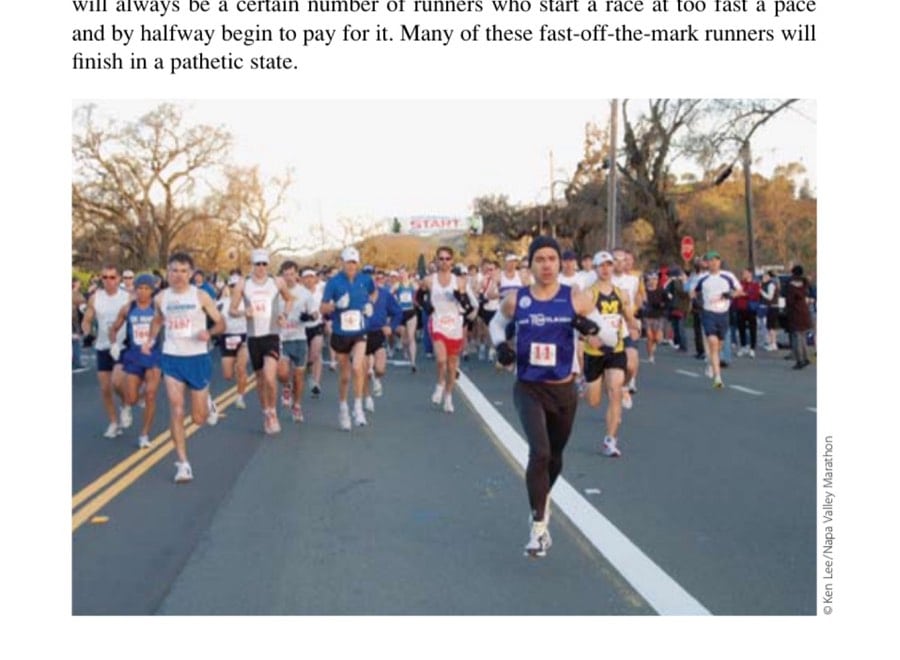
© Ken Lee / Napa Valley Marathon
This is the most common mistake made by runners. Regardless of distance, there will always be a certain number of runners who start a race at too fast a pace and by halfway begin to pay for it. Many of these fast-off-the-mark runners will finish in a pathetic state.
Studies prove that the most effective way to run a race of any distance is to run a negative split. It’s the method that most successful runners employ and is usually difficult for any rookie runner. For the marathon distance, the first half of the race should be run at least five seconds slower per mile than the average pace you wish to run over the entire distance. Incrementally pick up speed toward the middle of the race until the pace is approximately five seconds faster than the average goal pace. If a negative-split method cannot be employed, then you should at least run the marathon at an even pace throughout the entire distance.
Running faster than goal pace in the early parts of a marathon will cause a greater reliance on anaerobic metabolism and the accumulation of metabolic byproducts that cause fatigue. There is little chance of shaking off this state at goal pace once it has occurred. The only option is to slow down to allow the body to process and rid itself of its muscle- and blood-acidosis condition.
Don’t let race day adrenaline get the better of you—practice negative-split runs during training.
7
Not building an aerobic base
If there is such a thing as the glamorous part of training, then it has to be intervals and tempo work. The long, easy runs are usually dull, and many a runner wants to get a long run over sooner rather than later. Unfortunately, the long, slow miles give you the solid, efficient, aerobic-fuel system that cannot be attained with short runs. Not only this, but jumping into speed work or races too early in a season without first building an aerobic base is the fastest way to get an injury.
Specifically, aerobic running will increase a runner’s red blood cell count and the amount of hemoglobin those cells contain, thus increasing the runner’s bloodvessel oxygen-carrying capability. Muscle capillary volume is also increased, thereby allowing more oxygen to travel to the runner’s muscles.
It is a buildup of these attributes that will lead to much greater success in subsequent speed work. Also, recovery is an aerobic process, so being more aerobically fit means faster recovery times between interval workouts. This also means that more interval repeats can be performed in a particular session.
A gradual increase in base mileage month to month and year to year is the best way to find your plateau for the number of base miles you can sustain without becoming injured or burned out. To do it right will take a lot of time and patience, but once the optimum sustainable base mileage has been attained, you can gain great rewards in performance. Top-level male marathoners average about 90 miles per week with a 120-mile peak; for women, it is 72 miles per week with a 95-mile peak. Obviously, this is on the very high end for many people and just an example. But a slow and continued effort to find their maximum aerobic base is one of the best things that serious runners (of any ability) can do.
8
Getting injured
This is an easy one to understand: ignoring the warning signs of an injury and trying to “run through the pain” is a definite way to compound an injury and be sidelined longer than if the injury was treated when first noticed.
Even experienced marathoners can make this mistake—usually when they jump into a training plan too late and try to make up mileage too quickly. Building up weekly mileage gradually is essential to avoid injury. Many a minor injury can be treated with rest and simple treatments such as ice, compression, and elevation for a few days—with a few more days of easy reintroduction to training. Not listening to your body is a mistake that I paid for dearly when I did not want to acknowledge a knee problem. Instead, I continued a strenuous training plan for the Boston Marathon and eventually had to be sidelined for three months after arthroscopic knee surgery. Please don’t repeat my mistake.
9
Not resting enough
Rest is an essential component to any training program. It allows the body to adjust to a strenuous training regime, giving the body time to adapt to the elevation in physical stress. Resting is not just a training-free period but a period of relaxation where other stressful environmental factors are eradicated. Resting means adequate sleep, good food and hydration, and a stress-free environment that facilitates recovery.
Without real rest, an athlete will be in serious danger of burnout. Smart athletes who are serious about their training will arrange their lives in such a way as to allow good recovery periods. This may mean scheduling races outside of heavy work obligations and scheduling family vacations shortly after a major race and/or training period. Also, such athletes are usually emotionally intelligent and deal with inevitable life problems quickly and effectively so as to keep on track with their training efforts. This point has occurred to me many times on meeting ultra-dedicated, and divorced, triathletes who appear to lead very onedimensional lives.
10
Making mistakes with sports drink/gel usage during a race
During a race, athletes should be careful to imbibe the correct type and amount of sports drink or gels. In the case of gels, most people now believe it is too much effort to determine the correct balance of gel and water since exactly the right balance must be absorbed to be of maximum benefit. Too much water, and you will end up with a diluted mix that does little to deliver carbohydrates to your leg muscles. Too little water, and you will end up with a goopy lump in your
© Richard Benyo
intestines that begs for the next porta-potty. Adding sports drinks to gel ingestion ups the risk even higher. Also important is timing of sports drinks. Saving sports drinks to the end of a marathon is a misguided strategy, since by that point the body will gain little from the drink because the carbohydrates will have little time to traverse the gastrointestinal tract and travel through the blood to the muscles. You should first ingest about eight to 10 ounces of sports drinks about 10 minutes before the marathon begins. During the race, you should consume five to six ounces every two or three miles.
To sum up, unless you have spent plenty of time testing gels, they should be left in the hotel during a race. Sports drinks alone are much easier to utilize throughout the race. Water should never be used with sports drinks—a sports drink is already balanced for use without supplementation. Furthermore, sports drinks are just as effective as water in combating dehydration. (Note: I am not an employee of any sports drink company!)
Summary In summary, setting a correct goal, incorporating goal-pace runs, not trying something new, running high-quality training miles, not slowing down, not starting too fast, building up an aerobic base, avoiding injury, resting properly, and using sports drinks or gels correctly are all important factors in a solid training and race plan. Following most of the previous points will increase your confidence and give you the best chance of running a successful marathon. Good luck.

This article originally appeared in Marathon & Beyond, Vol. 13, No. 2 (2009).
← Browse the full M&B ArchiveMore like this
1,000+ stories from 19 years of Marathon & Beyond
The complete archive of the legendary long-distance journal — digitized and free to read.
