

Cobras and Concrete
“YOU DIE!!!!” I heard the spectators screaming at me with apparent glee as I staggered through the final sweltering mile of the Taipei Marathon. That they were correct in their assessment was indisputable. I had been dead, in fact, for several miles and only wished it were literally true.
Still, even in my broken mental state, I thought it cruel of them to so berate my bleeding corpse. There was so much about this culture I didn’t understand (and hadn’t understood) since setting foot on this (truly) godforsaken island.
Several months earlier, the Chinese Track and Field Association had invited me to their centerpiece event. I had always wanted to travel to the Orient, and with a reasonable shot at top-10 prize money, plus a sugar daddy sponsor fronting airfare for two and numerous perks, I jumped at the chance.
Not that I was blind to the hazards of running a marathon in a foreign land. I had recently competed in England, where the night-before-the-race meal was roast beef instead of pasta; this, at least, was better than the postrace fare of lemon wedges in Milan. Still, Taipei, Taiwan, presented new realms of experience for this Western man.
For starters, take the plane ride—if you dare. Just as a novice can’t understand that marathon racing doesn’t begin until mile 20, those who haven’t flown to the other side of the globe can’t appreciate this particular horror until they experience it firsthand. At least I wasn’t in my seat the entire trip. I spent the last hour in the lavatory yaking my guts out while flight attendants pounded on the door in a vain effort to extract me.
My stomach touched down a short while after the plane, and I emerged from my stainless steel stronghold feeling like a cross between John Glenn—man in a can—and Christopher Columbus, not knowing whether the greatest danger lay behind or just ahead. Nevertheless, I was pleased to be on terra firma in Taipei.
With my internal clock turned on its head, and not knowing whether it was night or day, I thought a short run would help orient me, so to speak. Besides, I had a nine-year consecutive-day streak to maintain.
A SERPENTINE RUN
After peeling off my travelling clothes and tossing them into the “burn” pile, I laced up my Brooks, and headed out of the hotel. I carefully picked a path through the chaotic tangle of streets, cars, and unfettered mercantilism that is downtown Taipei. Within moments, I was hopelessly lost.
Taipei is not runner-friendly. Traffic included cars, buses, mopeds, mobile food carts, drunks, mangy dogs, and even mangier prostitutes. After 20 minutes of bouncing around like a pinball, I found myself in a bazaar (and bizarre) area I recognized from guidebook descriptions as Snake Alley, one of the “must see” attractions.
A large crowd had gathered at a brightly lit, midway-style booth. I could read signs in English admonishing, “No Photos.” My interest thus piqued, I considered myself fortunate to have stumbled upon an authentic Taiwanese cultural attraction so early in my trip.
Ignoring the stares precipitated by my running attire, round eyes, and Brobdingnagian stature (I’m 5′ 10″), I easily peered over the crowd and spied a snake charmer working his magic on a cobra. Based on his incantations and gesticulations, I could tell that the snake hustler was working up to something big.
Suddenly, he grasped the snake with both hands and twisted the reptile’s neck, killing it instantly. He then suspended the lifeless body from a wire with a large clip.
To the steady accompaniment of his Chinese patter, the snake monger next brandished a knife. With the precision of a surgeon, he slit open the serpent and poured a surprising amount of blood into a large pitcher. The little man then squeezed the limp snake to find and remove the internal organs, which were added to the scarlet concoction. Finally, like some demented sommelier, he filled half a dozen shot glasses for the enthralled onlookers.
As my Mandarin was more than a little wanting, the point of this unsavory spectacle was lost on me. My green pallor notwithstanding, Snake Man flashed his steel teeth at me and proffered a glass. This particular onlooker, not feeling especially eager for culinary adventures, politely declined. On quaking legs, I jogged back toward my hotel with my second queasy stomach in as many hours.
ORIENTAL CAPITALISM
Taipei, a city of more than three million people, has all the public amenities of one of the moons of Jupiter. While the Taiwanese have embraced the philosophical principles of capitalism, economic growth there is unleavened by Western social norms and niceties. Practically speaking, running downtown sucked.
My gracious hosts had anticipated the hazards of city running and arranged transportation to workout sessions at the city university. Unfortunately, the bus left at 5:30 A.M. for a track an hour away. Ever sensible, I slept in and skipped the organized workouts.
Instead, I risked a short run to a bridge over a brackish river visible from my hotel window. Upon closer inspection, I thought the seething effluent could have been a tributary of the River Styx. Still, I was on the only unobstructed, runable stretch of road in the city, to which the sulfuric stench and roar of moped traffic were only minor irritants.
Ignoring abusive remarks and gestures from the drivers was easy, too—that was just like home. My fear was that some motorist would knock me into the festering waters. Nonetheless, I was grateful to have an uninterrupted running route. Like some demented bridge master, I trekked back and forth for 30 minutes every day.
VENUE INSPECTION
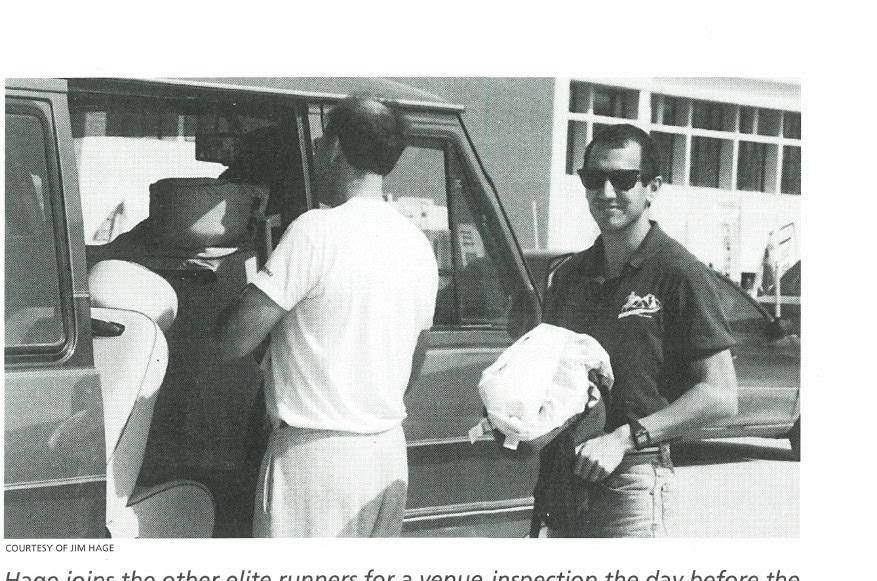
The day before the race, the invited runners were taken on a “venue inspection.” Several vans took us past dozens of landfills—urban planning is apparently an unpracticed discipline here—to the outskirts of Taipei. Another few miles of off-road maneuvering brought us to the race site.
Asians are renowned for their linear thinking, and the course layout reflected that inclination. Tollbooths marked the starting line, and the route then traced a straight shot out the turnpike. An orange traffic cone served as the turnaround point 13.1 miles later, after which we were to retrace our steps to the start.
We tried to maintain our game faces, and we joked about running with tokens or a roll of quarters. But many of the runners weren’t laughing, and others swore quietly. As we surveyed the starting area, intense winds sent giant multicolored tents skittering across the toll plaza and toward the vans. The drivers quickly restarted the vehicles and careened away from the runaway tents just before the tents slammed over a guardrail and crumpled into a ditch beside the road. My hopes for a fast, honest marathon were similarly crushed.
Although we had all seen too much already, the organizers insisted on driving the entire course. Actually, it turned out to be not unlike the New Jersey Turnpike, but eerily devoid of traffic: three lanes in each direction, wide shoulders, exit ramps, and a couple of toll plazas. Imagine a marathon on Interstate 95 from Seacaucus to Hoboken and back.
Although a hard surface—concrete, no less—was in place for the entire course, in many spots the highway was still under construction, with loose
gravel, dirt, silt, and standing water. Construction workers in conical straw hats gaped at the procession of vans plowing resolutely through the mess.
At the halfway mark, we saw a large sign fashioned from bamboo poles that had been laid flat by the wind. Inside the vans, the mood shifted from anticipation and nervous good humor to disbelief and brooding. The rest of the venue inspection did little to alleviate our initial misgivings.
THE NIGHT BEFORE THE DAY AFTER
Back at the hotel that evening, gallows humor dominated dinner conversation. We joked about trading racing flats for racing slicks, Goodyear sponsorship, and land sailing. You’re absolutely correct: It wasn’t funny.
One more thing: Taiwan is typically very hot and humid. With the race scheduled to start at 6:30 A.M. to beat the heat, we went to bed early, contemplating our sins, fearing a just God, and dreaming of home.
At 2:15 the next morning, the telephone startled me to semiconsciousness. It was a race official calling to say that breakfast was being served. Never mind that I didn’t want to eat or that I had set my own alarm for the slightly more reasonable hour of 4:00 A.M.—I got up.
With the moon still high, the vans took us back to the race site, which looked even more desolate in the darkness. Two huge construction cranes had been deployed to create an ominous postindustrial finishing chute, which looked to be the East’s answer to the West’s frivolous balloon arches.
All week we had asked how many runners were entered in the race. Official estimates ranged from 2,000 to 10,000. Apparently raceday entries were less than expected—only 400 starters assembled at the toll plaza. Not surprisingly, given the course location and layout, spectators were few and far between.
As the sun and temperatures began to rise just before the start, I drank as much as I could hold, doused myself with water, and hoped for the best. The Europeans and Canadians continued to grouse, right up until the start. We assumed the African and Eastern European runners were equally discontent, but they seemed to be keeping it to themselves.
A police whistle set us on our way. The first 10 miles were predictably uneventful, if not out-and-out monotonous. At least nobody got lost. For a small island country, however, Taiwan sure seemed to have a lot of hills.
As we circled the cone at the halfway point, all competitors were given a blue wristband to indicate that we’d indeed run that far. This safeguard seemed unnecessary, given the chances of anyone finding the course, much less sneaking onto it.
The handful of spectators made up in enthusiasm what they lacked in numbers. Several clapped and shouted, and I felt a kinship with those citizens foolish enough to journey out onto the course. Some held handmade signs with Chinese characters. I imagined them to say, “Go Dad” and “Everyone’s A Winner.” A few English-lettered signs also marked the course. Although it probably lost something in the translation, my favorite was “Go Able Men.”
CHANGE OF STATUS
Despite 70-degree temperatures, infrequent aid stations, and meaningless splits (17.5, 22.5, and 27.5 kilometers), I felt reasonably strong. By halfway, I was in seventh place and ready to move up. Around 18 miles, however, a pack of five came out of nowhere to join me and the Belgian with whom I’d been maintaining a steady and honest pace. The panic that I had struggled to keep in check since before the plane even touched down was erupting again.
I checked out my competition—of course, they looked great. The foreigners did, too. Never mind that I was a stranger in this strange land. Two miles later, my cockpit lights started flashing, and my veneer of optimism crumpled. In short order, I found myself out of the money, struggling to maintain contact, and finally shooting out the back door.
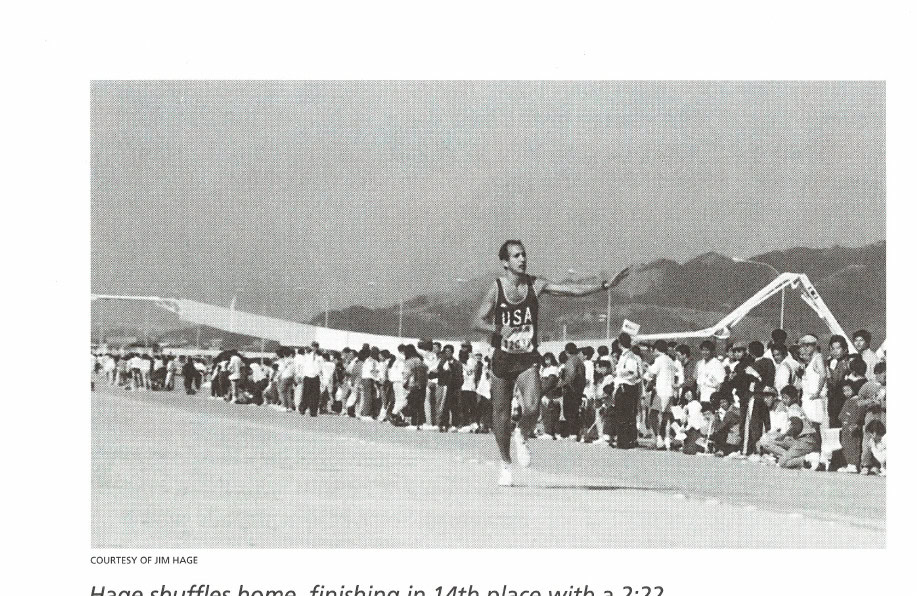
My formerly fond feelings toward the spectators soured, and their indecipherable signs seemed suddenly mocking. By the 23rd mile, their cries of “Yeedie!” rang in my frayed brain as “You die!!!” I shuffled home at almost six minutes per mile, finishing in 14th place with a 2:22.
Four Africans, a Korean, and a Pole took six of the first eight places. The Western runners, although evenly matched in numbers and on paper, could not produce under the difficult mental and physical conditions. Andrej Witczak’s
$7,000 third place money would pay rent and buy groceries for years in Poland; not one of the North Americans or Western Europeans had incentive like that.
That’s not to make excuses for my sorry performance, but simply to illustrate what Western runners seemed to lack all week: an all-consuming drive to succeed. In the face of adverse conditions, the Western runners faded like cheap Taiwanese suits.
The urgency of the African and Eastern European runners became evident at crunch time on the Taipei highway. The real competitors tapped into their heritage and cultural mettle to fight on, while this runner said “No thanks” and cashed in his chips. But all may not be lost, so long as I recognized, absorbed, and can someday invoke even a bit of their determination.
This article originally appeared in Marathon & Beyond, Vol. 1, No. 2 (1997).
← Browse the full M&B ArchiveMore like this
1,000+ stories from 19 years of Marathon & Beyond
The complete archive of the legendary long-distance journal — digitized and free to read.
