

Editorial: Vol. 11, No. 1 (2007)
An Experiment of One Dr. George Sheehan, running’s mad monk and philosopher, used to claim that each of us who runs long distances is an experiment of one: sort of a mobile science experiment run amok, where we learn as much from personal observations, consulting our running journals, and from intuition as we do from being poked and probed and preached to by scientists who specialize in human locomotion. George, in his way, was wonderfully retro. He got runners back to The Garden. Scientists wanted to put runners in a lab, on a treadmill, hooked up to wires and hoses. The first running boom hit, and George directed marathon runners in one direction and scientists in another. And sometimes the runners went both ways at once. Scientists had a field day with marathon runners back in the 1970s and ’80s. While some esoteric areas of science went wanting as far as scientists being able to lay their hands on guinea pigs on whom they could conduct their experiments, sports physiologists and human-performance specialists were suddenly swamped with a glut of tens of thousands of willing lab rats who had recently taken up long-distance running and who were curious as to its long-term effect upon them. On the
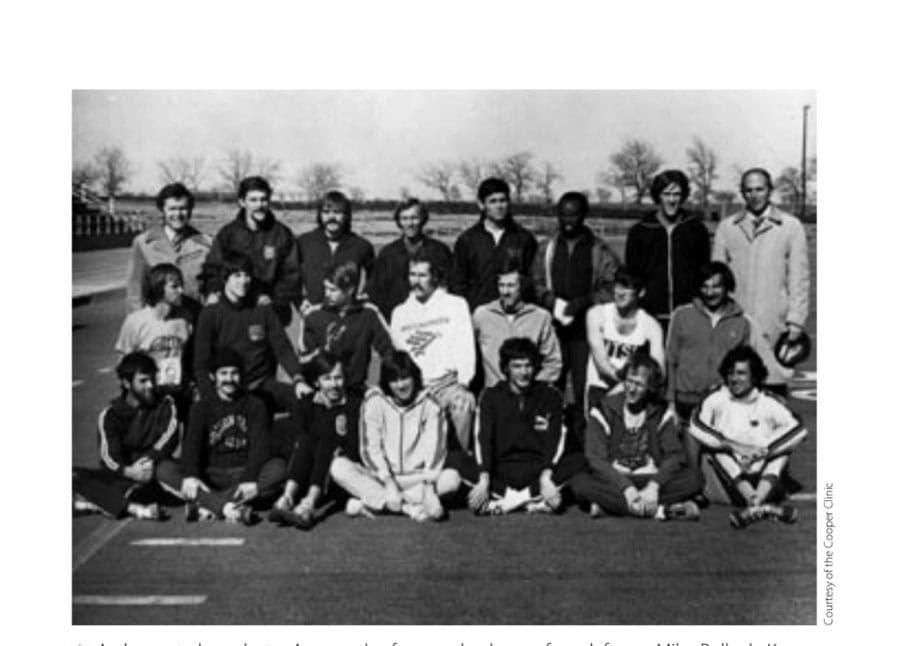
cutting edge of that sudden bonanza, Dr. Michael Pollock and associates did extensive testing on a couple of dozen world-class long-distance runners in January 1975. The tests, conducted at Dr. Ken Cooper’s Dallas Aerobics Center, were organized in large part by long-distance runner and Sports Illustrated writer Kenny Moore, who talked his fellow elites into taking part in the rather extensive intrusions into their physical space. Both the list of elite runners and the list of scientists from that session read like a who’s who of running and science. Among the runners: Doug Brown, Ted Castaneda, Jim Crawford, Jeff Galloway, Paul Geis, Jim Johnson, Don Kardong, Don Kennedy, Mike Manley, Kenny Moore, Philip Ndoo, Russ Pate, Steve Prefontaine, Frank Shorter, Gary Tuttle, and Ron Wayne. “The group included,” according to Dr. Pollock’s story on the experiment published in The Marathoner (September 1978), “12 middle to long distance runners (M-LD), primarily three to six milers and eight marathon runners who had won or placed high in national and/or international competition in the two years prior to testing. Seventeen of the elite runners were American, one was Kenyan, and two were Irish.” For comparison purposes, the scientists also tested eight good run-
ners (five of whom were from a local university track team) and 10 young, lean but sedentary men. Among the scientists: Michael Pollock, Larry W. Gibbons, David Costill, Peter R. Cavanagh, William L. Haskell, Larry R. Gettman, Peter R. Raven, and William P. Morgan. The tests were administered over four days:
• Table 2: Physical Characteristics and Maximal Working Capacity of Elite Distance Runners, Good Runners, and Untrained Men. • Table 3: Individual and Mean Values (+SE) for Muscle Enzyme Activities and Fiber Composition of Elite Distance Runners, Mean (+SE) Data Are Also Presented for the Middle Distance Runners and Untrained Men.
• Day 1: muscle biopsy; questionnaires: medical, psychological, and previous training record; beginning of 14-hour fast.
• Table 4: Selected Blood Chemistries. • Table 5: Physical Characteristics of Elite Runners, Good Runners, and Untrained Men.
• Days 2 and 3: blood drawing; body composition; noninvasive cardiac function; psychological interview; treadmill: submaximal and maximal working capacity; treadmill: filming; physical examination; continuation of 14-hour fast.
• Table 6: Comparison of Elite Distance Runners with Mean Data Collected from Other Athletic Groups.
• Day 4: six-mile race.
The week of testing was—and remains—a sports physiologist’s idea of dying and going to research heaven. I can’t recall that such an assembly of elite runners has since been corralled for such extensive testing.
From the experiments, the scientists came up with six tables (of the type over which scientists drool): • Table 1: Performance and Training Characteristics of Elite Runners.
ad
Courtesy of the Cooper Clinic
▲ A class act class photo: Among the famous, back row, from left, are Mike Pollock, Kenny Moore, and Pre, with Dr. Ken Cooper far right; middle row, far left is Jeff Galloway; front row are Don Kardong (third from right) and Frank Shorter (far right).
And the results? The results have been discussed for the past 30 years. Were there similarities between the elite runners? There certainly were. Were there startling differences between the elite runners? My, oh my, yes. The differences that many still find the most startling have to do with . VO2max, the ability to efficiently do work, such as running on a treadmill. . The higher the VO2max, the more efficient the athlete. The untrained lean . men averaged a VO2max of 54.2; the good runners averaged 69.2; our elite group averaged 76.9. . But the most startling VO2max numbers were the two extremes among
the elites: the highest and the lowest. Steve Prefontaine, who to that point had run a 3:54.6 mile and a 26:51.8 six-mile on 90 miles of training a week, . boasted a VO2max of 84.4. At the other extreme was Olympic marathon gold medalist Frank Shorter (4:04.5 mile, 27:09 six-mile, and a 2:10:30 marathon on 120 miles a week of training), who . had a VO2max of 71.3, barely above the average of the “good runners.” The year after the Dallas tests, Shorter would take the silver at the Montreal Olympic marathon; in retrospect, he should have taken gold, as it has since been learned from East German Stasi secret-police files that gold-medalist Waldemar Cierpinski
was the beneficiary of an extensive performance-enhancing drug program. Why do I bring up the star-studded 1975 elite distance runner lab rat bacchanalia? To illustrate the two extremes of our own human performances:
tance runners is that if you wanted to be world class, you should have picked better parents. Of course, there is also the factor of hard work: work hard enough at it, as the great Czech runner Emil Zatopek did, and you might be pretty darned good. But you’ll always be uniquely you. Which is why, when we closely watch a race, we see thousands of runners doing basically the same thing—placing one foot in front of the other and then alternating—but they are all doing it uniquely, which is why there are so many different styles of running. The styles of some of our running friends are so unique, in fact, that if we
1. As Thomas Jefferson wrote into the Declaration of Independence, we are all created equal. We all come into the world with essentially the same body parts pasted together in the same sequence. You know: “The knee bone’s connected to the shin bone.” In that regard, we are all equal. 2. But we aren’t, really, are we? The long-running joke among dis-
ad
were to see them 100 yards away silhouetted against the setting sun, we could immediately identify them—the same when they are hidden among hundreds of other runners: “Hey! Here comes Joe Spivy! I’d recognize that running form anywhere.” What the human-performance scientists spend their time doing and what we spend our training time doing is coming up with training regimens that are universally applicable but that are adaptable enough that we can customize them to our own needs. Back to Kenny Moore. While he was at the University of Oregon, training under Bill Bowerman, his successes came when Bowerman dictated that he take more time recovering from workouts than his teammates, because Bowerman intuited that Kenny Moore wasn’t built exactly like the rest of the team, that he couldn’t take the heavy stresses the rest of them could without suffering in performance. It obviously worked. Kenny represented the United States on the Olympic marathon team in 1968 and 1972, taking fourth place in Munich behind Shorter’s gold. Running is fortunate to have such a vast array of talented scientists who study the sport—and who go even further, as most of them also participate in running, from which perch they receive firsthand experience in their own experiment of one. Certainly, the scientists who study running are not always correct in the conclusions they draw. There was a ma-
jor push during the 1980s by scientists who studied running to have marathoners run fewer miles. Instead of 120 miles a week, the scientists suggested doing 75 to 80 high-quality miles. The American marathoning machine ground to a halt. The resurrection of American marathoning in recent years is built on returning to high mileage, where the endurance and strength that come with that elevated mileage come into play by keeping the runner going stronger in the final 10K. If we wish to excel with the genes our parents gave us instead of attempting to find the minimum by which we can get by, we should work to determine the maximum we can sustain without undermining our program. On the whole, from much of what the human-performance scientists have come up with in the past three decades, we’ve been the beneficiaries. It is still imperative that we remember Doc Sheehan’s admonition that we are an experiment of one. We can benefit a great deal from what science has learned about running; but in the end, it is up to each of us to keep track of how that knowledge can best be customized to the unique needs of our own running program. Science is the foundation; proven training programs are the walls; but intuition, based on our own personal running-around experiments and consulting our training journals, adds the roof, the solar collectors, the chimney—and the drive. —Rich Benyo
This article originally appeared in Marathon & Beyond, Vol. 11, No. 1 (2007).
← Browse the full M&B ArchiveMore like this
1,000+ stories from 19 years of Marathon & Beyond
The complete archive of the legendary long-distance journal — digitized and free to read.
