

El Gran Maraton
It is my second day at the hospital when I see the flier. It is taped up on a plain aqua-green wall in the main hallway. The flyer is white with black writing with what looks like a clip-art drawing of a runner. “Gran Maratón. Viernes. Su participación es importante.” * * * “¡Gran maratón!” I ask my hospital coworker, trying unsuccessfully to hide my excitement. “Sí,” she responds matter-of-factly. “
De, de. Veinte seis miles?” Blank stare. “Veinte seis, meele? . . . Mayles? . . . meeyes . . . ” I say, searching for the correct pronunciation. Blank stare. “Ugh, como . . . 40 kilómetros?” I ask. (Ugh, like . . . 40 kilometers?) “Sí, un maratón,” she responds. * * *
I continue quizzing her. “Y, aquí, en el hospital?” (And here, in the hospital?) “Sí, quieres correr? Solamente necesitas ir al abkfagartyo—”(This word I could not understand.) (Yes, you want to run? You only need to go to . . . ) “Um, sí, pienso que quiero correr. Pero, pues, no sé, es mucho, 40 kilómetros, pero sí.” (Um, yes, I think I want to run. But, well, I don’t know, it is a lot, 40 kilometers, but yes.) “Bueno. Deberías. Es en tres días. Viernes.” (Good. You should. It is in three days. Friday.) * * *
Despite my hesitant response, I really did want to run. I had been looking to race since coming to Guatemala one month ago. My primary reason for coming to Guatemala was to study medicine and Spanish. As a fourth-year medical student, I am interested in learning Spanish
Ethan Hyman
in order to treat Spanish-speaking patients, in helping in a country of limited resources, and in seeing a system of medicine completely different from the sophisticated one I was used to in Boston. In total, I planned on spending nine months in Guatemala.
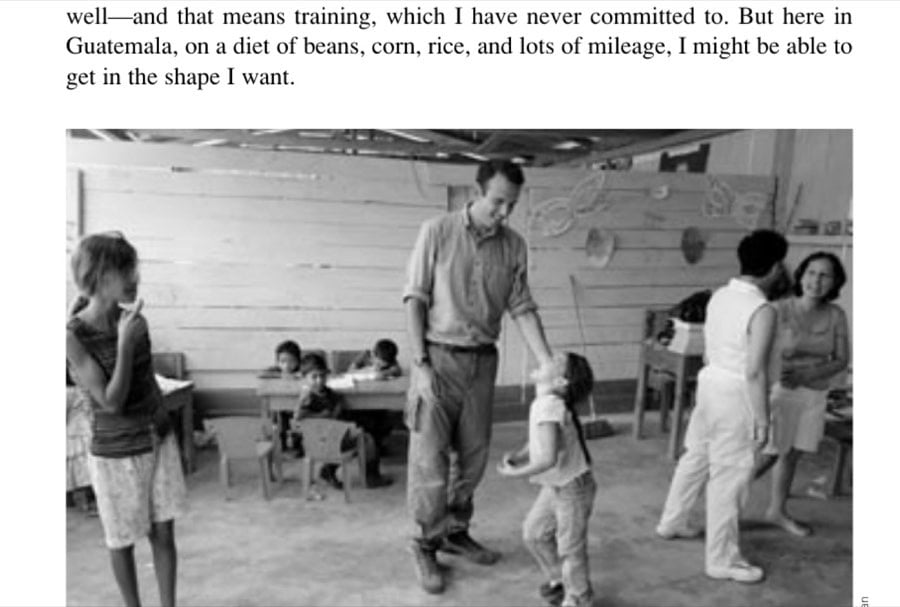
During the month I have been in Guatemala, I have lived in the relatively large city of Quetzaltenango (known as Xela—Shay-la—to many) and studied Spanish. Now I am living in the mountain town of San Marcos, working in one of the national hospitals. San Marcos is the capital of a department, the equivalent of a state capital in the United States, but it is small and modest. Stores close early, everyone in town knows each other, and there is not much to do outside of your daily work.
While studying medicine and Spanish were my primary reasons for coming to Guatemala, I have another goal. Alone in Guatemala for nine months, often living in the mountains, I hope to get into good running shape.
In shape for what? Although rarely admitting it to myself, I want to get in shape for the Boston Marathon. While the distance of the marathon has never been a huge obstacle for me, I have resisted running it because I want to run it well—and that means training, which I have never committed to. But here in Guatemala, on a diet of beans, corn, rice, and lots of mileage, I might be able to get in the shape I want.
▲ Paul Hyman at a school in the northern part of Guatemala, where he was working on a health project focused on treating intestinal parasites in schoolchildren.
In my first month in Guatemala, in Xela, I managed to start running. With the city being both dangerous and polluted, I found myself running at the “complejo deportivo,” the sports complex. Here, police with large rifles guarded the entrance to a gym, baseball field, and track. I usually stuck to running around the baseball field, monotonously circling the warning track, but at times I would find myself on the track. Most likely it was once a beautiful rubber track, but now it had large folds at each turn.
Xela is about 2,300 meters above sea level, and when I started running, I was slow. But by the end of the month, I had gotten used to the altitude, and all 6 foot, 3 inches and 200 pounds of me was lumbering past more petite Guatemalans.
Now in San Marcos, bored by the repetitive turns around the baseball field and track of Xela, I am excited about the possibility of a race. But how long would the race be, really? * * * I take other coworkers by the marathon flyer to get their opinions. “Veinte kilómetros.” “Ah, es diez kilómetros.” “Como tres kilómetros.” * * *
I also worry about the altitude. Are we higher than Xela? Would I feel it? My coworkers each seem to have an opinion unique to them. “La altitud. Ah, es mucho más de Xela.” “No, más bajo.” “Ah, depende. Este parte, es más alto. Aquí, más bajo.” * * *
I run a bit one morning on San Marcos’s version of a track, which is an abandoned airstrip. I resolve that San Marcos can’t be that much higher than Xela. Friday, the day of the race, I come to work with some running clothes in a plastic bag, still unsure if I am going to run.
After two hours in my white coat and scrubs, examining children with pneumonia, diarrhea, and/or malnutrition and writing hospital notes in poor Spanish, I decide I want to run and ask my boss if it is OK. “
Por supuesto.” (Of course.) Hearing the call for runners over the intercom, I dash off and change into my running clothes. Then I run over to the parking lot in front of the hospital, where the race will start. I feel strangely naked in my running clothes as I pass by smiling patients and nurses in the hospital hallways.
When I arrive at the parking lot, there is no one there. “Not surprising,” I think. “Things never seem to move as punctually in this country.” No problem. It would give me time to digest my cornflakes. It still blows my mind that in a country where they eat so much corn—corn tortillas, corn tamales, and corn on
Ethan Hyman
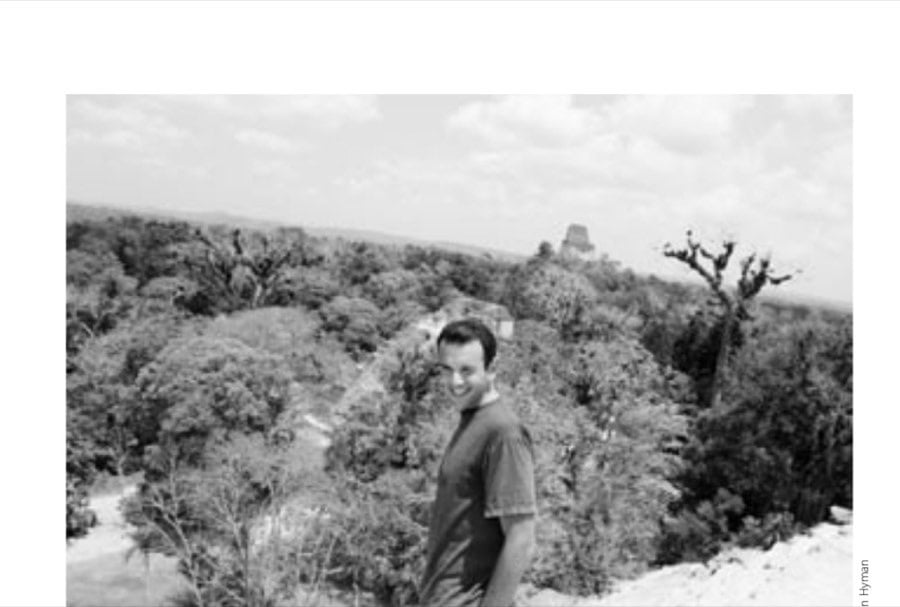
▲ Paul Hyman at one of the many beautiful tourist attractions in Guatemala, the Mayan city of Tikal.
the cob—that their number one choice of cereal would be cornflakes. Cocoa Krispies is a distant second. I alternately sit and pace, trying to enjoy the day as I wait for other runners. What a beautiful city. Green volcanoes tower over the city. The sky is a clear blue. 10:15. More pacing, a bit of stretching. 10:30. A couple of potential runners. 10:45. The runners begin filing in, about 25 in all.
I am confused as to how to size up the competition. I have learned not to look at musculature or clothes. Usually I try to guess based on how people are carrying themselves and their striders. Even then, I am usually way off. In the United States, I just resolve to try to beat as many people wearing racing flats as I can. I somehow think I am better because I am still wearing trainers and thus must be more relaxed and nonchalant about the whole race.
Here in Guatemala, it is hard to tell who is a serious runner. A couple of runners line up in sweatsuits, too warm for the day. Were they going to strip down before the race? Some wear shorts that make traditional running shorts look long. A couple of runners have on name-brand running shoes, although many are not wearing running shoes at all. “What if there is no competition at all?” I wonder. This poses another problem. I didn’t want to take the race too seriously, warm up seriously, and run hard when no one else really cares. That would just be kind of embarrassing.
I stand around in my shorts watching the competition. I decide not to warm up since no one else is. Besides, the race might be really long. One of the other runners comes up to me and points to two younger runners near the entrance to the hospital. “Those two, those two are serious,” he says in Spanish. One is a guy, probably about 18, the other a girl about 16. Both are wearing shoes that are actually designed for running. * * *
Finally, we line up to race. I carefully place myself in the second row, not wanting to seem too eager but wanting to stay near the front. “I will just try to stay with the leader,” I think to myself.
An ambulance pulls up, ready to escort us. I hear some incomprehensible Spanish words through a megaphone, and everyone starts running. I drop my shoulders, take a deep breath, and find myself about midway through the group. I take another deep breath and start to open up my stride. Before I know it, I am with the two front-runners, the two teenagers who were pointed out to me.
Soon the boy drops off, and within a few hundred more meters, I pull away from the girl. I feel that nervous surge of knowing it is your race to win, that you are in front, but that it is still early. “Am I running comfortably?” I wonder. “Is this OK?” I keep questioning myself. It seems all right . . . as long as the race isn’t too long.
ad
I follow the ambulance down the paved city roads onto older cobblestone streets. I brace myself so as not to turn my ankles. Bystanders line the streets at every corner. There are all types: farmers, men in business suits, women in traditional Mayan clothing, kids. And animals: cows, sheep, and plenty of dogs. Most people seem to pause and wonder what they are seeing. After all, it is not every day in this city that a big gringo comes running down the street behind an ambulance. There is often delayed applause after they realize what is happening. I struggle with the hills. The baseball-field running didn’t help with conquering hills. I remain alone at the front. Even though I know I am not supposed to look back, I do, and I see I have a few hundred meters on the teenage girl. The ambulance swerves into the town center. Several times, the ambulance gets stuck behind a car at a red light and cannot move. I am at a loss about what to do. I jog back and forth next to the ambulance. At one light, they yell, “Al hospital!” (To the hospital.) But I have no idea where the hospital is so I must wait. Finally the ambulance finds a clear path, and I follow it back to the hospital. I enter the parking lot relatively relaxed, to cheers of nurses, doctors, and patients dressed in gowns, some in wheelchairs. The TV news is there, although it will soon leave to cover an armed robbery at the gas station down the street—a gas station that I had just run by. Instinctively, I look at my watch: 17:01. “Three kilometers or four kilometers,” I think. “A three-kilometer or four-kilometer great marathon.”
A minute or so later, the teenage girl crosses the finish line. She makes the sign of the cross and thanks God as she finishes. In a makeshift awards ceremony, I receive a big red and gold trophy. I feel very lucky to receive it, as nothing is of small expense at a national hospital.
My glory is short lived. After the race, I am quickly recruited to play papifutbol, a small concrete version of soccer. I volunteer to be goalie, figuring this is a position I can play well, because of my size and the relatively smaller goals. However, balls fly past me at extremely slow speeds. It is very ugly.
That night, sitting around dinner with my host family, I am introduced to an older uncle. “Es Paul, de Boston. Paul es el campeón del maratón hoy,” says my host mom. “Paul. Boston, eh,” responds the uncle. Usually this is followed by a comment about the Boston Red Sox, who, at the time, were playing the Yankees in the playoffs. But the uncle does not ask about the Red Sox. “Boston. Boston Maratón. Próximo, el Boston Maratón,” he says with a smile.
I laugh to myself and smile back. “Maybe,” I think. “Maybe.” A little longer and a little faster, but maybe.
This article originally appeared in Marathon & Beyond, Vol. 11, No. 1 (2007).
← Browse the full M&B ArchiveMore like this
1,000+ stories from 19 years of Marathon & Beyond
The complete archive of the legendary long-distance journal — digitized and free to read.
