

Enjoying the Process
(age 36, 17 completed marathons, 2:46 PR)
TWO FACTS characterize my marathon experience. Number one is that I have been successful. I have not set world, national, or even local records, nor often won awards, but my success in the marathon far exceeds that in any other of my athletic endeavors. Number two is that I have never mastered the distance. I’ve never finished a race and been able to state, “Everything went right. I gave everything I had. This is the best I can do.”
These two facts draw me to the distance again and again. The potential of success first lured me to the marathon. After a childhood of experience that convinced me I was unsuited for athletics, I was thrilled to discover distance running in high school. I learned I had always been a marathoner. I hadn’t known it then, having never heard of the event until the late 1970s, but the essential characteristics were present from the start: a wiry frame, a penchant for challenging puzzles, and, most important, a tenacity that compensated for my small size and lack of athletic instincts.
By my sophomore year I discovered that the longer the event, the greater my comparative advantage. That spring, Joan Benoit (also from a small town in Maine) ran an American record at Boston, and the marathon began monopolizing my thoughts and dreams.
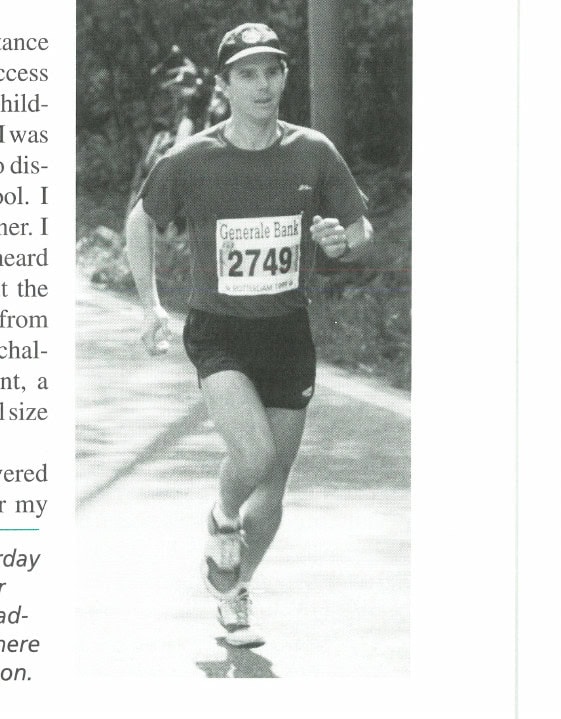
During the summer break I ran my first road races, culminating in a hilly 16-miler where I cruised comfortably past fading runners in the final miles. Afterward, my cross-country coach was more impressed than I was with my seven-minute-per-mile average. Her enthusiasm, and the congratulations of other runners, convinced me that this ability to keep running was not shared by everyone.
My road success didn’t translate back to cross-country as well as expected. I ran respectably on varsity that fall, but my heart had moved to longer things. When spring rolled around, I chose to skip track and train for a marathon.
A MARATHON VIRGIN
They say you never forget your first time, good or bad. Mine was great. I loved every aspect of it: researching training theories, laying out a plan, developing discipline, exploring ever farther from home, testing my fitness at races, meeting other marathoners, feeling growing confidence and fear, cruising through 22 miles on race day, enjoying new scenery, flying with the energy of the event, hitting the wall, surviving to the finish, and returning home a hero. I ran a 3:23 and won the 18-and-under age group, complete with a prize of a Nike jacket. I had found my event and thought I was on my way to stardom.
I did lower my marathon time by 20 minutes the next summer. Assuming a sub-3:00 was inevitable and a sub-2:50 just around the corner, I instead followed my summer marathon with two disappointing efforts (a DNF and a crippled, cramped, survival finish). Lack of success restored my respect for the distance, and I was reluctant to return without a new level of preparation. Different goals usurped priority in my life, and I became a former marathoner for eight years.
When I returned, the desire for mastery had risen to the top of my motivations. I no longer dreamed of winning Boston or making an Olympic team. I did, however, need a goal—something that could be defined and measured. It needed to be difficult but achievable, unsullied by the political and economic realities of daily life. I had found that life often isn’t like the marathon: rarely could I set my own goals, develop a plan, and succeed or fail on my own efforts. Many paths led to nothing; many goals were either achieved too easily or blocked by factors outside my control.
Over the ensuing years, now approaching a decade, the marathon has never disappointed me. I have enjoyed success beyond my expectations as well as spectacular failures. Each year I add to my knowledge and ability yet never exhaust the challenge or despair of further progress.
Progress in the marathon, however, is wonderfully difficult. It cannot be bought, bullied, or conned. Each improvement requires refined planning, stricter discipline, and expanded confidence. Mastering the marathon has become the process of mastering myself. Competition with others, though sometimes interesting and motivating, pales beside the desire to explore the limits of my ability, to discover how close I can come to the perfect race.
For several years I chased the three-hour marathon. When I achieved it, I hesitated to set a new goal, but the marathon had become too much of a habit to quit. I ran the next one without a goal and gave less than 100 percent. While I enjoyed the scenery, the camaraderie, and the energy of the pack, the race lacked passion and purpose. Like a noncredit class in school, removing the possibility of failure also eliminated the chance for success and the drive for excellence.
Six months later, mentally preparing the day before another attempt, I found that I again lacked purpose for the effort to come. Sure, I could set a time goal based on my training, which had gone remarkably well, but why should I put myself on this treadmill that runs ever faster and never ends?
FASTER BY FIVE
My answer came to me in the words of a song: “Each day I live, I want to be the very best I’m meant to be. . . . Give me one moment in time, when I’m more than I thought I could be, when all of my dreams are a heartbeat away, and the answers are up to me. . . .” I ran my best the next day—over five minutes faster than I had ever run.
The song, written for the 1988 Olympics, still expresses my goal as I line up for another marathon. Running may be only a small part of who I am. I hope to be my best in every aspect of life. But the marathon provides a rare moment where I can prove my resolve and set an indisputable mark of excellence. And perhaps because I have been given the chance for success, however limited, I cannot be satisfied with anything less. Fortunately, even as I celebrate each new mark, I discover areas in which I can improve the next time.
Enjoying the marathon as much as I do, I am often tempted to jump into one without adequate training, but have learned to resist. I respect the event too much to treat it lightly. The marathon is like a beautiful woman; showing up unprepared is like meeting her unshowered in shoddy clothes. At worst she’ll make me suffer for my mistake; at best, she may let it pass, but don’t expect any romance or passion. I know her well enough to know it is worth my while to be at my best.
(age 54, 37 completed marathons, 2:57 PR)
RUNNING HAS been very, very good to me. As a skinny kid with a severe stuttering problem, running many times saved me from a vigorous thrashing at the hands of my fellow kids. Early on, I discovered that although I was not terribly fast, if I could get a three-stride jump on a bigger kid, I could always outlast him. I spent much of my childhood on the alert for attacks from hidden assassins.
Although our high school had no track or cross-country teams in the early 1960s, the gym teacher did conduct an annual intramural track meet on the rutted dirt road that encircled our football field. The longest event was billed as the half-mile, although considering the ambling rut in which we ran, it was more accurately a 5/8th-mile steeplechase. In my junior year I finished a close second in the half; in my senior year I read War and Peace while waiting for the second-place finisher to come in; everyone went out way too fast and died on the back sort-of straightaway.
I engaged in (and managed to pervert) cross-country in college. Training three times a day left me so tired by race day that I never placed better than fourth on our team. In my junior year my running was complicated by a toe injury that I would freeze in a bag of ice before meets. During my senior year the toe would undergo seven surgical procedures (most of them incompetently performed in a podiatrist’s chair with two aspirin as anesthesia) in attempts to correct the problem.
In 1977 I joined the staff of Runner’s World, which in a big way rekindled my interest in running. That fall I covered the New York City Marathon from the rickety press truck. Witnessing Bill Rodgers run like a god behind the press truck while he sucked foul exhaust fumes from the NYPD Vespas and chatted with press guys convinced me that the marathon was a race worth pursuing.
Upon my return to California, I vowed to end my marathon virginity come spring. I entered the lottery for one of the 2,000 spots at the early May Avenue of the Giants Marathon in far northern California. My entry was accepted, so I proceeded to train like a demon during the winter. Unfortunately, I got waylaid along the way. . . .
In April, the Runner’s World staff traveled to Boston to host our annual “open house.” I let a friend persuade me to line up at the back of the Boston field as a bandit in order to get in a last long workout before my marathon debut two weeks later. Hal Higdon, who had been instrumental in my getting the position at Runner’s World, advised me to wait until I crossed the start line to click on my stopwatch so I’d get an accurate time. Three hours and 29 minutes later, I crossed the finish line accompanied by Hal, who I’d caught up to a mile from the finish when a chronic calf injury slowed him.
In May, I ran Avenue in 3:27; in June, I did Avenue of the Flowers (Lompoc, California) in 3:24; in July, I ran San Francisco in 3:52, accompanying a friend through his first marathon; in September, I ran Silver State in Nevada in 3:33; in October, I ran New York in 3:29; in November, I accompanied an undertrained friend through his first marathon (Golden Gate) in 4:07; then I closed out the year at Honolulu in December with 3:22. For good measure, I experimented with ultras, running 36 miles of the AAU 50-mile track championship in Santa Monica over the summer and then running the first Cow Mountain 50-miler in early October. Write this period off as a serious case of marathon addiction. Call it a case of running to run with no specific focus.
After a similar 1979, I’d had enough. I was stalled between 3:10 and 3:30. I wanted to run faster, to seek the Holy Grail of sub-3:00, so I embarked on a serious training program. I sustained a good mileage base, but I eliminated “junk miles” and got serious about speed work. It helped that Runner’s World was sponsoring the Corporate Cup series; two dozen of the RW employees did track workouts together on Thursdays and competed in shorter races on open weekends. We raced at the track on Corporate Cup weekends. My 400-meter times dropped, my mile times dropped, my 10K times dropped, and my marathons, now restricted to three per year (one for fun, two for serious) improved.
THE ROAD TO THREE
In October of 1980 I rolled through a 2:57 at the Humboldt Redwoods Marathon. I kept expecting something to go wrong, but the run was so under control that upon finishing I began sniffing around for a hotdog, an unheard-of postrace luxury I’d never previously lusted for while puking up postrace bile. In October of 1981, I returned and ran a 2:59 with less-than-adequate training.
In 1983, I was still focused and rationing out the marathons very gingerly. I decided I wanted to qualify for Boston. The qualifying time for my age (36 at the time) was a sub-2:50. The Napa Valley Marathon run in early March became my qualifier. As my last long run, I “jogged” through the Second
Could another activity, another goal, fill the same place in my life? Perhaps, but I have yet to find another event that encompasses so many facets of my being—an event that stretches my physical limits, challenges my mind, and tests my character. A challenge large enough to provide context and significance for the smallest daily decisions and complex enough that experts fail to agree on the best path to success. A goal as full as life, yet reducible to three digits.
I also admit that I enjoy the process as much as pursuing the goal or achieving the success. The long runs, the hills, the speed work—a looming marathon gives them urgency, but they are not enemies to be overcome on the road to a destination. They have become my daily affirmation of life and part of my identity. I do not dream of a day when Saturday mornings won’t find me on a road or trail 10 miles from home and still heading out.
I know there will come a day when I can no longer expect to improve on my best. Until then, I will keep refining my knowledge, pushing my limits, and celebrating improvements. Though I’m not sure how I will respond on that day, I believe the marathon will still turn my head, that I will still find in it a motivation and inspiration grand enough to get me out of bed each morning, working to be my best.
This article originally appeared in Marathon & Beyond, Vol. 4, No. 4 (2000).
← Browse the full M&B Archive1,000+ stories from 19 years of Marathon & Beyond
The complete archive of the legendary long-distance journal — digitized and free to read.
