

I proceeded to train like a demon during the winter. Unfortunately, I got waylaid along the way. . . .
In April, the Runner’s World staff traveled to Boston to host our annual “open house.” I let a friend persuade me to line up at the back of the Boston field as a bandit in order to get in a last long workout before my marathon debut two weeks later. Hal Higdon, who had been instrumental in my getting the position at Runner’s World, advised me to wait until I crossed the start line to click on my stopwatch so I’d get an accurate time. Three hours and 29 minutes later, I crossed the finish line accompanied by Hal, who I’d caught up to a mile from the finish when a chronic calf injury slowed him.
In May, I ran Avenue in 3:27; in June, I did Avenue of the Flowers (Lompoc, California) in 3:24; in July, I ran San Francisco in 3:52, accompanying a friend through his first marathon; in September, I ran Silver State in Nevada in 3:33; in October, I ran New York in 3:29; in November, I accompanied an undertrained friend through his first marathon (Golden Gate) in 4:07; then I closed out the year at Honolulu in December with 3:22. For good measure, I experimented with ultras, running 36 miles of the AAU 50-mile track championship in Santa Monica over the summer and then running the first Cow Mountain 50-miler in early October. Write this period off as a serious case of marathon addiction. Call it a case of running to run with no specific focus.
After a similar 1979, I’d had enough. I was stalled between 3:10 and 3:30. I wanted to run faster, to seek the Holy Grail of sub-3:00, so I embarked on a serious training program. I sustained a good mileage base, but I eliminated “junk miles” and got serious about speed work. It helped that Runner’s World was sponsoring the Corporate Cup series; two dozen of the RW employees did track workouts together on Thursdays and competed in shorter races on open weekends. We raced at the track on Corporate Cup weekends. My 400-meter times dropped, my mile times dropped, my 10K times dropped, and my marathons, now restricted to three per year (one for fun, two for serious) improved.
THE ROAD TO THREE
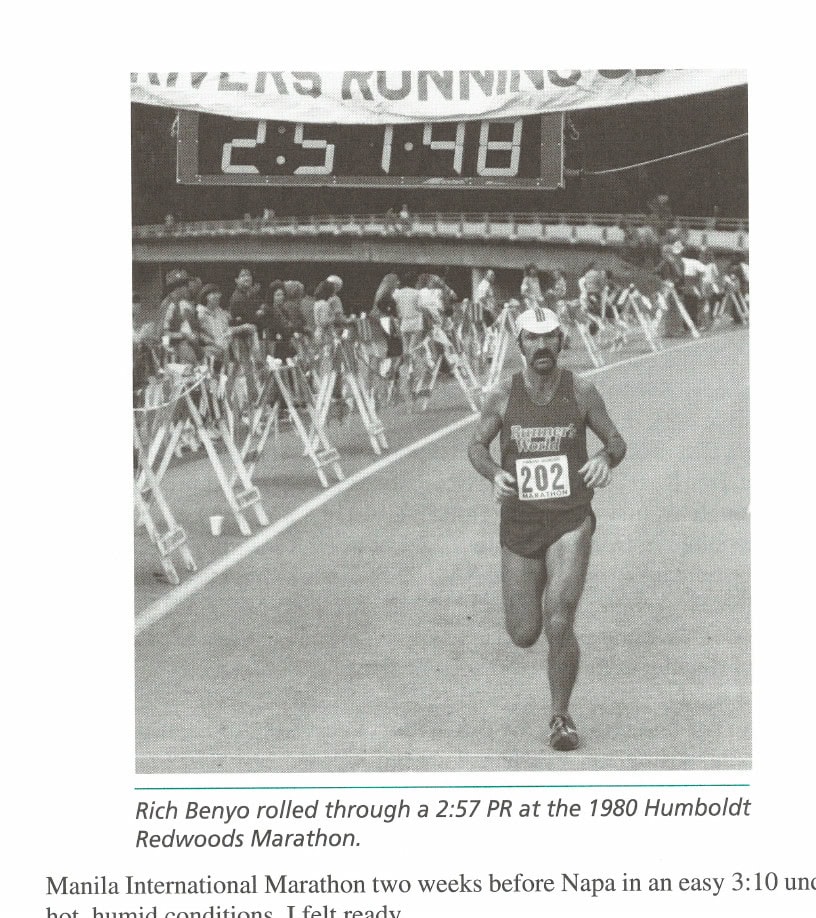
In October of 1980 I rolled through a 2:57 at the Humboldt Redwoods Marathon. I kept expecting something to go wrong, but the run was so under control that upon finishing I began sniffing around for a hotdog, an unheard-of postrace luxury I’d never previously lusted for while puking up postrace bile. In October of 1981, I returned and ran a 2:59 with less-than-adequate training.
In 1983, I was still focused and rationing out the marathons very gingerly. I decided I wanted to qualify for Boston. The qualifying time for my age (36 at the time) was a sub-2:50. The Napa Valley Marathon run in early March became my qualifier. As my last long run, I “jogged” through the Second
Manila International Marathon two weeks before Napa in an easy 3:10 under hot, humid conditions. I felt ready.
It had rained heavily the week leading to Napa. Access roads were submerged, and the race start was disorganized. Slower runners seeded themselves in the front rows. I encountered Jack Leydig, then president of the West Valley Track Club, who was also planning to run 2:49. As the field filled, we caught up on our respective lives. At the gun, we headed off at an easy 6:30 pace, chatting away, passing runners in droves.
A half-mile into the race we passed a runner in red shorts. He crossed behind me and caught my trailing leg, knocking me flat onto the road. Jack continued rolling along at 6:30 pace, still talking to me until he realized I wasn’t there. Meanwhile, both of my kneecaps were misaligned, my elbows were cut and dripping blood, and my glasses were broken. In that initial fight-or-flight response fueled by adrenaline, I bounded up and resumed running. Everything in me was programmed for that finish line. But at two miles I realized my race was ruined. I calculated that the adrenaline surge would catch up to me at around 18 miles and the run would then become grim—road rigor mortis.
I attempted to drop out, but each crossroad we passed allowing access to the course was under water. Finally, just beyond 11 miles, access opened, and my wife was able to scoop me up. Still on pace for a 2:49, I dropped out, dripping blood and discouraged. My focus had been shattered. My kneecaps took three weeks to work their way back to where they belonged.
After that, I avoided marathons for a while, then began running two a year for fun and fitness. For the next decade I found myself grinding through ultras and adventure runs, where speed was not of the essence.
DEATH VALLEY DAYS
My focus turned to Death Valley where, in 1989, Tom Crawford and I, after a year’s worth of course-specific training, became the first crazies to run from the depths of Death Valley to the peak of Mt. Whitney and back in the middle of summer, a mere 300 miles. Dissatisfied with my time, I went back into training and challenged the course again in 1991 and 1992. The 1992 effort sucked me dry, draining the psychological and spiritual reserves that runners typically dip into to complete a particularly arduous event. But I had a new book being published in the fall (Making the Marathon Your Event), and my editor wanted me to travel to New York to run the marathon in conjunction with the book’s release. I shuffled dispiritedly through a sub-4:00; then, with a pulled Achilles tendon, I returned home to recuperate.
The Achilles tendon healed in a year, but alas, nothing else seemed to. My running was lackluster. Even though I wanted to return to the challenge of the marathon, I couldn’t get going again. Ultras had been satisfying in their way, but they lacked something the marathon offered: a fear of failure and the lust for success at the intersection of a set time goal and 26.2 miles in which the potential for screwing up 16 perfectly good weeks of hard training was ever-present in a smorgasbord of ways.
During my annual trips to the Vancouver International Marathon in early May, I would enter the half-marathon. Typically, I’d run the first nine miles with my wife at a nine-minute pace. At that point, she would continue on with the marathoners across the Lion’s Gate Bridge. The half-marathon field would turn back toward the finish line. It was at that point that I would drop the hammer and pass two or three hundred people by running six-minute miles to average the race out to eights.
But I could not seem to sustain training for a marathon. When I tried to run the Royal Victoria Marathon, I blistered badly around the halfway point and limped back to the start. Two weeks later, at home, I ran a hilly 10-mile course in a credible 77 minutes. But most runs were an effort, not a joy. I ran the Okanagan Marathon in British Columbia in 1996 and halfway through began to fall apart as though I had merely jumped into it without training. I couldn’t sustain even a 10-minute pace. I ran/walked to the finish in what became my worst-ever marathon, a 4:13.
Perhaps, I thought, I was still not psychologically and spiritually recovered from the too-hard effort of Death Valley in 1992. Jeff Galloway and I sat down when we ran into each other in Edmonton, Alberta, and discussed my situation. After encouraging me to not beat myself up, he recommended that I stop, rest, then restart my running program as though I were a new runner. He made a lot of sense. I tried it. It didn’t work. I began to think I’d just turned yellow, couldn’t face the challenge of regular training anymore. Running had converted from something that I eagerly anticipated to something I dreaded.
THE WONDER YEARS
Certainly, I had to acknowledge that I wasn’t getting any younger, but my diminished performance was more dramatic than that. I had actually considered the idea of training for another sub-3:00 when I turned 50. Now, sometimes completing two miles without walking was a problem! When you run and race for many years, you come to know your body. I could no longer attribute my horrendous running to the dregs of Death Valley.
I visited my internist, a runner himself, and requested a thorough examination. Because he trusted my judgment as an athlete who knows his body, he thought my concerns were reasonable and appropriate. He honored my request, and ordered me a stress test and an echocardiogram. Procedures were performed where radioactive substances were injected into my body in order to video my heart activity to determine if arterial blockage was present. Upon completion of the tests, I realized that in addition to an internist, I now also had a cardiologist, a former runner who had developed a knee injury that sidelined him. His diagnosis was that I had developed a viral cardiomyopathy, a breakdown of the heart muscle caused by a viral invasion of the body. The weakened heart muscle rendered my heart less able to pump efficiently in order to meet the needs of my body. My running only aggravated the problem by increasing the demands being placed on an already compromised organ. Major bummer.
The cardiologist explained that the condition is much more common than people realize and that its incidence is growing in the general population. The reasons are unknown. In most Americans it is not diagnosed until much later in life. My previous level of fitness gave me a distinct advantage over the general population, for I had enjoyed a high level of fitness that served as a barometer for detecting changes in my well-being. My unrelenting lassitude
and fatigue served as a red flag early on. Most Americans, with no healthier frame of reference from which to compare their current condition, grow complacent and accepting of increasing fatigue and weight gain as they age. By the time they are diagnosed, their hearts are failing.
The cardiologist explained that in the normal, healthy heart, each pumping action (heartbeat) ejects 65 percent of the blood within the heart, sending it to body parts to meet their needs. My heart was ejecting only 15 percent! At the time, his concerns were twofold: first, I needed to markedly reduce my aerobic exercise to prevent a heart attack as a consequence of overtaxing an already compromised pump; second, my blood needed to be thinned so that the 85 percent left inside my heart at the end of each beat did not clot, escape into the coronary circulation (supplying the heart muscle with oxygen), and cause a heart attack.
PUT ON THE BRAKES
I was immediately warned to stop racing, reduce the pace at which I ran (now jogged), and limit my mileage. Medications were prescribed to slow down my heart and thin the blood so it wouldn’t clot. My cardiologist also prescribed a drug that in some instances had reportedly reversed damage to heart muscle and not just merely slowed the process of future damage. Overnight, I went from someone who took an occasional aspirin for a headache to popping seven pills a day.
I found myself wondering what had caused a fit, healthy guy who several times had broken three hours to become a semi-invalid. Had the extreme effort in Death Valley during 1992 suppressed my immune system so badly that it left me vulnerable to viral invasion? Had the gum surgery I’d undergone years ago released viruses from my mouth that then searched for a new organ in which to lodge? Had I stood too close to the wrong person at the wrong time? Had Mideastern terrorists loosed heart-seeking viruses into our beer supply? I didn’t know what to think.
Now that some time has elapsed, there are three things I do know:
1. The medications have helped. My heart isn’t yet ejecting 65 percent of the blood inside it with each beat, but it’s ejecting a lot more than 15 percent.
2. Every once in a while when I’m on a jog and I’m warmed up and my heart is ticking along at a comfortable rpm, I throw in a faster-than-10-minute-per-mile pace for a hundred yards just to remember what it feels like to really run.
3. Often I feel guilty about editing a magazine on marathoning when chances are I might never run another one. On one hand, my work here seems borderline hypocritical in that I can no longer practice what I preach. On the other hand, I feel that when you’re denied something, you’ll likely understand and value it even more—which is one reason I don’t take the marathon lightly (and don’t take well to people who do!).
Life has changed for me. No more solitary runs through pristine woods. I make sure to jog on well-traveled roads; this way, if I drop, someone is nearby to get help quickly enough so that my working organs can be harvested and recycled before they go sour.
I sometimes reflect on that period from my first marathon to my attempt at what was supposed to be my 2:49. The six-year period of striving to reach as perfect a place in the marathon as I could while working 60+ hour weeks and having a semblance of a life outside running was an invigorating experience and very satisfying—an experience that was translatable to other aspects of life.
It was also an experience that was rationalized by an interview I conducted in 1977 with an actor and lifetime runner, Bruce Dern. Dern explained that running, especially running well, is a creative endeavor that is undermined when you have other creative endeavors going on in your life. He maintained that when he began doing films that demanded an excess of creative energy, his running suffered. He lacked the creative energy to fuel everything simultaneously, so he backed off from his racing.
Today I suffer from a literally broken heart that very much misses running marathons. At the same time, I’m incredibly grateful for all the sport continues to give me freely, especially all the wonderful people in my life. I may never run another marathon, but my chase for perfection continues today as vigorously and enthusiastically as ever. My current pursuit is to help create the perfect magazine for my fellow marathoners. Let me know how we’re doing so far.
(age 51, 26 completed marathons, 3:18 PR)
MARATHONING, IN all its splendor, made a serendipitous entrance into my life. Roughly 20 years ago, to increase my aerobic fitness level, I embarked on a running program for the third time in my life. I was 30 years old and had noticed my clothes were fitting tightly. At one time I had been able to eat with abandon, anything I wanted, but now I felt soft, no longer lean as I had been in my relative youth.
In April 1979, as a native Bostonian, I was introduced as a blind date to the man who would become my husband. He was a journalist and was in town to cover the Boston Marathon. He was a veteran marathoner; I was a fledgling runner. As our relationship blossomed, we typically would frequent running events, including marathons, where I would cheer him on as he crossed the finish line. Within the first year of my running program, inspired by what I was exposed to in the marathoning community, I was motivated to run one.
My initial efforts to train for a marathon proved unsuccessful, however, for I lacked the endurance to run for more than 90 sustained minutes. I abandoned the marathon vision, presuming I wasn’t suited for the distance.
Early in my running pursuits I experienced the usual running injuries. As is typical for novice runners, long after my heart and lungs had adjusted to what I was demanding of them, ligaments and tendons still needed to comply. So I supplemented my running with strength and flexibility training. What resulted was not only hastened recovery from existing injuries but also prevention of future injuries. Over time, my running performance improved, fueling a desire to challenge myself more and test my limits.
DREAMS OF IRON
Witnessing coverage of Julie Moss’s heroic stagger-and-crawl finish at the Ironman Triathlon in 1982 sparked my interest in the sport of triathloning. As a nurse anesthetist with a solid background in the sciences, the physiology of

This article originally appeared in Marathon & Beyond, Vol. 4, No. 4 (2000).
← Browse the full M&B ArchiveMore like this
1,000+ stories from 19 years of Marathon & Beyond
The complete archive of the legendary long-distance journal — digitized and free to read.
