

The Grail Was Sub-2:20
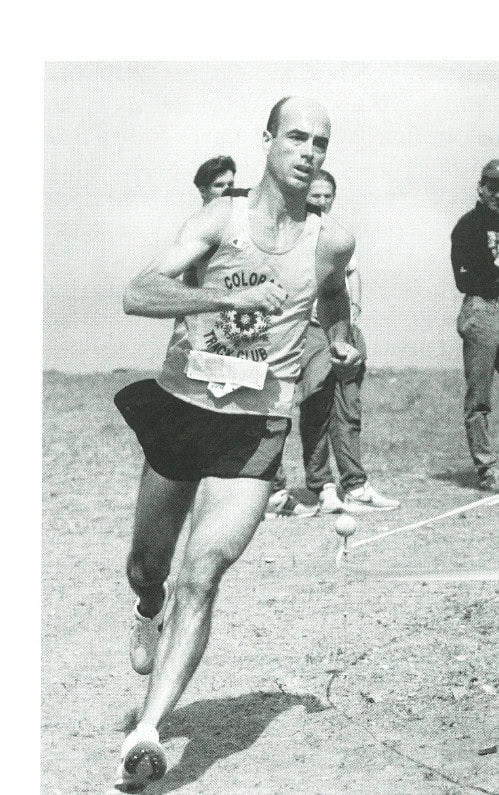
California International Marathon. The opening miles went by quickly and easily, and I remember counting off the miles and hitting halfway feeling like I was jogging. The better I felt, the higher my aspirations rose, like some sort of mental Egyptian obelisk. At 20 miles, I was cruising alongside a Kenyan runner, thinking I was going too slow and that I should pick it up to five-minute-mile pace the last 10K. I was strong and fast, confident in my months of 100-mile weeks. In fact, by 21 miles I was even scoffing a bit at the distance.
Bad move. I should have known better than to tempt the marathon gods. I went from running effortless 5:20 miles to feeling my legs stiffen up like pieces of petrified wood.
Despondent, I struggled in, still managing to finish close to my PR. But I was humbled. I vowed to run a better marathon at Las Vegas. That race, however, was more of the same. Half the battle in running your perfect marathon is getting to the race rested and ready to run, which is often a struggle for young runners.
Those were my salad days, when I was young and impecunious. Unable to afford a plane ticket and unwilling to drive my 1966 Volvo through the mountains in the winter, a buddy and I hitchhiked out to Las Vegas. I caught a ride south of town that took me over the Continental Divide to Grand Junction. There, a trucker hauling a load of frozen meat brought me to Las Vegas the day before the race.
To save money, we slept on lounge chairs at the Circus Circus pool. I woke up rested and feeling good. Fate, however, threw a stiff wind directly in our faces. Instead of Vegas’s traditional southern tailwind, we were greeted by a wall of wind. The leaders went out in single file. I tucked in and was able to click off 5:20s, running fast and knowing I was running fast. But, once again, just past 20 miles, I was forced to a crawl, slowing to 6:30 pace in a matter of minutes.
As many of you reading this know, in cases like this you can do nothing but try to keep moving and struggle in to the end.
I was reading all the extant plays of the ancient Greek tragedians that year and had brought Sophocles’s Oedipus Rex along on the trip. On those endless last few miles running in toward The Strip, I recalled how Sophocles sums up the fall of Oedipus—and all of us—with, “Let no man be truly called happy until he dies.” We long-distance runners who have run smack into the wall with such force that it nearly knocks us over can revise Sophocles’s ending this way: “Let no marathoner be truly called happy until the race is over.” Such are the vicissitudes of the marathon that disaster can strike at any moment, even with the finish line in sight.
PERFECTION PAST TENSE
I can see now that my first 2:24 was as close to perfection as I was able to get. That is not to say it was easy; it was not. In that race at Grandma’s, a gentle breeze seemed to push me along the shores of Lake Superior, and I was able to “redline” it just right. I can remember waiting for the wall with each passing mile, but it never came.
I had a pack of gum with me and every five miles would take out a new piece. Even a second or two faster per mile and I would have crashed. I reached the finish line completely spent, feeling like Roger Bannister looks in photos of his sub-4-minute mile. There was no feeling of elation afterward, only a great weariness that settled over me for the next several days.
What made Grandma’s my closest-to-perfect race was what occurred afterward.
A marathon is more than a race; it is the sum total of our experiences before, during, and afterward. And this trip to Northern Minnesota turned into a peak experience. The day after the race, I loaded up with former Grandma’s winner Garry Bjorklund, his attorney friend Dave Munz, and Dave Welch, husband and coach of Priscilla Welch. We spent a week canoeing in the Boundary Waters National Park, as pristine a place as you’ll find in North America. It remains just as it was the day the glaciers retreated north thousands of years ago, leaving behind countless beautiful lakes. There are endless miles of cold, clear water, fir-covered islands, loons with their haunting calls, eagles, large bass—and portages. Several times Welch had to carry the canoe by himself along the passageways between lakes as I trudged along the path behind him. It was a wonderful journey. We camped at night, built fires, told stories, went skinny-dipping off cliffs, fished, and learned about nature from BJ, a born outdoorsman. One evening as we searched for a campsite, Bjorklund decided we should forego one likely-looking spot. When asked why, he pointed to some claw marks about eight feet up a tree.
“A bear made those recently,” BJ said. “A very tall bear by the looks of it.”
“How recently?” I asked.
“Oh, maybe an hour or two ago.”
I soaked my legs in the cold lakes every day during that trip, and when I returned home I had that great postmarathon feeling of knowing I had accomplished something significant.
In the years to come, I had long runs that went so smooth and so well that I knew a better marathon was there somewhere inside me, even though I never ran faster. I did, however, have the perfect half-marathon at the Denver Mayor’s Cup. I stayed in the pack in the opening miles, and one by one the good local runners dropped back. Soon I was running in front, side by side with former University of Colorado All-American John Hunsaker. I pulled away and ran through crowds lining the mall in downtown Denver, with Hunsaker out of sight behind me. The headline in the paper the next day read “Cram, Sandrock Win Mayor’s Cup”. Mile world-record holder Steve Cram, in town for his spring base work, had won the accompanying 10K. “This was easier than our Sunday long run,” I was quoted as saying afterward.
TRAINING VERSUS RACING
That was the problem. Deek’s motto was “Train smarter, not harder.” Instead, I trained harder, not smarter. The fitter I got, the more miles I ran. Instead of recovering on recovery days (gee, what a novel concept), I ran 10 in the morning, 7 in the evening on my off days, because the group was so much fun to be with.
The problem was that while the elites were napping, getting massages, and doing whatever it is world-class runners do when they are not training, I was working 40-plus hours a week at a newspaper. I realize now I was training to train more, not running to race my best, and thus I left my perfect marathon up Left Hand Canyon or out on the dirt roads north of the Boulder Reservoir, where we did our weekly 22-miler. I was never rested, and I did not stretch. One cold November day I pulled an overworked and underappreciated quad muscle running 200-meter repeats on the track. That was the beginning of the end of my marathon aspirations.
I do, however, continue to train and to race. And I still chase perfection, trying to run as well and as fast as I can within the limits of 50 miles a week. The perfect race for me now is not based on getting a personal best, but rather on how well I can prepare and peak for a race within the framework of the busy 21st century Internet lifestyle I share with many of you.
I am proud of my 2:24, disappointed that I never ran faster only because I had put in the years of high mileage necessary to do so. That is one reason I wrote Running with the Legends—to pass along some of the wisdom of the greats, so that others might be able to get the most out of their talent and training.
And now I appreciate the effort all runners make, no matter what their finishing time. I have enough respect for the marathon to be happy when a friend breaks four hours. It might not be the perfect race, but for me, finishing any marathon is an accomplishment, one reason why then-world-record holder Steve Jones insisted on crawling in at over 2:20 during the European Championships marathon after cramping up.
I remember once asking Deek which runners he respected the most. He did not say Jonesy, Carlos Lopes, Toshiko Seko, Arturo Barrios, Rosa Mota, Ingrid Kristiansen, Lorraine Moller, Priscilla Welch, or any of the other elite marathoners with whom he was friends. Instead, he mentioned a 2:16 guy who trained with the group every day. “He does all the training we do, even though he is not going to make a living racing. The ones out there every day like that are the people I respect the most,” de Castella said.
I felt proud to be included among that group, and many of you reading this fall into that same category. Most of us choose to be marathoners (or does the marathon choose us?) not for any external rewards, but for myriad reasons, often unknown to ourselves. Training for the marathon is part of who we are. Eventually we reach the flash of insight the modern Odysseus gets when he realizes that Ithaca does not exist; but he keeps traveling to get there as if it does exist. So it is with us marathoners: we are perfection chasers, knowing we will likely never run our perfect race.
JUST REWARDS
De Castella said that what he liked about running was being able to see the concrete results of his hard work. That is how many of us feel, whether we are running 10-minute or 5-minute miles. We may never reach Ithaca, clock our sub-2:20, but will have many good runs and adventures along the way.
I have been running for more than 25 years now, and I still remember my first run as if it had been this morning. I was in high school in suburban Chicago.
(age 36, 17 completed marathons, 2:46 PR)
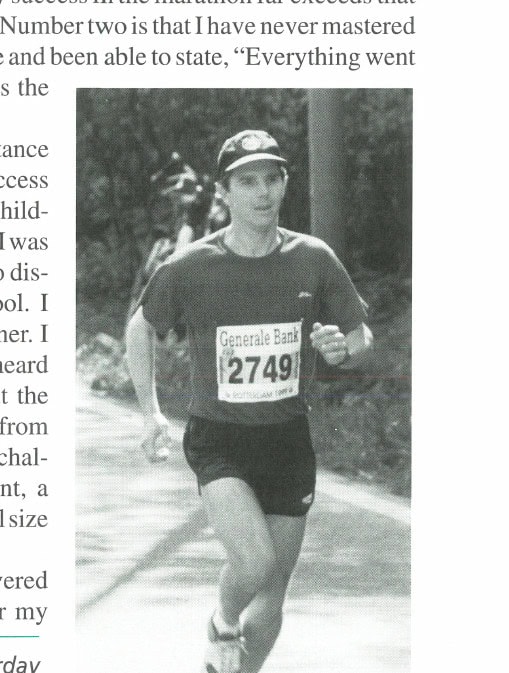
TWO FACTS characterize my marathon experience. Number one is that I have been successful. I have not set world, national, or even local records, nor often won awards, but my success in the marathon far exceeds that in any other of my athletic endeavors. Number two is that I have never mastered the distance. I’ve never finished a race and been able to state, “Everything went right. I gave everything I had. This is the best I can do.”
These two facts draw me to the distance again and again. The potential of success first lured me to the marathon. After a childhood of experience that convinced me I was unsuited for athletics, I was thrilled to discover distance running in high school. I learned I had always been a marathoner. I hadn’t known it then, having never heard of the event until the late 1970s, but the essential characteristics were present from the start: a wiry frame, a penchant for challenging puzzles, and, most important, a tenacity that compensated for my small size and lack of athletic instincts.
By my sophomore year I discovered that the longer the event, the greater my
This article originally appeared in Marathon & Beyond, Vol. 4, No. 4 (2000).
← Browse the full M&B Archive1,000+ stories from 19 years of Marathon & Beyond
The complete archive of the legendary long-distance journal — digitized and free to read.
