

Where Are America’s World-Class Marathoners?
THE AMERICA era of marathon running began at 2:22:17 P.M. eastern standard time on April 19, 1968, when Amby Burfoot crossed the finish line at the Boston Marathon and fell into the waiting arms of Jock Semple. It was the first time in 11 years that a U.S. runner had won at Boston, and that runner had been John J. Kelley, Burfoot’s high school coach and mentor. Burfoot was the vanguard of the baby boom generation that pushed marathoning onto a higher plateau, that transformed the sport from a queer little novelty event to an international phenomenon.
The American era of marathon running ended at the Los Angeles Coliseum on August 5, 1984, at 10:24:52 A.M. pacific standard time when Joan Benoit, joyously waving her white hat, won the first women’s Olympic marathon.
Between these two events, U.S. marathoners set the tone of marathoning on the world stage, from the front of the pack and everywhere behind. The American running boom ratcheted marathoning to a national mania that gradually spread throughout the world. A handful of highlights make the case:
- Americans Frank Shorter, Kenny Moore, and Jack Bacheler take first, fourth, and ninth, respectively, in the 1972 Olympic marathon. Americans Shorter and Don Kardong take second and fourth in the 1976 Olympic marathon.
- At Boston in 1975 Bill Rodgers sets a new American marathon record (2:09:55); he returns to claim three more Boston victories. Rodgers also wins the New York City Marathon four times, and in one stretch in 1978, he wins 22 road races in a row.
- Frank Shorter wins Fukuoka (the unofficial world championship of marathoning before there were World Championships) in 1971, 1972, 1973, and 1974.
- Alberto Salazar comes on to the marathoning scene like a comet; he wins New York in 1980, 1981, and 1982, each time in sub-2:10; and in the 1982 Boston Marathon he stages one of the sport’s most memorable duels, against Dick Beardsley. Both men go under 2:09, and only one foreigner breaks the top 13.
- At Boston ’83, the top three places are taken by Americans (Greg Meyer, Ron Tabb, and Benji Durden), all in under 2:10. Only one foreigner breaks the hold on the top 23 spots, and all those spots are run in under 2:15. In the same race, Joan Benoit sets a course, American, and world record of 2:22:43. Only two foreigners break the American hold on the top 30 in the women’s field.
- In 1977, 8 U.S. marathoners break 2:15. In 1978 11 do so. In 1979, 22.
- Using a less stringent standard, in 1977 the United States had 5,500 males and 29 females break 3:00; in 1981, 15,000 males and 300 women run under 3:00.
From 1985 onward, training methodology improved, training and racing shoes were improved, knowledge of high-performance diets escalated, weight work improved overall strength and upper body endurance, massage therapy prevented some injuries and sped the healing of others, and good money could be made in marathoning (certainly plenty more than was available in the 1970s). Considering all this, logic would indicate that the United States should have turned out world-class marathoners in assembly-line fashion. Instead, the opposite has occurred.
Not only haven’t U.S. runners kept up with the rest of the world, except for a rare performance here or there, they haven’t even approached the performances of the previous generation of Americans. Consider some of these facts:
- 1983 is the last year an American male won Boston (Greg Meyer), and 1985 is the last year an American woman (Lisa Weidenbach) won. Every year at Boston, the longest dry spell for Americans in the 101-year history of the race is extended.
- In what now seems like a coda—or perhaps an exclamation point—to the American era, Joan Benoit Samuelson runs the second fastest women’s time in history at Chicago ’85 with a 2:21:21. Since then the closest any American woman has come to Benoit’s performance was Kim Jones’s 2:26:40 in 1991. No American female has medaled in the Olympic Marathon since 1984; no American male has medaled since 1976.
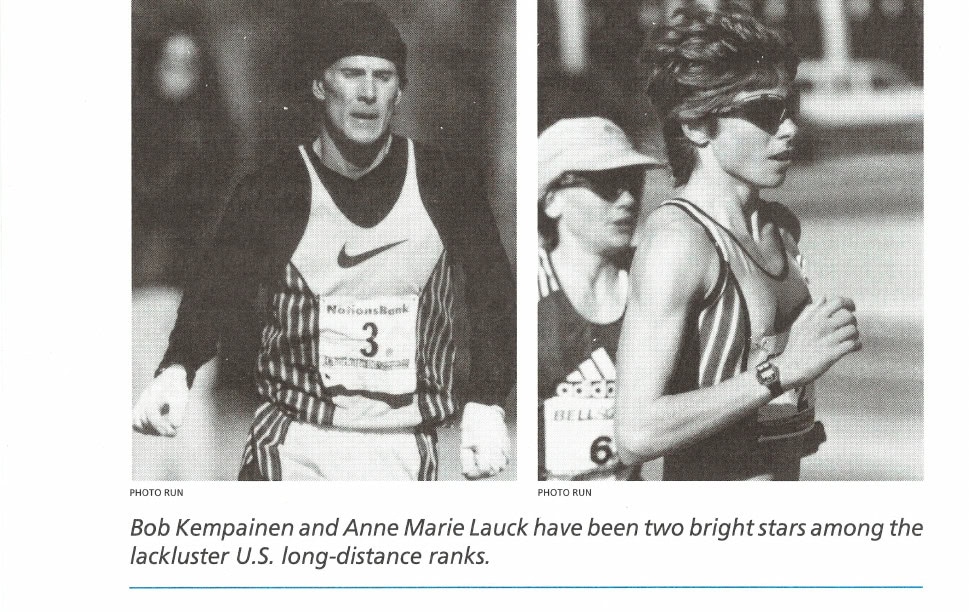
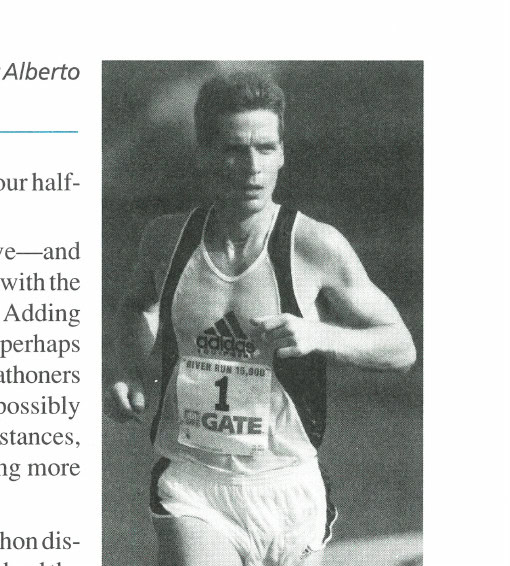
- Only two Americans have broken 2:10 in the marathon in the past decade. One, Bob Kempainen, set a new American marathon record of 2:08:47 at Boston in 1994; unfortunately, that time placed him only seventh in that year’s field.
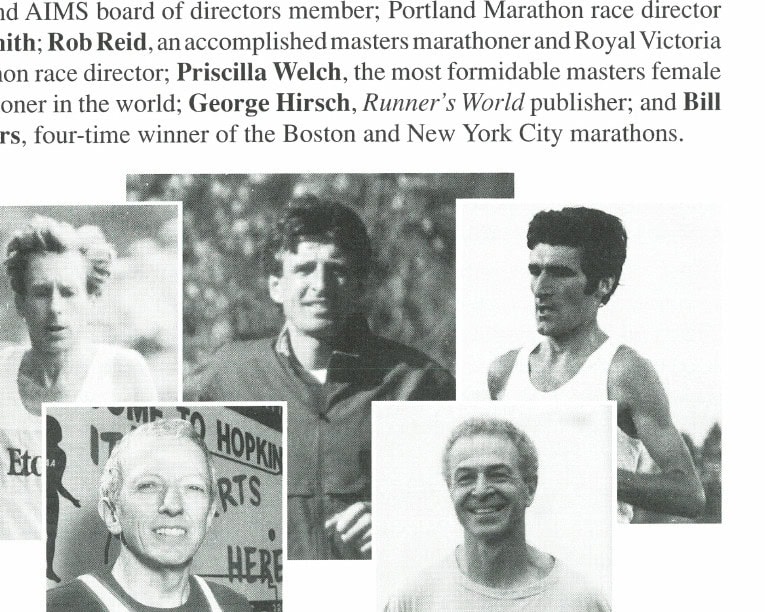
To gain a better feel for what has happened to undermine American marathoners and what hasn’t happened to make them improve, we solicited the opinions of a small army of marathoners, marathon race directors, and running journalists. Let’s meet our distinguished panel: Hal Higdon, senior writer for Runner’s World and world-class veteran competitor; Joe Henderson, Runner’s World West Coast editor; Mark Conover, winner of the 1988 U.S. Olympic Trials Marathon; Jim Hage, publisher of Running, Ranting, Racing and consistent sub-2:20 marathoner; Frank Shorter, 1972 Olympic Marathon gold medalist and 1976 silver medalist; Derek Clayton, two-time marathon world record holder, who on several occasions in the 1960s reputedly experimented with 200-mile weeks; women’s running pioneer Kathrine Switzer; Gordon Rogers, one of the moving forces behind the Vancouver International Marathon and AIMS board of directors member; Portland Marathon race director Les Smith; Rob Reid, an accomplished masters marathoner and Royal Victoria Marathon race director; Priscilla Welch, the most formidable masters female marathoner in the world; George Hirsch, Runner’s World publisher; and Bill Rodgers, four-time winner of the Boston and New York City marathons.
MARATHON DOMINATION CYCLES
Is it a natural process for the marathon to be dominated by runners from different regions of the world during different eras, as Americans had done from 1968 to 1984?
Higdon: Americans dominated in the late ’70s and early ’80s, the Italians in the late ’80s, and the Spaniards are doing well now. Distance running has always gone through cycles: the Brits, the Eastern Europeans, the Down-Unders. It’s nothing new, only different.
Henderson: Certain countries flex their marathon muscles at certain times. But possibly in no other event is talent so widespread. Look at the nationalities of men’s Olympic and World Championship marathon winners, from 1996 back to 1987 (since the period of “U.S. dominance”): South African, Spaniard, South African-turned-American, South Korean, Japanese, Italian, Kenyan. And the women: Ethiopian, Portuguese, Japanese, Russian, Polish, Portuguese, Portuguese. Mix in here the Mexican men, and the German and Norwegian women who’ve won at New York City and Boston, and we might conclude that the age of one-nation dynasties is past.
Conover: I disagree [with the cyclical theory]. We have Fiz (Spain), Taniguchi (Japan), Nakayama (Japan), Bordin (Italy), Kempainen (USA), Ceron (Mexico), Silva (Mexico), Espinoza (Mexico), Moneghetti (Australia), Salah (DJI), Thugwane (RSA), the Koreans, and so on. To me, it proves that the wealth of marathon talent is world-wide.
Hage: Success in marathons specifically and distance running generally tends to run in cycles. In certain countries at certain times, the marathon seems to “catch on.” That shouldn’t be such a surprise, given the exposure, increased levels of competition, and communal, focused training that typically accompanies such surges. Nationalism also plays a role, as the Kenyans, Mexicans, Ethiopians, and others develop an arena of superiority, and then defend their domain.
Shorter: Yes, [there are cycles], but the situation is becoming more culturally complex. African runners (mostly Kenyans) now have European agents and live and compete outside Kenya. The Africa/Kenyan cycle may last longer than those of the past.
Clayton: To a degree, yes. It’s only natural that the financial opportunities for good marathoners is ample incentive for residents of poor black nations—and in the future China—to train for the event. In Australia as in the U.S., there are many sporting opportunities in our schools (football, basketball, baseball, etc.)
that offer a diversion from the marathon. I am sure a lot of good marathon talent is lost to these other sports.
Switzer: First, cyclical shifts occur when there is a culture to spawn it. Like art or poetry in Renaissance Italy, the center creates the best. That’s why the center of Gainesville, Florida, was hot with Shorter and Bacheler; then came Eugene, then Boulder. The good ones go to the center and get better because this center inspires them.
Second, in the case of running, the Kenyans are expanding their culture and center into ours. They’ve always run, and they run better than us—they just haven’t had the chance (or incentive) to travel. Physiologically, they will be—or are—too good for Americans to beat. Opportunity has fueled the drive, and running is their national sport. Money in running is BIG to them but not to us.
G. Rogers: The opportunity for the Kenyans to better themselves within the environment in which they live, their personal, local, and even national recognition as heroes, the economic benefits that give them higher status and a better lifestyle than their fellow countrymen all contribute [to their success].
Smith: This cyclical pattern is all subject to talented persons who dedicate themselves to the sport to enhance their economic and social position within a country. The second factor is love of the sport and activity and the ability or reason to dedicate time to it. Thus, if economically secure, a great runner may keep running beyond college for reasons of personal fulfillment, patriotism, and so on.
Reid: As different areas of the world become influenced by a global economy, athletes will be given improved conditions, allowing them to take part in a sport on a larger playing field. Yes, there will at times be cyclical shifts, as new cream rises to the top of the marathoning world because the right conditions were met in developing athletes for the world stage.
Welch: High-profile sports heroes influence impressionable athletes in all countries. If the U.S. had more long-distance running heroes besides Frank Shorter, Bill Rodgers, and Joanie Benoit Samuelson, then maybe the marathon scene in the U.S. would be in better shape. The problem, though, is twofold: There are no new marathon heroes to replace Shorter and Rodgers and Benoit, and at the same time there are many other exciting sports that are hyped so much more than running is.
The countries that are doing well in the marathon right now have always had a multitude of talent. All of them are very motivated to achieve success [so they can] improve their living standard, especially now that the world has changed, and they have more freedom to travel and compete. This motivation has not come about overnight. These countries have their national running heroes, and these heroes have fired up the desires of a new generation to achieve the same and to keep the tradition going.
But their lifestyles are so different from the lifestyles of Western athletes, especially as far as women are concerned. There is suddenly an opportunity to make great strides through athletics. As children, these athletes were very, very physically active, while Western children have become progressively sedentary. The young athletes from these other nations have been put through a sort of preparatory phase, which rewards them well when they learn to compete later in their careers.
Add successful runners returning to their countries as heroes, mentors, and coaches, and you have a wonderfully rich athletic tradition building. Additionally, all these runners are totally committed to the arduous training required for the marathon event, and they have healthy training areas with an extremely simple lifestyle that is perfect for long-distance training. Also, since they’ve been running all their lives, they can approach the sport with a more relaxed attitude and actually enjoy it.
WHAT IT TAKES TO WIN
What are the most important elements for success in a grueling event such as the marathon? And is the prime ingredient missing from the current formula for success that American marathoners are using?
Conover: Consistent—but not over-done—training.
Higdon: Ability. We have it and have had it in the past. We often waste it.
Welch: Commitment.
Reid: A lifestyle condition that has molded the runner over many years into a promising athlete.
Smith: Money—the economics of what running can offer the individual.
Hirsch: Hard work and good coaching.
B. Rodgers: A burning interest in the marathon as an event and the necessary support systems provided by the athlete’s country.
Clayton: Physiology, mental toughness, and the ability to train correctly.
Shorter: Being willing and able to train harder, longer, and more consistently than all your opposition.
Hage: Sacrifice. Clearly, U.S. marathoners are not working as hard as the rest of the world. The level of competition now is so high that nothing less than 100 percent focus will yield success. Look at the Republic of South Africa’s Thugwane: A bullet in the face did not deter him from training for and ultimately winning the gold medal [in the 1996 Olympic Games]. I wonder if our culture can develop an athlete with the requisite mental toughness to beat runners from other countries, those who lack the distractions and relatively easy life we enjoy.
Henderson: I rate lack of experience as the most important element in marathon success. That’s right, lack of. This doesn’t mean that the runner can be an untrained novice. He or she must be experienced and talented in the shorter distances but doesn’t need to run a lot of marathons to do them well. I recall reading that marathoners usually peak in their first half-dozen races, when they first take their track speed to the roads, and then suffer when they become marathon specialists. Alberto Salazar comes to mind as an example. He won his first marathon, New York City, in 1980, the same year he made the Olympic 10,000-meter team. His “world record” in 1982 was his fourth marathon, and that year he set U.S. 5,000- and 10,000-meter marks.
A CHANGE IN FOCUS
Has there been a shift in focus among upcoming American marathoners? If so, what form has the shift in focus taken, and how does it undermine performance?
Clayton: They [American marathoners] are training too conservatively. They are also concentrating too much on smaller road races, and they are too concerned with making money. Put in the hard work, race hard, and the money will follow.
Shorter: They are concentrating on making a good living instead of working toward achieving long-term, specific athletic performance goals. The result is a psychological concession: “Even if I [do] focus my training and peak for only a few races, I probably [won’t] win anyway.” You don’t win that way.
Switzer: For most, it’s too much work for too little reward. Why bust your gut to run when a football, baseball, basketball, or hockey player gets a million while you get $250,000? Is $250,000 a lot? To a Kenyan, it’s a fortune. So the incentive is gone on both counts.
B. Rodgers: Top Americans don’t race in international marathons as much as they should. They’ve been overwhelmed by foreign athletes at U.S. races, and they don’t seem to know how to respond.
Hirsch: My sense is that Coogan, Brantly, Kempainen, Lauck, and the others train as hard as the Benoits and Shorters. One factor is that today there are so many other countries (South Africa, Korea) in the hunt, that [winning] becomes more difficult.
Smith: When the U.S. was the power, the others (Mexico, Kenya, Korea, etc.) were just getting started. As a result of his winning the gold in ’72, Frank Shorter was the spark that caused lots of people to start running. As marathoning spread to other countries, talent came to the surface. Unfortunately, unlike in Japan and other countries, in the U.S. we do little to take care of our long-distance runners.
Conover: The focus is the same as always. Things have just heated up quite a bit on the world stage compared to the past.
Henderson: The best potential American marathoners aren’t running marathons—not yet, at least. They are sticking with track and cross-country and laying the groundwork for future marathon success. Lynn Jennings could be the next Joan Benoit Samuelson of marathoning if she doesn’t wait too long to try another one. (She ran at Boston as a teenager, and now, at 36, she is a three-time world cross-country winner and three-time Olympian and a medalist in 1992.) Todd Williams could be the next Alberto Salazar. Todd is a two-time 10,000-
meter Olympian and has run a one-hour half-marathon.
Hage: Americans currently believe—and rightfully so—that we can’t compete with the rest of the world [in the marathon]. Adding the financial element to racing has perhaps kept some of this country’s better marathoners from destroying, and in the process possibly finding themselves at the longer distances, because they can make a living racing more often at less demanding distances.
Welch: The fascination of the marathon distance is still very much alive and is indeed the focus and challenge of many recreational athletes. However, for the more serious athlete, they don’t seem to be training correctly or comprehending the lengthy stages of preparation required to compete seriously, hence the shaky acceptance of a long gradual buildup covering a period of three to five years. [They seem to] expect results in three weeks or three months. Only a chosen few commit and stick to a lengthy program or stay with one coach during their build-up period. Maybe the coaches are at fault and not the athletes. Maybe we need to train coaches specifically for the marathon distance.
THE MOMENT THE FOCUS SHIFTED
Can you pinpoint when the shift in focus occurred?
Switzer: The shift was gradual, but it began around 1986, around the time Boston went pro. That sort of opened the floodgates. A good way to appreciate the gradual aspect is to look at the finish of women’s races. Three years ago, there was one Kenyan woman in the top five; two years ago, there were two, and now it’s three or more in all the big races. That’s also how it started with the men—gradually.
Shorter: For men, it was when Greg Meyer crossed the finish in Boston in 1983, and for the U.S. women it was when Joan Benoit crossed the finish line in LA in 1984.
Smith: The U.S. men started to go downhill or unwind in the early ’80s. U.S. women marathoners peaked in 1984 to 1986.
Hirsch: I don’t particularly see a shift in focus. We get a Shorter-Rodgers-Salazar period. Then we came on hard times. It’s the same situation with the Italians: Pizzolato-Bordin-etc. Same with the British middle-distance runners—Coe-Ovett-Cram, and now nobody.
B. Rodgers: [The shift occurred] in the ’80s when prize and appearance money came above the table (within IAAF rules). A key race was Boston ’86, won by Australian Rob de Castella.
Hage: I’d peg the demise of American marathoning with the beginning of prize money at Boston in the mid-’80s and the end of the Bill Rodgers era. Third-world countries found they could compete through hard work, and the financial remuneration and incentive has been huge.
Henderson: The focus of American marathoners shifted in the mid-’80s. It occurred when road running became fully professionalized, and there was more money to be made from competing in lots of short races instead of a marathon or two each year. It occurred when the emphasis in training shifted from “quantity” (marathon-level mileage) to “quality” (more suited to 5Ks and 10Ks). It occurred as marathons came to be seen in this country as big fun runs, hardly worthy of a “serious” runner’s efforts.
Clayton: The shift—for everyone—came when the marathon world record was taken down to 2:06:50 in 1988. It may be out of reach of the abilities of those currently in the sport.
DO KENYANS TRAIN HARDER—AND ENJOY IT?
Several U.S. marathoners who travelled to Africa to train with Kenyan runners report that the Kenyans train harder and seem to enjoy running more than their American counterparts. Is this your observation?
Hage: I don’t know that other countries collectively “enjoy” running more than Americans, but they sure seem to train harder. Perhaps their incentives are greater. But seeing how the rest of the world trains, and then emulating them, is key to upping our own performances.
Clayton: American and Australian runners enjoy training but very, very few enjoy training hard!
B. Rodgers: I’ve never seen the Kenyans train so I cannot say, but I’m sure they’re training very hard. And besides, they can get rich at it! The Americans I’ve trained with trained very hard—Tom Fleming, Greg Meyer, Randy Thomas, Alberto Salazar.
Hirsch: It [running] is a major league sport in Kenya. Kip Keino is the Babe Ruth/Michael Jordan of Kenya. Outside of the Olympic period, running is a minor sport in America. That has a lot to do with incentive, motivation, hard work, and perhaps the fun and enjoyment of the sport.
Higdon: Americans should stay home and maximize the opportunities to train in their own backyards, like Bill Rodgers has done. You don’t need to move to Kenya or Boulder or Eugene to train hard. It can be both a help and a hindrance to train every day with your peers.
Conover: Running is all they [the Kenyans] have and all they are. The top Kenyan runners are the Michael Jordans of their country.
Switzer: Definitely. It’s like American boys and men playing basketball. Running is not so much effort because all the Kenyans do it, and they are revered for it, so they are fueled to continue. Everyone works harder when their efforts are appreciated.
Welch: The Kenyan runners seem to train harder, and that’s what it takes to be successful and to reap results. Nothing is free in this world.
Henderson: I can’t really answer the question about how hard Kenyans train. However, I question the assumption that Kenya is a dominant force in the marathon. On the track and in cross-country, yes, and in the shorter road races, certainly, but not in marathoning. Note in my reply to the first question that only one Kenyan has won an Olympic or World title [in the marathon], and that was 10 years ago. This seems to say that Kenyans have figured out how to train for 5K to half-marathon better than for the marathon.
IDEAL WEEKLY MILEAGE FOR MARATHONING
Has total weekly mileage by U.S. marathoners dropped too much in favor of easy/rest days and a concentration on “quality” miles? What do you think is the ideal weekly mileage for maximum marathon performance?
Shorter: Yes, total weekly mileage has dropped too much. How much should U.S. marathoners be doing? 120 to 140 a week, a bit less at altitude.
Conover: You don’t need 175-mile weeks. Working on physiological components and proper running mechanics means you can get by on fewer than 100 miles a week. However, at some point in the athlete’s career, a substantial base must be established. I see no reason why a male in his early 20s can’t run up to 140 miles a week, say, during a summer break from college.
Higdon: Whether you run 80 or 120 miles probably matters less than what you do with those miles. Quality is important too. Obviously, today’s marathoners are training at a higher level than most of those during the time of Clarence DeMar—but DeMar was no stranger to 100-mile weeks. We’ve had ample evidence, however, of runners who have pushed their miles from 80 to 100 to 120 to 140 and beyond, only to crash badly. Sometimes mileage is important, sometimes mileage is very important, and sometimes it’s not important at all.
Hirsch: Some men and women can do well on 100 miles a week, while others must do 150 miles or more.
Clayton: A lot of it really depends on how the runner recovers.
Switzer: I believe in long stuff and tempo runs. So, for a woman, 100 miles per week is a good goal, and for a man, 120.
Henderson: The overall trend in marathon training is toward lower mileage and more easy/rest days, but not among the best runners. I surveyed top marathoners, past and present, for the book Road Racers & Their Training. Their answers showed no real drop in training mileage from, say, the ’70s and early ’80s to the ’90s. The old Arthur Lydiard formula of 100-plus miles per week still holds. The best runners still go at least 20 miles in their long runs and usually try to cover full marathon time (though at a slower pace while covering less than the full distance) on their long runs.
Welch: Not enough base mileage is carried out prior to quality miles. Some athletes experiment with alternative training during winter months, or, to re-
lieve pounding to the body in the initial stages of marathon training, and combine it with running lower road mileage. An elite marathoner on high mileage will not drop the mileage unless injured or overtired.
Ideal weekly mileage? Whatever works! There is no ideal—every athlete responds differently. For the elite, I’d say 120 to 140 miles per week to build endurance, stamina, and speed. It would be slightly different at altitude.
Hage: For myself, I ran best when my mileage was at its highest, 120+ per week. Although individual optimal levels vary, the “less is more” maxim seems to be an excuse not to do the work. Lynn Jennings and Joan Nesbit are famous for low-mileage, but they also seem content being among the top Americans (world cross-country aside) rather than mixing it up regularly on the international level.
ARE U.S. WOMEN DOING BETTER THAN U.S. MEN?
Have U.S. women managed to stay in the hunt because their worldwide competition is weaker than the men’s?
Hirsch: So far, yes, but that, too, is changing.
Welch: America is a huge country with talent in every town, in every state, and could be the dominating country in the marathon. Maybe the quality of fitness amongst the children of this nation is inferior because of the process of civilization. Maybe we need to look at the very young and nurture them along before predicting futures. It will take a while to produce results, which come from a combination of commitment and very long-term patience.
Higdon: No, American females (e.g., Joan Benoit) got to the top because we (read: Kathrine Switzer) invented marathoning for women. Eventually, a natural order reestablished itself!
Reid: The women’s situation is different, as results show, because of their late start in the sport, and because fewer women have had the opportunity to participate. As some countries become more sports-friendly to women, they will develop their potential, and we’ll see stronger female competition worldwide.
Smith: Yes, except the catch-up to U.S. women has been slow because worldwide, women were slower to get into competition than they were here in the U.S. To me, the crossover point was when Joan Benoit Samuelson eased out of the sport. Who in the U.S. was set to follow her lead? Who was going to train as hard as she did? We’ll continue to get shut out in the Olympics distance events. The days of winning or coming close to placing for the U.S. in
either the men’s or women’s marathon are over! We need to realize this and then do something about it.
G. Rogers: I don’t think so. I believe that women are now participating more, running better, and receiving the recognition they deserve for their accomplishments.
Clayton: Yes, but this will also change and more so.
Switzer: Yes, so far, but the U.S. women must be seeing the handwriting on the wall. There are plenty of societies out there where the only way for a poor girl to make money is to marry it or become a prostitute. In China and Kenya and such, all a woman has to do is run to get money and respect. That’s a huge incentive. U.S. women have lots of independent choices, and not such hard ones.
Hage: Women’s competition is obviously much weaker than men’s, although this seems to be changing. Equal prize structure for men and women, although politically correct, is an abomination based on time, the number of competitors, depth of the field, or any other factor you care to name. African women are on the rise, although cultural constraints in their own countries may keep them from attaining the domination of their male counterparts.
Henderson: The first American woman at the 1996 Olympics finished 10th; at the 1995 Worlds, 7th. The top U.S. men in these races finished 28th and 10th. These differences aren’t as great as they first appear, though, because worldwide depth among women still isn’t as great as men’s. The gap between the 1st
and 50th best times in the world this year was almost twice as much for women as men.
Shorter: Yes, I would say the worldwide talent pool for women is, as of yet, not as deep. Wait until more Kenyan and Ethiopian women move out of their home countries and acquire agents like their male counterparts have done.
THE COMMITMENT TO STEP UP
Is the richness of marathon participation and achievement in the United States a generation thing, and younger runners today are simply not making the commitment to step up to the marathon?
Switzer: The “fad” aspect is behind us. They [younger runners] are not making the commitment because for the effort, they’d rather do something that gives a greater—and quicker—return. Also, younger runners have no heroes and role models. The Kenyans are great runners, but white Americans want their own heroes to emulate.
Clayton: There are too many other sports and schoolwork to lure potential young runners away from our sport.
B. Rodgers: There is little incentive in our sport for young people to consider the marathon. I see the problems as ones that can be “fixed” to a degree, but we will not be a “power” in the marathon, not the way we are in sports Americans love and support, such as football, basketball, and baseball.
G. Rogers: I think you have to be an “old fart” to realize that it’s time to look after your body!! Younger people are still busy abusing their bodies, not respecting them and caring for them by taking them out on long runs.
Smith: There is an attitude of “Who needs it—?” There are two ways to get back the solid, world-class, medal-winning American male or female marathoner. One way is through the patriotic desire to compete for school, country, and God. The other way is that we get embarrassed at the Olympics so badly that we realize it is time to create the Japanese models of corporate clubs, through which U.S. runners can compete with dignity and not bust their butts in a few moneyed road races every other week or so.
Reid: I would like to see the media do a better job of promoting the sport of marathoning to the youth. There are athletes who do not get the ink or time a Michael Jordan gets but who deserve it and have a motivating story to tell the youth of today. The media seems to want to make us into a society of spectators—watchers, not doers. Increased support needs to be given to special interest groups like the Road Runners Club of America, who can spread their message and motivate the marathoners of tomorrow.
Higdon: In many of the countries where marathoners have achieved success, running has higher status. How many Kenyans have an opportunity to play golf or tennis or to ski? The golf industry, meanwhile, is ecstatic because they’ve discovered Tiger Woods—and he’s black, which opens new markets for them. Does running need a new American hero? Well, it might be nice, but look at what’s happening. Running has never been healthier. At Runner’s World, circulation is up, advertising sales are up, and our new Web site on the Internet is attracting a lot of traffic. I teach a class to prepare people to run the LaSalle Banks Chicago Marathon, and we’ve gone from 300 to 450 to 600 runners during the last three years—and we’ll approach 1,000 in 1997. A lot of those signing up for my classes are young, in their 20s, and increasing numbers are female.
So why is everybody worried? Quite frankly, the rank and file couldn’t care less who wins a marathon at which they’ve just had a medal hung around their neck for finishing. They’ll read about it in tomorrow’s paper—maybe. Or wait two months for RW. Or find the info on the Internet. I care who wins—somewhat—because I’m a fan of the sport, but while I would like to see Americans win a few more races, I’m quite happy to cheer Cosmas Ndeti and Uta Pippig, because they are both likable champions and have worked hard for what they’ve achieved.
Conover: Numbers and popularity of road racing, except perhaps the 5K, are down across the board. Not as many 20 to 29 year olds are in the sport long enough to become successful at marathoning. And our system can’t groom teenagers to become great marathoners by their early 20s like other countries.
Welch: Young people in their 20s generally love competitions or fitness activities that provide much speed, certain risks, short-term activity, and minimum concentration. Of course, exceptions do occur. Maybe the generation in its 20s is still studying, preparing for a career, or they’ve recently married and have a young family. Marathon training and racing would possibly be too stressful at this stage of their lives, especially when it comes to training for big-time marathon competitions and future representation of their country. Marathoning requires long-term training. To concentrate on running 26.2 miles suits the more mature athlete.
Hirsch: For the next few years I don’t see an American breakthrough. But I suspect the cycle will swing back, and we’ll find a new phenom, man or woman, at some point, and we’ll again be revived.
Hage: Among the men, we may get an occasional Kempainen, who’ll pop a 2:08 with a tailwind, or a Spence, who may claim a bronze, but as far as being
competitive regularly internationally, I don’t expect much. As for our women, the rest of the world, Africa in particular, is going to get stronger, and U.S. women will be hard-pressed to maintain even their current shaky status. Ours is not a culture conductive to marathon success. While individuals may overcome that bias from time to time, as a nation, the U.S. will not be competitive internationally until it develops radically different training methods and some synergy among its athletes.
Henderson: The “generational thing” plagues running in general. Track and cross-country are, in general, young people’s sports in this country. Road racing appeals more to the older age groups, particularly the folks who began running for fitness as adults and graduated into low-key racing. Many young athletes see the roads as a place where their parents and grandparents gather. I don’t detect any lack of commitment among the young, only some reluctance to mix with the road racers they see as generally uncommitted. The best motivators for the young are the medalists in the 1996 men’s Olympic marathon. Their average age was 23.
Shorter: The beauty of the running boom lies in its being a pure social trend. It was not the product of marketing, but rose from the people themselves. Why spend too much time analyzing it? Why not just encourage those who make the commitment? My personal opinion is that most young age-group marathoning has been the result of external pressure rather than personal choice; therefore, I would view any decline [in pressuring youngsters to run marathons ahead of their time] as a good thing.
Counterpoint
TODAY, the United States has one of its best marathoners ever in Bob Kempainen, a new star with serious track credentials in Mark Coogan, and the potential for future marathon greatness in Todd Williams and Bob Kennedy. What we don’t have is a slew of up-and-coming young runners like we did in the ’70s and early ’80s.
Take a look at the stats: In 1984, 201 U.S. men ran under the Olympic Trials Marathon qualifying standard of 2:19:04. For 1996, the trials qualifying standard was eased to 2:22:00, yet only 135 men met that standard. Only 54 runners went under 2:19:04—a 73 percent reduction from 1984 to 1996. This decrease in depth trickles down to far fewer men running under 2:15 and only one going under 2:10. What the U.S. long-distance running scene needs is new blood. Only with greater numbers of dedicated distance runners will we see improved performances.
An analysis of the 1996 Olympic Trials Marathon illustrates the lack of new faces. For the men, 16 of the top 25 and 32 of the top 50 finishers were over 30 years old. Our women are even older. In the 1996 women’s Olympic Trials Marathon, 23 of the top 25, 41 of the top 50, and 80 of the top 100 finishers were at least 30 years old. These data suggest that our prospects for international marathon success are not likely to improve.
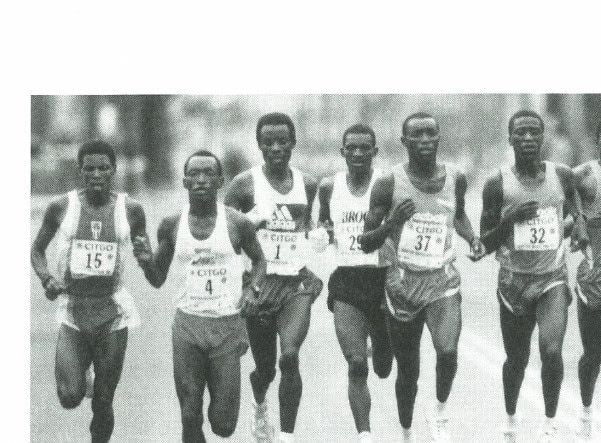
At the same time that performances by U.S. marathoners have slipped, the competition in the rest of the world has multiplied. Look at the Ethiopians, South Africans, Kenyans, Tanzanians, Portuguese, British, Russians, Italians, Australians, Mexicans, Colombians, Ecuadorians, Brazilians, Koreans, Chinese, and Japanese. Runners from every continent are competitive in the marathon.
Frank, Bill, and Joan were innovators. They ran over 120 miles per week when only a few hardened souls were training at that level. Their combination of training, talent, and racing savvy led to victories over the best runners in the world.
Today, there is much more depth in long-distance running worldwide. For example, how good have the experts been in predicting the medalists in the men’s Olympic Marathon? No one came close to predicting the top three in 1984, 1988, 1992, or 1996, and the 12 medalists in those races represented nine different countries. No country can dominate the marathon because the competition is just too fierce.
WHERE IS OUR DEVELOPMENT PROGRAM?
Kenyan national coach Kip Keino believes that the foundation of his country’s marathon success is that thousands of Kenyan children of all ages run and walk up to 10 miles to and from school each day. Kids in the United States start running at about age 15, if they start at all. In fact, the number of U.S. kids on high school track teams has decreased by about 40 percent from 1978 to 1990. Often, U.S. kids become runners because they aren’t big enough to play football or basketball, or skilled enough to play baseball or soccer. With all the diversions of U.S. culture in the 1990s, not many of our kids choose to run. As a result, we do not have the pool of talent to produce many competitive marathoners.
We also need a program to develop our athletes after college. Contrast the support available for developing marathoners in the United States versus Japan. Japan has about 30 corporate-sponsored teams of 12 to 15 runners each. That creates approximately 400 runners coming up through the ranks to maintain the country’s heritage in the marathon. In the United States financial support is not available until after a runner achieves some level of success.
DON’T BLAME BOB AND ANNE MARIE
The difference between the marathoners of today and those of the ’70s and early ’80s isn’t that the current athletes run fewer miles or race too frequently. There is no data to support those claims. Kempainen and Coogan race less than many of the Kenyan marathoners, and certainly less than Bill Rodgers did in his prime. Don’t blame the men and women who have risen to the top of the U.S. system for our lack of Olympic Marathon success. They have trained hard and intelligently and know how to race. If we want to improve our standings in international marathon competition, we need a program to develop more athletes like Bob, Mark, and Anne Marie.
Should the United States dominate the marathon? Of course not. The marathon isn’t beach vollyeball. Could we be more competitive than we are? Probably—but only with a grassroots program that brings 12 to 15 year olds into the sport. With enough kids coming through the ranks, we will have our best chance of finding the next Frank, Bill, Joan, or Alberto.
—Pete Pfitzinger, a graduate student in exercise physiology, won the 1984 U.S. Olympic Trials Marathon and was the top U.S. finisher in the 1984 and 1988 Olympic marathons.
This article originally appeared in Marathon & Beyond, Vol. 1, No. 3 (1997).
← Browse the full M&B ArchiveMore like this
1,000+ stories from 19 years of Marathon & Beyond
The complete archive of the legendary long-distance journal — digitized and free to read.
