

Fueling The Ultra-Endurance Athlete
Many ultramarathoners will tell you their success comes as much from making the right nutritional decisions before and on race day as doing the right volume and type of training. Thus, establishing the correct fueling protocol is critical for maximum ultrarunning performance.
Your running training is all in the bank on race day, because once you’ve done the training for your ultra, there is nothing else you can do to improve on it except to follow a tapering program to allow all your hard work to come through.
However, nutrition is where you can improve the most or, conversely, cause problems that will cost valuable minutes or hours or even lead to a DNF if you mess it up. Thus, ultrarunners need a sound working knowledge of the complex subtleties of fueling nutrition in addition to a solid background in ultra-training techniques.
How ultrarunners should establish their fueling protocols Maintaining an adequate fluid and food intake during an ultramarathon is as much an art as a science. Experienced ultrarunners will tell you that the best way you can prepare your gastrointestinal system for the fueling challenges of ultraraces is by practicing during training, under simulated ultra conditions and during shorter training runs.
Every ultrarunner has special nutritional requirements that are established through trial and error. Human taste and absorption rates are highly individualized. Novice ultrarunners need to realize that if raisins work for one runner, they may have the opposite effect on another, so wise athletes will try a variety of carbohydrate-rich foods and fluids to determine their personal preferences and tolerances.
In addition, ultrarunners also need to establish the volume of each foodstuff and drink they can handle without adverse side effects. Another often-overlooked
Nutritional logistics for hydrating, refueling, and electrolyte replacement for ultrarunners • Avoiding nausea, cramps, bloating, and diarrhea on race day • Ensuring that you feed when you lack appetite, a commonly reported
complaint by ultrarunners • Handling “flavor fatigue” with sports drinks • Avoiding hypoglycemia and hyponatremia • Training yourself to be able to eat and drink to handle extreme terrain challenges such as altitude sickness, hypothermia, and heat injury •
Training the support crew to practice passing feedings to the runner while he is in motion • Training the support crew to be responsible for making sure the runner eats, even when he or she has lost appetite and has little interest in food and fluids
factor among ultrarunners is the nutritional problems presented by training in a cold climate and competing in a hot climate, or vice versa. Many an ultrarunner has discovered the hard way that food and fluid choices will vary according to the temperature. Accordingly, runners need to practice eating a wide variety of foods in the environmental conditions that they will be competing in. And then there are the small things. Energy bars, for example, harden to the consistency of shoe leather in cold weather and should be cut into smaller pieces so they can be warmed in the mouth. Store them in Ziploc bags. Hot soup might be necessary on a cold day to provide an easily palatable food while warming the runner.
All these factors have to be considered and written down for future reference. Runners need to create a nutrition plan that is flexible enough to compensate when their favorite food suddenly causes cramping or low energy. Greg Crowther, a member of the USA Ultrarunning team, agrees.
He says, “It’s hard to improvise successfully when you’re tired, hungry, cranky, and so on! Having a plan does not mean you’ll stick to the plan, but it’s much easier to modify an existing plan than to make one up as you go along.” Brian Morrison, an ultrarunner and second-place finisher in the White River 50-Mile National Championships, agrees. “I have experimented on race day a couple of times, and it’s never worked out well. The last thing you want to worry about out there is having stomach issues. Running 50K or longer is hard enough, but mismanaging your
fueling creates an exponentially more difficult scenario. Whether it be bonking or vomiting, it’s best avoided with careful planning and preparation.”
The prerace diet The effects of tapering combined with carbohydrate-loading have been examined in several hundred studies since the 1980s, to the point where there is no longer much ongoing research into this procedure except on fine-tuning issues of dosages and so forth. We appear to have some definitive answers to our questions, and most experienced runners have established protocols based on these conclusions.
Generally, runners who maintain a diet of about 60 to 70 percent carbohydrates for at least four days (and follow a tapering program for at least a week) before their event will boost the glycogen stores in their liver and muscle tissue to a level about twice as high as during normal training and normal diet. A depletion phase where you starve your body of carbohydrates for a few days before starting the carbohydrate loading is no longer considered necessary and can have adverse side effects (although some ultrarunners and marathoners still swear by it).
The research shows that this supercompensation effect from carbohydrateloading results in significant improvements of up to 15 minutes in the marathon and even greater time improvements in ultraraces. Ultrarunners stand to improve
The ultrarunner has to establish • which sports drinks and liquid meals work and which don’t by practicing eating and drinking while training, • what different flavors of sports drink are palatable and how often
they should be changed during the event to prevent flavor fatigue, • what foods you can stomach and what make you feel nauseous, • what prerace meals give you the biggest boost, • what carbohydrate-loading protocol works best for you, •
how much you can drink and tolerate without feeling liquid sloshing around in your stomach, • whether salt tablets prevent hyponatremia or whether they simply suck up water from the extracellular spaces, further dehydrating you, and •
whether you can tolerate defizzed soft drinks to get a caffeine boost or whether they wreak havoc with your blood sugar.
Summary—The prerace diet • Stay hydrated before the race. • Carbohydrate load for 3-4 days before. • Consume more sodium and potassium for 3-4 days before the race. • Avoid consuming alcohol for 3-4 days before the race. • Do not alter the types of foods you are accustomed to before a race. • Eat a high-carbohydrate/low-fiber snack 1-3 hours before start time.
by huge amounts if they follow the carbohydrate-loading protocols diligently. In addition to experimenting with what fuels to ingest during ultra races, runners should obviously also ascertain what prerace meals and foods they can tolerate and what to avoid.
General guidelines are well and good, but exactly how much carbohydrate does the runner need? The ultrarunner can estimate his desired carbohydrate intake more precisely by calculating 8 to 10 grams of carbohydrate/kilogram/day. For example, a 72-kilogram (154-pound) runner should take on board 576 to 720 grams of carbohydrates per day. Elite ultrarunner Greg Crowther eats the usual “starchy foods like bagels with jam, pasta, pretzels, plus a bit of 100 percent carb junk food like licorice and soda.” Adam Lint, an ultrarunner, third-place finisher in the 2008 US 100K road championship, and second placer in the 2008 50-mile trail championship, eats “a dozen doughnuts the day before the race and a pot of coffee and some bread” before an ultra.
Nutrition during the race Renowned sports nutritionist Nancy Clark says, “The two primary goals of feeding the ultra-endurance runner during the event are to maintain normal hydration and to maintain normal blood-glucose levels.” Seasoned ultrarunners will tell you to eat before you get hungry and drink before you’re thirsty—you need to start eating and drinking very early in the race. These are two of the golden rules of ultrarunning. The basic rule is that the longer the race, the slower you go, and the more you eat.
Solid foods Start taking in carbohydrates right from the start and at regular intervals to help you conserve the glycogen that you have previously stored in your muscles and liver for as long as possible.
▲
Eat a variety of foods during an ultra, which will also help prevent flavor fatigue.
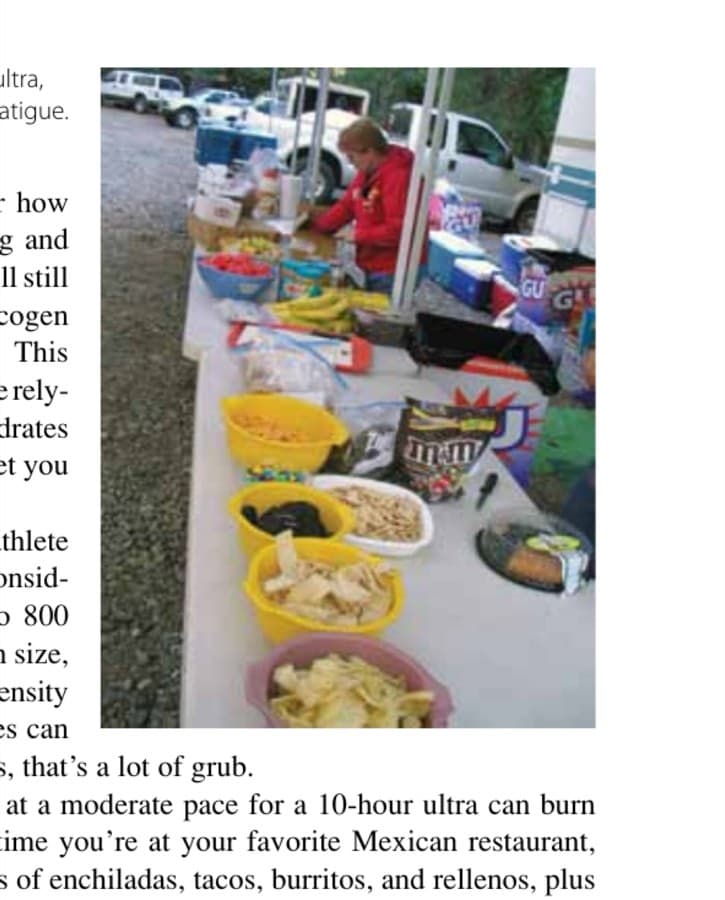
Also realize that no matter how good a job you do of refueling and drinking during an ultra, you will still burn through your stored glycogen toward the end of your ultra. This means that eventually you will be relying on the exogenous carbohydrates that you eat along the way to get you to the finish.
How much food should the athlete take in during an ultra? Lots! Considering that runners burn 200 to 800 calories per hour (depending on size, sex, temperature, terrain, and intensity of race pace) and that ultraraces can last from five hours to 24 hours, that’s a lot of grub.
A 150-pound runner going at a moderate pace for a 10-hour ultra can burn 6,000 or more calories! Next time you’re at your favorite Mexican restaurant, have a look at how many plates of enchiladas, tacos, burritos, and rellenos, plus beans and rice, you have to gobble up to eat this many calories. You would need to chew your way through half the menu!
How much should we be ingesting during our ultras? A good goal is to take in 1 to 1.5 grams of carbohydrate per kilogram of body weight per hour. For most runners, this will be between 280 and 420 calories per hour for a 70-kilogram (154-pound) runner. This should include a mix of solids and liquids. Sports nutritionist Monique Ryan, in her book Sports Nutrition for Endurance Athletes,
Digesting and absorbing food and drink during an ultra As an ultrarunner, you need to be able to digest and then absorb your food and drink. The food you ingest first starts to break down in the stomach. Then the bolus of food empties from the stomach into the small intestine where the carbohydrates, fats, and proteins are absorbed. Ideally, you want your food or liquid to become absorbed as fast as possible to fuel your muscles and brain.
recommends 30 to 60 grams of carbohydrate (120 to 240 calories) per hour from sports drinks. Brian Morrison says, “I try to eat 50 to 60 grams of carbs per hour. That’s a little bit more than two gels per hour. So I may eat two gels per hour plus a drink with calories, or I may eat as many as three gels with a noncaloric drink like Nuun [a portable electrolyte hydration drink that you add to water], or even water.”
Recent research has found that sports drinks with combinations of the carbohydrates glucose and fructose, or maltodextrin and fructose, can result in reduced fatigue and faster performance. And you can take in up to 90 grams per hour of these mixes. Maltodextrin especially, a more complex carbohydrate, has lots of calories, is well tolerated, and is quickly absorbed.
But be wary of beverages with fructose—they can cause stomach upsets, nausea, and bloating, so be sure to experiment with them in training simulations, if you insist on using them at all. Lab studies show that we digest and absorb only about 280 calories (or 70 grams) of carbohydrates per hour (Ivy et al. 1988). Well-trained ultrarunners believe they can absorb 400 to 500 calories per hour, and some evidence shows that ultrarunners may even be able to take in more than this, up to 800 per hour (Kreider 1991). Thus, there definitely appears to be a “trainability” effect for eating and drinking on the run.
What solids should you eat? Most ultrarunners will stock standard carbohydrate rich-foods like fruit, watermelon, lightweight fried fruit, bagels, fig bars, energy bars, chocolate bars, cakes, cookies, candy, jelly beans, pretzels, boiled potatoes, pies,
and sandwiches (cheese sandwiches seem to be a favorite). Seattle ultrarunner Brian Morrison says, “In longer races (50 to 100 miles), it’s important to eat some solid food, I think. In the case of those
longer runs, I’ll eat more bars, boiled potatoes, peanut butter and jelly sandwiches, even burritos, and less of the sugary gels.” But many an ultrarunner has fantasized about and craved pizza, potato
chips, milkshakes, and cheeseburgers during the latter stages of an event. Are there some higher-fat and higher-protein foods that you can experiment with? And don’t forget to wrap your foods so that they will not be ruined in wet weather.
Because ultraraces are generally at a slower pace (around 60 percent to 70 percent of VO2 max) and often conducted at fast walking pace, more blood flows to the GI tract, enabling faster absorption of the food and fluids. Lab studies (Brouns et al. 1987) show that exercise at less than 65 percent of VO2 max does not interfere with digestion, so the ultra-athlete may even be able to enjoy more solid, higher-protein, and fat-containing foods like peanut butter sandwiches and cookies. Liquid meals in cans like Exceed High Carbohydrate Source, Ensure, Boost, and even chocolate milk can help here.
This makes the ultra event unique in that it is actually an advantage to go at a slower speed for the long haul. So your ultra pace needs to be slow enough to permit this to happen. Many ultrarunners have told me that a good time to eat is when they are walking uphill.
Yet another nutritional factor that many beginning ultrarunners don’t consider is that as the race progresses, they may get a craving for fruits and salty or even fatty foods. This becomes more of an issue as the ultra gets beyond 10 hours, by which time it becomes very difficult to meet your energy demands.
Liquids Ideally, you should match your fluid and electrolyte needs with your losses on an hour-by-hour basis. “Ultrarunners need to start the race well hydrated by drinking 16 to 20 ounces of fluid in the hour before start time,” says Ryan in her book.
Why the wide range in recommended fluid intake? Sweating varies with ambient temperature, humidity, race-pace intensity, sex, and individual sweat rates. Generally, men will need more fluid than women because they tend to be larger and lose more sweat over a larger surface area.
Clearly the runner cannot carry these volumes of fluid, so the need for a support crew is critical. Fluid stops at drinks stations must be carefully planned, and the runner must carry enough fluid between checkpoints. Most runners are able
Drinking guidelines for ultrarunners 120 to 250 ml of fluid every 15 minutes = 1 liter (33 ounces) to 2 liters (66 ounces) of fluid per hour USA Ultrarunning team member Greg Crowther sips 5 to 10 ounces of sports drink (mostly Gatorade) or water every 20 minutes on a warm day, or more if it’s hot. Ultrarunner Brian Morrison advises, “A good rule of thumb is one 20-ounce bottle per hour, yet when it’s really hot, I may drink up to 40 ounces per hour. I’m consistently sipping from my bottles, so I don’t time my drinking as I do my eating.”
© Emily Berriochoa
▲ Carefully plan your fluid intake at aid stations, and make sure you have a solid support crew.
to absorb and process 1 liter of fluid per hour. An easy guide to whether you are hydrating adequately is to check the color of your urine. If it’s clear, you’re doing well. If it’s dark colored, start drinking more.
To gel or not to gel? Research has not yet shown that gels are absorbed better than standard sports drinks, which have the advantage of already having carbohydrates dissolved in them in the right concentration. If you prefer sports gels, avoid washing them down with sports drinks, as the overall concentration will be too hypertonic and will draw fluid from your gut, further dehydrating you, lowering your blood volume, and making your blood volume more viscous (which makes your heart work harder). Dilute gels by taking them with water. Greg Crowther takes gel or Shot Blok (about 100 calories) once or twice an hour.
Beware of sports drinks or soft drinks with high concentrations of carbohydrate (sugar)—above 10 percent. They take longer to empty from the stomach. Remember, you want quick clearance. If you insist on taking such hypertonic sports drinks, dilute them by 50 percent to play it safe. Brian Morrison says, “I will usually drink Nuun or just plain water. I’ve experimented with various other sports drinks, but many of them are just too sweet and sugary, especially when used in conjunction with gels.”
If your ultra lasts longer than six hours, attention must be paid to electrolyte intake, especially sodium, through sports drinks or food. This is the third golden nutrition rule for ultrarunning. Hyponatremia occurs in athletes who take in too much low-sodium fluid (water) or are excessive sweaters. It’s caused by a dilution of the sodium levels in your plasma and is potentially fatal. It affects about 5 percent of runners in any given ultra event (Tarnopolsky 2008).
The people at highest risk tend to be the less fit and those who gain water weight during the event. A higher incidence of hyponatremia among women has also been noted because they tend to gain more weight during an ultramarathon and have lower body-mass indexes and lower sodium levels than men.
Flavor fatigue An interesting nutritional phenomenon often happens under the stress of ultra-endurance competition—many runners find they cannot continue to stomach their favorite drink (or foods) throughout the event. Nutritionists refer to this as “flavor fatigue,” meaning the runner can no longer tolerate his favorite foods or beverages.
How to avoid flavor fatigue Prepare and pack several different flavors of drinks, gels, bars, and other foods that have proven tolerable in the past. Different flavored drinks should be alternated at checkpoints right through the event so the runner
does not get tired of the same flavor. Greg Crowther mixes things up to avoid flavor fatigue and drinks water instead of sports drink every third of fourth time to “cleanse the palate.” Adam Lint agrees: “Variety can be helpful, but honestly, everything tastes
repulsive toward the end of an ultra event.” Brian Morrison likewise experiences flavor fatigue. “In a 20-hour race, I definitely grow weary of flavors and usually resort to drinking plain water.”
Be aware of your caffeine intake
If you are at risk in these populations, you are well advised to experiment with sodium tablets or foods high in sodium like potato chips or pretzels. There are as yet no clear-cut guidelines for sodium intake during ultra events, but 200 to 500 mgs/hour is enough to prevent hyponatremia. Heavy sweaters may need as much as 1 gram/hour, and salt tablets may help here. It is important that you know the sodium content of your drinks, gels, bars, and other foods.
Make sure you take in enough calcium, magnesium, and potassium in the days leading up to the race. Although the evidence is inconclusive, these electrolytes may have an effect on preventing muscle cramps, one of the most dreaded afflictions that can sideline ultrarunners. Once you have cramps, it’s all over.
Some athletes take Rolaids (calcium and magnesium) to ensure that these minerals are topped up, but again, you should make sure you try these during your extended training simulations. ▲
Alternate different flavored drinks at checkpoints throughout the event so you do not get tired of the same flavor.
© Marcie Bettys/Long Run Picture Company
Adam Lint tells of his harrowing experience with caffeine. “My worst experience regarding food/nutrition was losing track of my caffeine intake during a 70-mile trail race. I had bought new caffeine tabs and did not realize they were double strength. These, paired with my prerace pot of coffee and the Mountain Dew I was drinking at the aid stations, seemed to be working well for my energy level but eventually caused major mental/physical issues, causing me to drop out at mile 58 with a 1.5-hour lead. I had somewhere between 2,000 and 3,000 milligrams of caffeine that day.”
Other nutritional considerations for ultrarunners Taking in caffeine toward the end of the ultra can be beneficial, and indeed, many ultrarunners and triathletes do this. Numerous studies have found an ergogenic (performance-enhancing) effect on ultra-endurance exercise when caffeine is taken an hour before the event. Doses of 1 mg/kg to 6 mg/kg have been shown to boost performance.
If you take caffeine at the start, it is important that you continue to take it during the event, as you do not want to suffer from withdrawal headaches toward the end of the Western States 100-miler, for example. Ultrarunners can argue a good case for caffeine supplementation if their event is longer than 10 hours and they will be running through the night. The wakefulness effect of caffeine may make it worthwhile.
Summary After practicing eating a variety of foods during extended training runs, the athlete can now select foods and fluids for the ultrarace. According to sports nutritionist Nancy Clark et al. (1992), the ultrarunner must do the following: •
Have a defined feeding plan with a written nutrition program that outlines the times and amounts of fluids and foods. • Be flexible and open-minded with alternative foods available in case the tried-and-true foods are not working out. Eat a variety of foods rather than
a limited number of items. • Plan for the effects of the climate on the foods. Hot weather may cause the runner to avoid his favorite sports bar and cause a need for colder drinks, while cold weather may cause the runner to crave warm soup instead of
a cold sports drink. • Cooperate with the support crew. The runner must relinquish authority and follow the crew’s directions when it is clear that the runner needs refueling. • Ensure that the crew keeps diet forms that record food and fluid intake,
preferably for each hour, and that also detail the frequency of the athlete’s urination. A runner who is urinating every 30 minutes is probably drinking too much fluid. • Select a crew leader who is well organized, a good motivator, and an enforcer of regular feedings.
ad
References Brouns, F., W. Saris, and N. Rehrer. 1987. Abdominal complaints and gastrointestinal function during long-lasting exercise. International Journal of Sports Medicine 8(3):175-189. Clark N., J. Tobin, and C. Ellis. 1992. Feeding the ultra-endurance athlete: practical tips
and a case study. Journal of the American Dietetic Association 92(40):1258-1262. Ivy, J., A. Katz, C. Cutler, W. Sherman, and E. Coyle. 1988. Muscle glycogen synthesis after exercise: effect of time of carbohydrate ingestion. Journal of Applied Physiol
ogy 64(4):1480-1485. Kreider, R. 1991. Physiological considerations of ultraendurance performance. International Journal of Sport Nutrition and Exercise Metabolism 1(1):3-27. Tarnopolsky, M. Adventure Racing and Ultramarathons. Summary for 2008 Sports Nutrition
Conference, Indianapolis, Indiana. Hosted by University of Birmingham, England.
Other resources Clark, N. 1995. Nutrition and Exercise Workshop. Seattle, Washington. August 25, 1995. Eberle, S. 2007. Endurance Sports Nutrition. 2nd ed. Champaign, Illinois: Human Kinetics. Ryan, M. 2007. Sports Nutrition for Endurance Athletes. 2nd ed. Boulder, Colorado: VeloPress.
This article originally appeared in Marathon & Beyond, Vol. 16, No. 3 (2012).
← Browse the full M&B ArchiveMore like this
1,000+ stories from 19 years of Marathon & Beyond
The complete archive of the legendary long-distance journal — digitized and free to read.
