

Glass City Marathon
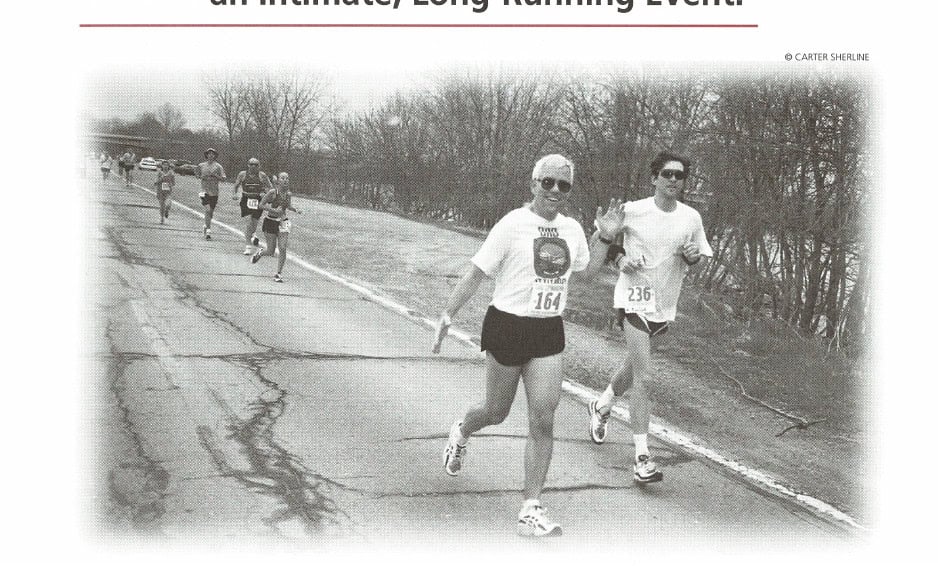
WHEN YOU think of Toledo, Ohio, the term “running hotspot” probably does not leap to mind. You would not name this city of 300,000 as having one of the oldest marathons in the country. And their marathon generates a little less excitement than the New York City, Los Angeles, or Marine Corps races.
But as you run the Toledo course, the terms “comfortable,” “easy-access,” and “runner-friendly” do come to mind. And, most often, so does the phrase “nice day.” If you want an enjoyable, extremely well-managed event, if you want a fair chance at a Boston qualifying time on a USATF-certified course, and if you want easy access to several free or low-cost art and music events, try the Glass City Marathon. For convenience, a small airport is located about 30 minutes from the race start/finish on Route 2 (Airport Highway); the next-closest airport is Detroit Metro, about 1 hour from downtown Toledo.
In 1790, French traders Gabriel Godfrey and John Baptiste Beaugrande built a permanent settlement, later to become the city of Maumee, on the Maumee River. After the Battle of Fallen Timbers in 1794, European settlers began trickling into area villages, which were united in 1833 and named for Toledo in Spain. The Toledo War of 1835 put the Toledo area in the center of a controversy over which Michigan and Ohio militia had actually taken up arms and nearly come to blows. The United States Congress finally ruled in Ohio’s favor, with Ohio gaining Toledo and Michigan being compensated by statehood and the annexation of the Upper Peninsula. The City of Toledo was incorporated in 1837.
As an entry to the Great Lakes, Toledo has been a business staple for the Midwest for many years. It is an industrial city but on a quieter scale than Chicago or Detroit. At one time, Toledo hosted five Fortune 500 companies. Now, the IntroToledo Web site lists 15 Fortune 500 companies that have sites or headquarters in the Toledo area, with industries including motor vehicle parts manufacturing, oil refineries, and the shipping of coal, petroleum, and grain.
Toledo also has easy access to Detroit (one hour) and Ann Arbor, Michigan (45 minutes), home of the University of Michigan and all the accompanying cultural events. Like other cities in the Midwest, Toledo’s downtown riverfront area has been revitalized. Within a short driving distance of the marathon’s host hotel are a number of restaurants and entertainment centers, including an excellent museum, a world-class zoo, and a hands-on science center for children.
The Basics
| Glass City Marathon 130 Yale Drive Toledo, OH 43614 |
||||||||||
| PHONE: 419/385-7025 | ||||||||||
| FAX: 419/531-0119 | ||||||||||
| E-MAIL: jpatmann50@aol.com | ||||||||||
| WEB SITE: www.toledoroadrunners.org | ||||||||||
| RACE DIRECTORS: Tom Falvey, Pat Wagner & Pam Graver-Koenig | ||||||||||
| YEAR RACE ESTABLISHED: 1971 | ||||||||||
| CERTIFIED: USATF | ||||||||||
| START TIMES: 7:55 A.M. wheelchairs, 8:00 A.M. runners, walkers, relays | ||||||||||
COURSE RECORDS:
|
||||||||||
| PRIZE MONEY: Top 3 in open divisions: $100, $75, $50. Top masters male and female: $75. | ||||||||||
| NUMBER OF VOLUNTEERS: 300 to 400 | ||||||||||
| MARATHON FINISHERS IN 2001: 220 full marathoners, 64 five-person relay teams, and 52 two-person relay teams | ||||||||||
| MALE/FEMALE FINISHERS: 74 percent male; 26 percent female | ||||||||||
| COURSE MARKINGS: Every mile. Splits and race pace given at 1 mile, 5K, 5 miles, 10 miles, half-marathon, 15 miles, 20 miles, and 25 miles. | ||||||||||
| MEDICAL AID: Two ambulances on course; doctor at finish line; four sag wagons on course with nurses | ||||||||||
| NUMBER OF AID STATIONS: 15 | ||||||||||
| RACE DATE FOR 2002: April 21 | ||||||||||
| HOST HOTEL: Radisson Hotel, 101 Summit St., Toledo, 800/333-3333 | ||||||||||
| ENTRY FEES FOR 2002: $30 if registered by April 8; $35 after April 8; $60 for two-person relay team by April 8; $70 for two-person relay team after April 8; $150 for five-person relay team by April 8; $175 for five-person relay team after April 8 |
Classical Glass
At the end of the 19th century, Michael Owens, financially backed by Edward Drummond Libbey, invented an automatic glass-blowing machine. With this invention, Toledo’s glass industry took off. For many years, Toledo was the glass capital of the world, and subsequently became known as the Glass City.
Toledo’s glass focus remained industrial until the 1960s; then, the Glass City was a logical place for the modern art glass movement to take off. According to the Toledo Museum of Art’s Web site, “In 1962, Harvey Littleton of the University of Wisconsin, with the technical assistance of Dominic Labino, a chemist and inventor from Grand Rapids, Ohio, solved the problem of melting glass on a small scale. At a workshop at the Toledo Museum of Art, they presented their revolutionary idea that an individual artist working alone in a small studio could make art glass. The workshop elevated the glass blower from craftsman to artist/craftsman, and the contemporary glass movement was begun.”
Located at 2445 Monroe Street at Scottwood Avenue, the Toledo Museum of Art is a world-class museum within 5 miles of the marathon’s host hotel. Edward Drummond Libbey founded the museum in 1901 as a free museum, and it remains so today. The classical revival style building that is its current location opened in 1912. Florence Libbey, the widow of
Must See/Must Avoid
GO SEE IT
Toledo Museum of Art. Located on Monroe Street at Scottwood Avenue, the Toledo Museum of Art is a definite must-see. Cruise through galleries of African and Egyptian art, European paintings, furniture, and hangings, glass, graphic arts, and on and on.
COSI. The Center of Science and Industry is at Summit and Adams Streets within walking distance of the race start/finish on Toledo’s riverfront. MindZone explores how our minds “process, interpret, and create illusions and perceptions.” Lifeforce, Body Music Evaluator (learn to play a tune using belches—that’s not a misprint), sports areas, and many other exhibits allow adults and children to actively explore science.
Toledo Metroparks. Check out the Toledo metroparks Web site (www.metroparkstoledo.com) for several beautifully maintained parks, including Sidecut Park, which is part of the race course. Sidecut Park opened in 1931 as the first Toledo metropark, with “two picnic tables and a well.” There is a monument to The Battle of Fallen Timbers within the park. The Battle of Fallen Timbers took place August 20, 1794, amid trees topped by a tornado north of the Maumee River. The battle has been called “the last battle of the American Revolution” and one of the three most important battles in the development of our nation. The battle, which opened the Northwest Territory for westward expansion, was won by the Legion of the United States led by General “Mad” Anthony Wayne. A confederacy of Indian tribes led by Miami war chief Little Turtle (Michikinikwa) of the Miami and Blue Jacket (Weyapiersenwah) of the Shawnee led the Native Americans. The outcome of the battle led to the signing of the Treaty of Greenville in 1795. Heidelberg College at Tiffin, Ohio, is financing an archeological project designed to preserve this historical battlefield. The actual battle site is a farm within the suburb of Maumee, Ohio. Fort Miamis, built by the British in 1794, is located nearby, 3 miles southwest of the City of Maumee near I-475 and US 24. Toledo Metroparks has purchased the original 66.8 acres of what will become the 185-acre Fallen Timbers Battlefield National Historical Site. Future President William Henry Harrison was also fighting under General Wayne at Fallen Timbers. In 1813 Harrison built Fort Meigs “to protect northwest Ohio and Indiana from British invasion.” Fort Meigs, currently undergoing renovation, is located on West River Road in Perrysburg, Ohio, close to the Fallen Timbers location.
Wolcott House Museum Complex. The Wolcott House is an 1836 Federal-style house, the original home of James and Mary Wolcott. The buildings in the complex include a log cabin, a 19th-century church, an 1840s saltbox farmhouse, and a station of the Toledo and Grand Rapids railroad depot. The house is located on River Road in Maumee, not far off the race course. It is a nice short tour that you can fit in within a 3-hour time slot.
MUST AVOID
There’s not much to avoid in the Toledo area. Generally, race participants should not walk alone in downtown Toledo after dark, a caution common to most metro areas.
WEB SITES:
www.oac.state.oh.us/niffegallery/glass/glasspr.htm
www.toledomuseum.org/info_main.html
www.toledoraodrunners.org
www.metroparkstoledo.com
www.cositoledo.org/home
www.ohwy.com/oh/w/wolhoume.htm
http://tristate.pgh.net/~bsilver/fallen.htm
Edward, continued to support the museum during the Depression era, when little was flourishing economically.
Over 30,000 works of art are housed there, with several thousand of them on permanent display in 35 galleries. Highlights include one of the world’s finest glass collections, and the Peristyle, a “classical-style concert hall that seats 1,700 and is home to the Toledo Symphony.” The glass gallery is a modern-style circular exhibit hall with a stairway in the middle. Visitors begin with ancient glass on the first floor and follow the stairway to the upper level as exhibits walk them through glass history.
On the upper level, Bohemian glass is on display, along with blown pieces by Dominic Labino, Fritz Dreisbach, and other modern artists. Want to see Picasso, Degas, Van Gogh, African, and Asian art? The museum has these and many more. It also hosts music events in the Peristyle and in the Great Gallery.
Toledo’s running community is as well established as its museum. The Toledo Roadrunners Club, some 850 strong, is one of the largest in the Michigan/Indiana/Ohio area. Check their Web site (www.toledoroadrunners.org) for applications for the Glass City Marathon as soon as they are available, as well as information about other runs in the Toledo area. For the past 10 years, the TRRC-sponsored Olander Park 24-Hour Run in the suburb of Sylvania has been the site of the USATF national 24-hour championships.
For first-class running shoes, check out Dave’s Performance Footgear, with locations in Delta (30 minutes outside of Toledo) and Sylvania (10 minutes from Toledo) for an excellent selection of last-minute goodies to make your race stylish and comfortable. Dave’s often exhibits at the marathon expo.
CORPORAL KLINGER ATE HERE
Remember M*A*S*H? Corporal Klinger sang the praises of Tony Packo’s restaurant on Toledo’s east side. The original east-side Packo’s was a staple of Toledo entertainment in the days when Klinger suffered through the Korean War, and it remains pretty much as it was then. The Cake Walkin’ Jazz Band is no longer available with Dixieland jazz on the weekends, but one of Tony’s satellite restaurants offers weekend entertainment. Many local groceries sell Tony’s pickles and peppers, or you can stop in at the original downtown restaurant or the newer sites in Sylvania or West Toledo for a Hungarian hotdog, pickles and peppers, and the necessary bread to soften the blow of the hot pickles.
According to www.tonypackos.com/history.html, Tony Packo, the son of Hungarian immigrants, opened the original restaurant on Toledo’s east side in 1932. The famous Hungarian hotdog began as a homemade sausage sandwich served on rye bread. When you visit for your postrace snack (we don’t advise calorie-loading on Hungarian hotdogs before the race), be sure to check out the walls of framed hotdog buns, signed by celebrities from every genre, including presidential candidates. The restaurant is still run by the Packo family.
Toledo’s zoo, one of the largest in the world, is located about 4 miles south of downtown and hosts 875,000 visitors per year. The zoo originated a century ago, when a single woodchuck was donated to the City of Toledo Parks Board. Now the zoo provides a home to 4,000 animals, representing over 600 species. Five Spanish Colonial-style buildings constructed during the Depression by the Works Progress Administration and the Federal Emergency Relief Act are still in use. The zoo is open every day of the year but Thanksgiving, Christmas, and New Year’s.
THE RACE
The Glass City race is user-friendly in all areas, beginning with the race application. The application states that the course is open for 5 hours and that runners and wheelchair participants run at their own risk after 1:00 p.m. But if you are a slow, persistent runner and know your finish will be slower than 5:15, you’re encouraged to call race director Tom Falvey to request an early start. In this year’s race, 25 to 30 people were given an official start at 6:00 a.m. Race officials provided reflective vests for the early runners who wanted them, as well as directions on where to discard the vests once daylight broke.
Counting these early starters and including relay teams added in the last few years, the total field was almost 250—less than half the size it reached in earlier years. Runners will note that the course has stayed essentially the same for the past several years. Runners who don’t wish to train for the full marathon can opt for the five-person or two-person relay.
A MULTITUDE OF AWARDS
Awards are plentiful. Cash is awarded to the top three overall runners, the top male and female masters runners, and the top male and female wheelchair athletes. There are also awards for each of the nine class divisions of the two- and five-person relay events, with special awards for the overall fastest two- and five-person teams. Age group awards go at least three deep in each category.
Other nice details include cheerful and plentiful volunteers available at every mile to provide water, sports drinks, candy, oranges, and bananas. Police monitor strategic turns and heavily trafficked areas. The Radisson Hotel is located at 101 Summit Street, only a block or two from the start and finish, and there’s plenty of parking.
The run begins on Summit Street and ends a few blocks closer to the river. It’s an easy walk back to the comfort of the hotel from the finish after you receive your finisher’s mug (Libbey glass inscribed with the marathon logo and date) and finisher’s medal (added in the last couple of years). If the weather is on the chilly side, finish line volunteers wrap mylar blankets around runners.
There is a banner, loudspeaker announcements of the runners, and music to herald your finish. About a block after the finish line, tables are set with refreshments and a good view of the river. Hot soup, bagels, fruit, cookies, and water are plentiful for even the latest runners. If it’s warm, you can sit on concrete steps and gaze at the Maumee River as you contemplate your achievement; if it’s chilly, you can limp back to the hotel to shower before the awards ceremony.
According to Pam Graver-Koenig, co-director of the Glass City Marathon for the last 11 years, a core group of about 25 people chairs individual committees and puts forth a major effort every year to pull off the event. Pam feels that smaller races give the runners more personal treatment. “We really try to treat the runners well,” she says. “The volunteers are very enthusiastic and come back year after year.”
THE COURSE
The Glass City Marathon is a flat course by anyone’s standards and is run on paved city streets. The course is pretty, given the frequent views of the Maumee River and the beautiful residential areas with spring flowers. Daffodils, tulips, magnolia trees, forsythia, and other favorites decorate the lawns of Rossford, Perrysburg, and Maumee, making for a beautiful and natural welcoming committee.
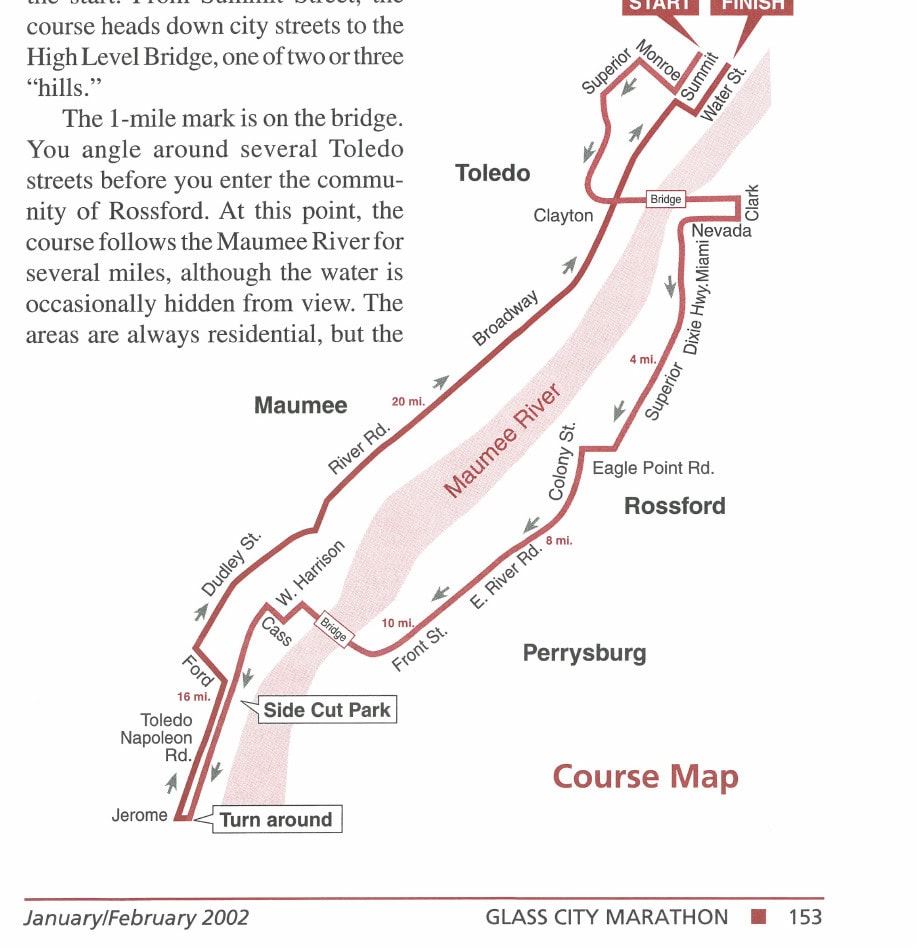
A banner on the skywalk over Summit Street identifies the start line. You hear the “Star-Spangled Banner” and occasionally “Oh, Canada.” You also run into a bagpipe serenade near the start. From Summit Street, the course heads down city streets to the High Level Bridge, one of two or three “hills.”
The 1-mile mark is on the bridge. You angle around several Toledo streets before you enter the community of Rossford. At this point, the course follows the Maumee River for several miles, although the water is occasionally hidden from view. The areas are always residential, but the course sticks to well-paved roads and attractive neighborhoods. It then moves into Perrysburg. The next river crossing occurs just after mile 10 as the course angles into Sidecut Park and follows the road through the park. Here crowds consist mostly of fishermen whose primary reason for coming to the area has to do with whatever is biting that day in the Maumee. Besides the fishermen, you’ll see very little traffic in this area.
| Runner’s High/Runner’s Low | |
|---|---|
| HIGHS Mostly scenic course High volunteer support Fluids, goodies available almost every mile Inexpensive hotels |
LOWS Little crowd support Minimal race expo Very flat course |
THE SECOND HALF
At mile 14.5, runners turn around and head back toward the park and into the residential area of Maumee. While the river is not always in sight, runners follow this path into downtown Toledo and curve back onto Summit Street until the detour at about mile 26, which directs them to the riverfront on Water St.
Do not expect many spectators along the course, but aid stations are well manned and enthusiastic. With the race held in mid-April each year, you’ll find that the weather is usually perfect for running. If there is a drizzle, it’s usually a mild one. If you need your Tyvek jacket at the start, you’ll have it tied around your waist soon enough.
There is rarely a strong wind, and you’ll pass plenty of folks out for their Sunday morning constitutional. You won’t need to carry fluids, as the aid stations are frequent. And you won’t have to go after your own water when you do reach an aid station; volunteers easily take care of the modest field of runners. You won’t find many runner-friendly bushes along the course, as mostly it runs through residential areas, but there are six Portajohns.
THE HISTORY
With the increase in marathoning throughout the United States and the world, you can choose any type of course, weather, toughness, or championship that you want. Go ahead and run in the big cities (New York, DC, or LA) and the exotic locales, but don’t overlook the Glass City Marathon. With the exception of a break from 1984 through 1989, this marathon has been running for 25 years. In 1971, when Sy Mah was running the course, the race began and ended at the University of Toledo on the west side of the city.
The race’s Web site declares “The Glass City Marathon honors the memory of Sy Mah, one of Toledo’s greatest running enthusiasts, who once held the Guinness Book of World Records spot for running 524 marathons in his lifetime.” The memory of Sy Mah is an integral part of Toledo’s racing history. Born in Alberta, Canada, Sy Mah moved to Toledo in 1970. He taught health education and initiated running classes at the University of Toledo. He was among the first to prove that it’s possible to run multiple marathons in a month—and even on the same weekend.
His lifetime total of 524 marathons was a record that stood for many years. His friend Tom Falvey went to a few marathons with Sy and reminisced about the triples Sy would do on holiday weekends: “Doing the marathons was no problem for Sy, but driving to the race, getting from one race to another—that was a problem.”
The Toledo Roadrunners Club is placing a statue of Sy Mah in Olander Park in Sylvania. Funds raised will be used to provide college scholarships for students interested in running. The tradition continues, for Sy’s grandson has been at the marathon start for several of the last years.
“ONE-PUNCH PETINIOT”
Tom Falvey has been involved in marathoning since 1978 and with the Toledo Roadrunners since 1983. His memories include the year 1979, when Bucky Cox, a 5-year-old from Kansas, completed the race with his father. He also elaborated on the story of “One-Punch Petiniot,” as mentioned on the www.OhioRunner.com Web site. It seems that Jim Petiniot and Tom were running on Bancroft Street with traffic when a motorist began honking and yelling at them. The third time was enough for Jim, a coach at Central Catholic High School in Toledo. The driver yelled: “Why don’t you get the hell out of here?” When the motorist came after Jim with his fists, Petiniot hit him hard and shoved him back into the front seat of his car. Thus was he dubbed “One-Punch Petiniot.”
Dave Kohler left teaching at Rogers High School in Toledo to become involved with bagpipes. Every year, for the price of a T-shirt, Dave shows up at the start of the race and serenades the runners. In 2001, he brought six young bagpipe players with him. After the starting ceremony, all six jumped into a car and headed out to various points along the course to continue the entertainment.
Dave Payette, an expatriate Toledoian who has since moved to Florida, had a show on a local cable television station for several years. As he ran the course, he would be followed/led by a Toledo Edison electric car filled with film equipment. Periodically he would grab the equipment from the car to interview runners along the course. Runners would find Dave closing in on them, mike in hand, not even out of breath as he popped interview questions and directed the video perched on the electric car. Runners could count on full marathon coverage on a local cable channel shortly after the race.
The Bottom Line
We have weighed various aspects of a marathon within a 1,000-point scoring grid. Besides the author of the article, two dozen runners at the race were randomly chosen to score the race for us (GCM = Glass City Marathon). The results follow:
1. HISTORY/TRADITION
Evaluate the race’s sense of history and tradition.
[Possible points: 30 GCM score: 26]
2. ENTRY FORM
Is the race entry form clear, concise, attractive, complete, and easy to fill out?
[Possible points: 20 GCM score: 19]
3. ENTRY COST
For most races, the entry fee covers between 30 and 50 percent of the cost of putting on the event. Rate the value of your dollar relative to this race.
[Possible points: 30 GCM score: 28]
4. LOCALE/SCENICS
Is the race held in an area that is easy to get to and scenic and offers adequate food and housing services and nonrace activities for family and friends?
[Possible points: 50 GCM score: 42]
5. REGISTRATION
Is registration well organized and efficient? Does it bog down unnecessarily?
[Possible points: 20 GCM score: 19]
6. PRERACE ACTIVITIES
Evaluate activities, such as pasta feeds, parties, and so on, during the days before the race.
[Possible points: 50 GCM score: 38]
7. EXPO
Does the expo offer a fair number and variety of booths relative to the race’s size? Are there quality exhibitors and good guest speakers?
[Possible points: 50 GCM score: 26]
8. COURSE
Take into consideration the following: degree of difficulty, certified, sanctioned, quality of road or trail surface, adequate mileage and directional markers, aid stations, medical coverage, race communications, accessibility to course for friends and family, typical weather, and so on.
[Possible points: 400 GCM score: 350]
9. RACE AMENITIES
This category includes race T-shirt, finisher’s medal, finisher’s certificate, adequate and efficient finish area, ease of sweatbag retrieval, showers, postrace refreshments, awards ceremony, raffles, results postcard, results book, and so on.
[Possible points: 250 GCM score: 220]
10. VOLUNTEERS
Are the volunteers experienced and adequate in number?
[Possible points: 100 GCM score: 94]
TOTAL SCORE FOR GLASS CITY MARATHON
862 points
This article originally appeared in Marathon & Beyond, Vol. 6, No. 1 (2002).
← Browse the full M&B ArchiveMore like this
1,000+ stories from 19 years of Marathon & Beyond
The complete archive of the legendary long-distance journal — digitized and free to read.
