

The Art of the Ultramarathoner
The first three installments of Tom Osler’s book appeared in our July/August, September/October, and November/December 2001 issues, respectively.
CHAPTER 7 RACING ALL DAY
In this chapter we examine races of 100 miles and twenty-four hours. In the past, runners were warned to avoid these distances, or advised to try them at the conclusion of a career as a grand finale to serious competition. Few ever raced these lengths more than once. Even the great Ted Corbitt established the present American record of 13:33:06 for 100 miles in 1969, in his first and only attempt at the distance. At that time there were so few 100 mile races that Corbitt went to England to set the record. He also established an American record of 134.7 miles for twenty-four hours, again in England and again in his only try at the event. In those days runners saw these as grotesquely long marathons, to be run every step of the way. Walking was not yet considered a serious skill within the sport, even though both these records could be matched by an athlete who knew the art of mixing. Since running the entire distance would sometimes “destroy” the runner, it was thought best—perhaps correctly—to retire after one such race.
Today we know that twenty-four hour runs, as well as 100 milers, are well within the capacity of trained athletes who mix walking and running. By doing this, such distances can be enjoyed and not feared. I have run three twenty-four hour runs in the past three years, as well as two 100-milers. In all these races I combined walking and running and had very positive experiences. My best twenty-four hour distance is 114 miles, and my fastest 100 miles was run in 16:11:15. While these are far short of records, they provided me with an opportunity to explore new dimensions of my athletic potential. They were not devastating; in fact, my recovery from these ultras was more rapid than recovery after many difficult marathons.
Continuous Running or Mixing
While many well-trained runners can race fifty-milers using only steady running, only the world’s finest athletes should attempt to cover 100 miles without some walking. It would be far easier to negotiate 100 miles in fourteen hours by mixing than it would by trotting at a steady 8:24 mile pace. One hundred miles in fourteen hours is an excellent time, and would win most races of this length. In a 1978 100-mile road race that was run in New York City, my good friend Nick Marshall tried steady running and turned in a brilliant 14:37:05 performance, the sixth best American ever at this distance. Unfortunately Nick’s legs have not yet returned to normal, even though a full year has elapsed. Nick is one of the finest athletes ever to attempt these distances, and I have respect for him as a competitor. No doubt he will soon recover and we will once again match strides on the track and road, but I would not want to endure the frustration that I know he feels when he cannot race.
On the other hand, Park Barner established the American twenty-four hour run record in 1978 without walking a single step. Park stopped only twice, once to change shoes and once for a bowel movement. There is no doubt that he has exceptional genetic gifts for this activity; the average ultramarathoner would take great risks if he used steady running only in races of this length.
Road and Track
Nearly all twenty-four hour runs take place on quarter-mile tracks. Races of 100 miles are also frequently run on a track, and when a road is used the course usually consists of a small loop that is repeated many times. Tracks and small loops are desirable because they require far less help from officials. These days, runners are never in short supply, but it is often difficult to find volunteers to help direct the race.
Many would-be ultramarathoners are intimidated by the track. They fear that circling a small oval all day will be unbelievably monotonous and detrimental to their performance. Surprisingly, most athletes who have run in long track races discover that boredom is rarely a concern. Ultramarathons are not even like 10,000 meter races. Here you do much more than simply circle the track. You walk, drink, eat, do exercises, reverse direction, sit, stop and talk to reporters and even nap on occasion. There is far too much happening in an ultra to ever cause boredom.
Most runners who have tried twenty-four hours on the track, and have been schooled in mixing, find upon finishing that they are eager to do it again. Rather than experiencing boredom, they discover that the track becomes a good friend. Where else can you find refreshment every quarter mile? There is no concern for losing your way, and officials can help a man if he gets into difficulty.
Because long distance track races have not been common during the past fifty years, one important feature has been ignored by race directors—reversing directions. In bygone pedestrian races, athletes were often free to reverse the direction in which they had circled the track. This is healthy for the legs and feet. While I am not recommending that runners reverse at will, they can reverse en mass, when directed by an official, to avoid chaos.
One simple way to coordinate the reversal of a race is to have an official blow a whistle at the end of each half hour period. At this signal, the runners complete the present lap, then turn around when they reach the starting point. Runners who have not yet reversed stay on the inside lane, while those who have just turned around run a bit wide. In this way the switch can be completed in a minute or two without collisions or confusion.
Last year I raced 100 miles over a track on which reversing was not possible because a twenty-four hour relay was also in progress. At about seventy miles I began to have trouble with my left ankle. After the race the ankle became swollen and remained so for over a week. In contrast, I have finished three twenty-four hour runs and one twelve-hour run in which the runners reversed each half hour. I had no difficulty at all with my ankles in these races. For some reason, reversing seems necessary only in the longest races. I never had difficulty in fifty-milers on a track where reversing is never considered.
Lap Counting
In races of many laps, counting can be a major problem. At times the race officials will miscount, and unless you are alert and can verify their counts, you will lose valuable distance. Few runners can count their own laps; it is too easy to become confused. Small, hand-held counters can make this task easier. The runner carrying such a counter can click it each time a lap is completed. While this method is not 100 percent reliable, it does allow the runner to check the official lap count periodically. Metal counters are sturdier than those made of plastic and thus are a better value.
Resting, Exercising, Sleeping
Besides walking, the runner can also take brief rest periods during which he leaves the track and sits or lies down. When I established my personal record at 100 miles, I stopped every ten miles and rested for a few minutes. Then I lifted my feet above my head for several minutes more. On returning to the track, I always felt refreshed by this respite.
Some runners have found that various stretching exercises are invigorating during these stops. In case of fatigue, the runner might even consider a brief nap. I have watched runners grow stiff and weary during twenty-four hour races, only to return from a thirty-minute nap looking like they just began running. These techniques sound strange to the uninitiated, but they are part of the sport of ultramarathoning, and they make it possible for ordinary runners to cover surprisingly long distances.
In addition to rests and naps, other methods, including massage, can be used to revive the runners. The great Rhodesian Arthur Newton, who held many world records from fifty miles to twenty-four hours in the 1930s, chose to stop during his twenty-four hour record race to take a hot bath and have a complete dinner, immediately upon completing one hundred miles. He then returned to the track and ran over fifty miles more!
Psychological Preparation
The runner’s attitude toward racing should become more casual as the distance increases. Marathons can be run with a certain intensity, but such intensity must be tempered considerably if fifty miles is to be completed. In races of 100 miles the approach is so casual that the scene resembles a workout rather than a race. This is true for all but a handful of world-class runners who can actually run all day long.
The thought of entering a twenty-four hour track race can be very frightening. For this reason I always promise myself that I will be especially timid in my approach to such a race. Unlike my policy for a fifty-miler, I won’t “engage” other runners in direct competition in a race of 100 miles. In fact, I promise myself that this will be a day of fun. After all, I’ll be free of work and family cares. Nothing more serious than gently walking and running around an oval need concern me. If I get tired, I sit down. If I get hungry, I eat. If I get weary, I sleep. What could be easier?
I will now describe my first twenty-four hour track run. It will allow the reader to see how different principles we have examined are put into practice.
Wednesday, December 8, 1976
I have been studying the efforts of the great pedestrians of the nineteenth century. I am convinced that the secret of their ability to cover 500 to 600 miles in six days lies in their combination of running and walking. Tomorrow, for the first time, I am going to put this theory to a test. I will circle the track for twenty-four hours, and while my greatest previous distance afoot was sixty miles, I am convinced that I can surpass one hundred miles by using this rediscovered technique.
I will be running alone, but the college and community have taken notice of my trial. Each year students at Glassboro State sponsor Project Santa, a fundraising drive for needy families at Christmas. My run will help in this effort.
A reporter from the local newspaper visits my home in the afternoon. As I relate my strategy for covering more than 400 laps on the track, I notice that my wife Kathy is growing uneasy. After the interview I ask if anything is wrong. We have been married for eleven years, and she has seen me off to hundreds of races without concern. But now Kathy confesses that she is afraid. “The whole idea sounds crazy, and you’re apt to kill yourself!” I try to convince her that I have no plans to be “heroic,” and that I will simply come home if I get too tired. I don’t think she believes me.
Pat Barrett, a three-hour marathoner herself, has driven from her home in North Jersey to help count laps and be my handler. Pat graduated from Glassboro last June and had been my frequent training partner for three years. I retire to bed at 9 p.m. while Pat and Kathy renew their friendship.
I set the alarm for 4 a.m. and for a 5 a.m. start. I try to sleep, but it’s impossible. I’m like a child waiting for Christmas. I can’t wait to get on that track and start running. Over and over I review my plans. I will start by running seven laps, then walking one, running seven, walk one, and so on. If this becomes too difficult I will switch to running three and walking one. If that in turn is too hard, I will alternately run and walk single laps.
I lay still, but don’t sleep. Usually I have no difficulty sleeping, but tonight I keep thinking of the old pedestrians. Tomorrow I will have my first chance to feel what they felt. I will start in darkness, I will watch the sunrise, I will see the day unfold. The sun will set, but I will go on into the night. Great!
The night passes without sleep. I rise at 4 a.m. Bob Zazzali, my training partner, who will be running several miles with me during the day, arrives to drive Pat and me to the track. I think about my lost sleep, but I should be fine even without it. Two nights without sleep would be a disaster, but I can survive one.
The Start (5 a.m.)
There is just enough stray light from the parking lot to light the school’s cinder track. It is 20 degrees, with no wind. I am wearing ski pajamas on my legs, two sweat shirts, gloves and a hat to guard against the cold.
A few professors and students are there to run a few miles, and without ceremony we start running at 2 minutes past 5 a.m.
I try to relax, but my legs are bursting with energy. I pass the first lap at a 7:30 mile pace. This is ridiculous! At this rate I will set the world’s record. Still, I cannot get control of my nerves. Seven laps pass—time to walk. I’ve never done this before, and my body resists what seems like a highly unnatural pause.
Finally, after covering six miles in 49:40, I have stilled my nerves and walk my first lap. I should have walked earlier, but I have never run and walked in training, and I found it impossible. In the future I’ll know better! After the first hour I have established the proper ratio of seven laps run to one lap walked. At last I am in control of myself. Phase one of this effort will continue until 1 p.m. In phase one running should be effortless and not tiring. While the effort is easy, I cannot relax completely, for the wind is beginning to pick up. I hate cold weather, and twenty degrees with wind is very cold.
My long-time friend Neil Weygandt is running the first fifty miles with me. Neil is a 2:40 marathoner; I assure him that he will succeed by using our technique of strategic walking.
The sun is shining brightly and the cinder track is starting to thaw. When we started, the track was frozen hard. By 10 a.m. it had a pleasant soft sponginess, but by noon portions of the inside lane were under water. Apparently there were ice crystals frozen in the cinders and now they have melted. The track has become so soggy that it is nearly impossible to run comfortably on the inside lane. I was aware before the race that this might happen. The outermost lane of the track is in good shape, and at forty-five miles I begin to run there. I won’t be able to return to the inside lane because of it’s soggy state. Since ten laps on the long outside lane equals eleven on the inside, the conversion to 440-yard laps is easy. After I run ten laps, I give myself a free one!
I have been reversing direction every half hour. Not only does this equalize the strain on my legs, it also provides an opportunity to view the stadium from a slightly different perspective. Each mile I check my hand-held lap counter. I confirm my progress with Pat Barrett, who is also keeping count.
Phase one ends with Neil and me passing 50 miles in 8:08:13. Neil stops and joins Pat to help with the lap counting. I stop and walk to the field house, only 50 yards away, for a bowel movement.
Phase Two
As I return to the track, I feel some slight fatigue. This is surprising, since I felt great when I left just ten minutes earlier. Now phase two has begun, and while I can’t expect my legs to trot on without some urging on my part, still I must remain very comfortable or the final eight hours will be wasted.
After running for twelve hours, the sun starts to set. I have anticipated this moment since I tossed and turned sleeplessly last night. My running speed is now about eleven minutes per mile, but I feel reasonably strong and am truly able to enjoy the twilight. I have run seventy miles. Many students and faculty came to the track in the afternoon to run a few miles with me, and as darkness sets in, more arrive.
I pass eighty miles in 14:06:27, but I am no longer comfortable. I shouldn’t be this fatigued until phase three! Twenty miles to go before I reach 100, and at this rate that will take four more hours. I am really finding this unpleasant, but I maintain the seven to one running and walking ratio.
After eighty-five miles, a small musical group arrives on the track. They are somewhat tipsy, but still able to circle with me while playing reasonably well. The carnival atmosphere they generate is just what I need to forget my somber trot. They stay for only ten minutes, but they succeed in rescuing me from self-doubt. I continue on with renewed cheer.
Phase Three
I pass ninety miles in 16:09:39. Phase three is just beginning, but I don’t see how I will be able to run much beyond 100 miles. As I near the 100-mile goal, however, my spirits rise. I grow more optimistic and the fatigue slips from my shoulders. A small crowd of friends, students and reporters has gathered for the conclusion of the first one hundred miles.
Much relieved, I reach one hundred miles in 18:19:27. Our college president greets me and I briefly enjoy one of the most fulfilling moments of my running career. I feel a desperate need to leave the track and sit down. Kathy has brought a large bowl of spaghetti, and I retire to the field house to enjoy it. I change my clothes and lie down for fifteen minutes, during which time I actually sleep. I am in the field house for fifty-three minutes before I return to the track for the final five hours of the night.
It is very cold, but the wind is still when I walk back down to the cinders. After sunset, the soft track has frozen again; this time it froze in ruts since so many runners had left footprints during the day. Fortunately, the outside lane has remained passable throughout the twenty-four hours.
I try to run a few steps, but my legs feel incredibly heavy. To my horror, running is no longer possible. (In retrospect, I made two mistakes. I should have taken several rest breaks during the day, and I should not have eaten so large a dinner. In addition, a nap of thirty minutes to an hour at this point might have enabled me to begin running again.)
If I could no longer run, I could still walk comfortably at three miles per hour. Students are night people, and many of them joined me as I slowly circled the track. By 5 a.m. I had walked fourteen miles for a total of 114 miles in twenty-four hours.
After a short interview on the college radio station, Neil and Pat drove me home. Kathy was relieved to find me alive, and we all went to the living room to discuss the day’s events. I fell asleep quickly while the others chatted, much to their amusement.
While my effort had created interest in Project Santa, it had another effect as well. Pat and Neil met on that icy track for the first time. What they said during the long hours spend counting my laps will never be known. Santa’s spirit was at work, though, for they became engaged shortly thereafter and are now married.
Post-Run Recovery
After spending a sleepless night Thursday, followed by running all day and night on Friday, I imagined that I would sleep most of the next day when I returned from the track. While I did take a few brief naps during the day I really felt no need for extended sleep.
Having suffered long recovery periods from prior marathon races, and even longer recovery times after fifty-milers, I also anticipated that bounding back from the twenty-four hour effort might be even worse. I was delighted to find that this was not so. In particular, there was no leg soreness at all. The following day I tested my legs by running a few steps. They felt a bit heavy, but they produced a smooth, pain-free stride. Nevertheless I thought it best to avoid any real running for three days, and when I did resume training, I only jogged a few miles each day for an additional week.
In subsequent long races which mixed considerable walking with running, I experienced comparable recovery. Leg stiffness, which can be painful for a week following a marathon or fifty-miler, is rarely present. In spite of my feeling of well-being immediately following such efforts, I still believe that it is best to forego normal training for at least a week to insure that no unexpected injury develops.
Statistics
The graph on page 133 shows the number of miles I covered during each of the twenty-four hours. It is interesting to note that the run actually does divide itself in to three phases of about eight hours each. During the first phase I averaged about six miles per hour, but during the second this drops to five miles per hour. Since I was reduced to walking for most of phase three, my speed dropped to about 3.5 miles per hour.
A close inspection of the data collected during this run reveals that of the 114 miles I traveled in the twenty-four hour period, 88.5 were run while 25.5 were walked. The time spent running was fourteen hours and twenty minutes, while I walked for seven hours and fifty minutes. Thus only fourteen of the twenty-four hours were spent in actual running. While running, my average pace was 9:43 per mile, and while walking it was 18:28.
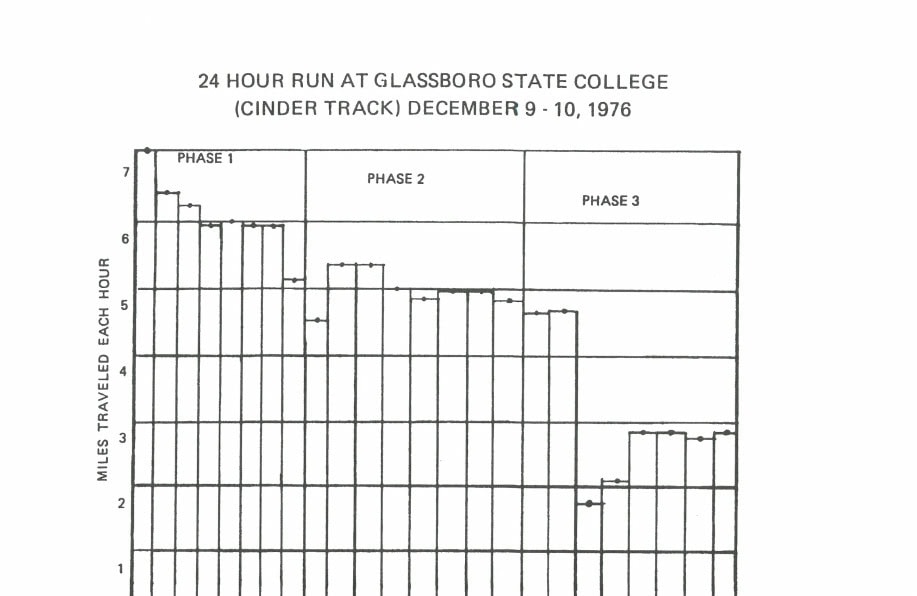
Many people feel that a steady pace is best for racing at short distances. But is it also best for a twenty-four hour run? True to my novice standing in this ultramarathon, my speed declined without interruption over the day. My goal, still far away, would be to blend running with walking so well that the final eight hours are as productive as the first.
Chapter 8: Racing for Several Days—Part 1
Very few races in America are scheduled to extend beyond one day. Such races had been popular among professional pedestrians in the nineteenth century but professional long distance walking and running has been dead since the great transcontinental foot races of 1928 and 1929. Should amateur runners attempt such efforts? Park Barner ran a solo 200 miles from Harrisburg to Pittsburgh in 1978 shortly before establishing the American twenty-four hour track record. Recently I ran for three days (200 miles in seventy hours) at Dr. David Costill’s Human Performance Laboratory in Muncie, Indiana. Even such demanding runs need not be feared if undertaken properly; they can offer many athletes a chance to explore areas of physical and mental capacity not often tapped.
By the time George Littlewood established the six-day record of 623.75 miles in 1888, the art of the pedestrian had reached great sophistication. Unfortunately that art is now lost. This chapter reports on my own recent three-day trial, and attempts to draw modest conclusions from it.
Sleeping
Sleep is clearly essential in events longer than twenty-four hours. The question really is, how much is enough? Before my three-day trial I was concerned that I would need at least six hours per day. I was surprised to find that I averaged three hours and thirty minutes each day without ever feeling deprived of sleep.
The great pedestrians of the six-day races normally slept only three or four hours per day. (The day before the contest started they would sleep as much as possible.) Newspaper accounts tell us that they would enter their tents, sleep for 30 minutes, awaken, and immediately resume traveling.
Many runners sleep for eight hours each day. How can they hope to get by on half that amount while expending so much energy, shall we say, for several days running? Perhaps the answer is not the total hours of sleep, but the quality of that sleep. Research shows that the deeper kind of sleep, known as REM (rapid eye movement) sleep, is more restful than the earlier, lighter slumber. Runners who can immediately fall into and awaken from REM sleep have a distinct advantage in ultramarathoning.
My sleeping pattern is unusual. I often nap for an hour or two in the afternoon. I go to bed at ten but get up at 1 A.M. for three hours of reading followed by two or three more hours of sleep. I am not recommending this schedule for others, and relate it because it was a factor during my three-day run. Weston had demonstrated that it is best to eat and sleep during a six-day effort at roughly the same times that one would during an ordinary day. A race extending over several days is best approached as a series of ordinary days during which a great deal of running is done at all times other than those reserved for eating and sleeping.
A pattern that emerged during my three-day run was as follows:
| 1 P.M. – Lunch | 1:30 P.M. – Sleep for thirty minutes |
| 7 P.M. – Supper | 7:30 P.M. – Sleep for one hour |
| 1 A.M. – Snack | 1:15 P.M. – Sleep for forty-five minutes |
| 5 A.M. – Snack | 5:15 A.M. – Sleep for seventy-five minutes |
I chose to sleep immediately after eating since it is difficult to run on a full stomach. In each case I fell asleep easily.
It was better to awaken from sleep naturally than to be jolted awake by an alarm; starting to run again is much easier. Only once in three days did I use an alarm clock, and I had a rough time returning to the track.
Eating and Drinking
Unlike races of a day or shorter, three days spent running make solid nutrition essential. In 100-milers or twenty-four hour efforts an athlete can get by on sugared drinks, if he or she has sufficient nutritional reserves. In events lasting three days or more, genuine meals must be eaten.
Earlier I examined how breakfast, lunch and supper might be coordinated with time spent sleeping. It is probably best to eat during the event at approximately the same time of day at which you normally would.
What you eat and drink should also not be too different from foods that you normally prefer. It’s likely that a few rich desserts such as pie and cake will help. Large quantities of fluid should be taken continually to avoid dehydration. I have found that fruit juices, coffee, tea and powdered milk mixed with sugar were all effective.
Reviving
It is surprising how quickly runners can revive after a short time spent off their feet. During my efforts at twenty-four hours as well as my recent three-day run I would frequently find myself growing slightly weary while running and walking. After a brief rest, lasting from fifteen minutes for a small snack to two hours for a meal and a nap, I would return to the track. Getting started was always a bit hard, but after about twenty minutes of motion I would begin to feel refreshed and could continue for several hours in good spirits.
As always, the reader must decide upon, through experiment, the effectiveness of these techniques for his or her particular body.
Walking
The longer the run, the greater the importance of walking. While trained runners need not worry about practicing long walks for efforts of twenty-four hours or less, this isn’t true for races of three days and up. During my best effort at twenty-four hours I ran eighty-nine miles and walked twenty-five. The walking gave me no problems in spite of the fact that I never walk further than one mile in ordinary days. During my 200 mile effort in seventy hours, I walked a full 100 miles in short segments; here the walking gave me great difficulty. Perhaps I made a mistake in choosing to walk so much. Nevertheless, I believe that I must now practice long walks if I am to attempt such trials again.
Why should training in walking be necessary for the trained runner? If an athlete wants to cover one hundred miles or more by using walking in a race of several days duration, then he or she had best become efficient in his walking style. I soon found that my walk was very energy consuming. In addition, walking places different stresses on the feet. I never get blisters while running, but I did get bad ones from prolonged walking. I need to toughen my feet so that they can also handle walking many miles.
I have outlined my suggestions for sleeping, eating, reviving and walking during pedestrian efforts lasting several days. I will now briefly describe my own three-day trial in order to put these theories in a practical setting.
A Three-Day Trial
Wednesday, April 25, 1979
I am flying to Muncie, Indiana. Tomorrow at 7 A.M. I shall begin my first run longer than one day, a three-day trial. Through the winter, as usual, my training mileage has been low. I have averaged fifty-five miles per week since December; worse, my weight is up twelve pounds. I have no special schedule of when to eat, sleep, rest, walk, or run, but I will decide these things as the event progresses.
At the airport I am met by Dr. David Costill, Director of the Human Performance Laboratory at Ball State University. This laboratory is well-known for its studies of runners. The world’s greatest athletes have come here for scientific analysis, and I am delighted that Costill wants to have my trial here. He informs me that he has a crew of twelve graduate assistants to record data during the run. They will analyze blood samples, oxygen, urine, and weight as well as record distances, times and psychological impressions.
Costill drives me to the lab and shows me his equipment. The lab is impressive, but I’m particularly interested in the track. There is a half-mile macadam oval passing through a park-like area of the campus that I can use during the daylight hours. A field house containing an indoor eight-lap-to-the-mile dirt track will be used at night. Both are within a few seconds walk of the laboratory.
At 7 P.M. Costill and I met with the support crew. After he reviews their schedule of experiments, I explain to them my reasons for attempting this run. I relate briefly the story of the great pedestrians of the past, with emphasis on my hero Weston. I confess that at present I know nothing about how such efforts are best negotiated, but I will learn and this is my school. Ultimately I want to try six days, in an attempt to cover 500 miles. The crew is enthusiastic; most are distance runners themselves. Without their help such a trial would be impossible.
Costill shows me the remaining preparations. There is a complete kitchen as well as a small private room for sleeping right in the lab. Everything I need is here.
I go to bed at 9 P.M. and sleep soundly for eight hours at Costill’s home. Unlike my twenty-four hour run described above prior to which I did not sleep at all, I now have the advantage of a full night’s sleep. Sleep lost before a twenty-four hour effort is of little consequence, but sleep missed before a three-day effort would certainly be reflected in a reduced performance.
After a breakfast of yogurt and coffee we drive to the lab. It is 6:30 A.M. and I am amazed to find everyone working so hard. Preliminary tests delay the start and I begin at 7:25 A.M.
The First Day—Thursday, April 26, 1979
I walk out the lab door to greet a partly overcast breezy morning. It is 64 degrees, delightful weather were it not for the wind. I walk the first mile in fifteen minutes, then I begin alternately running and walking the half-mile laps. My walking style is excessive; I lean forward and come down with my leg straight, like a modified “goose step.” In contrast, my running form is smooth and easy. Dave Elgar, a 2:25 marathoner himself, is timing my laps. I am running at ten minutes per mile and walking at fourteen. I am surprised that I can walk that fast.
As I circle the little oval, I enjoy looking at the budding spring landscape. Fresh grass and blossoming trees are everywhere. The path is crowded with students and faculty running in both directions. I always enjoy watching others run. I can study their style in relation to their build and weight. Watching the women run is an extra treat.
At twenty miles I begin to feel a strange sensation on the callus beneath the ball of my right foot. It doesn’t hurt, but I am alert to any possible problem. Little do I know that this is the start of a deep blister that will be my greatest concern in the final stages of the run.
After completing twenty-three miles I break for lunch. My bowel movement is very loose, probably due to the grape juice which I am drinking every mile. I have to correct this stomach problem if I am to get needed nutrition from my food.
I had mentioned to Costill last night that today is a my thirty-ninth birthday, and the lab assistants now appear with a huge cake. One quarter of it was reserved for me, and I managed to eat it all before the day was over. A tough stomach is a real friend in ultramarathons, and my stomach is my greatest asset. I head for my private room where I fall asleep for twenty-five minutes. When I return to the track, I find that lunch and sleep have taken only fifty-two minutes.
I continue to alternate running and walking half-mile laps. I am now running faster, and walking slower than I did in the morning; I run at eight minutes per mile speed and walk at sixteen. Pete Watson, himself a swimmer and marathoner and a member of my support crew, begins to walk with me. I tell him that the walking is starting to feel harder than the running. Pete reveals that the entire crew has been concerned about my walking stride. It looked excessive to them, but they chose to remain silent. How right they were! My thighs were beginning to stiffen and I had not yet traveled thirty miles. I notice that the thighs are stiff when I walk, but not when I run. This is terrible! Thigh stiffness is usually a severe sign of fatigue. In desperation I try to alter my walking stride. By bending my knee as my foot makes contact and by walking more erect, the stiffness starts to disappear. Blessed relief!
Since lunch I have been drinking powdered milk with extra sugar. This delightful drink tastes like a milkshake. I have never tried it before, and Costill is worried that the milk will be difficult to digest. It isn’t, and more importantly, it is helping to tighten my bowels.
By 5 P.M. I am growing weary from so much walking. Perhaps I have erred in choosing to run and walk equal distances. I thought walking would be restful, but it is in fact more tiring than running. I decided to change my ratio to three laps running for each lap walking. This feels much better.
By 7:30 P.M. I reach fifty miles and gladly stop for dinner. Mrs. Costill has prepared a delicious hot meal, and I devour it with delight. After dinner I take a forty-five minute nap from which I awaken very refreshed. This whole break took one hour and forty minutes.
It is 9 P.M.—too dark to run on the outdoor half mile oval. But the indoor facility is dreary. There is nothing cheerful about this giant quonset hut. The track is made of dirt, is very dusty, and measures eight laps to the mile, just like the original Madison Square Garden. At least I have something in common with Weston; I am now on a track similar to those that he made famous.
I am surprised at how quickly I get into motion again. I walk the first mile as a warm-up, then begin running 1.5 miles and walking 0.5 miles in a repetitive run-walk mixture. This feels very comfortable, and I continue in this way for an additional twenty miles.
At 1:30 A.M. I leave the track and take another nap. Fearing that I might sleep until morning, I ask to be awakened within an hour. I awoke from my previous naps without assistance, but this time I must be stirred.
On returning to the track I have great difficulty starting. Why did I get up? I want to sleep. I feel depressed for the first time. I promise myself that I’ll never try this again. Perhaps I should quit at forty-eight hours and return to my family.
I share these thoughts with my assistants, and we agree that I must have been awakened during a deep segment of sleep. In the future I will allow myself to sleep until I am ready to get up.
After thirty minutes, energy begins to return to my body and my stride becomes easy, but now the pain in the ball of my right foot is growing more noticeable. Costill examined it earlier and suspected that a deep blister was forming under the callus. Since I have never before had blisters in this location, I was a bit skeptical of his diagnosis. However, I had already walked thirty-five miles. I’ve never before walked that far in one day, and I believe that this has caused the problem.
At 5:30 A.M. I leave the track, having completed eighty-two miles. This time I’ll sleep as long as I like!
The Second Day
I arise at 7 A.M. after sleeping for ninety minutes. In the lab Costill and his crew are busy at work. They seem surprised that I appear fresh, and frankly, I am too. I thought I would want more sleep. A few hours ago I was looking for an excuse to quit, but now I’m eager to get started.
When I leave the lab at 7:30 A.M. I am greeted by warm sunshine. The morning is beautiful, and for once there is no wind. Convinced that I walked too much yesterday, I select a run-walk rhythm of 1.5 running miles to 0.5 walking. I feel great; even better than I did yesterday. The lab assistants continue to take periodic blood samples and every hour they also tap my “exhaust” by having me breath into a large bag for two minutes as I walk and run. Besides the four major rest periods during which I eat and sleep, there are approximately ten short “stops” during which I change clothes, record my body weight and relieve my bowels if necessary.
I pass 100 miles at 11:30 and decide to celebrate by lying down in Costill’s office for twenty-one minutes. One of the assistants is busy working at the newly purchased microcomputer. I own a similar computer and keep it in my office at home. For a few moments I forget the run as we discuss his programming problems.
I enjoy lunch and a short nap as I did yesterday, but when I return to the track in the afternoon the ball of my right foot is mildly uncomfortable. At 4:30 P.M. I ask Costill to examine it again, and now he is sure that it’s a blister. He places two small pieces of mole foam on either side of the blister to remove the pressure. When I return to the track I am amazed to find that the discomfort is entirely gone! I can’t even tell which foot is giving me trouble. I do have one reservation. Will the mole foam itself cause trouble later? It is always dangerous to change things inside a shoe.
I quit for dinner at 6:30 P.M. having completed 122 miles. If I maintain this pace, I could complete 250 miles in three days, the pace required for finishing 500 miles in six days. On paper it looks easy, but on the track it’s proving harder than I had anticipated. I sit down to a large dinner of yogurt, cheese, bread, lettuce, pie and ice cream, and then sleep for one hour.
I resume running at 9 P.M. on the little indoor track. Pete Watson arrives with his stereo, and the air is filled with the sounds of his favorite rock albums. I love music of all types, opera, classical, rock, disco, you name it. I find that running to the beat of the records is very enjoyable. In the old Madison Square Garden pedestrian contests a band played all day long. How this must have helped the pros!
I am still running 1.5 miles, then walking 0.5, but my legs are growing stiff. I’m not really concerned, though I am well into phase two of the trial, and I should be feeling some effort.
Suddenly at 11 P.M. I feel tremendous pain in the little toe of my right foot. We head for the lab and examine the foot. The mole foam that so effectively solved the problem on the ball of my foot has itself created a blister on the little toe. That blister broke while running and has left the skin really raw. Jeff Miller, Pete Watson and Dave Elgar work at devising various pads for the toe. All fail. It looks like I’m going to quit, for I can’t even walk slowly on this foot without a severe limp. As a last measure, I pull off the mole foam and place a band aid over the toe. Amazingly, the pain is gone.
I return to the track and run for only five more minutes. I solved the toe problem, but with the mole foam gone, the original blister is again bothersome. I feel weary but am convinced that I will be able to continue. I decide to sleep.
We worked on the blister for an hour, and I now sleep for an additional ninety minutes. When I return to the track at 3 A.M., my foot feels better running than it does walking. Why did I take long walks in training?
My body is reasonably fresh and willing to work. If only this foot would snap back! By 5 A.M. I have completed 144 miles. I retire again for 90 minutes sleep, hoping that I will awaken with renewed freshness as I did yesterday morning.
The Third Day
I return to the track at 7 A.M. I feel good, but my legs are noticeably weaker. The weather has also turned blustery and overcast with an occasional drizzle. I have to dress warmly.
For the first time, running is no longer comfortable. I decide to run the half lap into the wind, and walk the other half with the wind. In this way I will be warm when I walk.
By 11 A.M. I have reached 160 miles, but my foot is deteriorating rapidly. I stop for thirty minutes and try to alter the shoe so that the ball of my foot doesn’t hurt, but nothing really helps. I could travel well if only I didn’t have this blister. I begin to calculate how far I could go if I stop running and only walk. There are twenty hours left, and if I walk two miles per hour I will reach 200 miles. It is clear that I cannot cover 250 miles as I had hoped.
By 1 P.M. I have managed 165 miles. I stop for lunch and a nap of forty-five minutes. As always I return to the track feeling refreshed. It is amazing how quickly the body can revive after a good meal and a nap.
By 3 P.M. my run has become an eleven minutes per mile shuffle. I hate running this slowly, and decide to continue with walking only. My foot severely reduces the otherwise pleasant pedestrian stroll. My path takes me past a ten-
story dormitory. In one of the upper windows someone has placed a sign in letters four feet high reading, “Go Tom.” That sign sure helps lighten my steps. I have circled this path so many times that I was bound to attract some attention. Occasionally as a student passes by, I hear an encouraging “you can do it!” I still think I can cover 200 miles, but I had hoped to do it more pleasantly.
I eat dinner at 7:30 P.M., and I am desperate to relieve the pain in my right foot. I have covered 178 miles, and have twelve hours left in which to cover only twenty-two miles. I take a safety pin and begin to probe the callus under the ball of my foot. If there really is a blister there, letting the fluid out should reduce the pain. Sure enough, a small quantity of clear fluid oozes out. But when I try walking, I discover that I have made the problem worse; I now feel a burning sensation. I rub Vaseline into the blister and cover the area with mole skin.
I return to the indoor track and begin walking at 8:20 P.M. A small band of students arrives to watch my progress. There is almost a party atmosphere as Pete’s records are blasting and a game of Frisbee is begun. I feel embarrassed that I cannot run with so many people watching. At 10 A.M. Dave arrives carrying half a warm cherry pie on an aluminum plate. He holds the plate for me as I circle the track while gorging myself. What a sight I must be!
By 11:30 P.M. I have covered 189 miles and I decide to take my last nap. When I lie down the balls of my feet itch terribly. I rip off the mole skin protection and rub them furiously. How good that feels.
I sleep for only twenty-five minutes. I’m excited by the thought of finishing those last eleven miles.
On returning to the track I find that the blister really begins to hurt so I decide to walk very slowly. Soon the pain subsides to the level of discomfort; to keep the pain away, I stop after each mile and lift my feet over my head for five minutes. By 5:25 A.M., seventy hours after starting, I have completed 200 miles. Two hours remain in the three-day period, but I have no stomach for more walking.
I walk back into the lab. What a filthy mess I am! I shower and shave for the first time in three days, and cannot help but laugh as I retire for a few hours sleep. This has been harder than I expected, but I now know that my lack of experience in walking caused the blister. Nevertheless, I’m happy. I now know that sleep is no real problem in these trials; I need only three or four hours per day. In spite of the uncomfortable blister I feel fresh, and wonder when I can try this again!
Post Trial Recovery
In the days following this run I did not require any additional sleep. I was, however, more accident prone. I was especially careful while driving, for fatigue had caused my reactions to slow. I did very little running for ten days, as is my practice following ultramarathons. The blister slowly healed and there was no problem with leg soreness.
Statistics
I have given a narrative description of my three-day trial. For readers who wish to examine the run in minute detail, the three tables that follow provide a complete picture of miles covered, times taken for rests and sleep, speed walking and running, and more.
Table 1 gives a detailed picture of how the mileage progressed each hour as well as the number of miles traveled within each hour. The careful observer can see how I revived after each meal and nap. For example, on the first day I had lunch and sleep during the sixth hour; the mileage covered during the next three hours is greater than in the three hours before lunch. This pattern also holds following dinner.
| Time of Day / Start of Each Hour | Hour | DAY 1 | DAY 2 | DAY 3 | ||||
|---|---|---|---|---|---|---|---|---|
| Total Distance | Miles Per Hour | Total Distance | Miles Per Hour | Total Distance | Miles Per Hour | |||
| A.M. | 7:25 | 1 | 4.75 | 4.75 | 86 | 4 | 149.75 | 4.25 |
| 8:25 | 2 | 9.75 | 5 | 91 | 5 | 153.5 | 3.75 | |
| 9:25 | 3 | 14.25 | 4.5 | 96.25 | 5.25 | 157 | 3.5 | |
| 10:25 | 4 | 18.5 | 3.75 | 100 | 3.75 | 160 | 3 | |
| 11:25 | 5 | 23 | 4.5 | 102 | 2 | 162.75 | 2.75 | |
| P.M. | 12:25 | 6 | 23.5 | 0.5 | 102.25 | 0.25 | 165 | 2.25 |
| 1:25 | 7 | 28 | 4.5 | 106.5 | 4.25 | 165 | 0 | |
| 2:25 | 8 | 32.75 | 4.75 | 110.25 | 3.75 | 167.5 | 2.5 | |
| 3:25 | 9 | 37.25 | 4.5 | 115 | 4.75 | 171 | 3.5 | |
| 4:25 | 10 | 40.5 | 3.25 | 117 | 2 | 174.5 | 3.5 | |
| 5:25 | 11 | 45 | 4.5 | 121.75 | 4.75 | 177 | 2.5 | |
| 6:25 | 12 | 49.5 | 4.5 | 121.75 | 0 | 178.5 | 1.5 | |
| 7:25 | 13 | 49.5 | 0 | 121.75 | 0 | 179 | 0.5 | |
| 8:25 | 14 | 50.75 | 1.25 | 124.25 | 2.5 | 182.25 | 3.25 | |
| 9:25 | 15 | 55.5 | 4.75 | 129.5 | 5.25 | 185 | 2.75 | |
| 10:25 | 16 | 60 | 4.5 | 133 | 3.5 | 188 | 3 | |
| 11:25 | 17 | 65 | 5 | 134 | 1.0 | 188.5 | 0.5 | |
| A.M. | 12:25 | 18 | 69.75 | 4.75 | 135 | 1.0 | 190.5 | 2 |
| 1:25 | 19 | 69.75 | 0 | 135 | 0 | 192.5 | 2 | |
| 2:25 | 20 | 72 | 2.25 | 136.75 | 1.75 | 195.5 | 3 | |
| 3:25 | 21 | 77 | 5 | 140.75 | 4 | 197.5 | 2 | |
| 4:25 | 22 | 82 | 5 | 144 | 3.25 | 200 | 2.5 | |
| 5:25 | 23 | 82 | 0 | 144 | 0 | 200 | 0 | |
| 6:25 | 24 | 82 | 0 | 145.5 | 1.5 | 200 | 0 | |
In Table 2 we record the length of each rest period and note periods of sleep. We can see that little time was required for sleep, while much time was spent trying to relieve blisters and alter my shoes.
| DAY 1 | DAY 2 | DAY 3 | ||||||
|---|---|---|---|---|---|---|---|---|
| Time of Day | Rest Length | Comment | Time of Day | Rest Length | Comment | Time of Day | Rest Length | Comment |
| 9:33 A.M. | 6 | 7:54 A.M. | 7 | overdressed | 8:41 A.M. | 4 | ||
| 10:51 | 12 | rain | 11:09 | 21 | lay down | 9:15 | 13 | |
| 11:12 | 3 | 11:59 | 89 | lunch sleep 30 | 11:14 | 26 | ||
| 11:37 | 6 | 1:39 P.M. | 2 | 1:05 P.M. | 97 | lunch sleep 45 | ||
| 12:23 P.M. | 52 | lunch sleep 25 | 2:48 | 13 | 5:57 | 9 | snack | |
| 2:48 | 2 | 4:27 | 28 | fix foot | 6:47 | 31 | ||
| 5:03 | 16 | 6:28 | 139 | dinner sleep 60 | 7:27 | 51 | dinner sleep 20 | |
| 6:14 | 6 | dinner | 11:06 | 6 | 10:11 | 2 | ||
| 7:32 | 100 | sleep 45 | 11:34 | 55 | work on blister | 10:22 | 4 | |
| 11:18 | 10 | 12:44 A.M. | 132 | sleep 90 | 11:24 | 3 | ||
| 1:27 A.M. | 87 | sleep 50 | 3:16 | 5 | 11:36 | 55 | sleep 25 | |
| 4:57 | 6 | 3:22 | 5 | 1:14 A.M. | 2 | |||
| 5:27 | 119 | sleep 90 | 5:01 | 116 | sleep 90 | 1:40 | 6 | |
| 7:12 | 6 | rain | 2:34 | 7 | ||||
| 3:21 | 5 | |||||||
| 3:45 | 6 | |||||||
| 4:09 | 5 | |||||||
| 4:32 | 8 | |||||||
| 4:58 | 7 | |||||||
| 5:25 | 120 | sleep 90 | ||||||
| TOTAL | 7:02 | sleep 3:30 | TOTAL | 10:24 | sleep 4:00 | TOTAL | 7:41 | sleep 3:00 |
Table 3 summarizes the important activities of each day. When I first made these computations I was startled to see the comparative number of hours spent running, walking, and off the track. They are:
Hours Running = 16:26
Hours Walking = 30:27
Hours Off Track = 25:07
Over one day was wasted in not moving at all! There is clearly plenty of room for improvement.
| Day 1 | Day 2 | Day 3 | Total | |
|---|---|---|---|---|
| Total miles traveled | 82 | 63.5 | 54.5 | 200 |
| Miles Running | 47 | 40.5 | 12 | 99.5 |
| Miles Walking | 35 | 23 | 42.5 | 100.5 |
| Time Traveling | 16:58 | 13:36 | 16:19 | 46:53 |
| Time Running | 7:32 | 6:42 | 2:12 | 16:26 |
| Time Walking | 9:26 | 6:54 | 14:07 | 30:27 |
| Time Off Track | 7:02 | 10:24 | 7:41 | 25:07 |
| Time Sleeping | 3:30 | 4:00 | 3:00 | 10:30 |
| Average Speed MPH | 4.83 | 4.67 | 3.34 | 4.27 |
| Average Running Speed MPH | 6.24 | 6.04 | 5.45 | 6.05 |
| Average Walking Speed MPH | 3.71 | 3.33 | 3.01 | 3.03 |
| Number of Stops | 13 | 14 | 20 | 47 |
| Number of Times Sleeping | 4 | 4 | 4 | 12 |
Tom Osler’s book, The Art of the Ultramarathoner, will conclude in our March/April 2002 issue.
This article originally appeared in Marathon & Beyond, Vol. 6, No. 1 (2002).
← Browse the full M&B ArchiveMore like this
1,000+ stories from 19 years of Marathon & Beyond
The complete archive of the legendary long-distance journal — digitized and free to read.
