

How Soon Can I Race Again?
It’s a question that comes up again and again among a certain kind of runner: how soon after finishing a marathon can I run another one? For most runners, finishing a single marathon is the main aim of the race season, whether the goal is simply to finish, to qualify for the Boston Marathon, or to set a PR. Indeed, many coaches say that a runner should aim to race a marathon only once or twice a year and no more than once each in the fall and spring seasons.
This is good general advice, but like all generalities, the reality differs from runner to runner based on experience, physiology, and ambition. Some runners, like marathon champions Charlie Engle and Michael Wardian, find it possible to run high-quality marathons—with a finishing time under 2:30—on consecutive weekends, week after week, month after month. On occasion, these runners even race on consecutive days, as Wardian did when he raced in both the US Olympic Trials and the open category at the Houston Marathon in 2012.
Other runners, like the Marathon Maniacs and the 50 Staters, are chronic repeat marathoners, competing not necessarily for a low finishing time but out of sheer joy for the sport. They often care less about age-group awards than they do about participating in as many races as possible. They are marathon collectors, roaming from state to state and beyond, gathering up as many finisher medals and memories as they can.
I’m not interested in arguing about the merits of any of these approaches. If you are injury free and enjoying a full life, then any advice I could offer about what you should do would be like telling you that chocolate is better than vanilla: it’s all a matter of personal preference (though everyone knows that chocolate wins). I myself have swung from category to category over the years, depending on my shifting priorities, interests, and opportunities. But the one concern that all of
these marathoners must face is deciding how soon they can resume training and racing after crossing a marathon finish line. The goal of this article is to present a structured approach to analyzing recovery time. Instead of presenting a cookie-cutter recommendation on when you can get back on the roads and to the starting line, it will offer a series of questions for you to answer after you’ve finished a marathon. For those of you who, like me, are more visually oriented, you can think of these as falling within a flowchart. The answer to each question either ends your analysis or leads you to the next question and, ultimately, to your final answer.
Once you have completed this process, you will be in a good position to set realistic, fact-based goals for when you can resume training and racing. This won’t guarantee that you will hit all of your race goals and avoid injury, but it will give you a valuable tool that you can use in pursuit of your race ambitions.
First, analyze your training Like most things in running, figuring out what your body can accomplish and how much recovery time it needs is not an exact science. Nonetheless, researchers have identified a number of adaptations and responses triggered by running and racing that together define the broad parameters of our racing expectations. We’ll begin here in order to lay the groundwork for our discussion.
© www.EnduranceImaging.com
▲
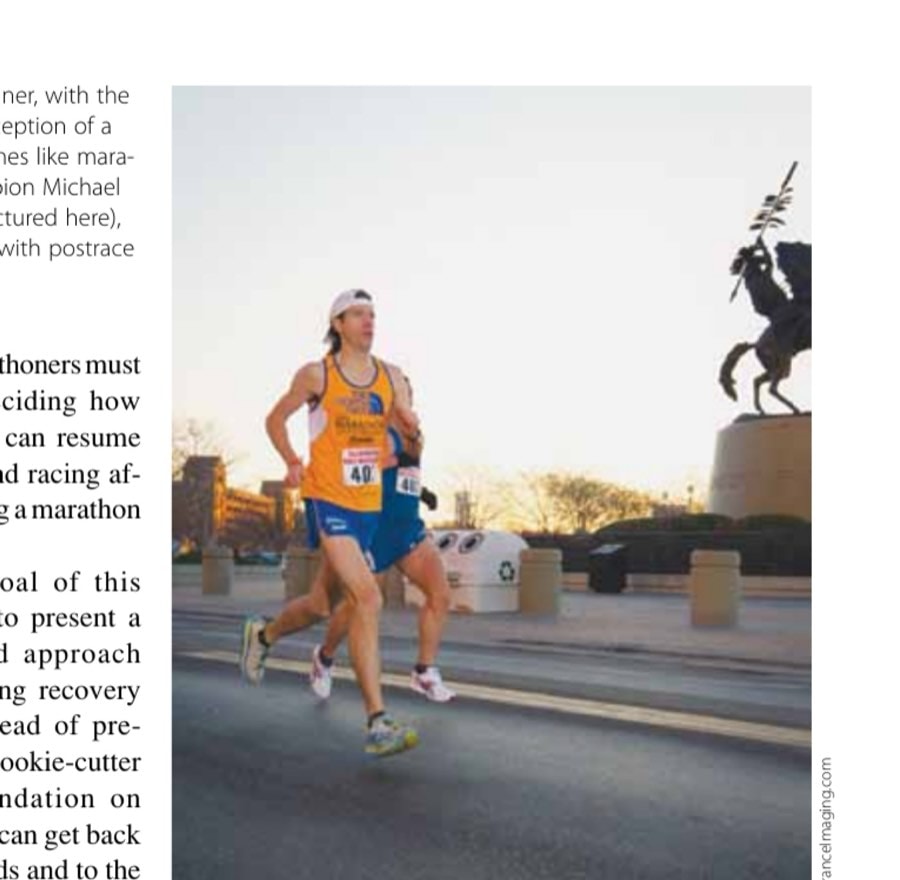
Every runner, with the possible exception of a few lucky ones like marathon champion Michael Wardian (pictured here), has to deal with postrace recovery.
All runners have experienced the thrill of improvement, of discovering how consistent training enables them to run farther and faster. But understanding what is happening within the body will enable you to set and achieve reasonable goals for race recovery.
Whenever you set your racing goals, whether for a particular marathon or for a schedule of races, it’s crucial to assess your fitness level. If you’ve trained properly, you will have triggered all of these adaptations. Each runner experiences all of them, though not necessarily to the same extent. Your ability to recover from a marathon effort will depend not only on what you experienced in that race, which we will discuss shortly, but also on how efficiently and effectively your body has made the following adaptations: •
Increased mitochondrial density. You may remember the mitochondria from biology class as the powerhouse of the cell. It is the structure within the cell where energy is produced. An increase on the energy demands of
the body, as induced by running, leads the body to increase the number of mitochondria, which increases your available energy level. • Increased fuel storage. As you demand more endurance from your body,
your body responds by increasing the amount of glycogen it stores within its muscle cells. This fuel is readily accessible and will enable you to run farther and faster. • Increased utilization of stored fat. Fat is not your body’s favorite fuel source,
but it is more calorie dense than carbs so it is stored more efficiently than glycogen. Even the thinnest marathoner has enough stored fat to help fuel a strong race. As you push your body to endure longer and longer runs,
your body begins to access these fat stores more readily, delaying the point at which you run out of fuel and hit the dreaded Wall. • Stronger muscles, tendons, and bones. The body reacts to the stress of
exertion and impact by improving its ability to handle these loads. It does so by resculpting itself—making the muscles stronger, the bones denser, and the tendons tougher. There are limits to this process, however; if the
stress is greater than the body’s ability to adapt, an injury can result: a torn muscle, a strained tendon, or a stress fracture. • Improved capillary network. Through a process called neovascularization,
the body responds to exercise by broadening its capillary network, which increases its ability to deliver oxygen and fuel to working muscles and to remove waste products. The result of all of these adaptations is an increased ability to handle a given workload—such as running—for longer periods of time and to recover more
quickly from the effort. Any recovery plan will depend on how successfully you’ve triggered these adaptations. The process of improving your body is within your control—that’s determined by the consistency, duration, and quality of your training. The ultimate limit of your body’s ability to adapt, however, is not—that’s set by your genes. The point of targeted training, of course, is to maximize the changes we can make. That takes time, which is why many coaches recommend that someone who is aiming to run a marathon should have a base of a year or more of consistent, injury-free running before taking on the race.
The recovery analysis here assumes a well-developed training base, with past race experience. While passion for training and racing is key to success, it should never cloud reasoned judgment. A first-time marathoner is still in the process of introducing the stress of long-distance running to the body, and this should not be rushed.
Some of the adaptations listed above, such as improved capillary network, take more than one training cycle to develop and up to several years to maximize. The psychological strength needed to run for hour after hour also takes time to develop. For these reasons, I don’t recommend that new marathoners attempt more than one marathon per season—and in most cases, more than one per year—until they have several years of running and racing on their resumes.
Once runners have the experience necessary to judge their training cycle, they can make judgments about their preparedness for race day, since racing success depends in large part on how well you were able to mimic the race experience in training. If you stressed the body in a carefully calibrated way, your body will be prepared for the similar (though somewhat greater) stress of race day.
If there were any gaps in your training, however—caused perhaps by illness or scheduling problems because of work or social commitments—then these have to be taken into account. Did you fail to get in your long runs? Did you rely more on cross-training than running in order to accommodate an injury? Did you neglect your hill work?
If this describes your situation, it doesn’t mean that you are doomed to failure. If we were able to predict race results with certainty based on training, we could give out the awards before the race and save ourselves the trouble of hitting the roads. But every deviation from the ideal circumstances increases the probability that you will experience problems, which, as you’ll see, can increase the necessary recovery time.
Second, analyze your most recent race The key to assessing your necessary recovery is to understand what happened in the marathon you just completed. In a way, it’s a very simple inquiry: how
much damage did you cause to your body by racing? How many microtears did you induce in your muscles, how much damage did you cause to your bones and ligaments, and how much fuel did you burn up? Most runners are very aware of what they experience in training and racing, so chances are that you are already doing a good job on your postrace analysis, even if you don’t run through a formal list of questions. To be more systematic in our review, however, we’ll need to reach that level of formality. Listed below is a series of questions. The answers to these should give us a good idea of what you experienced on race day and what’s going on in your body.
Think of yourself as being both a doctor and the patient during an examination—be as thorough, objective, and honest as possible with your questions and your answers. • The racecourse. Was it hilly? Did it have a net downhill gradient? How
was the surface—trail, asphalt, or cement and cobblestones? • The race support. Were there adequate supplies of water, sports drink, food, and electrolytes available? Did you use them? • The weather. The ideal temperature for racing is generally thought of as
being 55 degrees Fahrenheit. How far off this mark were conditions on your race day? What were the humidity, pollen, and pollution levels? Was it raining or snowing? Hot and sunny? Overcast? • Your condition. How did you feel going into the race? Were you well rested?
Getting over a cold? Jet-lagged? Distracted by work or family problems? • Your pace. Keep track of your splits. Be careful to remember anything that could explain anomalies, such as a steep uphill or sharp downhill, or any
stops at aid stations or port-a-johns or to tie your shoes. • Your postrace fueling. What you do immediately after your race will have a lot to do with how quickly you recover and when you will be ready to
race again. Research has shown that there is a window between 15 and 30 minutes after a hard endurance effort when the body can most effectively make use of an intake of replacement food by replenishing spent fuel stores
and beginning the rebuilding and healing process. Were you able to eat both carbs and protein soon after your race? • Your postrace hydration. To a greater or lesser extent, almost everyone gets dehydrated during a marathon. While the threat of hypona
tremia, or water poisoning, has gotten more and more attention in recent years, even the most conscientious runners may find it hard to take in and absorb as much water as they lose on a hot race day.
To gauge your hydration levels, weigh yourself before and after your race. Any weight loss you notice will be made up in large part of lost water that
© Jenny Stinson
▲ Were you speeding up or slowing down during your marathon?
needs to be replaced. You should also take note of the color and odor of your urine. The more yellow and concentrated it is, the more likely you are to be dehydrated. With this in mind, do you think you drank enough water before, during, and after the race to maintain adequate hydration?
Third, identify race goals Charlie Engle and Michael Wardian aside, few runners could plan to race at a high level week after week. As a rule of thumb, runners should plan on taking one easy day—either off completely or engaged in low-intensity training—for every hard mile they raced. That translates into a minimum of four weeks off from heavy training following a hard marathon.
That’s the rule of thumb, but it’s not a law of nature. Obviously, many runners defy that rule in races across the country every week. But their goals are often different from those of most elite runners.
Earlier we discussed the different kinds of marathon runners. Now is a good time to consider which kind you are for a given race. You may run all your marathons at an easy pace, savoring the experience each time, or you may target one or two key races each year for a hard effort and use other races as tune-ups or fun runs. Or you may aim to run each marathon you enter to the best of your
ability, pushing to the limits of your potential. Or you may take on characteristics of each of these types at different times of your running career. To effectively and realistically plan a race schedule, however, it will be necessary to decide what kind of runner you are for a given race and season.
Ideally, you will have decided this before getting to the starting line, and you will stick with the decision. Most of us, at one time or another, have failed to live up to this ideal; we feel good for the first few miles of a race and decide that this must be our day for a Boston qualifier, even though we had trained and planned for an easy run. On days such as that, even if the race is completed and the new, higher expectations are met, the expectations for recovery and continued racing must be changed.
Finally, do the analysis Now that you’ve got a good understanding of what you did to get to the starting line, what happened in the race, and what you did afterward, you’re ready to figure out how much time you will need to recover before you attempt another marathon. As I promised at the start, we’ll approach this as a series of straightforward questions, following our inquiry as if we were on a raft floating downstream to your answer. Rate your course. On a scale of 1 to 10, with 10 being the highest, how difficult was the racecourse? Remember: a perfectly flat course can sometimes cause as much soreness as a hilly course because of its relentless repetition, so take all features of the course into account. If it rates a 6 or above, you may need to add time to your recovery, ranging from a day or two off to a week or two of easy training, depending on what your answers are to the questions below. Rate your race preparation. On a scale of 1 to 10, with 10 being most fit and rested, how ready were you for your race? If you were below a 6, err on the side of caution as you go through the questions below and be willing to add a bit of extra recovery time before your next race.
Question 1: Did you experience an injury during the race? If yes—Did the injury involve a stress fracture? If so, consider yourself off running for six to eight weeks. Don’t play games with this one; you need to let your body heal completely to prevent further serious problems. If this is not your first stress fracture, consider getting a bone-density test and nutritional analysis. If the injury was muscular or involved tendinitis, wait until you are fully healed before resuming training, and you should register for your next race only after you’ve tested your body with some long runs of 18 miles or more. Do not schedule any marathons when you are injured; having a race day looming ahead
of you can warp your judgment and lead you to take chances with your body that aren’t worth the risk of further injury. If no—Continue to question 2.
Question 2: Did you run a negative or a positive split? If a negative split—Continue to question 3. If a positive split—We’ll need to understand why you slowed down. It took me a long time to recognize what should have been an obvious truth: runners don’t slow down in a race because they want to, they slow down involuntarily as their body begins shutting down. But the causes for slowing can be many and may lead to different expectations for recovery. We’ll explore these in subquestions A through E, listed below. • A. Was the positive split caused by muscle soreness and fatigue?
If yes—Then you ran a hard race, and you will need significant recovery time. You’ve pushed your body past its comfort zone in order to finish, and while your body gave you all it had in reserve—achieving your goal in the process, we hope—it came at a cost. You can expect that the rule of thumb described above will apply here and that it may take up to a month before you can feel like your old self when running. During that month, you will lose some fitness, which you will need to build back up before you race again. Even experienced chronic marathoners may find that they need several months after a hard marathon to get back to the starting line of their next race.
If no—Continue to subquestion B, directly below. • B. Was the positive split caused by dehydration and hot-weather conditions?
If yes—Then you may not have caused as much damage to your body as you think. Dehydration can rob you of 2 percent or more of your speed and strength, which can add up to quite a bit during a race. As uncomfortable as that experience may be, once those lost fluids are
replaced—usually within several hours—you should feel refreshed and recovered. It’s not unusual to feel completely depleted by dehydration one day and eager to get out on the roads the very next day with renewed energy.
That’s because the limiting factor that caused the positive split wasn’t damage to muscles and ligaments, which need time to repair, but simply your water levels. Once proper hydration levels are restored, those muscles and ligaments
will be ready to get right back in the game. The impact on your body of this marathon will be similar to that of a long training run, so you can expect
to be able to race another marathon in as soon as several weeks, depending on your race goals.
If no—Continue to subquestion C, below. • C. Was the positive split caused by muscle cramps?
If yes—Then expect a longer layoff. Cramping is an involuntary contraction of a muscle, caused in most cases by an imbalance in hydration and electrolyte levels in the body. These contractions are not only painful in the moment that they are experienced but often afterward as well, when the damage they caused to muscle cells is made apparent. If you were slowed by severe muscle cramping during your marathon, that is the equivalent of running a positive split due to muscle soreness and fatigue, and you can plan on a similar recovery.
If no—Continue to subquestion D, below. • D. Was the positive split caused by running at altitude or by stomach upset?
If yes—Then you might not need as much recovery time as you might think. Similar to dehydration, the limiting effect of high altitude on runners who are not acclimated to altitude (assuming you are not acclimated) or who are having gastrointestinal distress will prevent you from pushing your body to the full potential of your strength and endurance. The result is fewer microtears and less damage than you might expect from the finishing time you achieved. If you have no other problems, you can expect a relatively quick recovery. Proceed to question 3.
If no—Then you experienced fatigue and microtears and will need significant recovery time. Continue to subquestion E, below. • E. Was the positive split caused by blisters? If yes—This is a superficial injury, not affecting your muscles and ligaments,
so your recovery time should be short. Your challenge will be to determine why the blister occurred (Is there a problem with the fit of your shoes? Were you wearing appropriate socks? Should you use a lubricant on your feet?)
and to maintain fitness while the blister fully heals. Cross-training, such as cycling, could fill the gap. Continue to question 3. If no—As explained above, if your positive split can be traced to fatigue, then significant recovery time will be necessary.
Question 3: Were you sore immediately after the race? If yes—Did the soreness ease up after you walked around a bit? If yes, continue to question 4. If the soreness continued or increased during the days following the race, you caused muscle damage, apart from whether you ran a negative split
or were fully hydrated. After all, what you feel after the race is likely the best indicator of what is going on inside your body; everything else is a guesstimate. If you’re sore—even if the soreness roams from one part of your body to another in the days following the race—you’re going to need time to recover and then rebuild your fitness. Don’t plan to run another marathon for several months. If no—Continue to question 4.
Question 4: Were you hungry after the race and did you eat? If yes—This is a very good sign. Your body is continuing to process food as normal, which means it doesn’t consider itself to be in crisis. Taken into consideration with your answers to the other questions, it may indicate that you did not cause significant damage to your body.
Several years ago I ran the Richmond Marathon and was so ravenous afterward that I stacked three slices of pizza on top of each other at the finish line and swallowed them down as quickly as I could. The following day I ran the Veteran’s Day 10K in Washington, DC, and while not producing a PR, I felt fine and did well. I’m not suggesting that it was a smart thing to do—I wouldn’t do that now even if I could!—but my postrace experience at Richmond let me know that it might be a possibility.

Continue to question 5. If no—Your body was under stress and was shutting down its gastrointestinal system in order to move blood to the working muscles. This indicates a hard effort. While you might not have caused significant damage to your body, you may have put it under enough stress to warrant taking several days off or taking it easy for a week or two. Consider this factor in conjunction with your answers to the previous questions in order to decide whether more time off is needed.
© LaPayne Photography
Question 5: After a week has passed, are you still in the mood to run another marathon? This question requires real honesty. After all, among our defining characteristics as marathoners are our stubbornness and our refusal to give up when many others would have thrown in the towel. We expect to push past the negative thoughts that sometimes crowd our heads, confident that second, third, and fourth winds await to carry us forward—except that sometimes that’s not the case, and a bad attitude about training and racing indicates a deeper tiredness in the body that is ignored at our peril.
The answer to this question is more subjective than objective, so it is harder to determine the answer, but there are several indicators. Do you look forward to your next postrace workout? Do you lose yourself in your runs, or are you counting the minutes until the workout is over? Do you get excited about the idea of
▲ Were you smiling or grimacing immediately after your race? That will be a clue for determining your recovery time.
running your next marathon, or does it feel like a chore that needs to be done? Do you really still feel like getting out of bed in the morning for a run? If yes—If you’ve gotten this far—your training went well; your racecourse was favorable; you ran a negative split; you didn’t experience cramps, dehydration, an upset stomach, or blisters; you were hungry and ate immediately after the race; you felt a bit tired but otherwise fine in the following days; and you are really eager to get to your next race—then it sounds like your recovery should be short and you should be ready to get back to a start line soon. If no—Trust your moods. They are a gateway to insight into how your body is doing. With 20/20 hindsight, many of us could recognize that periods of burnout and injury were immediately preceded by a lack of enthusiasm. Even if all the other signs are favorable, give your mind and body a break and skip your next marathon. Run for fun, when you feel like it, and don’t sign up for another race until the idea of running it feels like opening presents on Christmas morning.
Final considerations We began this discussion with the admission that predicting race readiness is not an exact science. As you apply the concepts presented here, keep in mind that these are only indicators of possibilities and are not promises.
Like many other runners, I’ve experienced my share of ups and downs and have had to relearn this lesson again and again. Over a decade ago I ran a marathon in Madison, Wisconsin, coming within a whisker of setting a PR in the process. I felt strong afterward, and I was eager to get back out on a racecourse. I was convinced that I was on the verge of a breakthrough and that something special would happen in my next race.
You probably know where this is going. I ran a race in South Bend, Indiana, just two weeks later, and despite my high hopes, once I was on the course, I found that I had nothing left in my tank. I finished the race over 26 minutes slower than I had in Madison, and even I was able to calculate the per-mile slowdown on that one. I was disappointed but a bit wiser.
After all the calculations are made and everything is taken into consideration, aim to make the wisest, best-supported decision you can about when to run your next race. If you hit your goal, you will have the pleasure of knowing that it wasn’t a fluke but was instead the result of having taken a calculated gamble, just as any good coach would. And if it turns out poorly, you will have gained further insight to use in your next calculation, putting you that much closer to figuring out what your body is capable of doing.
Many years ago, the late George Sheehan advised us to run like a child. To this, we can now add, “But plan your races like an adult.”
This article originally appeared in Marathon & Beyond, Vol. 17, No. 5 (2013).
← Browse the full M&B ArchiveMore like this
1,000+ stories from 19 years of Marathon & Beyond
The complete archive of the legendary long-distance journal — digitized and free to read.
