

Into the Valley of Death
In 1913, Furnace Creek was merely a godforsaken ranch where its owners, Eagle Borax Company, attempted to cultivate date palms. As one of his tedium-splintering duties, ranch bossman Oscar Denton took daily temperature measurements. On July 10, 1913, Denton’s job turned deadly: “On the day that I recorded the greatest heat ever registered—134 degrees in the shade—I thought the world was going to end. Swallows in full flight fell to the ground dead, and when I went out to read the thermometer with a wet Turkish towel on my head, it was dry before I returned.”
WELCOME TO BADWATER, CALIFORNIA
Eighteen miles south of Furnace Creek squats Badwater, California, one of the most unattractive bits of real estate in the world. Badwater is a brackish pool of mineral-ripe water at the edge of the world’s most famous saltpan. The saltpan forms the crusted icing atop a rich mineral layer cake more than a mile deep that over eons has washed down from the sides of the mountains that imprison the massive valley.
Time easily fragments here. It took eons for the fill to wash into the valley—the driest spot on earth, a place that has gone as long as 18 months without measurable precipitation. It is not uncommon for evil-looking, rain-saturated clouds to pass over Death Valley and drop torrents as they scud by, only to have the rain evaporate before it reaches the ground, rejected by the hellish heat that rises from the surface. There’s even a meteorological term for this premature evaporation: verga.
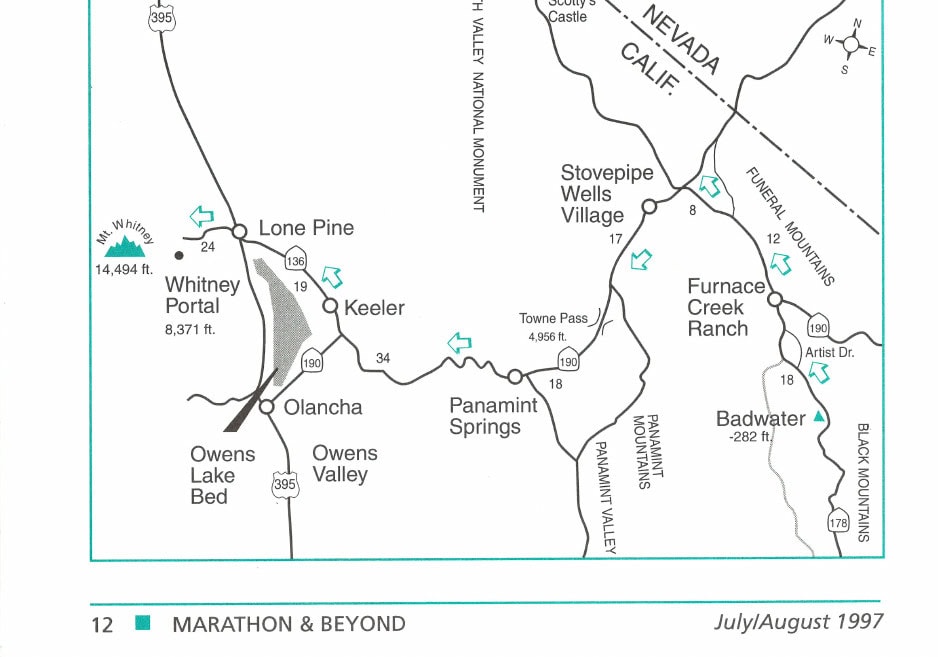
Nothing is done half-ass in Death Valley. When it does rain there, vicious flash floods wash tons of minerals from the imprisoning mountains. The Black and Funeral mountains that form the eastern walls are over 5,000 feet tall, while the Panamint Mountains that form the western wall top out at Telescope Peak, which is 11,049 feet. That’s a lot of elevation drop during which a cocktail of water and minerals can mix, pick up speed, and get concentrated to crash on one point in the valley. At low points along the two-lane, blacktop road that winds along the eastern edge of the valley, California Transportation Department engineers have anchored concrete stretches of road. Road crews grew tired of replacing the blacktop every time a flash flood tore it up and carried it down to the saltpan.
If you screw up your courage and leave the little parking lot at Badwater and walk two miles west onto the salt—something you won’t want to do in midsummer—you’ll reach a spot that is 282 feet below sea level, the lowest point in the Western Hemisphere. If you set out a chaise lounge during summer, you’ll be treated to the hottest temperature on the face of the earth. You won’t have a hankering to linger.
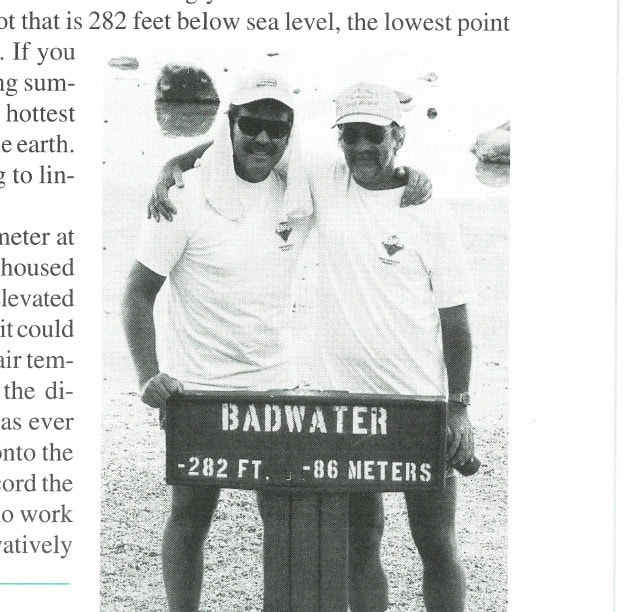
Oscar Denton’s thermometer at Furnace Creek in 1913 was housed inside a white, louvered box elevated five feet above the ground so it could record an accurate ambient air temperature well shaded from the direct sun. No human being has ever hauled the same apparatus onto the saltpan near Badwater to record the temperature, but rangers who work out of Furnace Creek conservatively claim that the temperature in the middle of the Death Valley saltpan is consistently five to eight degrees hotter than it is at Furnace Creek.
Measure the temperature on the surface of the blacktop road that runs past Badwater at 4:00 p.m. on a July day, and it tops 200 degrees. You can literally fry an egg on the hood of your car. The word “frying pan” is muttered frequently in Death Valley, even by foreigners.
MANY PATHS TO DEATH
It would not behoove a visitor to underestimate the ill effects of the extreme temperatures in Death Valley. Some years ago two fiftyish couples parked their car along the road between Badwater and Furnace Creek and decided to walk up Artist Drive. One of the women began to feel unwell and returned to the car. When the others returned, they found the woman near death. She was suffering from a fascinating phenomenon known as “disseminated intravascular coagulation,” or D.I.C. Dr. Ben Jones of nearby Lone Pine handled the case. He’s an enthusiastic participant in all autopsies in Inyo County, a generous-sized county that includes Death Valley and Mount Whitney, that, at 14,494 feet, is the highest spot in the lower 48 states. “D.I.C. is a curious condition,” Doc Ben explains brightly, “in which half of the blood in the body clots while the other half flows freely out of any body orifice it can find. It’s quite dramatic. The woman died, of course.”
In Death Valley, consuming massive quantities of potable water is essential for continued existence. Because of the near-zero humidity and almost constant wind, perspiration that manages to reach the surface of the skin evaporates instantly, which gives a person the illusion that one is not sweating, which lulls the unwary into a false sense of well being. In reality, a body at rest in the shade on a summer day in Death Valley will lose two gallons of water, which, left unreplenished, is enough to precipitate life-threatening failure in several major organs, including the kidneys.
In July 1991, Patrick Hodge of Columbus, Ohio, an arrogant and therefore badly misled adventurer who had been to Death Valley on several occasions and was suitably fascinated by its unearthly challenges, parked his compact pickup truck at Badwater and attempted to hike across the saltpan to the western mountains and back. From the relative safety of Ohio, he had somehow calculated that to lighten his load, he could survive the trek on three quarts of water, which he carried in a bandoleer-style canteen. It is more than five miles to the far side. He carried with him a 35mm SLR camera and an 8mm Sony camcorder. Unfortunately, Hodge had assumed that in mid-summer the saltpan is solid.
One lesson a Death Valley survivor learns early on is that there is a great deal of illusion in the world’s desert places. In the middle of the saltpan, Death Valley’s meager annual ration of rain water soaks into the ground under the protective shell of salt. The brilliant, white salt crust reflects the intense sun back into the laser sky, thereby slowing the evaporation of the groundwater.
When Hodge reached the middle of the saltpan, he broke through and sunk up to his knees in mud. The unanticipated exertion of trudging through the mud caused him to perspire his body’s precious fluids into the dry, greedy air. The three quarts of water he carried proved woefully inadequate. Through sheer determination and in part due to his good physical condition, Hodge was able to stagger out of the mud and to within a half-mile of his truck, where several gallons of water waited on the passenger seat. But he collapsed. His body was found a week later, more than one-third of his body weight sucked away by the dry winds. The tape in Hodge’s camcorder chronicled the first half of his fateful journey. The camcorder’s batteries died as he reached the far side of the valley.
NATIONAL LAMPOON’S ULTIMATE VACATION
It is the rare American who freely chooses to visit Death Valley—rarer still in the middle of summer. Its very name discourages American visitors who have so many other benign options from which to choose. Imagine this bizarre scenario: “Well, kids, where do you want to go for summer vacation? Disney World, Yosemite Valley, the seashore, or Death Valley?” The thought of vacationing in Death Valley is macabre. Perhaps we should suggest it to National Lampoon as the next Chevy Chase vacation movie.
Certain foreigners, however, especially those shoehorned into countries with limited borders, flock to the vast confines of Death Valley. Germans, French, Spaniards, and Japanese zoom around the valley in white, air-conditioned cars, awed by the outrageous elbow room. They have nothing even approaching it in their countries. Before its recent ascension to National Park status, which brought with it a million-acre (or 1,600 square miles) expansion of its area, Death Valley measured 3,231 square miles, one and a half times the size of Delaware.
And then there’s the weather! German families drive through the valley, hermetically sealed in their Las Vegas rental cars, until they find a scenic vista area. As though they had rehearsed it at home for weeks in advance (which they may have), the car pulls off the side of the road, all the doors open at once, the family ejects with Prussian precision and lines up in front of the vast scenery, and pater swings the camcorder in a slow pan, commenting on the incredible heat, one-upping the friends and neighbors who decided to holiday once again in Switzerland. On signal, the family pours itself back into the car, and they are off in a whoooosh!
Foreigners will stop very tentatively when they see a runner slowly jogging along the side of Highway 190 at high noon on a perfectly hellish July day wearing a flowing white suit to keep the worst of the radiant heat off a frazzled body.
The tourists initially inquire after the runner’s health and then offer a ride. When they realize that the runner is doing what he is doing of his own free will and not because his car has died, they reverentially inquire if they might shoot some camcorder tape. Even the usually aggressive Germans, who two days before had viciously elbowed the runner away from the postcard display rack at the General Store at Furnace Creek, are solicitous. This shot will really get them one up on the neighbors. Let’s see the Schmidts top this!
AN ULTRARUNNING TRADITION
So just what are fragile human beings doing running along a frying pan road in Death Valley in the middle of July? Vacationing in hell—it’s become ultrarunning tradition.
The noble, wholesome sport of distance running took a decidedly wrong turn in the early 1970s when it entered Death Valley—as though the Greek long-distance messenger Pheidippides, patron saint of marathoners, had lost his way on the 24-mile road from the Plains of Marathon to Athens to bring word of the Athenian victory over the Persians and had, muddle-brained, headed into the desert like prophets and saints before him, looking for a shortcut to immortality. Death Valley gladly accommodates ill-advised shortcuts and just as benignly confers immortality.
In 1849, the Bennet and Arcane wagon train splintered from a larger train taking an established but lengthy southern loop (the “Spanish Trail”) to California and blundered into Death Valley while attempting to find a purported shortcut. Brimming with dissension, the group arrived at what is now Furnace Creek and split up. A group of young and eager Ohioans known as the Jayhawkers pushed west, burned their wagons to smoke the meat of their oxen near what is now Stovepipe Wells, and broke down their belongings into jerryrigged backpacks and made it out, accidentally finding silver along their escape route.
William Lewis Manly and John Rogers, two bachelors who had attached themselves to the wagon train when it left Salt Lake City behind schedule, struck out together in hopes of finding salvation for the remainder of the party, which stayed behind at Furnace Creek. After a harrowing two-week trip through several deserts to the pueblo of Los Angeles, the pair eventually brought back enough supplies on a one-eyed mule to save what remained of the train. The disaster occurred over the Christmas Holidays of 1849; had it been July, there would have been no survivors.
Today, we remember the disastrous Bennett and Arcane wagon train as the Manly Party because 45 years after the fact William Manly sat down and committed the whole sordid affair to paper in a book unassumingly titled Death Valley in ’49. Now, when the occasional winter rains rush downhill to the middle of Death Valley, the resulting inch-thick sheen of water that covers the saltpan before osmosising through it is known as Lake Manly. William Manly is immortal thanks to his taking a wrong turn into Death Valley.
MAD DOGS & ENGLISHMEN
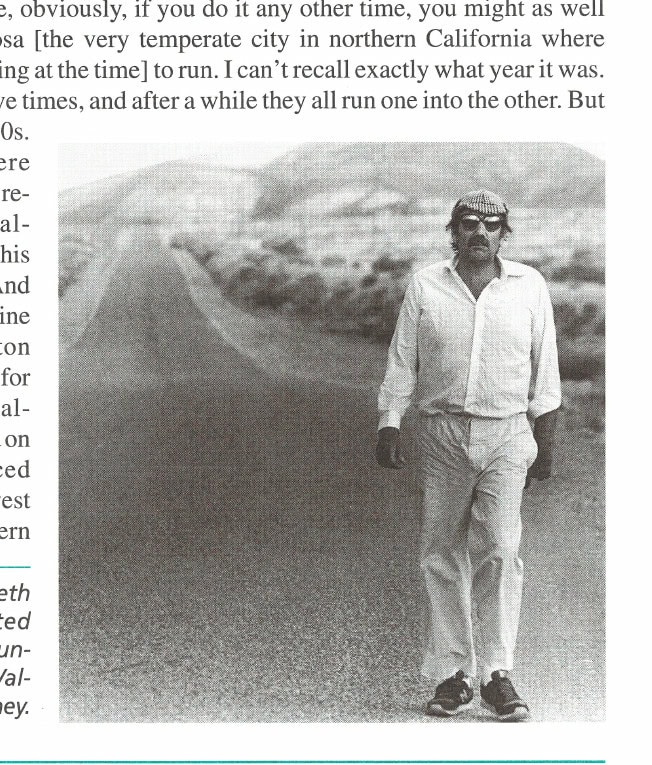
Kenneth Crutchlow, a shamelessly self-promoting expatriate English adventurer, has also been immortalized (in some circles) for consciously using Death Valley as a shortcut to fame. In 1974, he bet a friend a pint of ale that he could pedal a bicycle from San Francisco to Alaska faster than a steamship could make the trip. He won, and besides his pint of ale, he and his bicycle won passage back to San Francisco on the steamship. Crutchlow is the madman responsible for igniting the competitive passion of ultrarunners to cross Death Valley.
“I was in New York,” he explains, “and I had spent the previous seven years hitchhiking around the world and had been involved in a number of different physical things. In those days, I was quite fit. Many friends of mine were with the Rupert Murdoch group, the News Limited of Australia, and I was always in their New York offices.
“I remember distinctly being there on Forty-Second Street, at the Daily News building, and text came over the wires saying that a Frenchman had just completed a walk across Death Valley. I’d heard of Death Valley, but I didn’t know much about it at all, so I said to myself, ‘Obviously he’s a man to be congratulated, being the first to do something.’ And I didn’t think much more about it.
“But during the same time frame, a friend of mine, John Fairfax, was rowing a boat from the Canary Islands to Florida. He wanted to be the first to row the Atlantic Ocean. I went down from New York to meet John as he arrived in Florida. After he arrived, he was telling some silly joke that he couldn’t quite get straight, and he said, ‘Though I walk through the valley of death, I fear no evil, because I’m the biggest son of a bitch in Death Valley.’ He made an error in saying it in that manner. But something about it just triggered something in me, and I said, ‘You could never get across Death Valley, Fairfax,’ and he said, ‘I wouldn’t want to.’ Then he bet me a pint of beer that I couldn’t run across Death Valley. I accepted that bet. At that time, I did not know where Death Valley was. But this seemed like the thing to do. Fairfax had just done his Atlantic row, and I was looking for something to do. Death Valley was there, so I took his challenge.
“I decided to run from Shoshone [near the Valley’s southern border] to Scotty’s Castle [near the northern extreme]. And I decided it should be in July or August, because, obviously, if you do it any other time, you might as well come to Santa Rosa [the very temperate city in northern California where Crutchlow was living at the time] to run. I can’t recall exactly what year it was. I did that course five times, and after a while they all run one into the other. But it was the early 1970s.
“In 1973, there were not that many really serious challenges left to do in this part of the world. And a close friend of mine at the time, Paxton Beale, was looking for something to challenge him. I looked on a map and noticed how close the lowest point in the western hemisphere was to the highest point in the lower 48 states. So we decided to do it [Death Valley-to-Mount Whitney] in relay fashion. I considered it outrageous to even think that a man could do it alone. It was nearly 150 miles.”
IF AT FIRST YOU DON’T SUCCEED . . .
But when Al Arnold, a tall, large-boned health club manager in Walnut Creek, California, heard of their feat, he determined to be the first person to run the same course solo. He trained for the heat by lugging a stationary bicycle into a dry sauna, where he spent an hour twice a day pedaling himself into oblivion. After abortive attempts in 1974 and 1975 and a hiatus in 1976 to get married, Arnold successfully made the solo trip in 1977. It took him 84 hours. He nearly died of exposure on Mount Whitney when someone stole the cache of supplies he had left beside the trail for his eventual descent. Accounts of Arnold’s accomplishment forever closed the runner’s imagination to the shorter (and now deemed easier) Shoshone-to-Scotty’s Castle route as the official Death Valley course and elevated the Badwater-to-Mount Whitney course to prominence.
In the years that followed, hundreds of attempts were made to repeat Arnold’s feat, but the next successful crossing didn’t occur until 1981, when Jay Birmingham of Jacksonville, Florida, made the trip in 75:34. The following year, the New Zealand super-runner Max Telford, who had previously done Crutchlow’s original Shoshone-to-Scotty’s Castle course and who had previously failed in an attempt on the Badwater-to-Mount Whitney course, brought the Death Valley record down to 56:33.
In 1983, Greg Morris of Orange County, California, made a successful attempt, but it took him 76:38. Three years later, Tom Crawford and Mike Witwer of Santa Rosa, California, running together with a July 4th start, set a new American record of 70:27. Their ascent of Mount Whitney was especially grueling and perilous because an unusually violent series of February snowstorms in California left the mountain booby-trapped with decaying snowbridges, avalanched trails, and nearly impassable ice shelves. They were trapped overnight in the stone survival hut at the peak of Mount Whitney, where they huddled together against the bitter cold.
Crawford and Witwer made their 1986 attempt a month after their California Ultrarunners Club cancelled attempts to host the first-ever race on the course. All the necessary permits had been received, and 22 credible ultrarunners had signed up, but it became impossible to secure insurance to cover the support crews. Some potential crew members had inquired about the feasibility of bringing along their horses, while others asked after child care facilities. Crawford
and Witwer, well trained to participate in their own race but not eager to lose everything they’d worked a lifetime for in a lawsuit from an ill-prepared crew member, decided not to let their training go to waste.
On behalf of the California Ultrarunners Club, Crawford had conferred with the handful of graybeards of the course before he and Witwer put together the race, and they jointly came up with a sparse set of rules to govern the course:
- All attempts must be made in either July or August.
- Participants must stay on the prescribed course.
- The starting line is the pedestrian crosswalk at Badwater; the finish line is the survival hut at Mount Whitney’s summit.
- Participants must cover the entire course on their own two feet, without mechanical aids to locomotion other than shoes, and must do so completely under their own power.
- To be credited with an “A.M. start,” a participant must begin the course between 6 A.M. and noon, so as to experience the maximum daylight heat of Death Valley.
THE CHALLENGE, THE RACE
Not long after Crawford and Witwer returned to their Santa Rosa homes, an article in the San Francisco Chronicle about their exploits rousted Kenneth Crutchlow from a growing athletic lethargy that had added 40 pounds of body weight to the Brit. Crutchlow tracked Crawford and Witwer to a local watering hole, ambled in, and threw down the gauntlet. He proposed a team race in July of 1987 between the United States and England; Crawford and Witwer versus Crutchlow and a female runner; the two elapsed times on each side to be added together, the low combined time the winner. The wager: a pint of ale and $1,000 to the winner’s favorite charity.
Crutchlow advertised for a female partner in Athletics Weekly, the legendary British running magazine. He received one response, from Eleanor Adams, at that time the world’s most accomplished female ultrarunner. Mike Witwer, faced with the possibility of being beaten by a woman, eventually withdrew—a mere two weeks before the race. Crawford, coming off the Western States 100, enlisted Jean Ennis, a fellow Santa Rosan who had just finished the Western States 100 herself, a few places behind Crawford.
David Bolling, a local newspaper reporter who had been periodically covering Crutchlow’s attempt to whip himself into shape, decided to cover the race first-hand by running with the eccentric Brit. Adams and Ennis figured that one of them would be the first female to complete the course. But 1987 was to be a particularly active year on the course.
Before the dueling Yanks and Brits could get to the course, Linda Elam and Adrian Crane were already there, and Elam became the first woman to complete the course (69:12). The story of her overcoming an upset stomach by vomiting vertically while lying on her back has became an ultrarunning legend.
Meanwhile, Crawford, Ennis, Adams, and Bolling arrived at Furnace Creek, but there was no sign of Crutchlow. There was word, however, that there was yet another runner on the course, Gill Cornell from nearby Ridgeway, California.
On the morning of July 31, 1987, with the 6:25 A.M. start nearing, Crutchlow finally arrived, garbed in a tweed business suit. He and his handler had decided to make the trip in one of the decrepit, diesel-powered London cabs that Crutchlow had at one time driven in a Santa Rosa taxi scheme, only to have to push the underpowered antique over Tioga Pass.
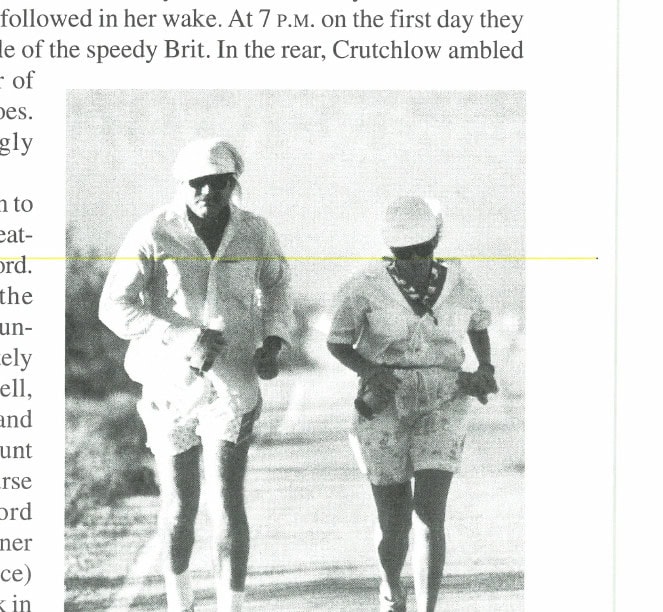
The “race” soon turned into high drama at the front and farce at the rear. Eleanor Adams went out fast and steadily and moved away. Crawford and Ennis stayed together and followed in her wake. At 7 P.M. on the first day they were still within a half-mile of the speedy Brit. In the rear, Crutchlow ambled along in a brand new pair of oversized New Balance shoes. Bolling grew increasingly impatient.
Eleanor Adams went on to finish the course in 52:45, beating Max Telford’s 1982 record. She called the course the toughest she’d ever encountered in her life. Unfortunately for her record, Gill Cornell, who ran into Crawford and Ennis on his way off Mount Whitney, had set a new course record of 45:15. Crawford (who became the first runner ever to do the course twice) and Ennis reached the peak in 58:57 but were then forced to spend a cold night in the survival hut.
Meanwhile, Bolling was becoming more frustrated with the pedestrian pace and lame antics of Crutchlow, who had begun to have his handler drive them into Lone Pine for meals, marking the course where he left it so he could return hours later to restart. Crutchlow and Bolling eventually reached the peak in 126:30, the slowest successful course crossing to that point.
While this race was going on, 68-year-old Richard Kegley of Washington state began his own trek from Badwater to Mount Whitney. He eventually finished in 113:09, becoming the oldest man to ever finish the course.
By the time the July/August 1987 window closed, there had been nine successful completions, three more than in the entire history of the course. Unfortunately, restrictions on the use of federal wilderness areas were being tightened. Rangers were attempting to control Mount Whitney from overuse. Crawford continued to pursue negotiations with the government entities he had worked with to put together the abortive race in 1986 (including former senator Alan Cranston, a runner himself) to “grandfather” the course in, which would have allowed continued unrestricted use of the course, even as regulations concerning the mountain tightened for other uses. Unfortunately, 1988 was about to see Crawford’s several years’ efforts ruptured in one day.
HI-TEC ENTERS—AND COMPLICATES—THE FRAY
The Hi-Tech shoe company of Modesto, California, a British-owned company specializing in hiking boots, decided to market a running shoe they planned to call the Badwater 146. One of its marketing ploys was to “road test” the shoes by putting together a race on the Death Valley-to-Mount Whitney course. They ran into a problem, however. The district ranger informed Hi-Tec that permits were needed to be on Mount Whitney after dark and that competitive events were illegal in federal wilderness areas.
Hi-Tec decided to hold its “event” anyway. Using a 2:46 A.M. start on July 28, 1988, eight runners left Badwater. One of the racers, Frank Bozanich, one of America’s premier road ultrarunners, lasted 17 miles before dropping out because of dehydration. Hi-Tec shoes had been given to all the racers, and in the heat of the day, the shoes began to come apart.
Four of the racers made it to the mountain, and against the district ranger’s ruling, they raced toward the peak. The most talented was Tom Possert, who struggled up the granite trail with help from his crew, which pulled him up portions of it. Chuck Jones, Linda Elam (becoming the second runner in history to do the course twice, after Crawford), and Douglas Mitchell eventually made it to the top.
Aware of the illegal ascents of the mountain, ranger and extraordinary mountain athlete Marty Hornick caught and cited three of the Hi-Tec runners. As the story goes, Hornick calmly put up with extreme verbal abuse from at least one of them. The California Ultrarunners disqualified Possert on two counts: Ranger Hornick’s report that Possert’s crew had helped him up the mountain and the half-page photo of his crew doing so that appeared in a feature in People Magazine that Hi-Tec had arranged.
Any hopes of “grandfathering” the course that Kenneth Crutchlow and Pax Beale ran relay style and Al Arnold ran solo were buried with the Hi-Tec race director’s illegal assault on the mountain.
TWO BEERS TOO MANY
While the fireworks were exploding on Mount Whitney in July of 1988, Crawford had gathered the main characters from the Britain versus United States duel of 1987 on his Santa Rosa deck for a one-year-later picnic. Every participant and crew member from both teams was present except for Eleanor Adams. In discussing the mountain portion of the course, Crawford and Rich Benyo, who had covered the 1987 race for the Chronicle and The New Yorker, noted the fact that once you reach the peak of the mountain, you have to descend roughly 12 miles on foot before you can meet your crew and catch a ride home.
“But you’ve already covered 12 miles of the return course,” Benyo said in the wake of too many beers. “Why not keep going?”
Crawford paused to blurrily think about that.
“You’re already on your way back to Badwater,” Jean Ennis observed.
Several more beers were popped.
“Let’s do it,” Crawford said.
The three raised a toast toward July of 1989, when they would “do it” by becoming the first runners to “do” the course in two directions—with an A.M. start.
Crawford and Benyo concentrated their training on teaching their bodies to “process” fluids. Building on Al Arnold’s dry sauna training, Crawford went to his health club and cranked up the dry sauna. Living more than 25 miles from the nearest health club, Benyo built a “hotbox” in his pasture and equipped it with space heaters. Unfortunately, Jean Ennis concentrated her training on overdistance, and in the spring of 1989 developed a stress fracture and was forced to cancel her attempt.
Both Crawford and Benyo went to the course armed with apprehension, Crawford’s based on his two previous experiences on the course and Benyo’s based on his long history of poor running in heat and poor performance at altitude. On their way into the valley, Crawford, Benyo, and their crews encountered Southern Californian Bill Dickey coming out of Panamint Valley. He had started the course the day before and would complete the course in 62:23.
Crawford went out from Badwater at a good clip, Benyo more conservatively. Crawford made the peak of Whitney in 55:08 and enjoyed a sunny day, but on the way back to the desert, he outran his body’s ability to process fluids. Near Keeler, Crawford began urinating blood and stopped until his body could catch up with his pace. From his folding chair he watched a black storm roll in on the mountain top, where Benyo was being assaulted by hail and lightning storms occurring below the peak, down through which he had to stumble to get off the mountain. Eventually, both completed the course, and on their way back to Badwater encountered Todd Leigh, who had started the one-way run while they were out doing the two-way. Leigh finished the course in 65:17.
HI-TEC RETURNS
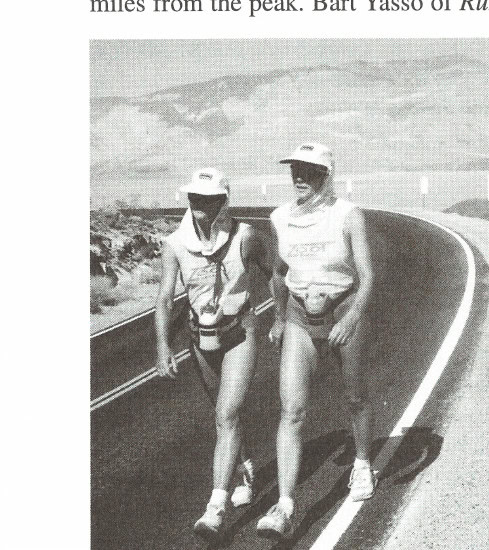
A week later, Hi-Tech held its second annual race, this time with an evening start, with a new race director, and the “option” for runners to proceed up the mountain to the top after removing their numbers at Whitney Portal, a dozen miles from the peak. Bart Yasso of Runner’s World and twin sisters Barbara Alvarez and Angelika Castaneda successfully reached the peak.
In 1990, the third annual Hi-Tech race saw the emergence of the runner who would effectively become the King of the One-Way, Marshal Ulrich. A Colorado ultrarunner, Ulrich finished second to Tom Possert’s record-setting 38:18 in 1990, but after that year Ulrich began regularly to dismantle the course record, especially the “unofficial” Hi-Tec course record, which runs from Badwater to Whitney Portal, in deference to increasingly strict ranger scrutiny above the Portal.
Not satisfied with his 1989 double crossing time of 170:58, in 1991, Rich Benyo returned to the course for another two-way attempt. Tom Crawford also returned, hoping to set a one-way A.M. course record. And Rich Benyo’s younger brother Drew came from Pennsylvania, attempting, in his typically perverse way, to be the first to do the reverse course. Crawford got off to a bad start, made up time on the mid-portion of the course, but faltered on the mountain and dropped out. Rich Benyo knocked 88 minutes off his one-way time, but faltered on the return trip, dropping out after 274 miles with what he thought was a stress fracture but turned out to be ligimentitis. Drew Benyo succeeded in his reverse course attempt in 90:14 and even enjoyed a spat of hallucinations in the latter stages, when he believed he saw a giant turtle.
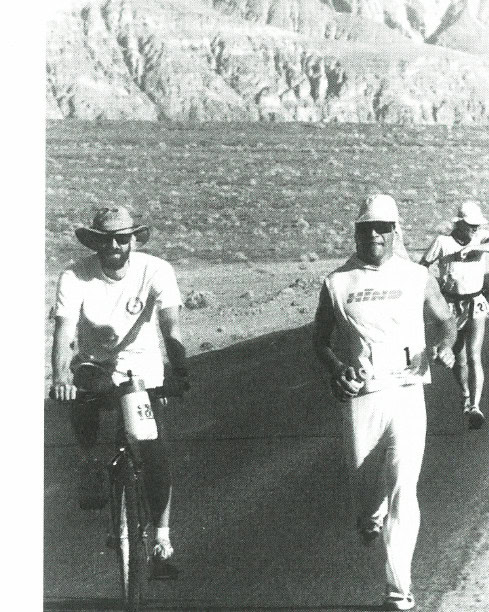
A week later Marshal Ulrich, taking part in the 4th annual Hi-Tech Badwater “146” race, clobbered the one-way course record by doing 33:54 with a P.M. start. Earlier in the day Ulrich had travelled to Badwater to also begin an A.M. start before returning to Furnace Creek to await the Hi-Tec evening start while the A.M. clock continued to run. His 40:09 A.M. start time remains the one-way record for morning starts.
Not content with his DNF in 1991, Benyo returned to the course in 1992 for his third attempt at doing an A.M. start double crossing. He encountered hotter temperatures than he had enjoyed on the previous two outings, but managed to better his time, and in the process became the first runner to do two double-crossings. A week later, Robin Smit, an eye surgeon from Fresno, California, who started the evening Hi-Tec race, became the third runner to complete a double. He reported hallucinating a cruise ship on the Badwater saltpan. Smit returned the following year to do a double again, and in the process became the first runner to go under five days on the out and back.
DOUBLE FEATURES
Double-crossings became the featured attraction in 1994. In the same year, Colorado ultrarunner Scott Weber went to near-obscene extremes and pulled off a triple-crossing.
The 1994 Hi-Tech race was the launchpad for three double-crossing attempts by U.K. runners Jack Denness and Steve Kerr, who had previously done the one-way, and military man Robert Lambert, who uncorked a very credible 118:57, to become the second runner to go under five days for the double-crossing. Lambert had done the one-way the previous year in 67:24. Denness and Kerr did the double together in 161:20.
The year was also noteworthy for the number of runners Hi-Tech allowed in its race, in the process adding eight names to the one-way completion list (including the three Brits who went on to accomplish double-crossings).
Scott Weber, who did the 1994 Hi-Tec race to Whitney Portals, then went back to Colorado, pulled himself together, and returned to the course in August to do the first-ever triple-crossing. He climbed to Whitney’s peak, ran a reverse one-way to Badwater, then turned around and ran back to Whitney’s peak, then turned around and ran back to Badwater, in the process using up 257:32 of his summer vacation. Incredibly, Weber was so enamored by the course that he returned the following summer to run the Hi-Tec race again; he reached the peak of Whitney in a very credible 68:02.
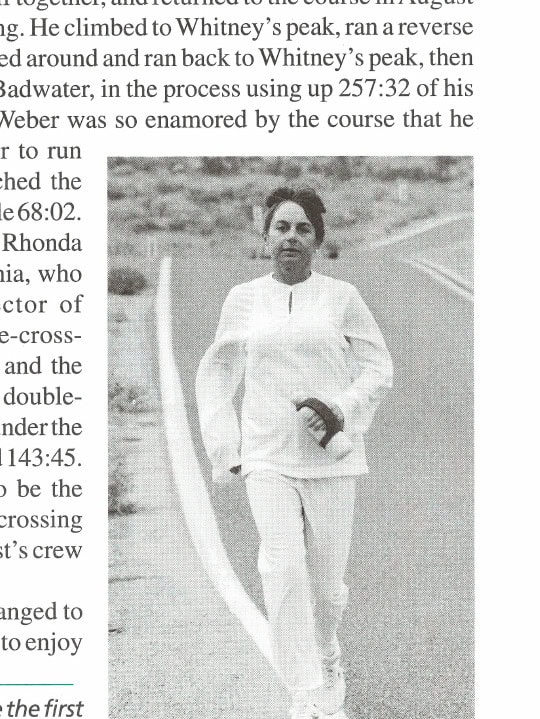
Later in the summer of 1995, Rhonda Provost of Forestville, California, who had served as medical director of Crawford and Benyo’s double-crossings, became the first woman and the eighth runner overall to do the double-crossing successfully, nipping under the six-day mark with a very focused 143:45. Jean Ennis, who had hoped to be the first woman to do the double-crossing in 1989, served as one of Provost’s crew members.
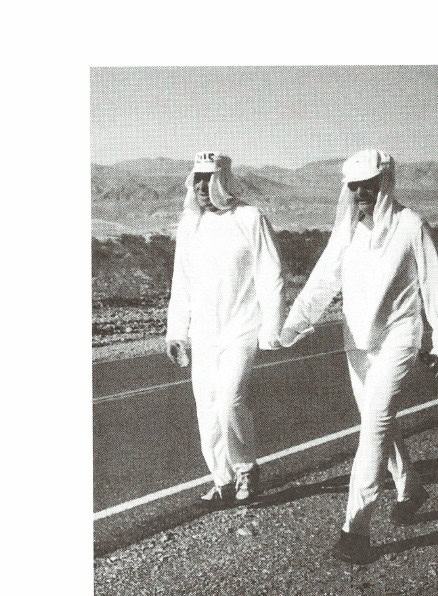
In 1996, Hi-Tech finally changed to an A.M. start to allow its runners to enjoy the unique daytime temperatures of Death Valley. Milan Milanovich of Switzerland started with the expressed intention of doing a double-crossing and raced to the summit in 52:00, turned around and raced back to Badwater, shattering the old record by over four hours, knocking it down to 110:26! He plans to return in 1997 in an attempt to better his time.
OBSERVATIONS
As far as adventure run ultras go, the Death Valley-to-Mount Whitney course is a beaut. Its extreme altitude changes combined with its penchant for heat and wind conspire to offer a unique challenge. Death Valley in mid-summer can offer temperatures nudging 130 in the shade. In the direct sun, the radiant heat on the human body combined with the 200+ degree heat coming up off the asphalt road is tremendous. This condition can also be complicated by 30 to 40 m.p.h. winds that can last for as long as 11 hours without letting up. There have been some days when runners leaving Badwater have had to wear goggles and masks against the gusting sand.
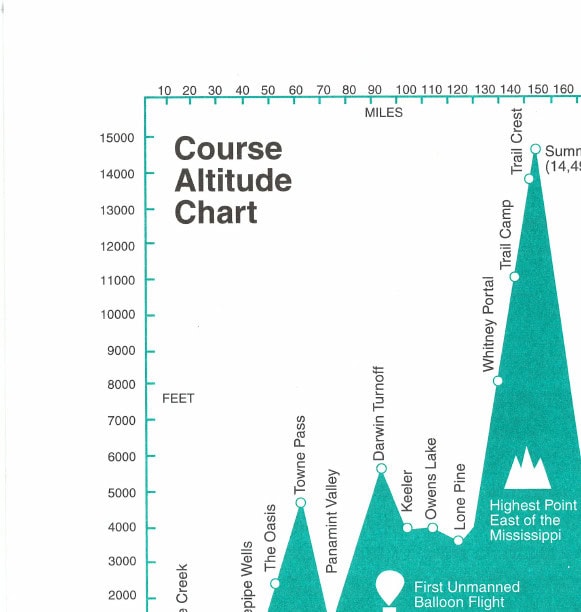
Most Americans also assume that the route from Badwater to the base of Mount Whitney is a direct shot. It isn’t. There is nearly a 5,000-foot, 17-mile-long ascent to escape Death Valley, then a descent to roughly 1,200 feet in the bottom of Panamint Valley, followed by an ascent to more than 5,000 feet coming over the Argus Range before dropping into Owens Valley (4,000 feet).
The most unpredictable segment of the course, however, is almost always Mount Whitney. A summer afternoon on the peak of Whitney can range from suntanning weather to hail and lightning storms that have on occasion taken lives. The challenge for ultrarunners on Mount Whitney is that they arrive saddled with all three of the contributing factors to altitude sickness: weariness, dehydration, and a rapid ascent. But like most seemingly overwhelming challenges, once Al Arnold proved in 1977 that a runner could in fact solo the course (something course founder Kenneth Crutchlow just four years before had assumed to be impossible), the veil was dropped. Through 1996 some 59 different runners have completed the one-way course. Marshall Ulrich holds both the course record and the record for the most number of successful one-way crossings (six).
When Crawford and Benyo agreed to attempt the supposedly impossible double crossing in 1989, they approached the challenge with fear and respect. They took tremendous precautions and ran the course conservatively, expecting at any moment to be crushed. Ironically, the completion percentage of double crossings overwhelms the success rate of the single crossings, likely due to the tremendous preparation and focus required for the double.
Certainly a number of runners who signed up over the years to do the Hi-Tec race have claimed to have a double crossing in mind, but did not really. The typical double-speak goes like this: “I’ll see how I feel after the one-way attempt, then I’ll go for the double.” Veterans of the course, who know first-hand how a runner feels after doing a one-way attempt, are able to predict precisely how runners expressing the “option” of a double would perform.
On the other hand, serious attempts at the double crossing have had an incredible 91.7 percent success rate. And here’s an even more incredible statistic regarding the double crossing: Of the 3,600 miles attempted on the out and back course, 3,574 miles have been completed. The author’s 1991 DNF after 274 miles is the only unsuccessful double crossing attempt made by runners who went to Death Valley with the double crossing as their prime focus.
Note: For those wishing information on the Hi-Tec race from Badwater to Whitney Portal, contact Hi-Tec at 4801 Stoddard Rd., Modesto, CA 95356; 209/545–1111. For an extensive history of the course, of the 1987 United States versus Britain race, and of the first double-crossing in 1989, the author’s The Death Valley 300 is available (see page 123 for more info).
Death Valley-to-Mount Whitney Master List, 1977–1996
Chronological List of Successful One-Way Attempts
| No. | Year | Name | Country | Hrs:Min. |
|---|---|---|---|---|
| 1 | 1977 | Al Arnold | US | 84:00 |
| 2 | 1981 | Jay Birmingham | US | 75:34 |
| 3 | 1982 | Max Telford | NZ | 56:33 |
| 4 | 1983 | Greg Morris | US | 76:38 |
| 5 | 1986 | Tom Crawford | US | 70:27 |
| 6 | 1986 | Michael Witwer | US | 70:27 |
| 7 | 1987 | Linda Elam | US | 69:12 |
| 8 | 1987 | Adrian Crane | US | 69:12 |
| 9 | 1987 | Gill Cornell | US | 45:15 |
| 10 | 1987 | Eleanor Adams | UK | 52:45 |
| 11 | 1987 | Jean Ennis | US | 58:57 |
| 1987 | Tom Crawford (2) | US | 58:57 | |
| 12 | 1987 | Kenneth Crutchlow | UK | 126:30 |
| 13 | 1987 | David Bolling | US | 126:30 |
| 14 | 1987 | Richard Kegley | US | 113:09 |
| 15 | 1988 | Chuck Jones | US | 45:54 |
| 1988 | Linda Elam (2) | US | 61:47 | |
| 16 | 1988 | Douglas Mitchell | US | 80:32 |
| 17 | 1989 | Bill Dickey | US | 62:23 |
| 1989 | Tom Crawford (3)# | US | 55:08 | |
| 18 | 1989 | Richard Benyo# | US | 79:23 |
| 19 | 1989 | Todd Leigh | US | 65:17 |
| 20 | 1989 | Bart Yasso | US | 63:21 |
| 21 | 1989 | Barbara Alvarez | AUSTRIA | 66:00 |
| 22 | 1989 | Angelika Castaneda | AUSTRIA | 66:00 |
| 23 | 1990 | Tom Possert | US | 38:18 |
| 24 | 1990 | Marshal Ulrich | US | 40:51 |
| 25 | 1990 | Odin Christensen | US | 45:05 |
| 26 | 1990 | Jurgen Ankenbrand | GER | 55:30 |
| 27 | 1990 | Kevin O’Grady | US | 65:09 |
| 28 | 1990 | Jack Christian | US | 66:00 |
| 29 | 1990 | Marvin Skagerberg | US | 69:19 |
| 30 | 1990 | Ed Ayers | US | 69:43 |
| 31 | 1990 | Joseph Marchand | CAN | 69:55 |
| 32 | 1991 | Bruce Sherman | US | 79:54 |
| 33 | 1991 | Kenneth Thompson | US | 79:54 |
| 1991 | Marshal Ulrich (2) | US | 33:54* | |
| 1991 | Richard Benyo (2)# | US | 77:55 | |
| 1991 | Odin Christensen (2) | US | 43:28 | |
| 34 | 1991 | Stefan Schlett | GER | 46:21 |
| 35 | 1991 | Don Choi | US | 67:04 |
| 36 | 1991 | Robin Smit | US | 68:48 |
| 37 | 1991 | Ben Jones | US | 75:30 |
| 38 | 1991 | Jack Denness | UK | 90:50 |
| 1992 | Richard Benyo (3)# | US | 77:22 | |
| 39 | 1992 | Joe Franiak | US | 39:46 |
| 1992 | Robin Smit (2)# | US | 68:21 | |
| 1992 | Marshal Ulrich (3) | US | 69:50 | |
| 1992 | Ben Jones (2) | US | 72:08 | |
| 40 | 1992 | Steve Kerr | UK | 72:30 |
| 41 | 1992 | Jack Speer | US | 97:02 |
| 42 | 1992 | Margaret Speer | US | 97:02 |
| 1993 | Joe Franiak (2) | US | 41:08 | |
| 43 | 1993 | Mark Macy | US | 51:20 |
| 1993 | Robin Smit (3)# | US | 55:39 | |
| 44 | 1993 | Robert Lambert | UK | 67:24 |
| 45 | 1993 | Bob Givens | US | 70:04 |
| 46 | 1993 | John Shehadey | US | 78:55 |
| 1993 | Ben Jones (3) | US | 90:30 | |
| 1993 | Marshal Ulrich (4) | US | 93:25 | |
| 47 | 1994 | Bill Menard | US | 49:49 |
| 1994 | Robert Lambert (2)# | UK | 50:15 | |
| 48 | 1994 | Rob Volkenrand | US | 64:00 |
| 1994 | Steve Kerr (2)# | UK | 74:45 | |
| 1994 | Jack Denness (2)# | UK | 75:00 | |
| 49 | 1994 | Denise Jones | US | 90:59* |
| 50 | 1994 | John Rosmus | US | 400:09 |
| 51 | 1994 | Joe Schlereth | US | 400:40 |
| 52 | 1994 | Lennie Lefler | US | 78:08 |
| 53 | 1994 | Scott Weber@ | US | 92:59 |
| 54 | 1995 | Scott Weber (2) | US | 68:02 |
| 55 | 1995 | Willette Ulrich | US | 72:20 |
| 1995 | Marshall Ulrich (5) | US | 72:20 | |
| 56 | 1995 | Whit Rambach | US | 89:41 |
| 57 | 1995 | Rhoda Provost# | US | 77:58 |
| 58 | 1996 | Milan Milanovich# | SWISS | 52:00 |
| 1996 | Marshall Ulrich (6) | US | 55:08 | |
| 59 | 1996 | Judy Overholzer | US | 55:30 |
A.M. Starts/One Way (Ranking)
| No. | Year | Name | Country | Hrs:Min. |
|---|---|---|---|---|
| 1 | 1991 | Marshal Ulrich | US | 40:09* |
| 2 | 1996 | Milan Milanovich# | SWISS | 52:00 |
| 3 | 1987 | Eleanor Adams | UK | 52:45 |
| 4 | 1989 | Tom Crawford# | US | 55:08 |
| 1996 | Marshall Ulrich | US | 55:08 | |
| 6 | 1996 | Judy Overholzer | US | 55:30 |
| 7 | 1993 | Robin Smit# | US | 55:39 |
| 8 | 1987 | Jean Ennis | US | 58:57 |
| 1987 | Tom Crawford | US | 58:57 | |
| 10 | 1981 | Jay Birmingham | US | 75:34 |
| 11 | 1992 | Richard Benyo# | US | 77:22 |
| 12 | 1991 | Richard Benyo# | US | 77:55 |
| 13 | 1989 | Richard Benyo# | US | 79:23 |
| 14 | 1992 | Jack Speer | US | 97:02 |
| 1992 | Margaret Speer | US | 97:02 | |
| 16 | 1994 | Denise Jones | US | 97:44* |
| 17 | 1995 | John Rosmus | US | 99:32 |
| 18 | 1987 | Richard Kegley | US | 113:09 |
| 19 | 1987 | Kenneth Crutchlow | UK | 126:30 |
| 1987 | David Bolling | US | 126:30 |
Double Crossings
| No. | Year | Name | Country | Hrs:Min. |
|---|---|---|---|---|
| 1 | 1989 | Tom Crawford | US | 126:34 |
| 2 | 1989 | Richard Benyo | US | 170:58 |
| 1992 | Richard Benyo (2) | US | 157:58 | |
| 3 | 1992 | Robin Smit | US | 124:20 |
| 1993 | Robin Smit (2) | US | 114:54 | |
| 4 | 1994 | Robert Lambert | UK | 118:57 |
| 5 | 1994 | Jack Denness | UK | 161:20 |
| 6 | 1994 | Steve Kerr | UK | 161:20 |
| 7 | 1994 | Scott Weber | US | 175:51 |
| 8 | 1995 | Rhonda Provost | US | 143:45 |
| 9 | 1996 | Milan Milanovich | SWISS | 110:26 |
Triple Crossings (Whitney to Badwater to Whitney to Badwater)
| No. | Year | Name | Country | Hrs:Min. |
|---|---|---|---|---|
| 1 | 1994 | Scott Weber | US | 257:32 |
Reverse Course
| No. | Year | Name | Country | Hrs:Min. |
|---|---|---|---|---|
| 1 | 1991 | Drew Benyo | US | 90:14 |
| 2 | 1994 | Scott Weber@ | US | 81:41 |
| 1994 | Scott Weber (2)@ | US | 82:52 |
Legend:
- #: one-way time recorded during double crossing.
- @: one-way time recorded during triple crossing.
- * In the cases of Marshal Ulrich in 1991 and Denise Jones in 1994, the runners travelled to Badwater earlier in the day of their attempt in order to make an official “A.M. start” before noon, then returned to Badwater later in the day to begin the journey with the Hi-Tec race group; consequently, their “A.M. start” total is different—higher—than their time from the Hi-Tec 6 P.M. start to the peak of Whitney.
WEATHER EXPERTS consider the United States and Canada temperate regions, but try telling that to a runner in New Orleans or Phoenix in July! The former feels like a sauna, the latter like a microwave, and even a social jog at dusk can be frustratingly difficult to a “Northerner” accustomed to less thermal stress. But even North America’s northern tier— from Winnipeg and Minneapolis to Toronto and Buffalo—can have sultry weather. True, if you endure a few weeks in this kind of weather, training “feels” more tolerable; but the training and racing pace you’re able to maintain is substantially slower than what you could do in cooler weather, even with comparable fitness. Why is this?
The laws of physics answer the question (Nielsen, 1996). The body must keep its internal temperature fairly constant, and any heat accumulated must be lost to the environment. The warmer our surrounding environment, the slower this heat transfer is, and the greater the trend toward heat accumulation. How do we accumulate so much heat from training and racing? How does heat accumulation slow performance? How do we remove it? How does training help in this regard? What else can you do besides training to manage optimally environmental thermal stress? Read on for the answers to these questions.
HEAT ENERGY PRODUCTION
Our body is only about 20 to 25 percent effective in converting stored metabolic fuels to energy for movement. The remaining 75 to 80 percent of exercise
This article originally appeared in Marathon & Beyond, Vol. 1, No. 4 (1997).
← Browse the full M&B ArchiveMore like this
1,000+ stories from 19 years of Marathon & Beyond
The complete archive of the legendary long-distance journal — digitized and free to read.
