

On the Road with Kathrine Switzer
THE MIRACLE OF THE UNLIKELY
WASHINGTON, D.C., April— Twenty-five years ago this spring, I came down from New York City to visit my parents in Virginia. I was on my way to Florida to do a magazine article on fishing, of all things, and the great baseball player, Ted Williams, who was also a great angler.
Williams was a cantankerous, untalkative guy even then, and the magazine thought if they sent a woman reporter, Williams would be caught off guard. The sticking point was that the reporter also had to be a good fisherman. Williams had already sent two reporters packing, and he was losing what little patience he had left.
With a bundle of clippings about my running prowess, and some totally convoluted reasoning about athletic capability in one sport carrying over to another (you know, if baseball equals fishing, then running also equals fishing), I convinced the magazine that I was an ace fisherman. What can I tell you? I was broke, and the magazine was paying $500—huge money in those days.
Gar Williams (unrelated to Ted Williams), one of the top U.S. marathoners at the time (seventh at Boston ’61 and national marathon champion in ’65) lived in the same town as my parents, and I phoned him just to chat. Gar was the president of the Road Runners Club of America, an organization I had come to love as much as I hated the AAU.

Among other things, Gar told me about a race the next morning called the Cherry Blossom 10-Miler, which went around the Jefferson Memorial and the Tidal Basin. He convinced me that I had time to run it and still catch my plane. I needed to run 10 miles that morning anyway, so the race was an excuse to get out of bed and get moving.
It was a nice enough race, under the cherry blossoms and all, and outside of using it for a 71-minute tempo run, I didn’t think much more about it. I was recognized as the “first woman,” but that was no big deal—I think there was only one other woman who showed up. Races were popping up everywhere in those days, and most of the ones I entered I “won” the women’s division because there were no other women!
I went on to Florida and met the irascible Williams, who was indeed an intimidating figure. But with all his steam and bluster, he reminded me of Jock Semple; and if Jock and I wound up friends, Williams would be a piece of cake. All I had to do now was fish.
I’ve never believed that I was “talented,” and I’ve had to work very hard at everything to get results. But nature is interesting. In moments of incredible pressure, when we totally focus, sometimes we can accomplish the impossible.
With totally artificial outward calm, I watched every move that Ted Williams made, memorized it, imitated it, and outfished him. Had the trip lasted more than two days, I could not possibly have held the tension. But I only needed the two days, and the visit produced one of the best stories I’ve ever written. And one of my best lessons in life: Give it everything, even when the odds are against you, and you might do something amazing.
For various reasons, I haven’t been in the Washington, D.C., area for the Nortel Cherry Blossom 10-Miler since 1972. The years have brought prestige and thousands of runners to the starting line. One of the best sponsors in the business, Nortel (Northern Telecom), has transformed the little event I ran in 25 years ago into one of the hottest races on the international calendar.
The race has also made me kick myself annually for 25 years because the entry form has a column of the women’s winning performances, beginning with my glaringly pedestrian 71 minutes right at the top. If I had known that history was going to record me, I would have kicked it under 70 minutes for heaven’s sake, since everyone knows that even 69:57 sounds three minutes, not three seconds, faster than 70. This year, the race even had a special souvenir mug made for every woman who could run faster than my 1972 time. “That must have required an entire china factory,” I grumbled at Phil Stewart, the event’s tireless race director.
So it was fun to find myself invited to the VIP dinner the night before the race as one of the “originals.” After two glasses of wine, old friends at the table suggested that I actually run the race the next day. Since I needed 10 miles on Sunday anyway, I figured it was a good excuse to get out of bed and get moving.
Don’t worry. Nothing spectacular occurred because I suddenly put myself in a pressure situation. At age 50, I don’t do that any more. Not without preparation, anyway. Instead, I ran the race at about the same effort as I expended when I was 25. And that effort came out at 84 minutes. When I passed the 71-minute mark, though, I did wonder for a moment if it would be worth the effort to try to train down to that time again, something I did do at age 45. That notion passed quickly, and instead I decided to run my next Cherry Blossom in another 25 years, for the 50th Anniversary, which will be in 2022!
The performances of winners Peter Githuka and Valentina Yegorova were superb on a muggy day: 46:29 for him and 54:28 for her. (I wonder if Valentina picked up her souvenir mug in addition to her $5,000 check.)
But running never disappoints, and for that matter, occasionally produces an outright miracle. At the awards, I bumped into Norm Green, the legendary masters runner who rewrote the books for many male over-50 and over-60 records. Five months ago, when I last saw 64-year-old Norm, he was recovering from prostate cancer surgery and was 25 pounds overweight due to intensive hormone therapy. At that time, he was wearing the most cheerful expression he could muster, probably because at least he was beginning to walk/jog again. At the time I was not only shaken by the possible loss of a friend, but also profoundly saddened by the demise of a great champion, the man who was going to show through his 60s, 70s, and maybe beyond, what running possibilities the human body could hold.
But at the Nortel Cherry Blossom, Norm was ebullient. He had just finished in 64:50 and won the 60–64 age group. Maybe Norm’s already shown what possibilities we hold. As he and his wife Dolores drifted into the crowd, they were as giggly as teenagers. The rest will be a bonus.
BOSTON, April
BOSTON, April—Last year’s “100th” Boston Marathon produced enough miracles to last another century. Plenty of conversations at the 1997 edition simply took up from where they left off 12 months ago, only in quieter hotel lobbies. In between, there was a big marathon held last August in Atlanta that precipitated plenty of drama in Boston.
Notably, that Boston’s three-time champion duo, Cosmas N’deti and Uta Pippig, were both felled by Olympic attempts. N’deti didn’t even get to the starting line in Atlanta, so devastated physically and emotionally was he by his third-place Boston finish last year. By his own admission, he just couldn’t lift it in time for a top performance in Atlanta and asked Kenyan selectors to take a worthy up-and-coming runner. (They wisely chose Eric Wainaina, who ran a brilliant 2:12:44 for the bronze.)
In Boston, N’deti was still in his trough, also fighting the residue of malaria, and was never a factor in the race. With a cool head wind, it was a tactical affair, made interesting by the feisty rivalry between the Mexicans and the Kenyans. Such a battle played into the hands of someone who could hang off the back and then finish fast, and Lameck Aguta, a perennial bridesmaid, was first down the aisle this time with a 2:10:34. His grin was as wide as the white finishing tape.
DEATH VALLEY. The name reverberates with ill intent and conjures up the most perverse meteorological conditions on the poxed flesh of the earth. Death Valley is a huge gouge whose steep sides have filled in its bottom with debris; the bottom of Death Valley lies 8,000 feet below the top of the debris, yet the top of the debris still represents the lowest point in the Western Hemisphere. The valley is so commodious and its sides so formidable that the heat trapped there in mid-summer can be reheated on subsequent days, which makes it the hottest spot on earth.
Death Valley’s landscape is so alien that in 1992 Russian scientists carted a six-wheeled, Martian probe vehicle to the place to run it through its paces in otherworldly conditions. The very expensive robotic crawler ran into an environment it liked less than Mars—Death Valley killed it.
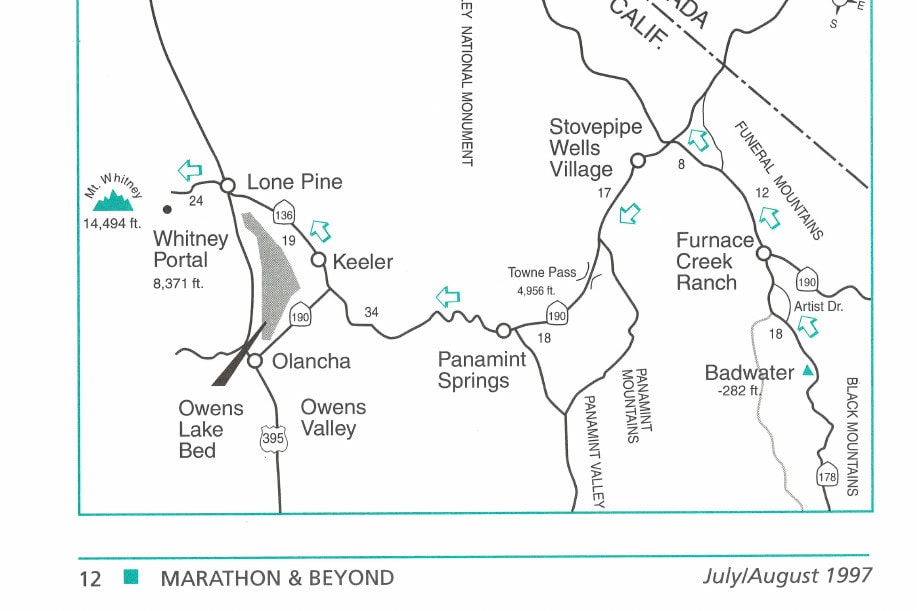
German high-performance carmakers such as BMW and VW regularly send tough prototypes to Death Valley’s Stovepipe Wells (5 feet above sea level) in mid-summer so they can torture the cars on the 17-mile ascent to 4,956-foot Towne Pass. Death Valley is a caldron that will giddily boil flaws to the surface.
Twenty-six miles down the street from Stovepipe Wells lies Furnace Creek, the figurative and literal capital of Death Valley. It boasts a steady supply of water, a modern air-conditioned motel complex, an airport, a golf course, a post office, stores, barely-functioning restaurants, acres of date palms, and guests who speak enough non-English languages to keep the U.N. translation corps working overtime. Female coyotes in heat wander into Furnace Creek and lure guests’ dogs into the surrounding desert where they are eaten.
In 1913, Furnace Creek was merely a godforsaken ranch where its owners, Eagle Borax Company, attempted to cultivate date palms. As one of his tedium-splintering duties, ranch bossman Oscar Denton took daily temperature measurements. On July 10, 1913, Denton’s job turned deadly: “On the day that I recorded the greatest heat ever registered—134 degrees in the shade—I thought the world was going to end. Swallows in full flight fell to the ground dead, and when I went out to read the thermometer with a wet Turkish towel on my head, it was dry before I returned.”
WELCOME TO BADWATER, CALIFORNIA
Eighteen miles south of Furnace Creek squats Badwater, California, one of the most unattractive bits of real estate in the world. Badwater is a brackish pool of mineral-ripe water at the edge of the world’s most famous saltpan. The saltpan forms the crusted icing atop a rich mineral layer cake more than a mile deep that over eons has washed down from the sides of the mountains that imprison the massive valley.
Time easily fragments here. It took eons for the fill to wash into the valley—the driest spot on earth, a place that has gone as long as 18 months without measurable precipitation. It is not uncommon for evil-looking, rain-saturated

This article originally appeared in Marathon & Beyond, Vol. 1, No. 4 (1997).
← Browse the full M&B ArchiveMore like this
1,000+ stories from 19 years of Marathon & Beyond
The complete archive of the legendary long-distance journal — digitized and free to read.
