

Beating the Heat
WEATHER EXPERTS consider the United States and Canada temperate regions, but try telling that to a runner in New Orleans or Phoenix in July! The former feels like a sauna, the latter like a microwave, and even a social jog at dusk can be frustratingly difficult to a “Northerner” accustomed to less thermal stress. But even North America’s northern tier— from Winnipeg and Minneapolis to Toronto and Buffalo—can have sultry weather. True, if you endure a few weeks in this kind of weather, training “feels” more tolerable; but the training and racing pace you’re able to maintain is substantially slower than what you could do in cooler weather, even with comparable fitness. Why is this?
The laws of physics answer the question (Nielsen, 1996). The body must keep its internal temperature fairly constant, and any heat accumulated must be lost to the environment. The warmer our surrounding environment, the slower this heat transfer is, and the greater the trend toward heat accumulation. How do we accumulate so much heat from training and racing? How does heat accumulation slow performance? How do we remove it? How does training help in this regard? What else can you do besides training to manage optimally environmental thermal stress? Read on for the answers to these questions.
HEAT ENERGY PRODUCTION
Our body is only about 20 to 25 percent effective in converting stored metabolic fuels to energy for movement. The remaining 75 to 80 percent of exercise energy production is in the form of heat. A certain amount of heat energy is essential to maintain the healthy body temperature of 37°C (98.6°F). Enzyme-controlled chemical reactions in the body function optimally a few degrees above this, making it quite appropriate for exercise body temperature to be in the neighborhood of 37.8°C (100°F) or more. However, your performance will begin to deteriorate at temperatures beyond 40.5°C (105°F), and cell death is essentially inevitable beyond 43°C (109.4°F). In short, relatively little heat energy can be stored.
During aerobic running, the heat liberated from metabolism amounts to about 955 kilocalories (4 kilojoules) per kilogram of body weight per kilometer of distance run. As you increase your running pace, your rate of heat production rises. For example, a runner with a V̇O2max of 66.3 ml/kg/min. can run at an energy production of 16.1 kcal/min. (5:44/mile), which permits a 2:30:00 marathon, whereas a runner with a V̇O2max of 76.2 ml/kg/min. can run at an energy production of 22.2 kcal/min. (5:04/mile) and complete the distance in 2:13:00. The increasing energy dynamics with the faster pace cause a greater rate of heat production. Thus, as mentioned earlier, it isn’t just fitness that contributes to how fast we can run. It’s also physics, because one’s pace cannot be so fast that metabolic heat accumulates; for a runner to remain in thermal equilibrium, the heat must be removed.
Shunting Heat Away from the Core
Some of the physiological mechanisms designed to dissipate heat in the body are similar to those which optimize physical performance. In both instances, blood is shunted from regions less involved in the exercise to regions more involved. The best example for performance enhancement is when blood flow is redirected primarily from the visceral region (gastrointestinal tract, liver, and kidneys) to the exercising skeletal muscles. The best example for heat dissipation is when warm blood is sent to the cutaneous region (skin) so that its accumulated heat can be lost to the environment.
Now you can appreciate the challenge of trying to perform well in thermally stressful conditions. You will simply not be able to maintain the working pace that was possible in cooler conditions. Instead of greatly enhanced blood flow to working muscles, your body has to divert blood to the skin for cooling, which decreases the blood supply available to working muscles. As a result, your finishing times in warm-to-hot weather races are slower than those in cool-to-cold weather events. Whether you are hiking across Death Valley or racing a half-marathon in Miami, when you’re performing in thermal stress, you have to determine early on what pace will be manageable throughout the activity without exceeding your threshold of heat accumulation.
ADAPTING TO INCREASED ENVIRONMENTAL TEMPERATURE
You’ve probably read that over time it’s possible to adapt to hot, humid weather simply by training in such conditions. That’s indeed correct. However, keep in mind that this adaptation does not involve a rise in your body’s maximum tolerable core temperature. Instead, what’s occurring is that once you’re heat-adapted, you have an improved ability to remove heat, and thus delay core temperature from rising to an intolerable level.
Several physiological mechanisms help this adapting occur. First, although training even in cool weather increases your blood volume, training in the heat increases it even more (values expressed in the scientific literature suggest anywhere from 300 to 500 milliliters extra, depending upon the quality of training, the training period, and the environmental temperature). This increased blood volume permits more blood to shunt to the skin for cooling before infringing on the blood supply needed for your working skeletal muscles.
Second, training in the heat substantially enhances your body’s sweat response, and as we shall see shortly, sweat evaporation is a major component of cooling. Sweat production starts to occur at a lower core temperature, and more sweat is produced each minute. The sweat is more dilute, that is, it has fewer electrolytes, such as sodium and chloride. Maintaining optimum electrolyte balance is particularly important for optimum neuromuscular functioning. Although it may seem unsophisticated, experienced runners who are in the process of heat acclimation know very well the practical value of licking a sweaty forearm arm and sensing its saltiness as they finish a run.
The essence of published research suggests that 90 to 95 percent of adaptation to warm-to-hot weather occurs within two weeks of roughly 60 minutes per day of moderate-intensity training in those conditions (Armstrong and Dziados, 1986). While a runner can gain a bit more tolerance to heat stress with a longer period of training in hot weather, as a coach I don’t recommend such an extended preparation. Prior to two weeks before a major competition, a number of fairly high intensity workouts are still on an athlete’s training schedule. It’s important that the runner execute these workouts with quality and a positive mental outlook. The risks of the runner completing them unsatisfactorily because of the hot weather do not outweigh the benefits of extending the adaptation period.
MECHANISMS FOR HEAT DISSIPATION
The body has four major heat transfer mechanisms: conduction [Cd], convection [Cv], evaporation [E], and radiation [R]. Three of these mechanisms can
cause the body to lose or gain heat, depending on whether the body skin surface is warmer or cooler than its surrounding environment. Evaporation is solely a mechanism for heat loss. To determine whether the body will store or lose heat, sum the combined influences of these various mechanisms on metabolism [M]. Mathematically, heat storage [S] is thus summarized as S = M ± Cv ± Cd ± R – E (Aoyagi et al., 1997).
If you can understand how each of these heat gain/loss mechanism works, you’ll gain useful information about how you can cope successfully with warm-to-hot and humid conditions and thus be able to run at an elevated (training or competitive) workload with minimum slowing of your pace. Data from the 1996 Atlanta Olympic marathons will help illustrate the various aspects of heat gain or loss. A hot and humid Atlanta in mid-July provided the perfect laboratory for us scientists to study the potentially adverse consequences of the weather on athletes’ performances.
Convection
Convective heat transfer from your body increases when there is a breeze blowing past your body’s surface, and when the thermal gradient between skin temperature (Tsk) and environmental (ambient) air temperature (Ta) increases. Thus, on a cool, breezy day, you can experience considerable convective heat loss. Its effects are probably familiar to most. While standing in the shade on an otherwise calm day, you can easily notice the cooling influence of a sudden breeze. The ambient temperature hasn’t changed, but warm air surrounding the body surface has been convected away.
For the mathematically inclined, convective heat loss is calculated as Cv = 8.3 × √v × (Tsk) – Ta), where the two temperatures are in °C, and v is wind velocity in meters per second. The units of conduction are watts per °C temperature difference per square meter of body surface area. The Atlanta Olympic marathons were scheduled to start at 7:05 A.M., just as the sun was rising. Using an estimate of 95°F (35°C) as an average skin surface temperature and five-year temperature averages for 7:05 A.M., we calculated that the expected Tsk-Ta differential would be substantial—as high as 22.4°F (12.6°C) at the start and decreasing to 18.4°F (10.2°C) by the finish (Martin, 1996).
On both marathon racedays, however, the wind was calm. Did this mean that the athletes experienced no convective heat loss? No, because the athletes created their own breeze while running. This cooling was highest initially, when the Tsk-Ta differential was highest, before the environmental temperature started to rise. And the cooling was greater for men because of their faster pace. Josiah Thugwane’s Olympic gold medal performance of 2:12:36 (a pace of 5:03/mile or 3:08/km) gave him an 11.9 mile/hr. (19.1 km/hr.) breeze. By contrast, Fatuma Roba’s winning time of 2:26:05 (a pace of 5:34/mile or 3:28/km) gave her a 10.8 mile/hr. (17.3 km/hr.) breeze. However, as ambient air temperature increased toward the end of the race, heat loss by convection started to decrease.
Conduction
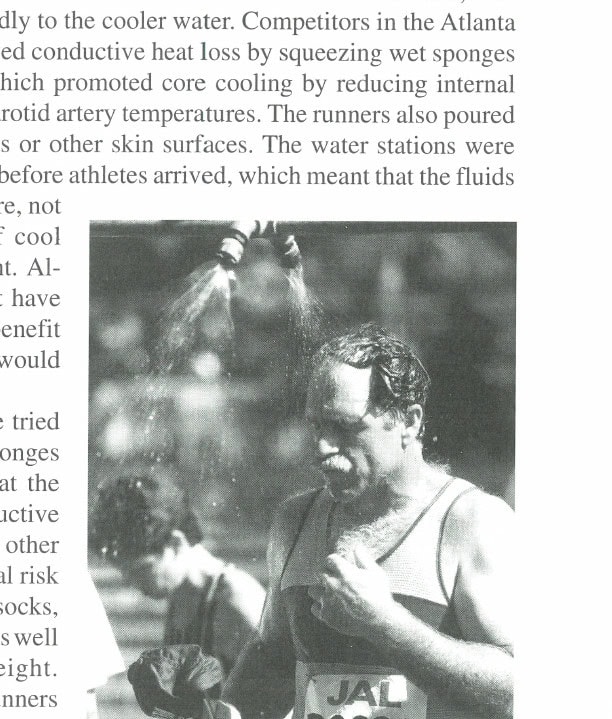
As a mechanism for heat loss, conduction requires the presence of an adjacent cooler surface. A good example is what happens when you jump into a swimming pool after a morning run. The cooler water is an enormous heat sink, with body heat transferring rapidly to the cooler water. Competitors in the Atlanta Olympic marathons achieved conductive heat loss by squeezing wet sponges onto their neck surface, which promoted core cooling by reducing internal jugular vein and internal carotid artery temperatures. The runners also poured cool water onto their heads or other skin surfaces. The water stations were stocked with supplies well before athletes arrived, which meant that the fluids were at ambient temperature, not refrigerated. This lack of cool water was not an oversight. Although cooler fluids might have “felt” more refreshing, the benefit to the runners of cool water would have been negligible.
Those of you who have tried dousing your head with sponges or cups of water know that the potential benefits of conductive heat loss can be undone by other practical problems—the real risk of waterlogged shoes and socks, which can produce blisters as well as additional running weight. Some of the more savvy runners have attempted with varying success to counteract these problems by using small socklets instead of standard socks and by spray-waterproofing their shoes.
Radiation
The transfer of radiational energy occurs from a combination of long-wave (infra-red) radiation from the sun and nearby surfaces, such as streets and buildings, and short-wave (ultraviolet) radiation from the sun. Infra-red energy accumulation is more critical from the standpoint of thermal stress because it represents heat energy. A familiar example is the heat that builds inside a car parked in the sun (even on a chilly winter day) due to infra-red energy accumulation. Another common example is the difference in how the air “feels” when you run on the sunny versus the shady side of the street, particularly with respect to the potential heat gain from running in the sun.
Heat can also be lost by radiation as well. As with convection, the extent of radiational heat transfer depends on the difference between skin temperature (Tsk) and the surrounding mean radiant air temperature (Tmrt). Radiant energy is calculated as R = 5.2 (Tsk-Tmrt), where the two temperatures are in °C and the units are watts per °C difference per square meter of body surface area. The greater this thermal gradient is, the greater the potential for radiational movement.
The radiational component of heat gain or loss was an important consideration in the decision to schedule both Atlanta Olympic marathons during the early morning hours (Roos, 1996). The original plan was for the men’s marathon to occur at the more “traditional” time (dating back only to 1984) of late-afternoon/early evening to coordinate nicely with the closing ceremonies.
The switch to a morning start could not have been wiser. The expected race weather was cloudy and cooler conditions prevailing during the early morning, with a greater likelihood of sunny skies—and hot streets—near the end of the day. This exact scenario occurred. Skies were foggy-to-cloudy during almost all of both marathons, and radiational heat gain was unmeasureable. However, shortly before the last men’s marathon finisher crossed the line, the sun appeared and remained in full force the rest of the day. At the proposed 6:30 P.M. marathon start, the temperature in the sun was 36.3°C (97.3°F), which meant that the combination of hot pavement and continuing sun would have caused a net heat accumulation for the athletes even as they were standing on the street—without running! The early-morning start was indeed a blessing.
Evaporation
Quantitatively, the most effective mechanism for heat loss is evaporational cooling. The extent of this heat loss depends on the water vapor pressure difference between the skin surface and the surrounding environment, as well as the influence of an accompanying breeze. The greater the breeze and the lower the ambient water vapor pressure, the greater the maximum evaporation rate, and thus the greater the heat energy loss. Mathematically, evaporational heat loss is calculated as E = 124 × √v × (Psk – Pa). The two vapor pressures are measured in kilopascals (the metric equivalent of millimeters of mercury), and wind velocity (v) is measured in meters per second. Thus, evaporational heat losses are greatest on a dry, breezy day, regardless of temperature. Under this situation, the water vapor pressure gradient is large. As relative humidity rises, the water vapor pressure gradient decreases. Evaporative cooling thus decreases as well, and if the two vapor pressures equalize (the relative humidity would reach 100 percent), evaporative cooling would cease to occur (even though you would still sweat).
During the Atlanta Olympic marathons, the relative humidity was very high initially (92 percent), dropping to 79 percent by 9:00 A.M. Thus, the athletes were sweating, but it didn’t cause much evaporational cooling initially because the water vapor pressure gradient between skin and air was minimal. However, as the race progressed and the humidity started to fall, this evaporational component steadily became more effective.
Although sweat evaporation is an extremely powerful cooling mechanism, remember that a large proportion of sweat is derived from blood volume. If sweat losses greatly exceed fluid replacement, blood volume will start to decrease, which in turn will reduce the amount of blood pumped with each beat (the stroke volume). Remember the formula for cardiac output—heart rate × stroke volume. To maintain cardiac output, and thus ensure adequate tissue blood flow, one’s heart rate must rise if the stroke volume decreases. This adaptation has its limits too, and cardiac output will soon start to fall. With it, the sustainable workload (training or racing pace) must decrease. Also, the resulting lowered perfusion of blood to the skin and the working muscles will cause inappropriate heat accumulation and a decreased oxygen supply to highly metabolic tissues. These two factors will also inevitably slow your performance.
During the first few hours of a very long run or a fairly long race, such as a marathon, your sweat production can range routinely from 1 to 1.5 liters/hr. and can even exceed two liters/hr. in some individuals (Gardner et al., 1996). Olympian Alberto Salazar fell into this latter category, and his extraordinary sweat rate may explained some of his difficulties with the 1984 Los Angeles Olympic Marathon (Armstrong et al., 1986). As part of his preparation to endure what was projected as a potentially brutally hot Olympic marathon, Alberto underwent some physiological studies at the U.S. Army Research Institute of Environmental Medicine at Natick, Massachusetts. Results of a heat chamber treadmill test at his anticipated marathon race pace of 5:00/mile—with temperature and humidity similar to a “worst-case” scenario (30.6°C, 76 percent humidity)—indicated a potential 2.79 liters/hr. of sweat loss. On raceday, weather conditions were not as bad as in the heat chamber, but Alberto’s race pace was slower (5:07 per mile, good for 15th place). Calculations made on the basis of estimated fluids ingested and body weight loss suggested that his actual marathon race sweat rate was 3.71 liters/hr., even higher than in the
heat chamber. Thus, it is not surprising that Alberto’s several super-fast marathon performances around the world have all occurred in cool-weather circumstances, where minimal sweating kept his fluid losses manageable.
The maximum absorption of fluid from the gastrointestinal tract during exercise is typically much less than sweat losses, averaging around one liter/hr. (Coyle and Montain, 1993). However, it is unlikely that while competing at the marathon distance or less you could achieve that kind of ingestion rate. One important reason is that runners devote very little training time to perfecting the techniques of actually drinking on the run. Another reason is that the substantial shunting of blood away from the gastrointestinal tract decreases the total volume that can be absorbed. In Salazar’s case, one can imagine that even under the most ideal conditions of fluid ingestion, his sweat loss would still greatly exceed his fluid replacement.
In my own advising of such marathoners as Keith Brantly and Steve Spence, I have harped upon the need for them to find fluid bottles that are easy to grab and hold, to practice emptying the entire contents—which means finding the best spout and the best size to hang on to for perhaps half a kilometer of running—and to practice drinking various quantities during training to learn how much fluid loading they can tolerate. Along with drinking too little, there is also the problem of drinking too much. If absorption isn’t fast enough, the stomach distention from excess fluid is itself uncomfortable and can even result in eventual vomiting to remove the excess. If you’re going to work hard to develop superb fitness, also have a sensible approach to managing your fluids. Then you can actually use that fitness successfully when it counts in important races. Spence earned a bronze medal in Tokyo’s heat at the 1991 World Championships, and Brantly was the first U.S. finisher in the Atlanta Olympic marathon. Ultrarunners typically find it much easier to ingest fluids along the way, in part because their pace is slower but also because not as much blood is being shunted away from their gastrointestinal system, and absorption is more effective.
THE CONSEQUENCES OF FAILING TO COOL
The consequences of excessive heat accumulation vary from discomfort on one extreme to death on the other. Negative consequences on performance are virtually guaranteed. The two most commonly used terms for describing heat-related problems are heat exhaustion and exertional heatstroke (ACSM, 1996). Heat exhaustion is not permanently harmful, and its effects are entirely reversible with oral rehydration and/or the administering of intravenous fluids. Symptoms are quite varied, depending on the situation, and range from dizziness, agitation, confusion, and incoordination to vomiting, nausea, headache, and
fainting. Those most susceptible to heat exhaustion are poorly heat acclimated, minimally fit, not attentive to adequate hydration, and trying too hard to perform well.
Exertional heatstroke, on the other hand, is indeed life-threatening if not attended to promptly. It is a true medical emergency. Irreversible cell and tissue damage can occur in multiple organ systems. Those who have experienced heatstroke previously have a higher risk for subsequent recurrence under similar conditions (Epstein, 1990). Death is indeed a possibility unless the person’s body temperature can be promptly and profoundly reduced. When an athlete collapses from heatstroke, measures as drastic as total-body ice-water immersion can indeed be life-saving. The key is to prevent the rapidly rising excessive body temperature, which has been caused either by excessive work rate, excessive dehydration, or inappropriate functioning of other heat loss mechanisms. Sunburned skin is less effective for heat dissipation than healthy skin, which points out the importance of taking precautions during long-lasting activity in sunny conditions. Obesity also reduces skin blood flow heat loss.
Marine recruits who are treated for heat injury as they go through boot camp at Parris Island, South Carolina, all seem to have the following characteristics: they’re fairly unfit and a little overweight, with a previous lifestyle involving indoor, sedentary workaday jobs; they come from the northern states and start boot camp in early summer. An unfortunate statistic that emerges from the medical records of recruited military trainees at Parris Island and similar facilities during World War II is that nearly 200 deaths occurred from heat stroke (Minard, 1961). The vast majority of those who died match the characteristics above. Subsequent work by Captain David Minard and a colleague, Constantin Yaglou, resulted in a substantial revamping of policies for training patterns. These changes have dramatically reduced the risk for heat injury and death in this population group. I cannot emphasize enough the seriousness of heat accumulation. Preventing it must always be one of your top priorities as a runner.
PRACTICAL STRATEGIES AND CONCLUSIONS
Just as you have an anaerobic threshold running pace above which metabolic lactic acid accumulation exceeds your tissue’s ability to metabolize it, so also do you have a threshold running pace above which metabolic heat accumulation exceeds your body’s ability to dissipate it. The anaerobic threshold is a chemical phenomenon, whereas the thermal threshold is a physical phenomenon, dependent upon the interaction between pace and environmental weather conditions. Flaunt the laws of either chemistry or physics, and you’ll be guaranteed a most profound and debilitating impairment of your performance.
The experiences of the athletes at the Atlanta Olympic marathons show nicely the multiple interacting environmental factors that contribute to heat loss. The faster the pace of the runner, the greater was the convective heat loss. But as the air temperature started to warm, this mechanism became less effective. As humidity decreased, evaporation became more effective in removing heat. Cool streets and a lack of sun minimized radiational energy gain. And splashing water on warm skin surfaces helped the runners conduct heat away. Overall race times were faster than expected primarily because thick clouds delayed air warming while humidity gradually decreased.
You, too, must use a multifaceted approach in all of your training and competitive experiences to manage thermal stress effectively.
Be Sensitive to Pace
Do not cause excessive heat accumulation by maintaining a pace that is so fast that heat production greatly exceeds heat loss.
Be Smart
Use a variety of strategies to optimize heat loss and minimize heat gain. Drink frequently to maintain adequate blood volume for flow to the working muscles and flow to the skin for sweating and radiant heat loss. Apply water (sponges, cool water from cups, etc.) to conduct heat away from your body. Remain out of the wind shadow of athletes in front. While wind-shadowing may be energy-conserving, in warm conditions there is a greater decrease in convective heat loss. Restore fluid/energy dynamics as soon as possible following training or racing.
Plan Ahead
Planning ahead also involves several strategies. One is to bring fitness to the thermally stressful environment rather than to arrive early and expect to acquire it thereafter. One of the best examples of this is the recent series of fast winning times at the Honolulu Marathon. The island’s weather is not conducive to achieving supreme fitness on site, but athletes who undergo such training in ideal weather will have already increased their blood volume. A brief period of final tapering on site can help athletes acclimate to the time zone change and strengthen a positive mental attitude when they successfully manage some easy training before the event.
A second strategy is to load up with fluids before a very long training run or long race. This is somewhat analogous to loading with carbohydrates to ensure adequate energy. Simply drinking lots of water by itself is ineffective, however, because the body very accurately attempts to maintain its blood volume constant. This explains the long urinal lines at the start of races, as runners get rid of all the fluids they drank prerace. What you need to do is mix water with a substance that will transport it to the fluid compartments other than the bloodstream (such as within cells and in the extracellular spaces).
Hyperhydrating with glycerin effectively provides such water storage because the ingested water-glycerin mixture (3 tablespoons glycerin/36 ounces of water) quickly leaves the circulatory system and is dispersed in all fluid compartments (Lyons et al., 1990). It is absolutely essential, however, that the glycerin be greatly diluted, rather than used directly from a bottle purchased from a local pharmacy. As with carbohydrate loading, considerable practice prerace will tell you how much to ingest (e.g., a liter or more), how fast to ingest it (e.g., over a period of 30 minutes to an hour), and when to ingest it (e.g., a few hours before the activity).
This mixture provides a prerace water reservoir that can help ensure adequate fluid availability. However, prerace glycerin hyperhydration does not eliminate the need for additional fluid intake during a very long training run or long hot-weather race. Also, adding glycerin to during-race beverages should not be necessary. Fluid ingested during the race will automatically move directly from the stomach to the blood to working tissues and sweat glands.
Remember—you can never change the weather, but you can indeed use some viable strategies to beat the heat.
No doubt about it—there is a revolution afoot. And like any revolution, it seeks to alter an archaic way of thinking. Perhaps you are aware of what’s going on. The reporters would have you believe that the ideas fueling this revolution are bold and brand, spanking new. The leaders of the movement have been branded as rebels and opportunists by the traditionalists of our sport. The cynics claim the revolution is all a grand marketing ploy aimed entirely at selling expensive—and useless—gadgets. And, as usual, the pundits fear for the survival of the democratic republic.
At fault are those demented, antiestablishment heart rate monitor addicts! Tossing aside their reliance on the old-fashioned stopwatch, these lunatics stand at the starting line with silly grins on their faces. The gun fires, and you can’t wait until the crowd thins out so you can be rid of their incessant “beep-beeping.”
Twenty miles and two hours and some minutes later, these runners stride by you with apparent ease, but they are no longer beeping. They acknowledge you with those same silly grins, while your face wears only a late-race grimace. Don’t they know there’s a “wall” up there? You watch helplessly as they pull away over the final stages of the marathon. What do these rebels with their expensive toys know that you don’t?
NEW EQUIPMENT, OLD SCIENCE
As with any revolutionary movement, the ideas behind this one have sprouted and grown from seeds containing thoughts and observations nurtured ages ago. From the dawn of time people have been aware of the heart’s propensity to beat. Even the most physically unaware freshman in health class would have to admit, “Like, you can sort of hear it and feel it sometimes, ya know?”
The field of medicine has certainly known about heart rate for centuries. Long ago it was commonly accepted that a human heart held only so many beats, and when you used them up, . . . oh, well! As recently as 60 years ago, it was believed that too much exercise led to an enlarged, weakened heart, which would eventually lead to, shall we say, a permanent early retirement. Doctors in Boston detected an enlarged heart in Clarence DeMar and warned him to stop running immediately. He eventually won Boston seven times, more than any runner in history.
Thanks to physiology and other disciplines, we now understand more about the heart and how it works. From its very inception, the sports medicine and exercise science fields have been studying the relationships between human performance, cardiac output, and how muscles react to exercise. In The Lore of Running, author Tim Noakes, M.D., cites research work from the British physiologists A. V. Hill and Hartley Lupton dating back as far as 1923. Scientists in human performance laboratories have known for years that the more efficiently the heart can supply blood (which contains vital oxygen and nutrient supplies), the better the athlete will perform. As we will discuss later, scientists know that runners rely on a series of fuel systems to provide the energy for continuous running. Many physiological events connected with burning those fuels can be predicted fairly accurately by observing the heart rate during exercise.
Armored with their heart rate monitors (HRM), runners can now take advantage of years of research and apply those principles to the healthy and self-fulfilling pursuit of personal records. A heart rate monitor, properly used, provides a link to exercise physiology and science in a way that no other tool can.
Training at scientifically determined heart rates is the simplest way to train smarter. Because heart rate-based training is highly individualized, the numbers you rely on have to be your numbers, not your training partner’s. The remainder of our discussion will help you determine your numbers and explain what they represent.
HOW’S YOUR ENGINE RUNNING?
Explaining the science behind the fuel systems of the body and the effect training has on them can be confusing, even for experienced coaches. Let’s look at the body in terms of an automobile’s engine and see if we can make it all a bit clearer.
Typically, an automobile is powered by a combustion engine fueled by gasoline and oxygen. When the oxygen comes into contact with gasoline, either by way of the carburetor or fuel injectors, and a spark is provided, the engine

This article originally appeared in Marathon & Beyond, Vol. 1, No. 4 (1997).
← Browse the full M&B ArchiveMore like this
1,000+ stories from 19 years of Marathon & Beyond
The complete archive of the legendary long-distance journal — digitized and free to read.
