

Is a Heart Rate Monitor Worth It?
THESE DAYS it’s pretty common to see runners wearing a heart rate monitor (HRM) while they train and race. Pick up almost any health and fitness magazine and you’ll find articles and advertisements on heart rate monitors. These fancy little devices have “captured the hearts” of people around the world. More importantly, heart rate monitors have survived the “honeymoon” period that so many other training aids and nutritional gimmicks have failed to pass. The fact that heart rate monitors have endured the test of time suggests that they have been warmly accepted by people who use them.
HEART RATE MONITOR HISTORY
Heart rate monitors, as we know them today, have been on the market for 15 years. The Sport Tester PE2000, produced by the Polar Electro company in Finland in 1983, was the first wireless heart rate monitor and consisted of a transmitter strap worn around the chest and a receiver worn on the wrist. The transmitter sent a signal to the receiver, coinciding with each heart beat. The signal was processed, converted to a heart rate in beats per minute, and displayed on the monitor worn on the wrist. Early validation studies showed that heart rate measured with these wireless heart rate monitors was very similar to heart rate measured with an electrocardiogram (ECG).
This was considered breakthrough technology because it allowed heart rate to be measured under free living conditions, with relatively inexpensive equipment. It created wonderful opportunities for athletes who wanted to monitor their performances in a systematic way.
The following year Polar Electro produced the Sport Tester PE3000, a unique model that was designed to store heart rate, which could be transferred to a computer at a later stage for detailed analysis. This model represented another big step forward in technology and immediately caught the attention of scientists and serious athletes. Scientists could measure heart rate under free living conditions in their experiments and analyze the data later, and serious athletes could analyze their training intensity after the training session.
The next 10 years saw heart rate monitor features become more sophisticated while the memory capacity of the monitors also increased. The latest models of heart rate monitors, for example, are able to store heart rate data for up to 134 hours (Polar NV Vantage).
APPLICATION LAGS BEHIND THE TECHNOLOGY
However, the increasing sophistication of the technology and the memory capacity of heart rate monitors soon exposed the lack of knowledge and understanding that scientists, coaches, and athletes had to interpret the heart rate measurements. While the electrical engineers involved in developing heart rate monitors had excelled, the exercise physiologists were lagging behind in their understanding of the relationship between heart rate and exercise intensity. As a first step to bridging this gap in knowledge, in December 1997 a first-ever “International Conference on Heart Rate Monitoring and Exercise” was organized at the Sports Science Institute of South Africa. Scientists and coaches from around the world met to further their understanding of heart rate and exercise, with the overall goal of discussing ways of using heart rate monitors to their full potential. We discussed the following points relevant to endurance running.
Heart Rate and Exercise Intensity
Heart rate can be used as a measure of exercise intensity. This is based on the understanding that there are linear relationships between heart rate, workload, and oxygen consumption. We must not forget, however, that the leg muscles are the structures in the body that determine the running speed and the rate of fatigue after running for a long time. Under most circumstances the harder the muscles work, the faster the heart beats. In a sense, the muscles of the legs drive the heart. This explains why there is generally a linear relationship between running speed and heart rate. But this relationship between running speed and heart rate can be affected by a number of factors, which, therefore, may affect the interpretation of heart rate data. For example, the day-to-day variation in submaximal heart rate is about six beats per minute. In other words, heart rate measured in a runner under identical conditions at a fixed running speed may range between, for example, 130 and 136 beats per minute without any change in fitness. Obviously, this day-to-day variation needs to be considered when heart rate data are interpreted.
Other factors such as duration of exercise and cardiac drift, environmental conditions, competition, the time of day, and a runner’s state of training affect the heart rate/running speed relationship. The first step in using a heart rate monitor effectively is to understand how these factors affect the heart rate/running speed relationship.
Exercise Duration and Cardiac Drift
Heart rate increases gradually as the duration of exercise increases. This is known as cardiac drift. The magnitude of the cardiac drift is large and can significantly influence the heart rate/running speed relationship. For example, Elske Schabort from the Sports Science Institute of South Africa showed that the average heart rate of eight subjects who ran a 60-minute time trial in the laboratory (20 degrees C and 5 percent relative humidity) increased from 158 beats per minute during the first five minutes of the test to 177 beats per minute at the end of the test. Increasing ambient temperature and humidity during exercise exacerbates the cardiac drift.
John Booth of Australia conducted an experiment in which runners ran on a treadmill at 14.5 kilometers per hour (9.01 mile/hour) in a warm laboratory (32 degrees C and 60 percent relative humidity). The heart rates of the runners increased from 168 beats per minute to 188 beats per minute after 30 minutes. The body mass of the runners in the study also decreased 1 to 2 kilograms (2.2 to 4.4 pounds). The 20-beats-per-minute increase in heart rate of these runners, which may have been related to fluid loss, can perhaps be explained by the study from Austin, Texas. These scientists showed that for every 1 percent loss in body weight due to dehydration, heart rate increased by about 7 beats per minute. Their results also showed that adequate fluid replacement during exercise reduced the cardiac drift considerably. Table 1 shows the magnitude of heart rate increase after fluid loss and can be used as a guide for adjusting heart rate during exercise.
Environmental Conditions
Training and racing occurs in diverse environmental conditions. Many of the longer ultra races start in the early morning. By midrace the temperature can easily have increased by 10 degrees C. An increase in temperature of 10 degrees
How can you use your heart rate monitor to optimize your long distance training and racing performance? The first step in using a heart rate monitor effectively is to understand that the heart rate/running speed relationship, although generally linear, can be affected by a number of factors. Having said that, training intensity can be prescribed for a runner based on a certain heart rate. This approach has been described in many articles written for coaches and runners and does have potential for being a precise way to regulate running intensity in training, particularly for novice runners. However, at present there are no scientific data to support an ideal specific heart rate for different types of training, and much of what is written is based on anecdotal experiences. There is no doubt that future studies will refine this area, making the prescription of training heart rate a more exact science. As a starter, however, the advice offered by Pete Pfitzinger is as good as any. It is described in Table 2.
C may cause heart rate to increase by 10 beats per minute. This increase in heart rate as a result of increasing ambient temperature, coupled with the increase in heart rate as a result of dehydration and cardiac drift, can obviously alter the heart rate/running speed relationship quite significantly.
Competition
Competition is another factor that affects the heart rate/running speed relationship. In 1994 the second-placed finisher in the 90K Comrades Marathon claimed that he had under-performed in the race because he had adjusted his running pace according to a predetermined heart rate. After the race he believed the “heart rate-assisted pacing strategy” he adopted had caused him to run slower than he would have run had he paced himself without a heart rate monitor.
There are three possible outcomes from this example. Perhaps the runner ran to his full potential and with that pacing strategy did the best he could ever have done. Perhaps he would have won the race had he run at a faster pace earlier in the race, or perhaps he would have finished poorly had he run faster in the early stages of the race. Unfortunately, at present we do not know the answers to any of these questions.
The following year we conducted an experiment on running intensity during races and found by chance that runners’ heart rates during 10K and 21K races were higher than their heart rates at similar running speeds during noncompetitive training. We studied this phenomenon of a competitive-induced increase in heart rate further when we monitored the heart rate of an elite long-distance runner for five months during which time he participated in nine races over varying race distances (5K to 28K) on both the road and track. We found that during the competitive races there was absolutely no relationship between his heart rate and his running speed. For example, when he raced at 2:57 per kilometer (4:43 per mile), his heart rate varied from 148 to 193 beats per minute.
This finding has important implications for runners using heart rate monitors during competition as a gauge of their running pace: should your racing target heart rate be calculated on a heart rate determined during training, it would result in your running slower than expected during the race—exactly what the second-place Comrades runner claimed had happened to him.
Time of Day
The time of day during which training is carried out is another factor that can effect the heart rate/running speed relationship. A study has shown that the peak resting and exercising heart rate occurs at mid-to-late afternoon, and the lowest heart rate values occur in the early morning. The difference between the heart rate measured in the morning and mid-afternoon may be as much as 10 beats per minute, which exceeds the day-to-day variation of heart rate under controlled conditions. It is clear, therefore, that the time of day should be considered when heart rate is used during fitness testing or as a marker of exercise intensity.
State of Training and Heart Rate
Most of the scientific studies on heart rate and exercise training have been conducted on unfit subjects who underwent exercise training as part of the study. The results in these studies are varied, ranging from no change to a decrease in heart rate of up to 10 beats minute at a fixed running speed.
The research data on changes in heart rate with training in already highly trained individuals is scarce. We studied a top-class half-marathoner and found that when his half-marathon (21.1K) race time improved from 64 to 62 minutes, his heart rate at 2:51 per kilometer pace (or 4:33 per mile pace) decreased from 164 to 160 beats per minute. This decrease in heart rate after training coinciding with improved running performance is within the day-to-day variation in heart rate. Collectively these studies show that the exercising heart rate of a sedentary person who trains and becomes fitter will be reduced and easily measurable. The same cannot be said for highly trained runners who might only have a marginal decrease in heart rate with improved running performance.
New Features—Heart Rate Variability
Another innovative feature of heart rate monitors is that the newer models (Polar’s NV Vantage, for example) are able to measure and store heart rate variability. A measure of heart rate variability can give some information about the underlying controlling factors that increase or decrease heart rate. This measurement offers great potential as a marker of one’s state of training and more particularly as a predictor of the onset of overtraining as the control of heart rate changes under these conditions.
WHERE ARE WE NOW?
What are the relevant research questions that will improve the use of heart rate monitors? The concluding summary at the first “International Conference on Heart Rate Monitoring and Exercise” acknowledged that while it is generally accepted that heart rate monitors accurately measure heart rate under a variety of free living conditions, there is less agreement on how these heart rate data may be interpreted and used to optimize exercise prescription for health or performance. The following questions, which are relevant to long-distance running, arose from the conference and need to be answered before we can claim that heart rate monitors are being used to their full potential.
- What heart rate training prescription produces optimum athletic performance? In other words, is it better to conduct long training runs at 70 percent of maximum heart rate or 75 percent of maximum heart rate? Or should runners start the training run at 70 percent of maximum heart rate and increase it to 75 percent as the run progresses? The answers to these questions are not presently found in the scientific literature, and coaches and athletes who use heart rate as a training aid do so merely on their own personal experience. Some probably get the formula right, others probably do not.
- Do athletes who use heart rate monitors in training and racing perform better than those athletes who do not? This is the million dollar question! At this stage it cannot be proved that running performance is enhanced through the proper use of a heart rate monitor, although one can create a strong argument as to why athletes who use heart rate monitors have an advantage over athletes who do not. Should it ever be proved that heart rate monitors, if used properly, offer some advantage to athletes it will raise interesting questions about whether or not heart rate monitors can be used in competition.
- Can heart rate monitoring be used to detect the early onset of overtraining? The biggest challenge for high-performance athletes is to get the balance correct between training too little or training too much. Although some researchers have monitored runners’ heart rate during sleep as a way of predicting the onset of overtraining, the greatest potential for monitoring overtraining symptoms lies in measuring heart rate variability as discussed earlier.
As discussed previously, heart rate during competition is not an accurate marker of exercise intensity and therefore cannot be used as a sensitive gauge of running speed during competition. However, when we understand better the factors causing the elevated heart rate so that we can “correct” the heart rate/running speed relationship, determined under noncompetitive conditions, then it may be possible for runners to use heart rate during competition to assist their judgement of running pace. This area needs to be addressed in future studies. The prudent advice at present, then, is to pace running speed during races according to perceived effort.
As explained earlier, the heart rate is an imperfect marker of exercise intensity. However, if we can control the factors that affect heart rate, then the heart rate/running speed relationship is fairly constant with a day-to-day variation of up to six beats per minute at any submaximal speed. The fairly constant heart
| Change in body weight loss as a result of fluid loss: kg (lbs) | 50 kg (110 lbs) | 60 kg (132 lbs) | 70 kg (154 lbs) | 80 kg (176 lbs) | 90 kg (198 lbs) |
|---|---|---|---|---|---|
| 0.5 kg (1.1 lbs) | 7 beats/min | 6 beats/min | 5 beats/min | 4 beats/min | 4 beats/min |
| 1.0 kg (2.2 lbs) | 14 beats/min | 12 beats/min | 10 beats/min | 9 beats/min | 8 beats/min |
| 1.5 kg (3.3 lbs) | 21 beats/min | 18 beats/min | 15 beats/min | 13 beats/min | 12 beats/min |
| 2.0 kg (4.4 lbs) | 28 beats/min | 23 beats/min | 20 beats/min | 18 beats/min | 16 beats/min |
| % maximum heart rate* | type of training session |
|---|---|
| 90 to 100% | 200 to 400m reps |
| 85 to 90% | 600 to 1600m reps |
| 80 to 85% | tempo runs |
| 75 to 80% | hard effort distance runs |
| 70 to 75% | recovery runs |
| *maximum heart rate can be easily measured as the heart rate at the end of an exhausting 3 to 4 minute run, done after an adequate warm-up. | |
rate/running speed relationship under controlled conditions can be used to assess a runner’s state of training. But, as the changes in heart rate after training are likely to be rather small, hovering on the upper limit for day-to-day variation in heart rate, it is important to monitor trends in heart rate over time, rather than place too much emphasis on a single measurement. In other words, runners who use heart rate monitors need to become proficient at recording details of training so that trends in changes in their heart rate become apparent.
To facilitate this process of record keeping, at the start of a season or training cycle, a runner must determine the relationship between running speed (ranging from a slow training speed to a 10K racing speed) and heart rate. A runner can easily do this on a track according to the procedure described by Selley et al, (1995). The procedure requires that you run a series of 1000m repeats on a 400m track. The pace for each kilometer repeat is kept constant. Run the first kilometer about 20 seconds per kilometer slower than your current 5K time. After a 2-minute rest, run the next kilometer 10 seconds faster. Repeat this pattern of 1000m followed by a 2-minute rest period until you have completed about 6K. Record your heart rate throughout the test. After the test, plot your average heart rate for the last 60 seconds of each kilometer against the average running speed for that kilometer. This test can be done more accurately if you use a heart rate monitor that stores the heart rate until after the test and if a helper assists with pacing. The relationship between your heart rate/running speed should resemble a straight line and should be fairly reproducible from day to day, providing the conditions during the test are the same. This relationship between heart rate/running speed should represent the standard baseline assessment.
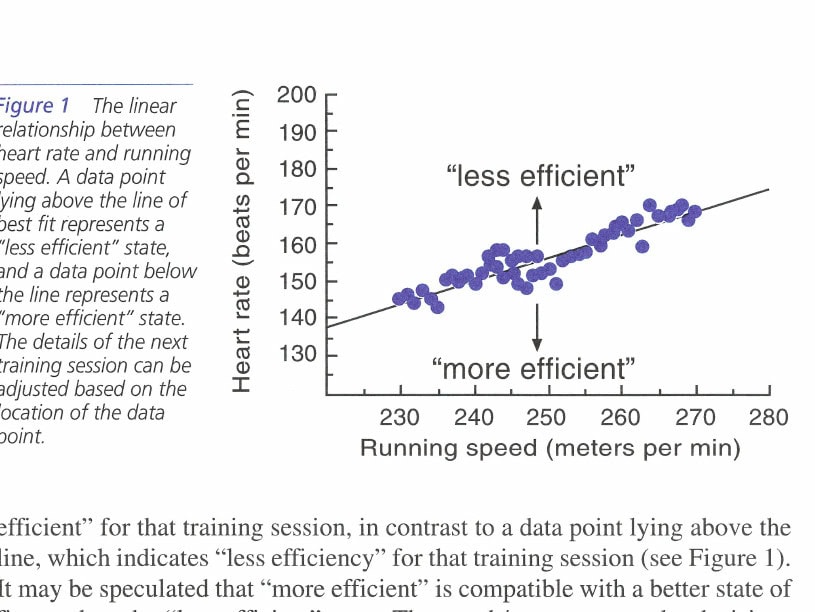
Previous studies have shown that the relationship between heart rate and running speed is almost linear between about 40 and 95 percent of maximum heart rate. After this standard baseline assessment, the relationship between a runner’s heart rate/running speed needs to be performed regularly, and can even be done on a daily basis during training runs. The test can be structured into the beginning phase of the training session. The runner needs to wear a heart rate monitor that has the capacity to store heart rate. The athlete should run over a marked, calibrated distance (about 1K) on flat terrain, protected from the wind. This test should be performed after the runner has fully warmed up and reached a steady-state. Running speed does not have to be the same for each test, providing the running time for the known distance is recorded. After the training session the athlete’s running speed over the calibrated distance can be calculated and plotted on a graph against the average heart rate for that section of the training run. This graph can easily be compiled; calculating each data point should take less than a minute. In simple terms, a data point lying below the standard line of heart rate/running speed suggests that the runner was “more efficient” for that training session, in contrast to a data point lying above the line, which indicates “less efficiency” for that training session (see Figure 1). It may be speculated that “more efficient” is compatible with a better state of fitness than the “less efficient” state. The coach/runner can make decisions about the next training session based on the location of the data point (i.e., whether the data point lies above or below the standard line of heart rate versus running speed).
CONCLUSION
Heart rate monitors measure heart rate very accurately. However, the interpretation of these measurements is lacking. At present heart rate monitors can be used as a guide of exercise intensity providing that we can control those factors that effect the heart rate/running speed. At present heart rate monitors should be used with caution in races, as the heart rate is higher at any running speed compared to training.
It is tempting to speculate that in the future, as more knowledge becomes available, heart rate monitors will be used to a greater potential in training and racing, making them true “ergogenic” aids. Then runners who use heart rate monitors in training and racing will have a clear advantage over runners who do not.
REFERENCES
Selley, E. A., Kolbe, T., Van Zyl, C. G., Noakes, T. D., and Lambert, M. I. 1995. Running intensity as determined by heart rate is the same in fast and slow runners in both the 10- and 21-km races. Journal of Sport Sciences, 13, 405–410.

This article originally appeared in Marathon & Beyond, Vol. 2, No. 6 (1998).
← Browse the full M&B ArchiveMore like this
1,000+ stories from 19 years of Marathon & Beyond
The complete archive of the legendary long-distance journal — digitized and free to read.
