

My Life as a (Marathon) Dog
My team will run together like a Bay-to-Breakers centipede, and there will never be more than a few yards between us front to back. We’ll take only one 15-minute snack break all day, and we’ll haul everything we need for the five-day trip. There’ll be no aid stations. Like Abebe Bikila, we’ll go barefoot, and we’ll run most of the day, putting in at least 50 miles before calling it quits, all at a pace of about five-minutes per mile. Oh, yeah, did I mention that half our team is female?
The course will be run on our home turf, and the terrain will be varied and rugged, with a lot of hills, some wind-blown, flat areas, a lot of places where you can sink in up to your whoozis, and maybe some very interesting wildlife you can make friends with. (You might get a very special luncheon invitation.) You won’t have to worry about overheating. In fact, wear your warmies, Furless, because temperatures will probably not get even as high as zero most of the time; and when the wind whistles in the open areas, you’re going to wish you were doing Peachtree on a record-hot day.
Let’s make this even more interesting by making a little wager. How ’bout half-a-ton of meat? The fattier the better, and please, uncooked. We eat a lot, maybe four or five thousand calories a day.
By the way, your chances of beating us are between zero and nothing, you scrawny, two-legged weenie. No human being has ever come close. The fact is that for centuries you humans have been relying on us to do the really tough running. Like your postmen of yore, before the union took over, we are there, ready to run, whatever the weather, and we work on the cheap.
INTRODUCTIONS ARE IN ORDER
But I’ve been rude. Please permit me to introduce myself. I am Diamond—runner, stud dog par excellence, and, of course, an alpha male. The bitch to my left is June. (We have a, ahem, special relationship, if you know what I mean.) June and I lead the team, which can be any number of fine beasts, usually from 6 to 10 of us. When we’re running, there is no question whatever about my authority: The team follows me.
That’s right, me, not the two-legged freak back there hooting and hollering. Oh, he might make some suggestions from time to time, but keep in mind that I’m the lead dog here. June runs right beside me, and right behind us are Whitey and Flash. They’re what we call swing dogs. June and I make the moves to set the course, and they implement it by following us. Theirs is an important job, and maybe someday they, too, may get to be lead dogs . . . but not while I’m still on the job.
We always put a female beside a male because, well, some of us sometimes forget our manners. We’re very close to our wolf brothers, you know, and we’re inclined to mix it up a bit sometimes. Fighting doesn’t help us in our long runs. We also put a male behind a female, and vice-versa. This arrangement keeps the peace, if you know what I mean.
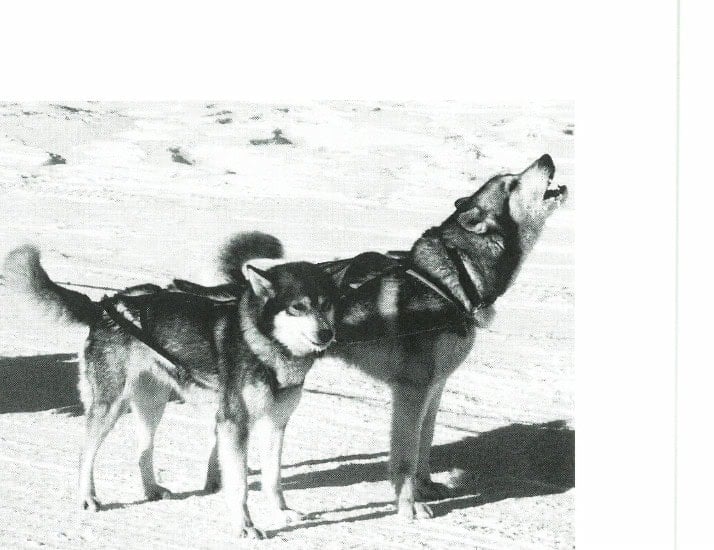
We line up in pairs all the way back, depending on how many of us are working that day. Way in the back there is Rebar, our Wheel Dog. He’s a real grunt. Note foremost that he’s BIG. Rebar has his butt right up against the sled. What happens to the sled happens to Rebar’s butt, so he exercises control on old Two Legs and the load.
Not just anyone can be a sled dog. The common conception is that we’re Huskies or maybe Malamutes. Those are legitimate breeds, and there’s a good deal of both of them in us, but the fact is we are, in the good old American tradition, mutts.
Our Malamute and Husky ancestors have been used for hauling heavy loads in the north countries for years. That is not what we do: we’re runners. Our bloodline also includes some hound, and that gives us the speed and endurance to run fast and long.
Years ago when asked how to become a great runner, your Billy Rodgers replied that you have to select the right parents. Uh-huh! A real test for us is something like the Iditarod Race, 1,049 miles, more or less, from Anchorage to Nome, which commemorates the time, years ago, when our supreme running ability saved an entire Alaskan community from an outbreak of diphtheria. Only WE were able to deliver the needed vaccine.
HOW MANY MILES A WEEK DO YOU RUN?
You run 100-mile weeks, huh? If you will pardon the expression, that’s piddling! I won’t go into details, but a 100-mile week is not very much of a training effort. That won’t get you very far in real endurance runs. Maybe try running 200 or 300 miles a week, for openers, but you’ll have to do it under the kind of conditions that you’re likely to find on the trail in a big race like the Iditarod. You must include hills. Uphills give the workload your body will need. Downhills are even more important for a very good reason: When we’re careening down a mile-long slope at sub-five-minute miles, that sled, a slave to the laws of gravity, wants to go even faster, and old Bipedal back there had better be heavy on the brake or Rebar is going to get a new crease down his back. If a 400-pound, loaded sled came bearing down on me at 20+ miles per hour, there might be a need to break in a new alpha real fast, so I take the hill training of our Mr. Vertical very seriously. Like it or not, he is a part of our team, even if he is the weakest link. The things a dog has to put up with!
WHAT DO YOU DO WHEN THE WEATHER GETS SCUZZY?
What do you humans do when the weather starts to get scuzzy? Like as not, you take your annual sabbatical from running. Oh, yeah, there are the winter runs in places like Florida and Hawaii, and there are those guilt-encrusted “Recover from the Holidays Fat-Ass Fifty” runs all over the place, but really, most runners just flake for the winter.
Up here, when the running gets tough, the tough get running. Semper Fi and all that stuff. Ten feet of snow? No problem. The lead dog (Me!) just plows ahead, and the rest get to do the easy part. Temperatures as low as 50 or 60 below? Give me a real problem. Below zero is when the fun really starts, and it’s just part of doing business up here.
And then there’s the wind, coming straight out of the north with a ferocity to rival a hungry spring grizzly with a bad attitude. Some days, maybe in a pretty place where there are a lot of trees to provide a wind break, it isn’t too bad. But when you’re out on the open ice in a place like Norton Sound, and you have to run 20 miles into the wind with no shelter at all, it can get to be a bit dreary.
Did I say Norton Sound? That’s the kind of place where I can really show my stuff. Sure, the ice on this arm of the Bering Sea is five or more feet thick, but keep in mind that this is an ocean, and the tides, constantly going up and down, cause that ice to fold and break into bergs and leads and cracks. It takes a really savvy lead dog to get the team through that minefield. I might be going across the ice hell-bent for leather in blizzard conditions when that sixth sense kicks in . . . an opening in front of me, big enough to swallow the whole team. Gotta find a way around it fast. This is no place to dilly-dally.
Yes, Dogs Are That Smart
IF YOU own a dog, you know how smart they really are. They communicate in many ways. When serenading them, it became unquestionably obvious to me, by Diamond’s querulous expression, that he really disapproved of my behavior. I shut up, but it took a while before he forgave me for the transgression.
My Iditarod team had encyclopedic knowledge of the trail, over 1,000 miles in length. One day when we attempted to go down a rather obvious route on a glacier, Diamond put up a big fuss, refusing to go on. After a discussion with the other mushers, we came to the conclusion that he was right, and we had been wrong. We turned back a half-mile and got onto the right track again. Even more impressive is how the dogs know just where to go to avoid being swallowed up by open leads when crossing ocean ice, or how they can sense and communicate the nearness of some dangerous animal, like a polar bear, a grizzly, or a pack of wolves.
At the same time, there is never any question of these animals being pets. They’re only a half-step from their cousins, the wolves. That becomes very clear when you put two males within fighting distance. They’re ferocious, determined fighters, and will not stop until one animal clearly asserts dominance, or one dies in the process.
Even more closely akin to the wolf is their nightly chorus. They will be lying in the snow, perfectly silent, the teams of several mushers chained in a big circle. Sometime in the middle of the night, every night, there will be a yip from one dog, then another, then the first throaty howl; then all of them, maybe 30 at a time, join in, each with a distinctive voice, chiming in, trailing off, for no more than a few minutes; then one by one they stop, and it’s over. In my sleeping bag I could sense the power and the cohesiveness of the pack, and the potential for real violence. It’s a sound that will stay with me forever.
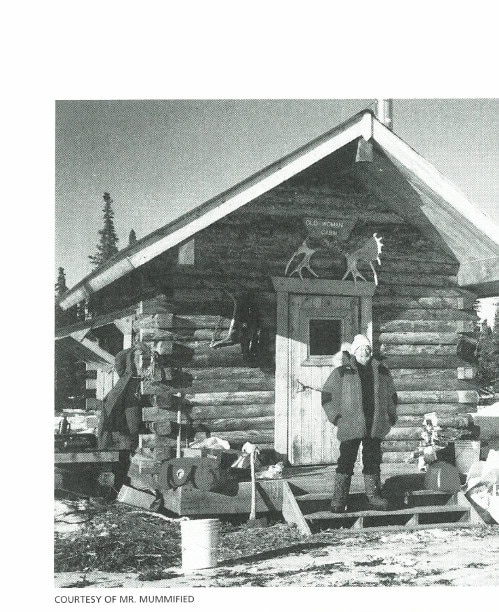
The team I used was loaned to me by Iditarod legend Jerry Austin, who lives in the Yupik Eskimo village of Saint Michael’s near the mouth of the Yukon River, facing the Bering Sea. Jerry, now retired from mushing, enjoys taking a tenderfoot out onto the trail. Just don’t go there looking for a Hilton, a Starbucks, or a McDonald’s. He may, however, ask you to bring along a few hundredweight of fatty lamb as entrance to the world of mushing. —Joe Oakes
Editor’s note: In March of 1997, Joe Oakes journeyed 400 miles on a dogsled, going in the reverse direction of the Iditarod Trail from Nome to the Yukon River.
HOW ABOUT YOUR ACCOMMODATIONS?
What kind of an accommodation would you like, sir? Maybe a suite at the Hilton or a Sheraton with a swimming pool and a sauna? Here’s what I get: a six-foot chain to keep me from romancing the female on the next six-foot chain 12 feel away, or from killing the next male on a six-foot chain another 12 feet away beyond her. I can dig myself into the snow and curl up in a tight, snug circle, cozy enough for the worst weather. If we’re especially lucky there might be some straw or grass to nestle into. We’re not lap dogs. We’re professionals, and as a rule, we never enter a house of any kind for any reason. Ours is a very simple, Spartan, life. When we’re not running, we’re chained down. When we’re chained down, we eat, sleep, and get ready to run again. No computers, no cars, no heaters, no oatmeal.
LET’S GET TO THE REAL FOOD
Oatmeal. I’d like to talk to you about that one. Absolutely disgusting stuff. How can anyone, man or beast, expect to endure on such pap? Meat, that’s what I need: good, red, fatty meat, and lots of it. My Two Legs is trained to take care of that little detail. In the morning he prepares a huge breakfast for us. If things go right, he’ll be in a place where he can heat it up. He’s developed a pretty good concoction of fatty lamb leftovers from the butcher, blended with some salmon parts. I’ve been getting the feeling lately, though, that he’s sneaking in some cheap-o veggie stuff, but I haven’t gotten the goods on him yet.
At dinnertime, after the day’s work is done, we get another big helping of the same stuff, usually about an hour after we finish up for the day. It’s noteworthy that we get to eat before he does—always. That’s a hard and fast rule. That’s as it should be. During a long day’s run we get to take one 15-minute break, and Hairless gets out some frozen salmon (everything is frozen up here), hacks it up into slabs of about a pound each, and tosses them to us. Good, strong teeth, good strong stomachs, and this little tidbit of a fish-sickle is gone in two minutes. On with the show.
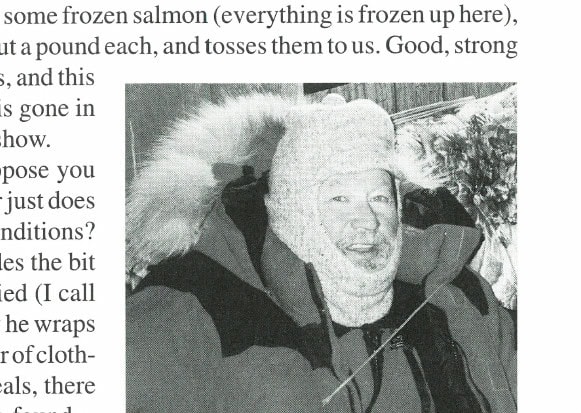
What about water? Suppose you lived in a place where water just does not exist under normal conditions? What would you do? Besides the bit of water that Mr. Mummified (I call him that because of the way he wraps himself up in layer after layer of clothing) uses to prepare our meals, there just is no liquid water to be found.
Remember, I said no aid stations. As we are running along, each of us reaches down and snags a bit of a chunk of loose ice. Sometimes, when we’re running in a rut between snow banks, it’s a little easier. We just reach our snouts out, on the run, and bite off a piece of the frozen bank. That’s what we do for water, all day long, every day. Once in a while we get a banged up snout or a bloody tooth, but that’s the price we pay for keeping the hammer down, relentlessly, all day long. Try grabbing a cup of water with your teeth at an aid station during your next marathon. Not so easy, is it?
Port-a-potties? That’s a real yuk-yuk. Yes, we sled dogs do the same things that you do, but as with our drinking, we do it on the run. Did you read that item in the first issue of M&B about Doug Latimer, the Western States veteran, who made a big deal of learning to pee zigzag patterns while on the run? Try this, Dougie: While harnessed to a dozen others who have no intention of slowing down for you, try cocking your leg or squatting. Try it at 12 mph. You’d better be fast, because you’re going to get neither help nor sympathy as you get dragged dribbling as you go.
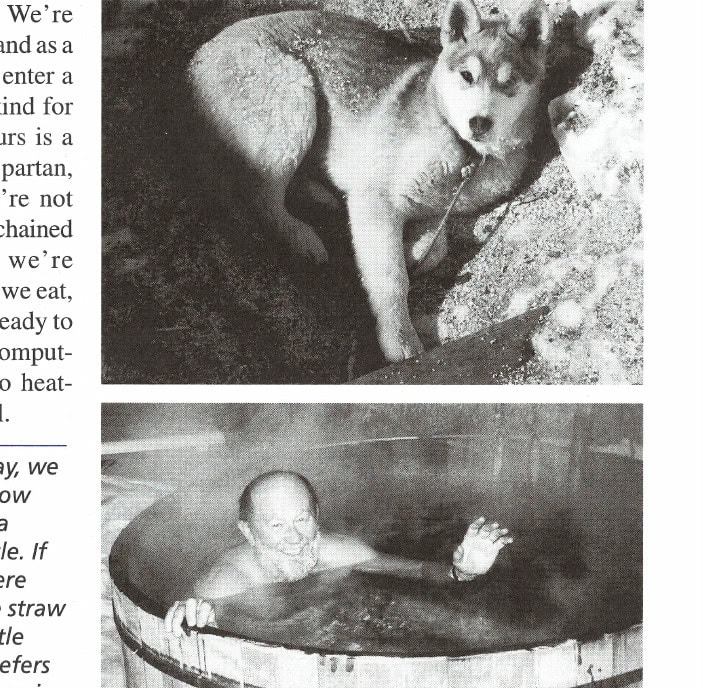
Maybe you’re getting the idea that I’m being disrespectful of my “master.” Master my hairy, curly tail! Perhaps I’m a little tough on him, but he does need to be kept in his place. Still, we do love the hairless bugger. After all, Man is Dog’s best friend. When he’s a bit persnickety on occasion, we all try to keep in mind that we’ve long existed on this planet, running in free packs before we captured our first men, even as our crude brothers the wolves do to this day. Our Man, however, is somewhat trainable, and he does seem to have our best interests at heart. He can be a bother, though.
A SEASON FOR ALL THINGS
But back to running. What we do is seasonal, and our season is when there is a lot of snow on the ground. The best snow is packed some, so the really best time for us is later in the winter and early in the spring. It doesn’t really thaw here until maybe May or June. In fact, the Yukon River, which must be crossed in the Iditarod, usually breaks up in late June. The Two Legs have a big betting pool every year on the exact day, hour, and minute the ice will break, accompanied by the imbibing of that infernal hooch they drink. You won’t find us taking in that garbage.
Anyway, summer is a bad time for us. Keep in mind that we’re very hairy animals, which is wonderful in the winter, but horrid in the warm summer months. Training really goes downhill then, both because of the heat, and because it’s really tough to pull a sled when there’s no snow. So we use our off-season for such things as resting, eating, and creating a new generation of superior sled dogs. When we’re blessed with pups, we know that it’s going to take at least two years before they’re ready for the real world of endurance mushing.
COMMUNICATING WITH THE MAN
You may be wondering how we communicate with The Man. That part’s easy. Over the years we’ve indoctrinated him into understanding such simple commands as a growl, a howl, and a scowl. A simple stare can often produce the required results. More interesting is how we’ve trained him to communicate his primitive thoughts to us.
In trying to satisfy his needs for the very basic laws of motion, we’ve trained him to tell us when he wants us to GO, to STOP, to go LEFT, or to go RIGHT. In his puny, almost inaudible voice, he shouts HI, WHOA, GEE, or HAW. It’s most amusing to listen to a terrified WHOA!!!!!! at a time when Hairless, lacking sufficient confidence in our leadership abilities, thinks he is about to die.
I want to repeat my challenge. Run with us if you can. I doubt you have either the ability or the guts even to come up and give it a try. We are, after all, a far superior race of running machines. Still, the challenge has been made. You know where to find us.
What’s It Like Being on a Dogsled All Day?
On a dog sled, the two “runners” extend about 18 inches back from the body of the sled. They’re about 2 inches wide, 36 square inches each, 72 square inches total. That’s where you live, where you stand while everything else is snow and ice moving by at 12 miles per hour. It can feel very, very confining. Because of the speed at which the dogs run, it’s really difficult for someone (especially a slow runner) to get off and run alongside, although the professional dog mushers do just that.
The dogs are hauling about 400 pounds of sled, food, gear, and me. That makes it particularly difficult for them to pull uphill. That’s where I come in. I lighten the load by hopping off the sled, holding the handlebar, running a short distance uphill alongside and, if possible, pushing the sled a bit on up the rise.
Downhill is quite another story. I’ve got to be jamming down really hard on the brakes to keep the dogs pulling. The constant pressure of the dogs pulling keeps the sled straight, which keeps it from running over the dogs—a definite no-no. When the going is relatively smooth, you can amuse your-
WELL-WORN wisdom tells us that every journey begins with a step. Thus, a marathon is a journey of many steps. But it is the rare marathon that requires the well-worn traveler to carry his passport, too. But when you choose as your first marathon a race that runs between Hong Kong and Shenzhen, China, a mere 135 days before Hong Kong reverts to Chinese rule, the journey becomes more than a mere 26.2 miles.
My marathon journey began more than a year ago as I was embarking on another journey—marriage. A few days before our wedding day, we were at my fiancée Sharon’s home in Ohio. It was May, and all things were right with the world. Spring gave off signs of arriving in a big way, which created perfect running weather.
Considering the beautiful weather and how it can change without a moment’s notice, the subject of taking a jog around the neighborhood came up. Would I like to join my soon-to-be father-in-law for a little run? I knew that Ed was an avid runner and had at one time been a devoted marathoner. I felt I was in decent enough shape, so I figured we’d go out and “bond” a bit before the wedding.
It was a very pleasant run. We chatted about this and that. About the upcoming wedding. About Malaysia, where Sharon and I had recently moved. And, of course, about marathoning.
Ed was the expert here, so I let him talk while I actively listened. He covered it all: training strategies, raceday mechanics, past experiences. It was very inspiring stuff, if not downright daunting.
Yet in his own gentle way, Ed wasn’t attempting to impress or overwhelm me. His overall message as I heard it was this: It can be done; it is achievable.
After all, look at Ed. He hadn’t started running marathons until he was in his 40s. And here I was, still in my 20s.
This article originally appeared in Marathon & Beyond, Vol. 2, No. 1 (1998).
← Browse the full M&B Archive1,000+ stories from 19 years of Marathon & Beyond
The complete archive of the legendary long-distance journal — digitized and free to read.
