

Doing the Old “Soft Shoe”
30-mile Colorado event that offers more than 10,000 feet of altitude gain as well as breathtaking views from the three 13,000+ foot peaks that mark the course. I had also run the soggy Seattle Marathon in late November.
My first snowshoe race came three weeks after the Seattle Marathon. It was a 10K event, and to be brutally honest, I didn’t have a clue what I was doing. I wore snowshoes that had been express mailed to me the day before the race from a snowshoe manufacturer that asked me to test its product under race conditions. The race marked only my second time wearing modern snowshoes. My first time had been the day I proposed to my wife near the summit of a blustery Mt. Elbert, the second highest peak in the Continental United States. She said yes, which most people we know attribute to a lack of oxygen.
Mercifully, my introduction to snowshoe racing was relatively uneventful, since this 10K event took place on a groomed course at a Nordic ski center, and the weather was good. Running on prepacked snow felt natural and left me with the impression that the snowshoes were mere window dressing that hindered one’s forward progress—not unlike running shoes of 25 or 30 years ago. After getting through my first snowshoe race unscathed, a naive sense of ease moved me to register for the Turquoise Lake 20-Mile race. Why not take advantage of my running base, I thought, and jump into this event, one that was highly regarded by local trail and ultrarunners?
START YOUR DAY WITH AN AVALANCHE
Raceday began in the dark. Two feet of snow had fallen in the high country, and not long into our drive to the race our packed car (my wife, two friends, three dogs, and yours truly) was stopped at a high pass that separated us from Leadville. All traffic had been halted as a helicopter flew near the summit of an overhanging peak to fire an explosive into the slope to instigate an avalanche. Seeing an avalanche up close is not an experience many live to talk about, but those who do marvel at the magnitude of the power released in the chain reaction of rushing snow. The snowy explosion was tremendously exhilarating but cast an ominous spell over the day.
Our delay left little time to get to the start on time. I changed clothes in the car en route, and had to guess at the conditions. As we neared Leadville, at 10,000 feet, the highest town in the United States, we could see that the heavens had been more than generous the night before, having deposited 28 inches of fresh snow. The temperature was creeping up to five degrees Fahrenheit—without taking into account the wind chill factor. To warm our thoughts and raise our spirits, we blasted a Phish tape and sang along.
When we reached the race start, I jumped out of the car and quickly registered for the race. I had no time to look at, much less study, the course map, but I figured I could always backtrack or follow the leader if I got lost. With moments left before the start, I grabbed a handful of PowerBars and stuffed them into a fanny pack that held a single water bottle on the side. I strapped on my prototype snowshoes and waddled up for the prerace briefing.
SHUFFLE OFF TO BUFFALO
Locals Tom and Melissa Lee Sobal organize the Turquoise Lake race. It is no exaggeration to say that they have helped shape the face of modern snowshoe racing. Tom has failed to win only a handful of the more than 100 snowshoe events in which he has competed. Needless to say, he has won the Turquoise Lake race every year since its inaugural year in 1989. The Sobals’s races are designed to be low-key, with an emphasis on physical exertion and not on glitz. As testimony to that approach, the Turquoise Lake event is free to those racers who bring a healthy, homemade dish to share at the postrace feed.
The prerace announcements included a description of the course conditions and the mandatory fluid and calorie aspects of the race: all participants were required to begin with a minimum of 20 ounces of fluids and 200 calories of food. Two aid stations were planned, assuming the new-fallen snow didn’t prevent the volunteers from reaching the 7- and 13-mile points. Because of the danger of having racers out on the course after dark (sunset came at about 5:00 P.M.), there were cutoff points along the course at which tardy racers would be pulled. The math was pretty simple: we had seven hours to cover 20 miles: we would have to average just under 20 minutes per mile.
The race start was understated. Tom Sobal simply said, “Ready, set, go!” He immediately assumed the lead, a position he would never relinquish. The bright and flashy colors of the competitors’ apparel contrasted nicely with the downy new snow. I was intimidated, though, by the number of team uniforms and racers sporting mounted shoes: racing flats that were riveted to snowshoe frames to eliminate the binding weight and the loosening that often haunts snowshoe straps. These were some very serious, sponsored athletes who really knew what they were doing. I, well, I had to swallow hard and wonder if I was in over my head.
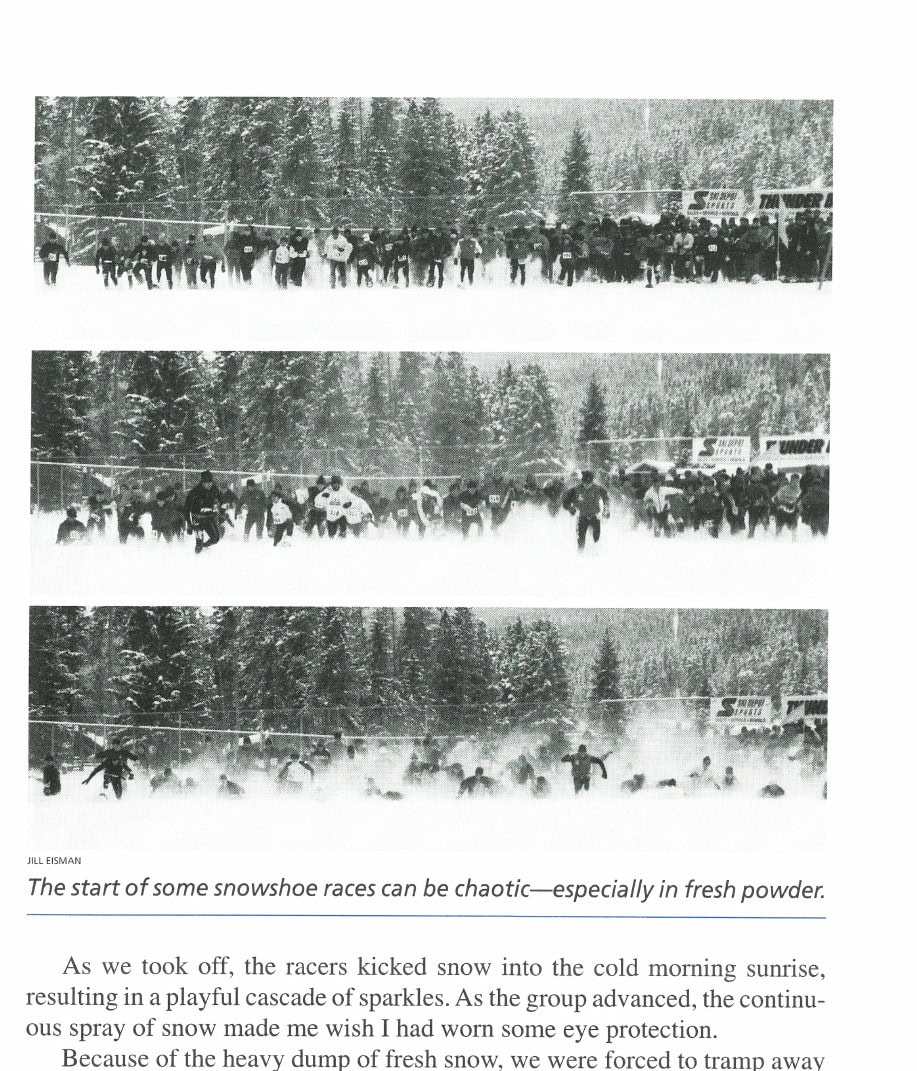
As we took off, the racers kicked snow into the cold morning sunrise, resulting in a playful cascade of sparkles. As the group advanced, the continuous spray of snow made me wish I had worn some eye protection.
Because of the heavy dump of fresh snow, we were forced to tramp away from the starting line in single file. I fell into place near the front third of the pack of 60 racers. Like a bicycle peleton, we took turns at the lead where breaking trail was so grueling that after only a few minutes the leader needed to be relieved. I heard happy chatter amongst the racers as the mass cooperated and repressed a sense of competitiveness, fighting the shortness of breath that comes with racing at altitude.
After climbing through woods and clearing a wood rail fence with typical snowshoers’ gracelessness, the pack made its way across the frozen surface of Turquoise Lake, which came approximately two miles into the race. The wind from the lake was bitingly cold. I was wearing a pair of pants I had volunteered to test for snowshoe worthiness and, much to my chagrin, I discovered a latent defect: the pockets, which opened at the hip for easy access, filled with snow kicked from behind as I pushed forward. My pockets soon began to swell, and the weight caused my pants to pull down. To avoid embarrassment and melting, I had to empty my pockets constantly.
NO STRIDE-FOR-STRIDE
As the group progressed across the lake, our turns in the lead grew shorter, and the wind filled our track with snow in a matter of moments. To complicate matters further, parts of the mostly frozen lake were slushy, which caused the watery snow to stick to the cold aluminum shoes and freeze from the cold winds. The result was a heavy load of caked-on, clinging snow. The fact that I was not wearing gaiters didn’t help matters either, and soon my wool socks were dangling with icy balls.
The race really began when the lead group of 15 racers finally reached the far side of the lake. The pack broke apart as soon as we climbed up the steep bank into the woods and turned onto a wind-packed trail.
At about five miles, I was still feeling fine as we started a long and steady climb to Uncle Bud’s Cabin, the first checkpoint. I was maintaining a consistent pace but became frustrated when two racers wearing ultralight snowshoes passed me. They seemed just to float on the snow, which made me ponder the weight of my test shoes. I knew that they were heavier than some of the other makes, but I thought that the new design might compensate with added performance and durability. It’s a good thing that I didn’t know then that I would finish the race with two broken snowshoes caused by design defects and welding failures.
At about mile six we started a steep climb on an out-and-back section of the course. I was running in the top fifth of the field but was far enough back that the tracks were well cut in the fresh snow and protected from the wind by the woods. At times I felt as though I were ascending a very long, white flight of
stairs. I once heard perpetual motion described as a Slinky on an escalator, and I had to wonder if that vision applied to us in these cold and snowy conditions.
As I neared the turnaround point, Tom Sobal passed me coming back the other way, followed by a pack of four in hot pursuit. It was quite cold at the top of the climb, but the gorgeous views at over 12,000 feet and the thought of descending comforted me. What was not comforting was that there was no aid station at the top of the climb. I reached the cabin and shuffled around until it became obvious that there would be no warm milk and cookies. I must say I was very disappointed.
TAPPING OUT, AKA “SHUFFLE-BALL BONK”
Instead of consuming treats from an aid station, I had to make do with a rock-hard PowerBar. Other, more natural energy bars don’t tend to freeze or harden in the cold, but PowerBars get brittle when chilled. Chewing was only half the battle. Before I could chew, I first had to complete the Houdini-like task of unwrapping the thing, which is damned near impossible when your hands are in mittens and frozen numb.
The second blow to my sustenance plans was that my water bottle had frozen because I had placed it right side up in the holster on the side of my fanny pack. As a snowshoe rookie, I didn’t know that the squirt nozzle freezes unless you place it upside down to prevent the top from freezing. Like an infant trying to get milk from a spent bottle, I only semi-succeeded in warming the nozzle enough to allow for some passage of liquid.
After a quick mile drop from the turnaround point, the course turned on to a cold straightaway stretch fraught with headwinds and no direct sunlight. The winds made for slow going as they blew fresh powder into the tracks of the racers ahead. By this point my face was numb, and my hands had lost almost all feeling. I had consumed fewer than 250 calories and had drunk almost nothing. In spite of these problems, I was having a good time in such a beautiful setting and in such fine company.
At roughly mile 13, just when my spirits began to take a turn for the worse, I rounded a corner and saw an aid station. I gladly accepted a cup of hot Tang from a kind gentleman who had driven his snowmobile up a trail and built a snow shelter to shield him and his gas stove from the wind. The hot fluid got my blood flowing again, and I braved the adventure of opening another PowerBar as I strode away from the station. I had to take off my mitten to remove the wrapper, and to make sure I stored the wrapper in my pocket. I get peeved at people who leave energy bar and gel wrappers on trails, and I refused to break my own rules, even if it meant frostbitten fingers. Tote it in, tote it out. It took me another quarter of a mile to get my mitten back on. I wondered whether the temperature had dropped or whether I was losing dexterity because of exertion and lack of nourishment.
The Tang and PowerBar combination likely fueled my progress for another three or four miles, at which point I experienced my first-ever “bonk.” I began to get numb and disoriented and even went off-course when I thought I saw some tracks go into the woods and down a snowbank back to the lake.
When I discovered that I had made a wrong turn, I literally had to crawl back up the bank to get back on track. My legs were barely responding to my mind’s commands, and I can recall not really caring about much of anything. It was a rather existential experience and not one I wish to repeat. I would prefer to read about such episodes in works such as Jack London’s To Build A Fire, while sitting in front of a roaring fireplace.
By this time, after more than five hours in the cold, I was running on autopilot. The temperature was hovering around zero—sub-teens with the wind chill factor. The natural beauty of the setting inspired me to finish the race. All I had to do was to traverse a short portion of the lake and then descend the final mile to the finish line.
The final miles came rather easily because I was too bushed to feel much of anything; my numb legs had stopped registering pain or exhaustion. I could even say that I was enjoying myself—in a demented sort of way, that is.
CLATTERING-TEETH FINISH
When I reached the finish line, I found my lovely wife and friends waiting patiently. They were cold, and our dogs were frozen, but when they saw how cold I was, they probably felt balmy by comparison. They led me into the warming hut where I consumed every warm drink placed in front of me in an effort to reduce my uncontrollable shivers. It took about 15 minutes and an intimate affair with a space heater before I was able to feel good enough to think about replacing my wet clothes with a dry outfit.
At this point I realized that both snowshoes were broken, which explained the funny sound I had been hearing for the last five miles of the race. I also became aware that my gray wool socks were now pink from a couple of spots where my feet had been worn raw. One advantage of numbness: you don’t have to deal with pain.
The potluck was delicious, and the hut began to get warmer as finishers congregated and recounted the day’s adventures. As it turned out, a number of racers had turned back early because of the cutoff times. I just sat fighting off shivers, feeling very content to be finished, warm, well fed, and in such good company.
DANCING TO A DIFFERENT TUNE
Although I often question the saying, “Father knows best,” my dad was right about benefiting from life’s adversities. I went back to the Turquoise Lake 20-Miler in 1997 and bettered my time by almost two hours. Although that improvement had something to do with faster snow conditions, it was primarily due to the lessons learned in the 1996 race.
Starting in the late fall, I altered my resistance training regime to concentrate on my hip flexors, adductors, and abductors, the muscles that are taxed more from snowshoeing than from running. I also made sure to maintain a good endurance base through running, especially running on high mountain trails.
As I had learned, the effort and time involved in running 20 miles on snowshoes can, depending on the snow conditions, be equivalent to running 30 to 40 miles on roads. I also made sure to avoid avalanches and arrive with plenty of time to spare before the start and was pleased to know the course well enough that I didn’t need to carry a race map.
I brought along two water bottles and mixed in some sports drink before putting the bottles in my belt upside down. For nourishment, I carried Boulder Bars, which did not freeze solid and were easy to tear open without having to remove my mitten.
I used lighter snowshoes, ones that I had tested thoroughly before the race. I also made sure that my socks fit well in comfortable, well-worn racing shoes that had a rear lip on the sole to prevent the snowshoe straps from slipping off.
This year I also made sure that my pants didn’t have open side pockets, and I protected my ankles from clumping snow with low-cut gaiters. I also added some warmth and protection by wearing a windproof vest with a high collar to hide behind if the wind picked up.
In addition, I sported a pair of protective shades to save my eyes from flying snow and cold, dry winds. Finally, in the intervening year, I even managed to sprout a chest hair to remind me of my father—and Nietzsche.
HEY, YOU! Yeah, you, with the sweaty T-shirt. Yeah, you, meatless. They tell me you know something about distance running. Skinny Man, let me tell you something: You don’t know diddly-squat about running. You don’t even qualify as a rank amateur in our league. Me and my team are here to lay down a challenge to you or to any and all comers—and that includes the Kenyans, the Tarahumaras, the Ethiopians, the Ruskies, and the best all-time aggregation of American runners you can come up with. You can throw in Frank Shorter, Billy Rodgers, Alberto Salazar, and Johnny Kelley at their primes. Hell, throw in both Johnny Kelleys.
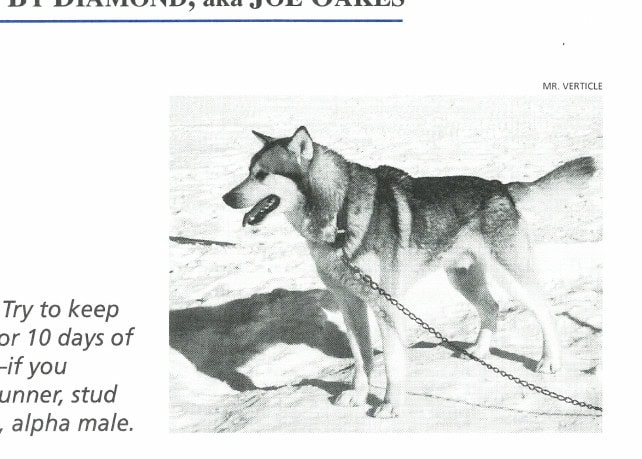
Here’s the challenge: Just keep up with my team for 10 days of our usual routine—if you can. Make that 5 days, just to make it easier on your wimpy selves.
This article originally appeared in Marathon & Beyond, Vol. 2, No. 1 (1998).
← Browse the full M&B ArchiveMore like this
1,000+ stories from 19 years of Marathon & Beyond
The complete archive of the legendary long-distance journal — digitized and free to read.
