

My Most Unforgettable Marathon (Vol. 15, No. 3)
EVANSVILLE, INDIANA, April 11, 2010—“Whether you believe you can do a thing or not, you are right.” Henry Ford most certainly was not thinking about marathoning when he put this wonderful insight into human nature to words, but it nonetheless applies. Whether beginner or well-seasoned, we all plan a strategy for our marathons. Our approaches vary nearly as widely as our personalities. Regardless of our ultimate goals, there are fundamentals all runners follow. From the rigor of our training program we estimate the pace we believe we can maintain for 26.2 miles. We consider our health and how any injuries might affect our performance. We ask ourselves, Will I go for a PR (or as we age, an age-group PR), or will I take it easy? The more serious among us consider the course, factoring in the hills and the surfaces when calculating our finish times. Then we develop a strategy for reaching our goals by asking ourselves these questions: Will I plan for the holy grail of a negative split—or not? How will I adapt my pace to variations on the course? On race morning, the weather and maybe even how we’re feeling become inputs to the final tweaks to our plan. Finally, we lock our plans in, and as Henry Ford would surely have us do, we think and then believe we can.
Approaching my 58th year on this planet and with 20 marathons under my belt, I’ve become very good at crafting my plan. For example, one warm race-day morning in Hopkinton, I made a decision to add five minutes to the goal I had been planning for weeks. It was just too warm. My training partners, with me virtually every step of the arduous road to Boston, chose not to make an adjustment. On my way to a PR, I passed them somewhere between Heartbreak Hill and the Citgo sign—as they walked. I know myself well, deviations from my plan are minor, and I consistently finish within two minutes of my goal time. I’ve won age-group awards in 75 percent of my marathons.
In April 2010, I did something I never do in a marathon. I threw out my plan during the first mile. I went out too fast, pushed the pace beyond that which I believed the intensity of my training program dictated, and resisted the wisdom to revert to target pace. My calves were tight by the half split. Later, they would cramp, forcing me to walk four times in the last four miles. This led to a worst-ever positive split for me of over four minutes. With my history of careful planning, the reader may surmise that I was somehow lured from my carefully crafted plan, beckoned by a sweet call into an absolutely terrible strategy that I will not repeat, but nor would I ever trade the end result!
Serendipity The marathon was the inaugural Southern Indiana Classic (SIC). With 324 marathoners and nearly three times as many half-marathoners, it was an impressive turnout for an inaugural event in a small city. At the expo, the SIC committee had a table set up where runners could view the three eye-poppingly large overall winners’ trophies. I only glanced at them. After all, what was the point in coveting something so out of reach? Also at the expo, the cotton participant’s shirt could be upgraded to a tech shirt for a small fee. I favored the cotton version. The expo wasn’t crowded, so I began shootin’ the breeze (you know how runners can’t resist that) with one of the volunteers (hereafter referred to as JD) who was operating the shirt-exchange table. Comparing race plans, JD said he was targeting a 3:15. Maybe he would hang with me on race day, if I didn’t mind. I was thinking of running about 3:10 and enjoy company during a marathon, so I said, “Sure. See you at the start tomorrow.” Unbeknownst to me, that casual conversation set into motion a chain of events that would shape the entire next day and beyond!
On race eve my wife and I skipped the pasta dinner, opting, as is our habit, to sample the local fare. We lighted a few miles from the hotel at the Haub House, a great steak/seafood place in the nearby town of Haubstadt. For $14, I had a 4-ounce filet, potato, salad, and bread. The steak was fantastic. I figured a little protein could only help the next day!
Sunday morning I arrived at the race site early, as is my custom. I ran for several minutes to warm up and took refuge from the 44-degree temperature in a heated pavilion—a nice amenity for a marathon. About 10 minutes before the gun, I headed for the start line and found JD. It felt a little cold now, but cloudless skies signaled an impending warm-up. One guy was wearing arm warmers and a knit hat. I’m sure he felt great just then, but I wondered how he would feel after 20 miles. My rule is: if I’m not shivering at the start, I’m overdressed. The self-doubts crept in and at the last instant, I considered adding a minute or two to my goal time because it would get warmer later. Start-line butterflies are not to
be confused with prerace planning. I recognized this as prerace jitters. I expected it. No change was necessary. A prayer and national anthem later came the sound we had been waiting for! I took off faster than my target pace—not planned, but also not uncommon for me. (I think it’s the butterflies helping me get going. I adjust to my target at the first mile marker.) I figured my fast start had unintentionally dusted JD, but I was mistaken. After 400 meters he was next to me.
The sirens’ lovely music I believe in negative- or even-splitting a marathon—that is, running at an even pace or perhaps even a little faster in the second half. With a negative split, the first half is comfortable and you suffer only in the second half. With a positive split, you go out fast and suffer through both halves of the race. But like sailors lured to the rocks when the sirens sing their lovely music, most runners succumb to the instinct that tells them that time can be banked in the first half. It seems logical to think that when you inevitably fatigue in the second half you can make a withdrawal, but it doesn’t work that way in a marathon. Simplistically, if you go out too fast and deplete your glycogen stores before the end of the race, all you have left to burn is fat. You cannot metabolize it fast enough to maintain your pace. You will experience the proverbial Wall—often manifesting itself as cramps and/or a total loss of energy. You never get a chance to test this in your training because few programs take you beyond 20 miles. And should you venture beyond 20, you most certainly are not running at race pace. Therefore, negative-splitting requires a leap of faith—faith that you will have the energy in the second half. It will be there! Trust me. At one marathon, I ran with a fellow for about 12 miles. His strategy was to purposely go out fast and hit The Wall. He had done this so many times it defined his comfort zone. He believed it was the only way for him and he had no faith that a slower start would leave him stronger later, even though he had never tried it! I checked his time later. Needless to say, he hit The Wall just as he had planned and gave back double every minute he had banked! Like Odysseus, lash yourself to the mast or put beeswax in your ears. When the sirens beckon you to go out fast . . . If you heed their call, you hit The Wall.
No! No! Forget I just wrote that, and not just because it’s corny! Go out fast! I want you to go out fast, because I just gave away one of my greatest motivational secrets! Negative- or even-splitting does something very important for me. It provides me with a steady string of people to pick off late in the race—those who had succumbed to the call and are paying the price. You need a lot of motivation to run a marathon; I find it even in little things. Passing people is very motivating, and late in the race is just when I need it most!
Plan A and reckless abandon
Dan Patmore / Evansville Courier & Press
Plan A was to ease into the first five miles, running the early hills about 15 seconds per mile slower than goal pace, and then pick it up a bit and settle into a rhythm at goal pace through the easier rolling section of the course. Then, after the half, pick up the pace a bit and negative- or even-split to finish with the 3:08. From the intensity of my training regimen, I had calculated that I was physically prepared for a 3:05. So plan A would be comfortable: I would win my age group for sure and maybe have a top 10 finish.
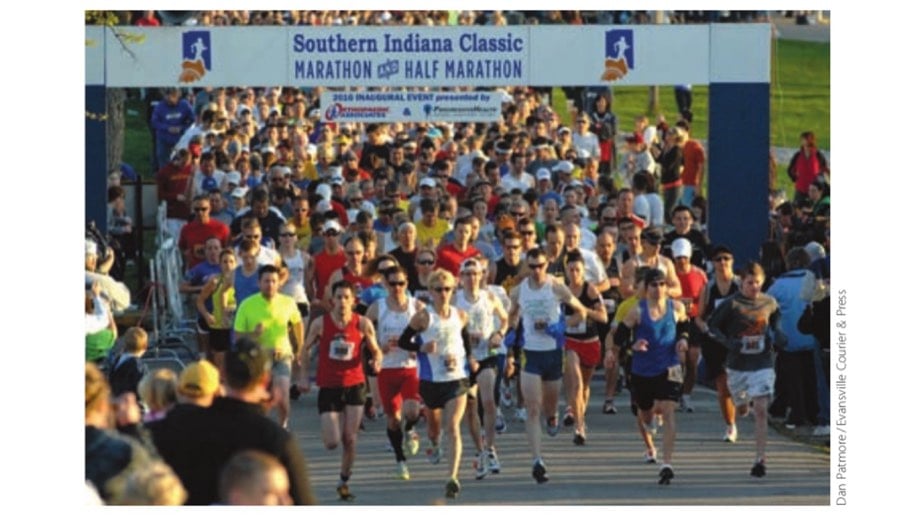
Well, plan A didn’t make it through the first mile. That youngster JD just wanted to push. We did the first mile in 6:45 on a net uphill. We ran side by side for the next five miles, exchanging occasional thoughts. Glancing at my watch, I saw that we were on a sub-3:00 pace. Thinking about plan A, I said to JD, “I’m going to slow a bit.” But he didn’t take the hint and I hated the idea of being dropped at that point, so we kept running 6:50s. Did I say this was on hills? And wasn’t this the guy who wanted to run only 3:15? Steve Prefontaine once said, “Don’t be afraid to give up the good to go for the great.” I wasn’t thinking about the great, but I knew that by listening to the sirens, I for sure was giving up the good.
For the next five miles, the rollers eased. We ran in a comfortable rhythm side by side or taking turns at “leading.” The temp was good, and JD and I were still on a three-hour pace. The course was mainly through farm country with the houses few and far between. I was impressed to see families out and cheering
▲ Off and running! The author is about four “rows” back from the lead runner.
at every house. Seeing a rock band playing in the middle of a cornfield was a unique sight, too.
At mile 13 we met with the first teething problem of an inaugural marathon. The water stop there had plenty of water, but the cups were en route and hadn’t arrived. OK, skip that one! JD and I crossed the half marker at 1:30:20—just over
three-hour pace. Shortly after, we passed our first runner on the second half. I didn’t think too much about it at the time, paying more attention to the onset of the next round of hills. At mile 14, the second teething problem: the cups again
hadn’t arrived. This time, one of the kind volunteers handed me a 2-quart pitcher full of water. Taking a gulp on the run, I got a drink, bath, and near-drowning experience all at once! But at least I had replenished. JD skipped the drink again—
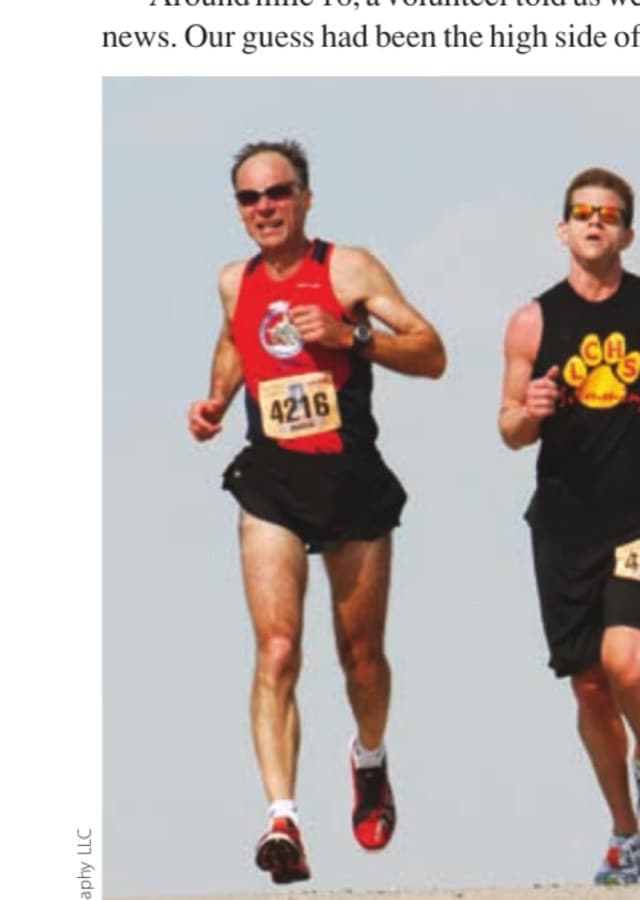
maybe a costly decision. Around mile 16, a volunteer told us we were third and fourth. That was exciting news. Our guess had been the high side of the top 10. The half-, full, and marathon relay had all started at the
same time, so there were a number of runners ahead of us. At the half-marathon split-off, the leaders were far enough ahead that we couldn’t discern who went where. With that news, we understood that the
person several hundred yards ahead of us was the current number two. No need to change the pace, though. A mile later, we passed him. That’s the beauty of a marathon. It’s a long race—no need to rush
things. Let them come to you. While anything could happen in the remaining
The author (left) and JD crest one of the many rollers.
▲
PBC Sports Photography LLC
Teething, a midrace bath, and patience
eight miles, it did occur to both JD and me that two of the aforementioned eyepoppingly large trophies could be ours. A fleeting fantasy about winning flashed through my head, but I didn’t allow myself to believe it. No, I would be happy now just to have any trophy. Finishing third in a marathon would be the race of my dreams.
Then there was a small dot of a figure in the distance ahead. That dot began to grow, and over the next two miles we reeled in the leader! He was the guy wearing the arm warmers and knit hat at the start line. His early comfort had come with a steep price tag! He wished us well as we passed, saying he was just hanging on now for the 3:10 he needed for his Boston qualifying time (he did get his BQ time and ultimately finished fifth).
For the time being, JD and I were laying claim to the top two podium spots! Being in the lead pack of a race was certainly unfamiliar territory for me. I had never won a race outright. One of my main sources of motivation was gone— picking off the next runner. JD still looked strong. In contrast, I felt like I was dying as we climbed a healthy hill on mile 21, but I figured he was equally tired. I use that for motivation—telling myself that the other guy is feeling bad, too, and all I need to do is just be a little tougher than he is. It may not be true, but I’m pretty gullible by that time in a race! Something happened then. With the finish line about 30 minutes ahead, I began to believe that I could win. Just as Henry Ford had predicted, my newfound belief brought with it a great motivational force, a force more powerful than a hit of vanilla bean flavored energy gel! But motivation alone would not be enough. I needed a real plan and I needed it now.
Plan A had been abandoned long ago, and I had been running without a real plan other than to keep pushing and to keep JD nearby. I reasoned that if JD didn’t fade soon, I would have to make a move. The last thing I wanted was a finish-line sprint with a guy about half my age who would, no doubt, out-kick me.
Plan B Plan B was concocted during mile 22. I took stock of my strengths, one of which is hill climbing. There was no shortage of hills. Developing a lead on one and then maintaining a push just might create a gap. If that gap was big enough, JD might forget about me and begin to think, instead, about the guy behind him. If JD forgot about me, I might have a chance. Finally, with luck, I might not have repercussions from my fast-start folly—a lot of mights, but being low on options, I implemented it on the next hill. JD’s response would be critical.
Plan B began to work. I created a small but not insignificant gap! But just as I crested the hill, a sharp calf cramp stopped me in my tracks. As I stood rubbing it out, JD passed and asked if I was OK. I told him, “Go on, it’s a cramp.” I started running again after seconds that seemed like an eternity. After half a mile the gap
between JD and me had narrowed to just a few meters. But once again, the cramp forced an abrupt stop. As I was working it out, a nearby first aid volunteer asked me if I wanted her to massage it. I think I screamed at her as I resumed running and tried to explain, “No way, I’m in second place. That’s number one right up there, and I’m not stopping now!” I probably came off as a little curt. But I confess to experiencing some panic as I felt a unique chance for a victory begin to slip through my fingers as though it was fine sand. I was encountering The Wall, and I recognized that I could not catch JD doing what I had been doing.
The story of Dick Beardsley and Alberto Salazar dueling it out at Boston in ’82 popped into my head. Near the finish, Dick, hobbled with a bad cramp, accidently stepped into a pothole. Somehow that action stretched out his cramp, he miraculously recovered, and he became part of the most exciting finish ever at Boston. It was a motivating thought, and now, I needed a pothole badly! Not finding one, I tried an experiment. I lengthened my stride, landing farther back on my foot, thus easing the workload on my calves. It helped! A mile later, JD and I again comprised the lead duo.
Going a little berserk Now I really didn’t want a sprint at the finish. Age difference aside, a sprint would have triggered the cramp for sure. Bill Rodgers once said of racing, “If you want to win a race, you have to go a little berserk.” Having come so close and with only one other contender, I was ready to go a little berserk. For me, that meant attacking the next hill (a word I use loosely here because there was not too much attacking left in me) and holding as rapid a pace as I could without cramping. It was a real balancing act. Again a gap was created. I was afraid to look back to see just how big a gap it was. A backward glance would be interpreted as a sign of weakness and could motivate JD, so I didn’t sneak a peek for a long while. I think not allowing myself to look back helped me keep up the pressure. Had I seen a gap, I might have slowed unconsciously. Twice more I was stopped in my tracks by the cramp but managed to work it out without relinquishing the bulk of my advantage.
Mercifully, mile 26 finished with a downhill grade with only a gentle rise over the last 385 yards. The participants from the half-marathon had merged with the full around mile 23, but the traffic was thin enough. Some of the half-marathoners recognized that I was the leading marathoner and cheered me on as I passed them. I appreciated that. The finish chute narrowed a bit toward the timing mats, and I had to dart around a small group of slower-moving half-marathoners to avoid slowing down. The sideways motion triggered the calf cramp, and I just about had to walk across the finish line but somehow managed to hitch up my gait to avoid walking. I had won! JD held on for third, overtaken in the closing 5K by a guy
PBC Sports Photography LLC
▲
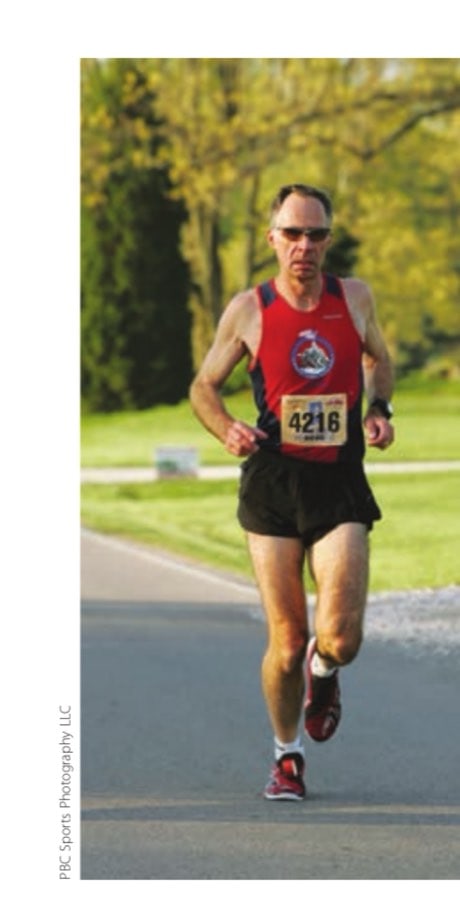
The author was determined not to let cramps spoil a magical day.
who had applied beeswax to his ears and negative split. Perhaps too, missing out on water at those two dry water stations had taken a toll on JD. I was glad he had gotten a podium spot. I felt that he had earned it.
My plan B had been successful. My overall race had been successful beyond my wildest dreams, despite a strategy that I can most charitably describe as “running a marathon the hard way.” I had heeded the call of the sirens,
hit The Wall, and lived to tell about it. I finished with a 3:04:53—a full 10 minutes off a PR set in 2008, ranking fifth fastest on my all-time list. But considering I had set out to run only 3:08—and factoring in the sun, the now-warm temperature, the hills, and
my four stops to work out cramps—it was an effort I was proud of regardless of the finishing position! I would estimate that on a flat course, cooler conditions, no cramps, and a better pacing strategy, this would have equated to a sub-3:00
result. If you qualify for Boston on this course, you’ve really earned it. A picture on the Evansville Courier Web site the next day showed me at mile 25 looking like I’m in pain—not exactly flattering, but certainly showing determination! I kind of liked it.
Laughing out loud When I crossed the finish line, the media swarmed me. The newspaper, the TV station, and a representative from the race all interviewed me before I even had a chance to get a drink of water. My voice was croaking so badly that someone finally noticed and got me a drink. I was so happy to be the celebrity of the minute
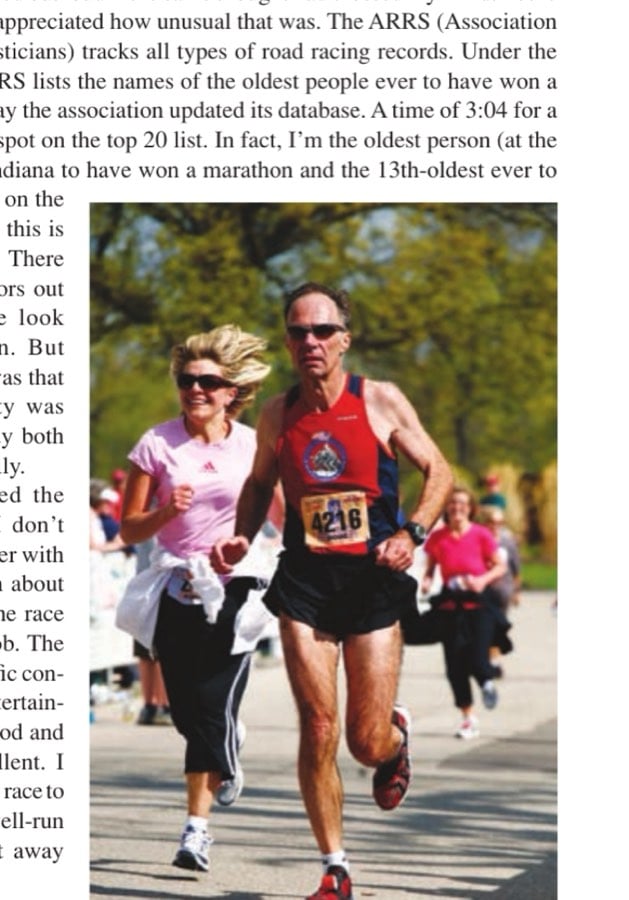
▲
The author, one stride away from completing a run for the aged!
PBC Sports Photography LLC
that I didn’t care! I thought afterward that it probably made for a bad TV interview because I could barely talk. I watched the televised interview a few days later. What a masterful editing job! Someone commented about my being somewhat older than the winner was expected to be. I laughed out loud—the same thought had crossed my mind. At the time, though, no one appreciated how unusual that was. The ARRS (Association of Road Racing Statisticians) tracks all types of road racing records. Under the heading “Trivia,” ARRS lists the names of the oldest people ever to have won a marathon. The next day the association updated its database. A time of 3:04 for a 57-year-old earned a spot on the top 20 list. In fact, I’m the oldest person (at the time of the race) in Indiana to have won a marathon and the 13th-oldest ever to have won a marathon on the world list! Of course, this is simply a fun statistic. There are a number of seniors out there who make me look slow by comparison. But what I take pride in was that when the opportunity was presented, I was ready both mentally and physically.
Having mentioned the teething problems, I don’t want to leave the reader with the wrong impression about the SIC Marathon. The race director did a great job. The communications, traffic control, shirt, medal, entertainment, and postrace food and festivities were excellent. I would recommend this race to anyone looking for a well-run family-oriented event away from a bustling city.
No one wins something like this in isolation, and I’ve certainly had help along the way. My daughter inspired me to start running when I was 44—another story in itself. My loving wife of 34 years is my marathon-destination companion and supporter. My running group punishes me regularly with its speed workouts. Three special friends—John, Byron, and Rob—have challenged me well beyond where I thought my capabilities ended. Last, for this race, I owe JD. Were it not for a simple encounter at the expo, the story would have been different. I would have run (in the words of Pre) a “good” race. I would have done what I set out to do—win my age group. And I would have gone home satisfied. But on that Sunday, JD lured me from my comfort zone. He helped me run a “great” race. A race for the aged!
Epilogue JD and I have become friends. We text occasionally to bridge a several-hundredmile-distance gap. He read my story and has verified the accuracy of my description of events as they unfolded. We both raced in a half-marathon a few weeks after the SIC, and after the six-mile mark all I could see was the back of his shirt. It was a different day. I was very happy for him.
And what I learned from it I will take with me a renewed perspective about setting goals. Stretch more. You never know when it will be your day, and if you don’t leave comfort behind, it never will be. This doesn’t apply just to running!
Look everywhere for motivation—even little bits of it. It’s everywhere you look, and it all adds up! When all seems like it’s unraveling, don’t panic. Recognize that just doing more of the same won’t help. Keep moving and take stock of your
strengths. Figure out how to reravel it. I know I’ll never use this strategy again—going out too fast and hanging on. It was, uh, painful, and I know I could have done even better with a more controlled race.
Take advantage of serendipity. Meet people, make connections. You never know where luck and your contacts may lead you—maybe to your big day. Pre was right!
This article originally appeared in Marathon & Beyond, Vol. 15, No. 3 (2011).
← Browse the full M&B ArchiveMore like this
1,000+ stories from 19 years of Marathon & Beyond
The complete archive of the legendary long-distance journal — digitized and free to read.
