

My Most Unforgettable Ultramarathon (Vol. 10, No. 1)
KThe National Capital Runners Association
NOWLTON, QUEBEC, CANADA, October 30, 1980—This day was my older son’s 16th birthday. I’ll never forget it. Craig won’t let me. On that date he spent more than seven and a half hours on a bicycle accompanying me as I ran four loops around a small lake in Quebec’s Eastern Townships to complete the Lac Brome 80K. It was my first—and last—official1 ultra (to date). I learned a lot that day. By October 1980, I had learned quite a bit about running the standard marathon distance. I had made my first journey over the distance—in fact, my first road race of any distance—in the National Capital Marathon (NCM) in Ottawa, Ontario, in
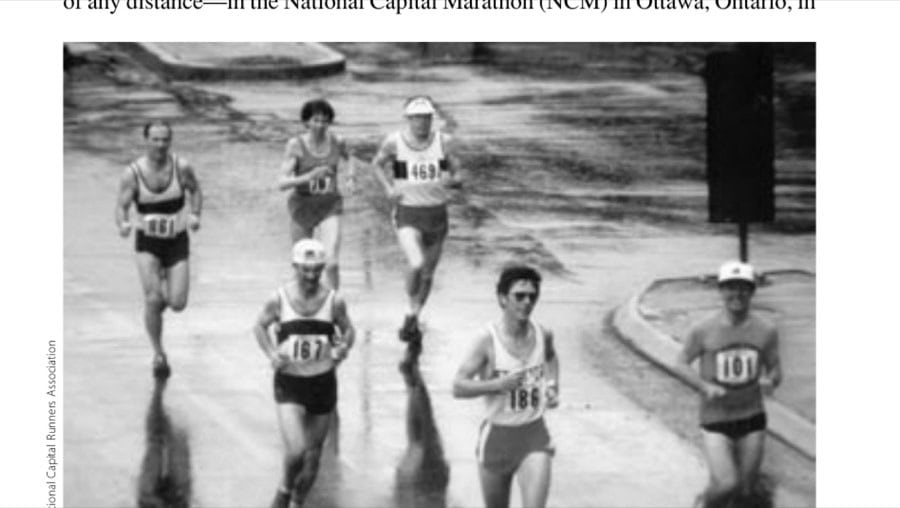
▲ The author (middle runner, back row) in the last miles of the National Capital Marathon in May 1980, in the pouring rain, on her way to a 2:52:51.
May 1976. That run had taken me three hours and 54 minutes. As I was recovering and deciding that it had not been as painful as I had feared, I was approached by Eleanor Thomas, the winner of the women’s race. She invited me to join the National Capital Runners Association (NCRA), participate in its training runs and monthly time trials, and then join the group on a planned excursion to run another marathon that fall. Thirty minutes after having completed my first marathon, I already had a second one on my calendar. Maybe I had found a new pastime.
It was that second run, the Skylon Marathon, that removed any doubt. This time it took me 3:22, well under Boston’s 3:30 qualifying time for women in those days. More important, I had placed. (Remember that this was 1976.) I was called up to the stage and given what looked, and still looks, to me, like a small silver ashtray. However, it was engraved “Buffalo to Niagara Skylon International Marathon 1976—Women—5th.” At 38 years of age, the mother of four, I had won an award for running! I was hooked.
UNDER THREE In the next three years, I ran races on the road, the track, and cross-country, including eight more marathons. My times gradually came down until, in the World Association of Veterans Athletes (WAVA, now WMA) race in Hanover, Germany, in August 1979, I ran 3:01:19, a Canadian 40-plus record. Ha! Maybe breaking three hours was not impossible after all. I trained for the 1980 NCM with that goal in mind and ran my “breakthrough” race. My 2:52:51 was good enough for second overall, first master, and a big improvement on my masters record. The ensuing coverage brought me to the attention of the organizers of the Lac Brome event.
While Quebec had a great tradition of male road racers at and well beyond the traditional marathon distance,2 very few of its women had responded to the call to the roads in the 20th century.3 It was the idea of the race directors to change this by inviting some successful women marathoners to participate in their event.
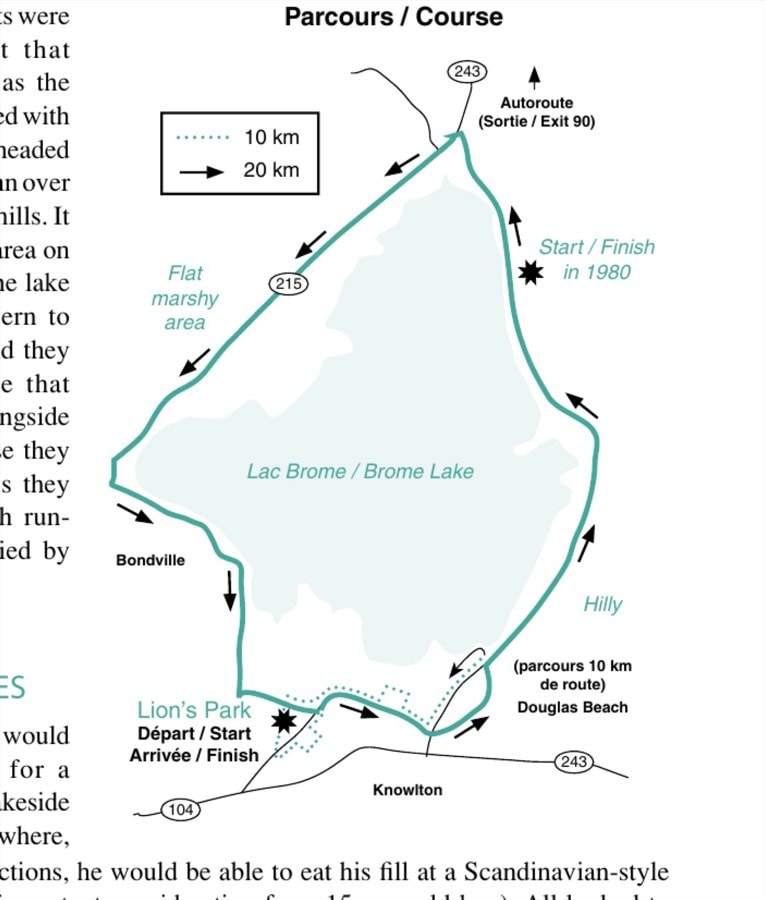
They contacted me, explaining that they would look after all my expenses. All that they asked of me—besides running 50 miles—was that I provide my own “buddy”: someone to accompany me on a bicycle as I covered the 20K of roads around Lac Brome four times. The event was, at that time, a very small race with only 30 or so runners and a few volunteers. The course started on the east side of the lake, in front of the charming Nordic-style inn that also served as race headquarters. After heading north for less than a kilometer, it turned west off the main road onto a side road that curved through the marshy, largely uninhabited countryside on the west side of the lake. Turning back east and south, it led to a public park area where the main aid station was set up.
These segments were mostly flat, but that changed quickly as the runners reconnected with the main road and headed back north to the inn over a series of rolling hills. It was the “empty” area on the west side of the lake that was of concern to the organizers, and they wanted to ensure that someone was alongside the runners in case they needed help. Thus they required that each runner be accompanied by a cyclist.
I LURED HIM WITH CALORIES
Parcours / Course 243
10 km
Autoroute (Sortie / Exit 90)
20 km
Flat marshy area
215
Start / Finish in 1980
Lac Brome / Brome Lake
Bondville
Hilly (parcours 10 km de route)
Lion’s Park
Douglas Beach
Départ / Start I asked Craig if he would Arrivée / Finish 243 like to join me for a Knowlton weekend trip to a lakeside 104 resort in Quebec where, among other attractions, he would be able to eat his fill at a Scandinavian-style smorgasbord (an important consideration for a 15-year-old boy). All he had to do was ride a bicycle for 80K/50 miles.
Despite the fact that he was a competitive 110-meter hurdler whose only cycling at the time might have been from home to the track, Craig agreed to help me out. I went back to our hosts-to-be to accept and to ask for the exact date. And that’s when we learned we would be making our circuits of the lake on his 16th birthday. Oh, well. Maybe the inn could whip up a birthday cake as part of the postevent refreshments.
At this point, experienced ultrarunners might have begun working out their training plans. But I already had a busy season of racing planned, starting with the U.S. Masters Track & Field Championships in Philadelphia in June. Besides the marathon, I had raced on the track at the WAVA meet the previous summer, placing second to the great Miki Gorman in both the 10,000 and 5,000 meters. But for this meet, I had decided to try some of the shorter distances, partly because I
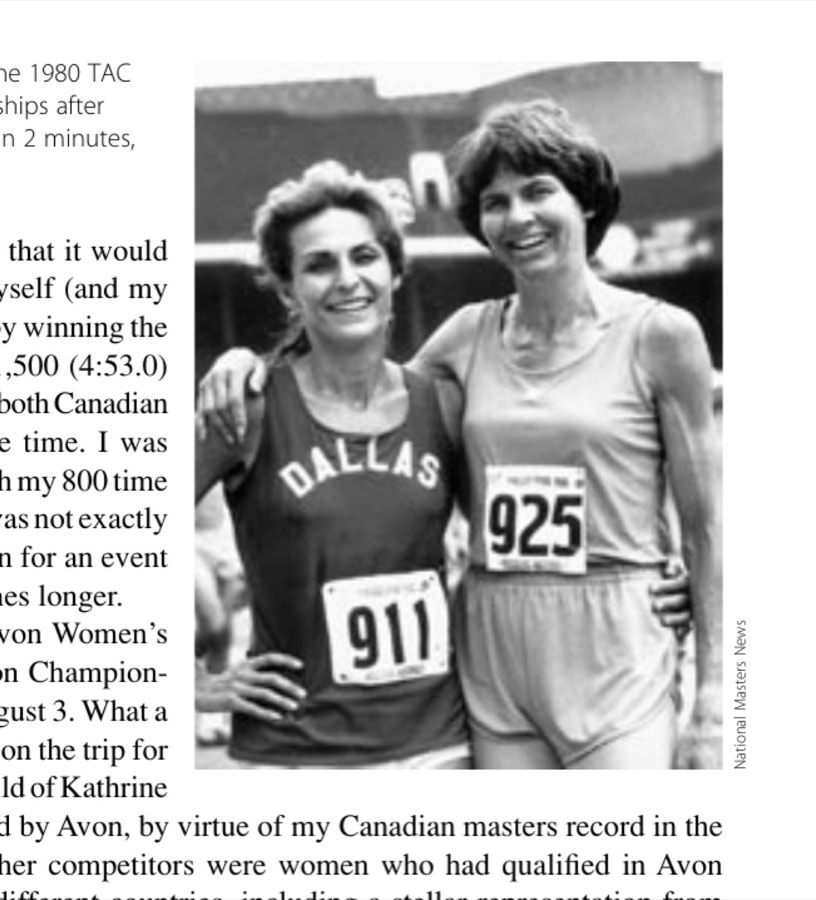
anticipated, correctly, that it would be hot. I surprised myself (and my competitors, I think) by winning the 40-plus races in the 1,500 (4:53.0) and the 800 (2:20.9)—both Canadian masters records at the time. I was especially pleased with my 800 time but also aware that it was not exactly relevant as preparation for an event that would be 100 times longer.
Next it was the Avon Women’s International Marathon Championship in London on August 3. What a thrill this was. I had won the trip for this event, the brainchild of Kathrine Switzer and sponsored by Avon, by virtue of my Canadian masters record in the NCM. Among the other competitors were women who had qualified in Avon events in at least 26 different countries, including a stellar representation from the United States.4 On the same day that the men ran the Olympic Marathon in Moscow, the participants in this event demonstrated to the Olympic “powers that were” that women from all over the world were capable of racing 26.2 miles—and should be doing just that in the Olympic Games.
THE LONDON EXPERIENCE We ran a course that subsequently became the basic outline for the London Marathon: over London Bridge and past Big Ben. Despite the heat of that August day, plus a nasty section over cobblestones in the last few miles, there were some outstanding performances. Lorraine Moller of New Zealand won with a 2:35:11. I was satisfied with my time of 2:57 and thrilled with the small silver medallion necklace engraved “London, 3/8/80,” which I still wear on special occasions.
After a wonderful week exploring the delights of London, it was back to Ottawa to settle into my new job as an editor in training for the Canadian Medical Association (CMA) Journal. That position did contribute, in a way, to the other type of training I needed to be doing. The CMA offices were about six miles from my home, on a path along the Rideau Canal and River. So I ran back and forth to work several times a week and squeezed in noon runs on other days. These
National Masters News
▲
The author (right) at the 1980 TAC Masters Track Championships after winning the 800 meters in 2 minutes, 20 seconds.
Avon Running/Jane Art Photography
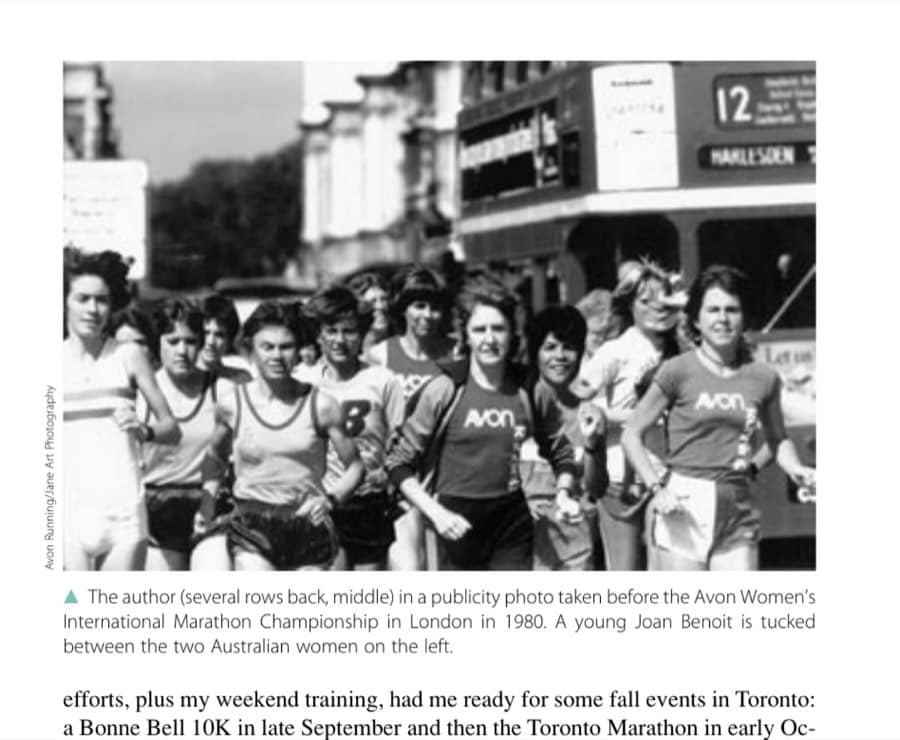
▲ The author (several rows back, middle) in a publicity photo taken before the Avon Women’s International Marathon Championship in London in 1980. A young Joan Benoit is tucked between the two Australian women on the left.
efforts, plus my weekend training, had me ready for some fall events in Toronto: a Bonne Bell 10K in late September and then the Toronto Marathon in early October. Apparently I wasn’t too pleased with my marathon result, as I can’t find
a record of my time, though I do recall that I won the masters race. I also recall that I had started out hoping to go under 2:50 and had run out of steam in the last few miles of gradual but unrelenting uphill running to the finish. Was this a
sign of things to come? I now had four weeks to recover from this effort and get ready for the 80K/50 miles. Since there were no books or published training programs for ultras at that time, I just went back to what had become routine: a total of 12 miles a day for
three or four days during the week, a day off, and one long 15- to 18-mile run on the weekend. I did ask some of my clubmates in the NCRA for advice about running on beyond the marathon. The consensus from my more-or-less experienced
advisers was that I should follow a system of running for 25 minutes and walking for five. Maybe Jeff Galloway did not invent the concept after all.
OFF TO THE RACES Armed with this advice, we headed for Montreal: me, Craig, and his bicycle. Our hosts met us there and transported us to the inn/race headquarters on the afternoon
Colin Ramplee-Smith
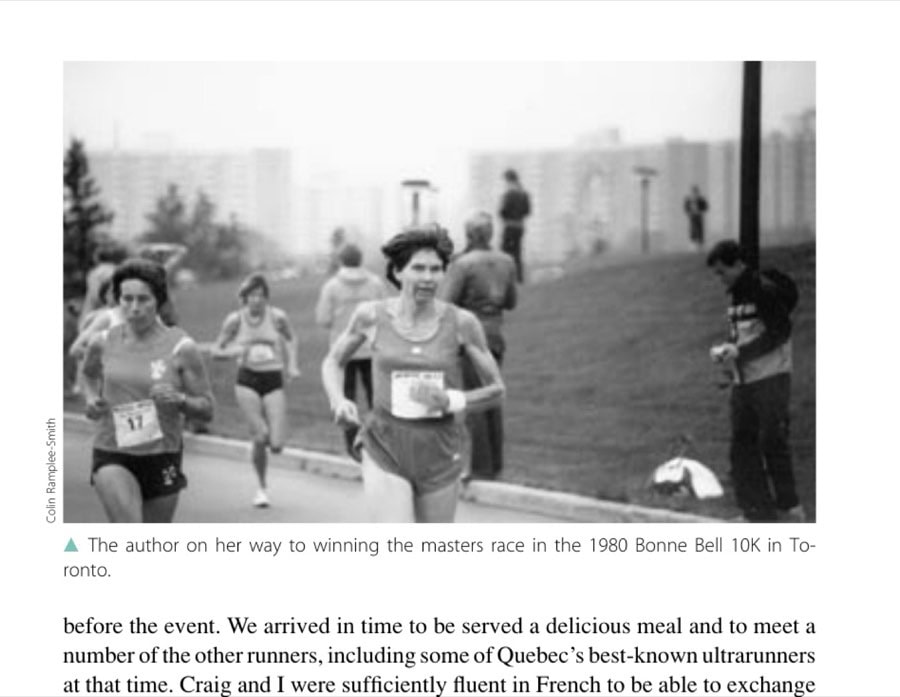
▲ The author on her way to winning the masters race in the 1980 Bonne Bell 10K in Toronto.
before the event. We arrived in time to be served a delicious meal and to meet a number of the other runners, including some of Quebec’s best-known ultrarunners at that time. Craig and I were sufficiently fluent in French to be able to exchange
pleasantries but not to discuss strategies for the next day’s race. The event directors gave us some instructions, including the fact that breakfast would be ready for us well in advance of our early morning starting time. Then we all turned in.
I had noted that many of the runners seemed to have appetites to match Craig’s for Friday’s dinner, but I was not prepared for the sight that greeted me in the dining room early Saturday morning. There they were, tucking into their oatmeal, their toast, their waffles—eating everything in sight, it seemed to me.
I, experienced marathoner that I was, knew that my prerace breakfast should be, as always, a glass of orange juice and a couple of cups of strong black coffee. A few last-minute trips to the washroom, some agonizing over how much to wear
as we felt the cold breeze off the lake, a check of Craig’s bicycle chain, and we were off. The small field spread out very quickly, and soon it was as we had been warned. I was running by myself with just Craig for company. I started the run/
walk routine right from the start, so I would catch up with a runner or two for a while and then perhaps be passed by one as I took my walk break. This felt fine—easy—to me. I reached the aid station in Lion’s Park at 15K, drank some fluids, and ran the hilly portion for the first time. Very pleasant. How nice to be among these lovely big trees.
Another aid station was set up outside the inn/start point. Some pleasant exchanges and we were off again. The day remained overcast and cool—perfect, really—and I cruised the second 20K without incident. By this time, Craig was getting a little tired of creeping along at my pace, so he would cycle ahead to check on other runners and then connect back with me. Since I didn’t feel that I was in this to race anyone, his reports on how other runners were faring helped to pass the time but didn’t induce me to change my pace in any way. Past the Lion’s Park aid station and into the hills for the second time. I was now getting into that 35K zone that had been my undoing in Toronto. However, my average pace on this day, with the walk breaks, was considerably slower. So I was up and over the hills with no problems and on to the halfway point outside the inn.
More nods and checks, and we started our third circuit. As we approached the aid station that was now 55K into the race, I noted I was beginning to feel a bit empty. Besides fluids, I munched a banana, made a quick pit stop, and was ready for my third ascent of the hills.
WHEN THE HILLS GREW They seemed a bit steeper this time, but with some encouraging banter from Craig, I managed to maintain my steady pace and reached 60K, where my time was announced as 5:21. That sounded good enough for my first attempt beyond 42K. As I considered this rationale for ending my efforts, two men whom I had passed, and who had passed me from time to time—always with an encouraging remark—ended their stay at the aid station and headed out for their fourth loop. And there was Craig, perched, if somewhat uncomfortably now, on his bike. I resolved that I must go around again. Maybe it was the fluids at the inn. Maybe it was the banana finally kicking in. Or maybe it was just the nice little downhill as we headed off the main road for the last time. Whatever it was, I felt better for a while, though grateful for the long flat stretches along the far side of the lake.
However, as we rounded the bend and started east again, I became aware that I was slowing down. I was no longer interested in Craig’s remarks. What did he know? He was sitting on a bike! What did I know? I had never sat on a bike for well over six hours in my life, and we still had another 8K or so to go.
Last stop at the park aid station and then those *@$#* hills. “Enough. This is it. It’s not time for a walk break, but I’m walking. Maybe I’ll walk all the way to the finish.” On hearing these mutterings, Craig became alarmed. If my quads were complaining, his glutes were screaming. “Mom! There’s a bit of a downhill here. Do you think you could get back to running?”
Grumbles, but I start to run. For a while. Then I grind to a halt again. Out of fuel. Why hadn’t I hit the porridge with the other runners? Too late now. More urgings from Craig. Whose idea was it to send this kid out with me anyway? But I manage to get myself back into gear and finally finish: in 7:31:55.
I had fallen off the pace by more than 23 minutes in the last 20K. But I was finished, and the time was a Canadian masters record that stands to this day. And who was stiffest and sorest walking back to the inn? And even sorer the next day? The athlete who had not trained for his part of this caper at all. A few hours stretched out on the beds of our room, however, and we were sufficiently revived to enjoy a great smorgasbord served up by the inn to all the competitors that evening. And the race directors did have a birthday cake for Craig. Everyone sang “Happy Birthday” to him, in French and English, and then helped us to finish off every last crumb.
LAKE DUCK—AND BEYOND This final touch to the meal was top class, as everything about the organization and presentation of this event had been, including the venue. Lac Brome is a popular tourist area in the summer and is particularly well known for the ducks who make the lake their home. They are the basic ingredient for the area’s most famous dish: Roast Brome Lake Duck. I don’t remember whether duck was on the menu for dinner, but I do know that the award was a wooden carving of a duck, with “1st, 80K du lac Brome, 1980” inscribed on a silver tag glued to one side.
I was able to learn (see www.courir.org/c-tour-du-lac-brome.html) that roast duck is served to the runners who now compete in the Tour du lac Brome every spring. This past June was the 27th anniversary of the event, and 245 runners participated in its revised and diminished format as a 10K/20K race. What? Just one loop around the lake? Piece of cake! Birthday cake.
In a sense, it’s surprising that this event is no longer 80K—or 60K, 40K, or even 100K—given the burgeoning popularity of the ultra distances in North America. I am not aware of any races at 80K now, which may explain why my record is still good in Canada.
Recently, Craig has reminded me that the organizers had marked out the additional distance to make the race a complete 50 miles, and I did run it, even though it took me a few hundred meters beyond that longed-for path up to the inn. Unfortunately, we didn’t note the time, and I can’t find any record of it anywhere. I guess I’ll have to run 50 miles again—some other year.
NOTES 1. While this was the first time I had finished an official ultramarathon, I had run beyond 26.2 miles before. The occasion was a 24-hour relay held on the track at Mooney’s Bay in
Ottawa in the spring of 1978. I decided to take advantage of all that that entailed—event organizers, a lighted track, the presence of other runners—to try to run 40 miles. Craig volunteered to come along and help with providing fluids and counting laps. Since it was
June, I started at 6:00 P.M. so that I could run in the cool of the evening. All went well until lap 150. I was hit with stomach cramps that sent me quickly into the trackside clubhouse. By the time I got back on the track, it was well after 11:00 P.M. and I had stiffened up completely. “Well,” I said to Craig, “that was 37 ½ miles. Close enough. Let’s go home.” “
Mom. You said you were going to run 40 miles.” “Uh, so I did.” And back I went onto the track to drag myself around for another 10 laps. 2. One of the most famous was Gerard Coté, four-time winner of the Boston Marathon in the
1940s (1940, 1943, 1944, and 1948). Gerard was still competing when I started my first running career as a high school sprinter in Montreal in the 1950s. I remember watching him and his teammates, in their yellow and blue “Les Francs Amis” team singlets, run
ning six-mile races in track meets around the province. I couldn’t imagine ever running so far. 3. A number of Quebecoise had won fame, and some fortune, during the pedestrian craze that hit North America in the middle of the 19th century. But by the 1900s, they all seemed to
have returned to the French-Canadian equivalent of “Kinder, Kirche, Küche.” (Enfants, église, cuisine, does not have quite the same ring.) 4. Among the U.S. runners were Joan Benoit, Marty Cooksey, Laurie Binder, Gail Volk, and Joan Ullyot.
And What I Learned From It I learned that running 80K involved more than just running for 42.2K and then carrying on for another 38K or so. One of the women I coach offered this analogy: “Having a second baby is not about caring for two children instead
of just one. It’s a different world!” It’s the whole world beyond 26.2, as so aptly described by Denise Dillon in the November/December 2004 issue of Marathon & Beyond. Unfortunately, Marathon & Beyond wasn’t around in 1980,
so I learned this lesson the same way I’ve learned so many others in the 30 seasons that I’ve been running: by pinning on a number, responding to the starter’s signal, and giving it a try. Specifically, I learned that fueling myself for 80K required a different intake than
what I had been getting by with for the marathon. More generally, I learned that I should heed the examples being set by competitors far more experienced than I. Those lean, tough-looking ultrarunners were eating breakfast—lots of
breakfast. I should have followed suit. I also learned that racing ultras was not for me—not then, anyway. The shorter distances, both on the track and on the road, still challenged me. Could I run a faster marathon? And what about all the events on the track? Running in
the masters meet in Philadelphia had reminded me of just how exciting track racing can be. No need to insert walking breaks there. So that is what I’ve been
But I’ll keep reading all the stories about the Texas Trail Endurance Runs, the Western States 100—even the Badwater Ultra! Maybe I will go on beyond 80K one day. After all, I have done crazier things, like running 10K, 100 meters, 400 meters, the mile, and the marathon between 8:00 A.M. and 5:00 P.M. one fall day in 1987. But that’s another story.
Photo courtesy of Kevin Smith
doing ever since: racing every distance from 100 to 10,000 meters on the track and from the mile to the marathon on the road. And I still love it all. My favorite distance? The 800. That’s 800 meters, not 80,000 meters.
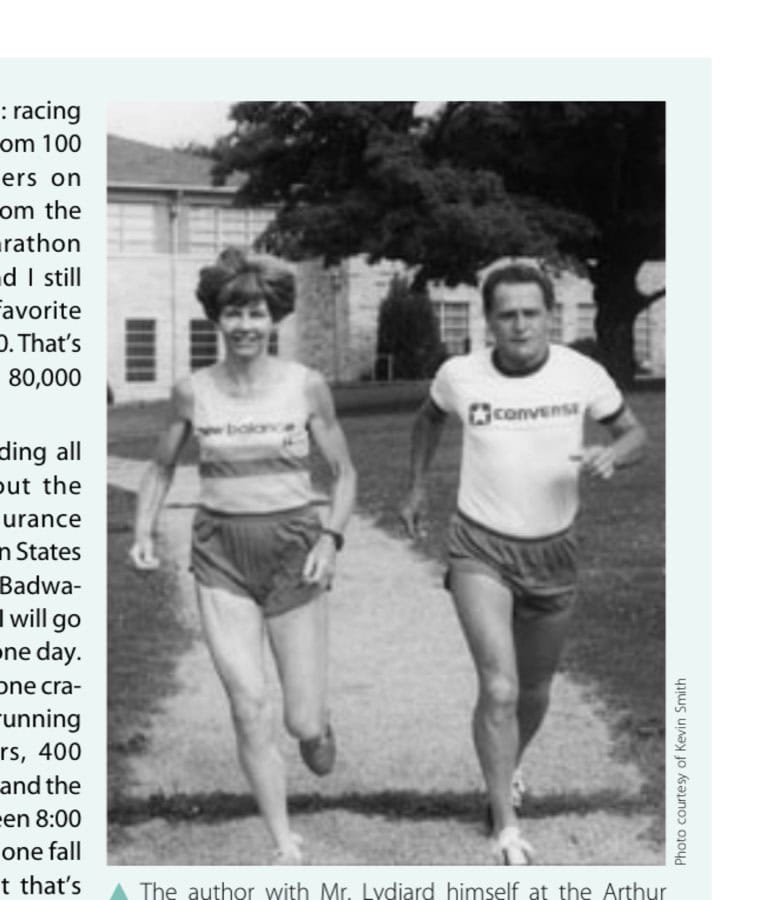
▲ The author with Mr. Lydiard himself at the Arthur Lydiard Running Camp in Scarsdale, New York, in 1983.
What Craig Learned From It The little lesson was about choosing between light weight and padding in selecting the saddle for my bicycle. Luckily, I suffered no lasting damage, as evidenced by two healthy, strong grandchildren for my mom.
The bigger lesson was an understanding of the value of a goal and of assisting others to reach their goals. I learned that however much my efforts may not have been appreciated in the moment—when my coaching became prod
ding, needling, cajoling—in the end the person would be proud of what was accomplished, and I would be proud of how I had helped. This lesson was applied later in my life when I found myself the labor coach for the births of my two healthy, strong children.
This article originally appeared in Marathon & Beyond, Vol. 10, No. 1 (2006).
← Browse the full M&B ArchiveMore like this
1,000+ stories from 19 years of Marathon & Beyond
The complete archive of the legendary long-distance journal — digitized and free to read.
