

My Most Unforgettable Ultramarathon (Vol. 14, No. 1)
COTSWOLD, UK, May 24-25, 2008 —With the last name “Stroud,” I’ve
long suspected that my family hails from the Cotswold region of western England. In recent years, I was able to confirm that by tracing my family genealogy to that area, including marriage records between Edward Strode and Joan Gunning in the town of Bristol (less than 30 miles from Stroud) in the year 1629.
Then a little over a year ago, via the magic of the Internet, I found the Stroud and District Athletic Club (SDAC) and, as an avid runner, thought it would be really cool to join and get a club vest with my name on it!
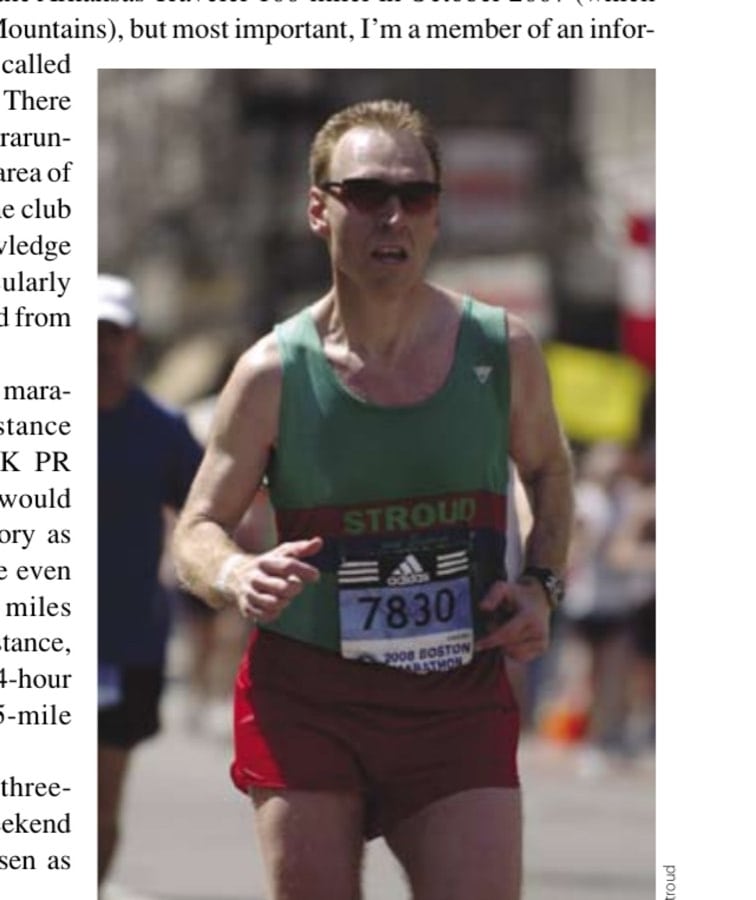
I contacted the club, had a little hassle getting my membership dues to them in British pounds, but joined the club and then would wear my vest occasionally at a race and send photos of “the namesake Yank.” I even wore it when running the Boston Marathon in April 2008.
During this same time, two foreshadowing events were taking place in the SDAC: a talented young runner, Jonathan Brough, contracted meningitis while skiing in Canada and was ultimately left paralyzed from the neck down; and Martin Humphries decided to run the entire length of the Cotswold Way in May 2007 with a goal of “under 24 hours.” Martin committed to the effort with little time to plan it as a fund-raiser, but he accomplished his goal—suffering mightily during the later miles from blisters.
Kenny Roberts, a member of the board of directors of SDAC, saw the opportunity to have the club assist in making a follow-on assault on the Cotswold Way as a fund-raiser for The Meningitis Trust, which provides support services to people and their families affected by meningitis and which has its headquarters in the town of Stroud.
Kenny began planning the effort early in 2008 by contacting SDAC members and nearby runners to find those willing to take on the challenge and to begin planning a date. Ultimately, three runners were ready, willing and able: Martin Beale, Dave Burton, and I.
Martin has great experience at fell running and ultradistances, including a finish in 32:08:13 of the Ultra Trail Tour du Mont Blanc, which has a total distance of nearly 100 miles with over 27,000 feet of elevation gain as it circumnavigates the tallest of the Alps. Sponsored by the Vasque running team, Martin was sure to be well prepared and up for the task.
I’ve done a fair amount of ultrarunning, including numerous 50-milers and a top 10 percent finish in the Arkansas Traveler 100-miler in October 2007 (which traverses the Ouachita Mountains), but most important, I’m a member of an informal ultrarunning group called “the Buffalo Warriors.” There is a lot to learn about ultrarunning, particularly in the area of running nutrition, and the club is a great source of knowledge and inspiration—particularly the training I’ve received from Tracy Thomas.
Dave is an excellent marathoner and shorter-distance ultrarunner with a 50K PR of 3:39, which many would consider quite satisfactory as a marathon performance even though a 50K is five miles longer! In very-long distance, Dave turned in a sub-24-hour performance at the 85-mile Hadrian’s Wall in 2007.
With this intrepid threesome at the ready, the weekend of May 24-25 was chosen as ▲
The author runs the 2008 Boston Marathon wearing his Stroud and District Athletic Club racing kit.
Courtesy of Kevin Stroud
Planning
the best dates to coordinate the supporting runners from SDAC, which would be key to the success, and e-mails began flying!
The run-up to the run Sarah, my middle daughter of three, enjoyed running for a few years, but now that she is nearing her teenage years, her interest has waned. So, I took this opportunity to offer her an incentive: if she could train to run a 10-mile leg of the race with me (late in the race, when my pace would be slow), then I would take her with me to England. With a prize like that, even though it wasn’t easy to coordinate with her other activities, she did an admirable job of training and joined me for the trip.
We flew from Chicago to London, so as to have a direct flight, arriving early on Wednesday, May 21. We didn’t have long in London, but I had asked Sarah what she would like to see—expecting to hear something like Big Ben or Buckingham Palace. What she wanted to see, though, was the London Dungeon, which is kind of a cross between a haunted house and an amusement park and which just happens to be on the opposite side of London from the airport! It took us three hours of driving to get there, with only one hour lost during that time, but we made it and she had a great time. I can think of a lot better things to see, but since the trip was mostly about me running, I wanted to do some things that she would enjoy. We arrived at Kenny’s home in Stroud early that evening, and it turns out that he is quite a good cook as he made an excellent dinner and we dined on the back patio in his garden.
Thursday, the 22nd, Sarah and I wandered around the town of Stroud during the day doing a little shopping. We had an appointment that evening to meet up with some of the club runners and a BBC reporter for a promotional video shoot and to get in a few miles of running on the Cotswold Way, which would be my introduction to the course. The video shoot was a live broadcast during the evening news, and it went well, with people I met later commenting on seeing it. Also important is the fact that it drove donations to the JustGiving Web site.
The point we met at is known as Coaley Peak and gives a broad vista of the Severn River valley to the west. Most important, it shows how the Cotswold escarpment towers over that plain and that the course we would run is up, down, and along that escarpment—seriously intimidating when considering 105 miles. We did a short 5-mile run that evening on the Cotswold Way, and it was definitely an eye-opener to me, having come from Illinois, which is nicknamed “The Prairie State.”
One hilarious incident that evening occurred when we topped a particularly scenic hilltop and paused to enjoy the view. I let out a long yell of “buff-aloooo,” which echoed down the valley for what seemed like 10 seconds. We
were a group of about eight runners, and the response from Philip Manning was “Bloody hell! What was that?”—which cracked us all up. I explained that, while it wasn’t typical of American running clubs, it was the club call from the Buffalo Warriors, and we would often let out just such a yell and then be answered by other members of our herd with the same yell in response. I suggested they use a similar yell for SDAC, to which the reply was, “But we don’t have buffalo here”—which cracked me up! I replied, “No, use some local animal.” Richard Hurdle suggested “badger,” since those were quite common in the area forests, but his clipped British rendering of “baj-ah” failed to resonate down the valley quite the same as my ode to the American bison, the largest terrestrial mammal in North America and Europe.
We all had dinner that evening at a local pub, and Sarah was thrilled to see that Philip was able to bring his dog, Sam, into the bar area, where Sam was happy to eat scraps from everyone’s plates while we dined.
Friday, the 23rd, was our last full day before beginning the run, so Sarah got to pick an activity for us. She selected Go Ape! in the nearby Forest of Dean which, from its Web site, is a “high wire forest-adventure course of rope bridges, Tarzan swings, and zip slides . . . all set high up in the treetops.” And it’s not kidding about “high up,” as the later courses are about 30 feet up in the trees. We had great fun, though, until the rain and hail hit when we were almost done—so we were quite drenched on the drive back to Kenny’s house. We enjoyed seeing Gloucester Cathedral, featured in some of the Harry Potter movies, as we drove to and from the Forest of Dean.
That evening we went to visit Jonathan Brough at a hospital facility near Cheltenham, and it was pretty tough. Like many people, I suppose, I don’t spend a lot of time around severely handicapped people, and it was tough to see such a vibrant young man wheelchair bound and not even able to turn his head. He can speak softly between puffs of his ventilator, is able to use a vision-tracking computer to write e-mail, and is learning to drive his wheelchair with a cheekcontrolled joystick. What was most touching to me was that he had a picture prominently displayed in his room of himself finishing the Stroud Half-Marathon in 2006 where he was in the final sprint toward the finish line, with both feet off the ground and his hair flying, to a very respectable finish of 1:33:38. Later in the trip, I met Jonathan’s mother and father, Sue and John, and ran with John quite a bit—very strong, good parents, who are obviously doing all they can for Jonathan. This gave running for The Meningitis Trust a lot of meaning.
Saturday, the 24th, we had planned for Sarah to spend the day and night with Tim Walton, a fellow SDAC runner with two daughters nearly her age. They stayed up until well past midnight, giggling and “swapping accents.”
Kenny and I spent the morning taking a quick trip to the Cotswold outdoors store near Cirencester to pick up gels and powder for Dave (I had brought all
my own gels and drink powders from home), and then I got in a short nap in the afternoon, since we were starting at 8:00 p.m.
The course The Cotswolds technically aren’t hills but are an escarpment—a tilted bed of honey-colored limestone nearly 100 miles in length formed during the Jurassic period almost 200 million years ago. The slope of the escarpment toward the east is ▲ Cotswold Way course (in red), along
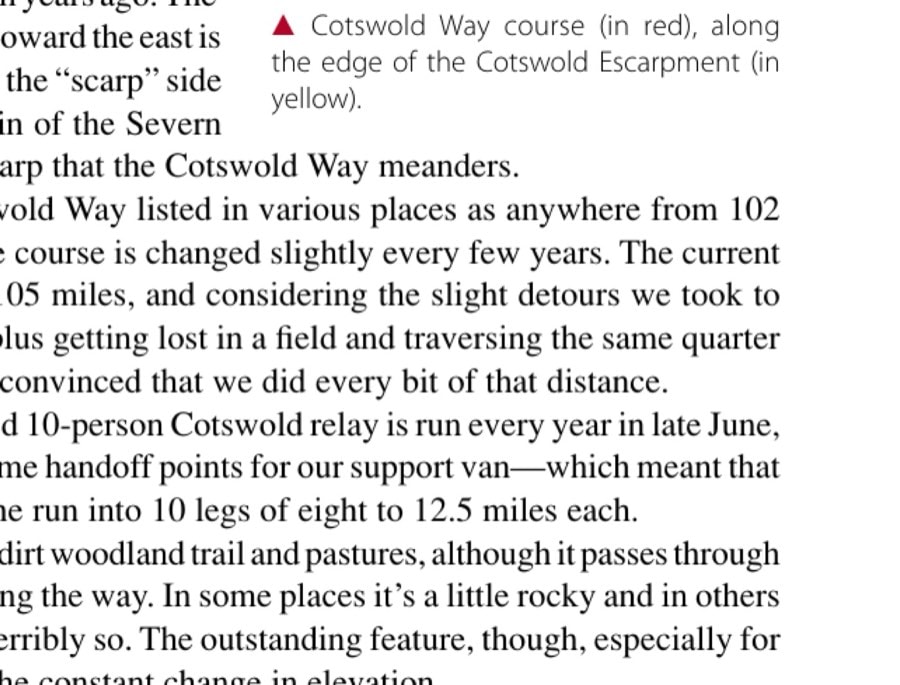
the edge of the Cotswold Escarpment (in gentle, while to the west the “scarp” side yellow). drops steeply to the plain of the Severn River. It is along this scarp that the Cotswold Way meanders. You’ll see the Cotswold Way listed in various places as anywhere from 102 to 105.5 miles, since the course is changed slightly every few years. The current incarnation is listed at 105 miles, and considering the slight detours we took to reach our support van, plus getting lost in a field and traversing the same quarter mile several times, I’m convinced that we did every bit of that distance.
A regularly scheduled 10-person Cotswold relay is run every year in late June, and we would use the same handoff points for our support van—which meant that we would be dividing the run into 10 legs of eight to 12.5 miles each.
Most of the course is dirt woodland trail and pastures, although it passes through a handful of villages along the way. In some places it’s a little rocky and in others a little rooty, but never terribly so. The outstanding feature, though, especially for a flatlander like me, is the constant change in elevation.
The total elevation gain (counting only the ups and not the downs) is listed variously as between 12,000 and 14,000 feet in the north-to-south (Chipping Campden to Bath) direction, which we took. Notable points include Cleeve Hill, the highest point in all the Cotswold range, and running up the side of Cooper’s Hill, site of the annual death-defying cheese roll. Yes, you really should check it out online at the official Web site if you’re not familiar with the cheese roll, which we just missed seeing (www.cheese-rolling.co.uk/). We ran up the hill on Sunday morning, and the annual event was held the next day at noon.
As I was soon to learn, the other outstanding feature would be the never-ending gauntlet of stinging nettles. I joked during the run that obviously “Cotswold” was Old English for “stinging nettles”—but the humor didn’t help the constant burning and (attempted) sidestepping while trying to run through the numerous patches of this egregious herb!
Start of the run and ultrarunning notes
Courtesy of Kevin Stroud
We began at 8:00 p.m. on Saturday at the gates of St. James Church in Chipping Campden, with the idea of being relatively fresh for the approximately six hours of night running that would start a couple of hours into the run. We had a projected finish in Bath of 8:00 p.m. Sunday, plenty of time to pop in to a local pub for a pint to celebrate the sub-24 accomplishment!
We had collectively worked out a schedule beforehand that took into account the various elevation changes of each leg and that also allowed for a slight slowing toward the end. The schedule also allowed for alternating five- and 10-minute breaks between the legs. However, as often happens in ultramarathons, the pace started out quicker than planned.
Richard, one of our pacers, had a GPS watch on and was agog that we were running the first few miles at under 8:00-mile pace. While that’s not a pace that can be held the entire distance, considering that we’re all marathoners who run about 7:00-mile pace, it’s not uncomfortable, either. Thus, we finished the first leg of 11.5 miles about 25 minutes ahead of schedule. The pause before starting the second leg was about 10 minutes instead of the scheduled five, which was longer than I’m accustomed to, since I usually walk through aid stations.
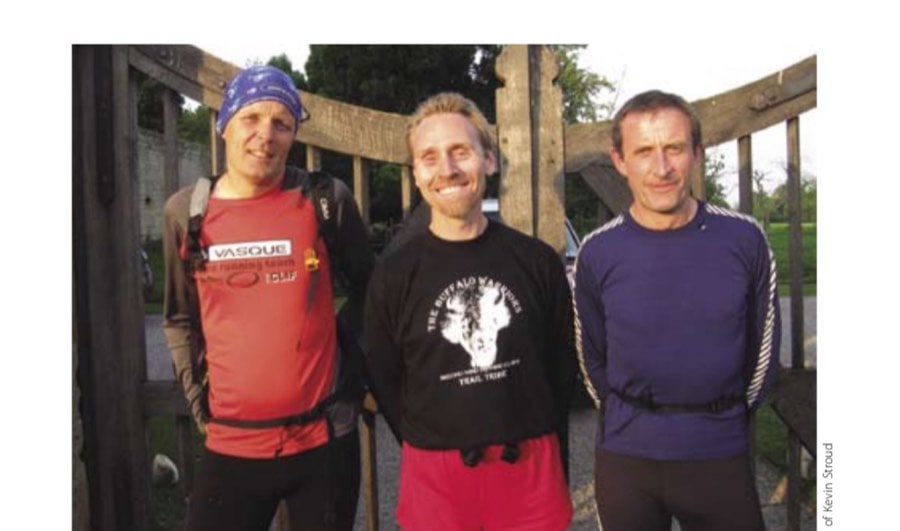
▲ The author (center), Martin Beale (left), and David Burton at the start at the gates of St. James Church in Chipping Campden.
Courtesy of Kevin Stroud
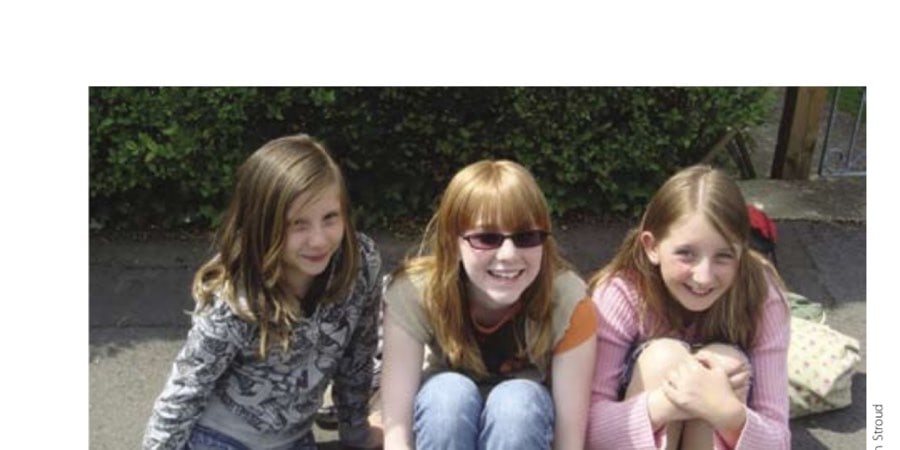
▲ The author’s daughter Sarah (center) with her new English friends, Lily and Mabel.
It was just getting dark enough, at about 10:00 p.m., that we turned on our head-mounted flashlights at the beginning of the second leg, which was 12 miles. Kenny and Richard paced us both the first two legs, while Philip drove the support van to the rendezvous spots between the legs. The pace continued to be brisk, and we gained another 25 minutes on the planned schedule. Notably, Dave’s stomach began to get a little queasy.
Some notes about ultrarunning, for those not experienced at this kind of stuff: First, it’s pretty surreal to be running in total darkness along woodland trails with only a small patch of light about 10 feet ahead of you bobbing along showing a dirt path with scattered rocks and roots. And when I say “dark,” I mean dark, dark, dark in the woods. If you haven’t tried it, you really should, since it’s invigorating to hearken back to the way our primitive ancestors would have experienced it. One plus of being in the dark is that when you start an ascent, you can’t see the top, so you can focus on only the trail directly in front of you and not worry about it being a half mile or more to the top!
Second, on long runs such as this, particularly where someone like me doesn’t know the course as it meanders through fields, it’s vitally important to have pacers along with you. As you may be aware, the human body burns glycogen as energy until the glycogen runs out (which is when you hit The Wall in a marathon), and then the body will burn fat to keep the muscles going.
Of course, we try to eat along the way to keep adding to what meager amounts of glycogen might be left, but it’s interesting that the human brain uses only glycogen for fuel. Thus, short-term memory and cognitive thinking ability (such
as calculating split times) are severely affected in a long run—so you literally need pacers to do the thinking for you. Besides the obvious experience the SDAC runners have with the Cotswold Way since they run it regularly, good pacers are also motivators. Especially late in the race, when the runner might otherwise be inclined to walk, a good pacer will suggest and cajole the runner into running whenever possible. On that score, I had two standout pacers: Paul Rowley during the middle legs, and Simon Barnes for an early leg and then the last three legs. Without their gentle encouragement (translation: ass kicking when I needed it to get up a hill!), I certainly wouldn’t have finished in the time that I did. My sincere appreciation to them for their selfless efforts!
Finally, the key to successful ultrarunning is being able to eat and drink on the run. At my body weight of slightly more than 160 pounds, 105 miles would burn about 16,000 calories—more than an average person eats in a week—and there is no way to do that without keeping food coming in, which isn’t as easy as you might think. During running, the body shunts blood flow away from the stomach to your heart, lungs, and legs, so your entire digestive tract is working at a disadvantage compared with normally sitting down for a meal—yet greater demands are placed on it to digest as much energy as possible. Runners will eat gel, which is similar to honey or maple syrup but with more energy, but all gels are not created equal. Many are fructose based, which some people, including me, find hard to digest. However, even eating only maltodextrin-based gel can lead to diarrhea at distances of more than 50 miles, so some sort of solid food must be added (bananas and peanut butter and jelly sandwiches for me!). Of course, it’s important to drink enough liquid as you’re sweating, but it’s equally important to be taking in salt/sodium/electrolytes, which you’re also losing while sweating, or else you run the risk of hyponatremia, which can cause death. Figuring out how to balance the right foods, the right amount of liquid, and the right amount of salt/sodium/electrolytes is an “experiment of one” that each runner has to figure out. Even then, it can vary based on the details of the run, particularly the temperature, which directly contributes to your sweat rate. Since, as I joked with the SDAC runners, “this wasn’t my first rodeo,” I had brought my own gels (Hammer Nutrition), drink powders (Clip2), and salt tablets (S! Caps), which I had determined from prior races work well for me.
The middle of the run We started the third leg of 10 miles about 12:30 a.m. with two fresh pacers, Martin Humphries and Jim. Both are strong runners, which is exactly what we didn’t need at that point because I knew the pace wouldn’t abate. Now, I don’t mind putting a few minutes in the bank, but we were gaining approximately 30 minutes per leg, then taking longer than planned for the breaks between the legs, which means
that we were overrunning the pace by more than two minutes per mile. I knew that I couldn’t run the Cotswold in under 20 hours, but that’s the pace we were moving at; and while it’s nice to have just a little in the bank, any runner will tell you that withdrawals from the time bank often get made late in the race with accumulated interest! Thus, while I was having no problem keeping up, when we finished the third leg putting another 30 minutes in that bank, I got vocal about getting on the scheduled pace and not adding more time to it!
Somewhere in the third or fourth leg, the course had a short distance on a road (going uphill, of course!), and we were stopped by two policemen in a car who were wondering what five guys were doing running around in the dark with lights on their heads. Ninja training? They bought the story that we were running 105 miles and let us continue—so they must not have been too smart!
The fourth (12.5 miles) and fifth (11.5 miles) legs were then run right on the predicted time per leg, which wasn’t bad considering that the rain that had been predicted hit about 3:30 a.m., turning much of the trail to mud. At times the rain was torrential, and when we crossed open fields on the hilltops, it was vigorously whipping our running jackets—very man versus nature, and it was a thrilling experience! I believe it was at the end of the fourth leg, having covered 46 miles, that Dave Burton retired from the run because of stomach problems and the inability to eat and keep food down. He had really been running on empty for a while, so he slept quite a few hours in the van as Philip drove to the leg handoff points.
We finished the fifth leg about 6:00 a.m. on the edge of Stroud at The Fifth Dimension Health & Fitness Club, where we had a brief respite planned. At that point we were soaking wet and tired from having run 57.5 miles, but the sun had been up a couple of hours, the rain was abating, and we were over halfway. Spirits were high for Martin, the support runners, and me, but the break lasted about 30 minutes (way too long for me), so my body temperature plummeted and I was shaking from hypothermia as I began the sixth leg.
Leg six was only eight miles—the shortest leg yet, but very hilly—as Paul and Philip paced me. In a run of 100 miles or so, you’re guaranteed to have down spots where you don’t feel good, that you just have to push through knowing that it’s only a phase. I often refer to the black hole of mile 70 in a 100-mile race, where you’re tired from the distance, yet the end is still very far away. My lowest spot during this run was the end of leg six, at which point I had been on my feet for approximately 12 hours, running 66.5 miles, and I was seeing my daughter Sarah for the first time in nearly 24 hours. I never doubted that I would finish, but it crossed my mind at the time that it might not be within the planned 24-hour window. Something that picked up my spirits was the fact that I was joined by runners from Dursley, as leg six ends in their town, and by Jonathan Brough’s father, John. It was quite a large group running through the mist for a while, and I was sorry that I wasn’t able to see the views.
Legs seven (eight miles) and eight (12 miles) went by in a blur. I know that it wasn’t a blur at the time—it was just interminable running down hills, running as much of the flats as possible, and then trying to walk briskly up the hills. I joked that if I got lost, I could just stop, pour some liquid out of my water bottle, and whichever direction the water flowed (downhill), then I could run the opposite direction (uphill) and be assured of going the correct direction. The Cotswold Way, in attempting to be scenic, makes a point to summit every hill from Chipping Campden to Bath.
Also, from about the sixth leg on, due to glycogen depletion, my brain was so drained that I would ask three or four times during each of the legs, “What leg are we on?”—and Simon always had the answer ready!
This is the end By the start of leg nine (another eight-mile leg), I was feeling pretty good, all things considered. No, I wasn’t ready to perform any mental math calculations, but I knew that I had powered through the black hole, there was less than 20 miles to go, and a sub-24 finish was looking promising. Nothing is ever guaranteed, and I couldn’t quite just walk it in from there, but it definitely looked as though my goal was attainable. Besides Simon, I was paced
ad
Courtesy of Kevin Stroud
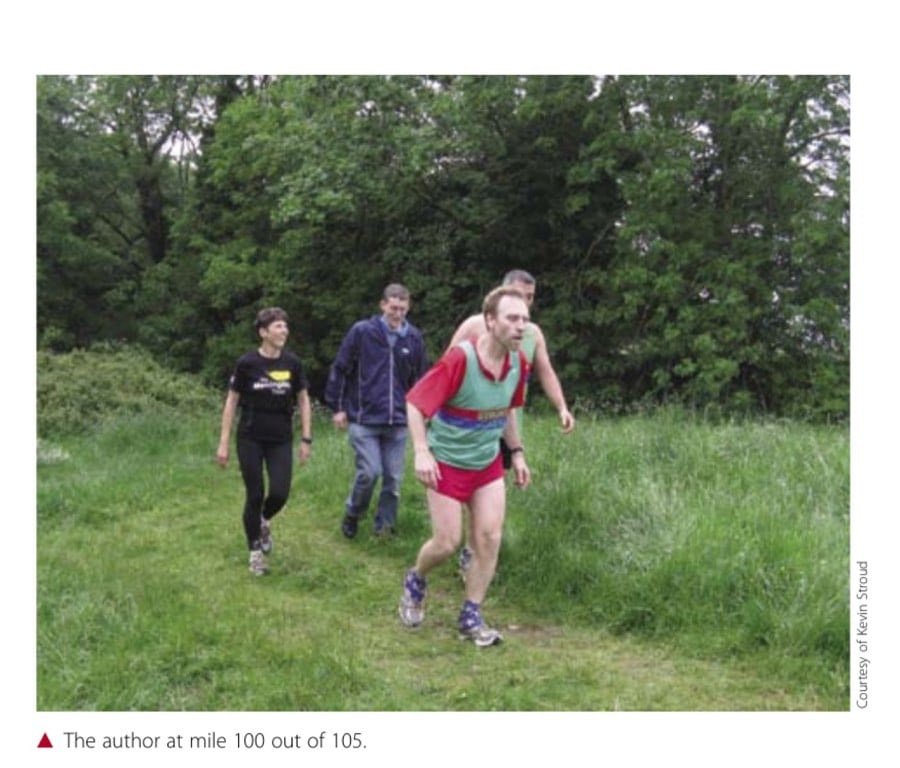
▲ The author at mile 100 out of 105.
by Richard and his girlfriend, Hayley—who hadn’t done much running, especially trail running—and it was fun to chat with someone new. This is also the leg that we had tentatively planned on Sarah running, but scheduling and the muddy conditions meant that instead she joined me for only the first mile of leg 10.
Leg 10 is 10.5 miles to the gates of Bath Abbey, and I remember it well. I was paced by SDAC runners Simon Barnes, Louise Little, and Fadi Dahdouh, and we ran through an awesome iron age fort atop Solsbury Hill, made famous by Peter Gabriel, but all that remain now are the earthworks.
One frustrating thing during that last leg was that as we were coming down the hills near Bath, we could see Bath Abbey in the city skyline because the towers top 162 feet, yet it took forever to get to it. Even once into the city proper, the Cotswold Way meanders through a park area and then into a field on the edge of town—complete with stinging nettles—before finally heading toward the great Bath Abbey doors.
The Cotswold Way officially ends at Bath Abbey, where it is customary to kiss the intricately carved doors to mark the end of your journey. Of course, as the doors finally came into sight, I sprinted toward them as fast as I could and then saw that a barrier of a low metal fence had been put up to keep people away
from the doors. Not to be deterred from my mission of lip-locking the portal, I continued to run toward it, stutter-stepped at the last second, and attempted to jump the fence—but caught my foot on it and went down in a pile on the other side of the fence. Undaunted, I jumped to my feet, took a bow, turned and kissed the doors, and collapsed on the fence.
Official finish time was 23:08, which isn’t too bad for the distance and elevation traversed. So, mission accomplished with plenty of time to spare—but glad to be done when I was. Martin Beale, who pulled away from me after leg five, finished in what is believed to be a course record time of 22:44. My hat is off to him!
Oh, yeah—I had only one rather small blister on my left little toe from the run. My most serious injury was that I bruised my left big toe in falling over the gate at the very end.
Epilogue
Courtesy of Kevin Stroud
Immediately afterward, we all went to a nearby pub, but it didn’t allow children to even sit inside. So, with Sarah along, we had to relocate and went to a restaurant close to Stroud, where I had half of a really good steak, since that was all that I could stomach at the time. I finally hit the sack about 11:00 p.m. and, except for the night sweats that are common after a run like this, slept well. I took it pretty easy on Monday, May 26, and Kenny and Richard hosted a party at their place that afternoon and evening that gave us all a chance to get
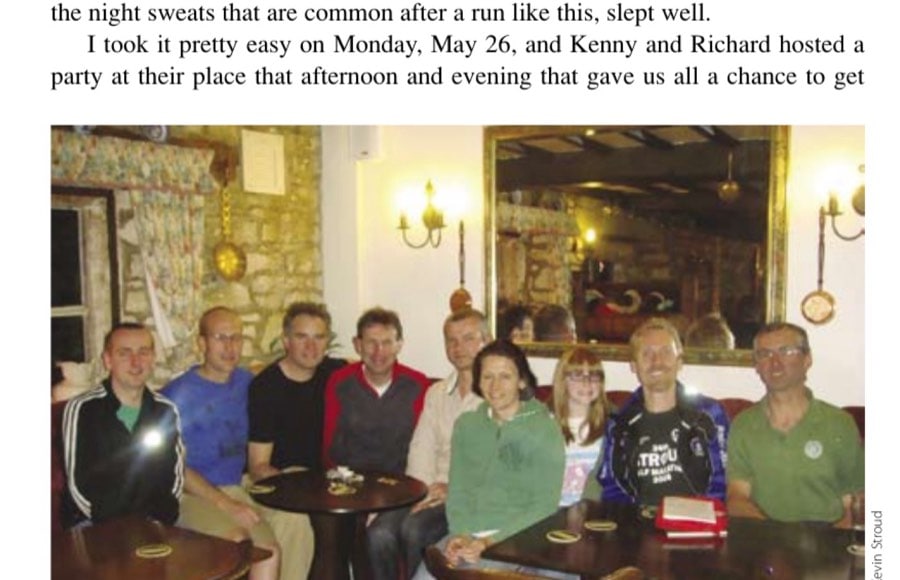
▲ Postrace farewell dinner with the race planner and most of the pacers.
together and reminisce about the adventure. They were pretty busy getting all the press info together regarding the fund-raiser, and we had a great time. On Tuesday, May 27, Sarah and I did some final shopping around the town of Stroud, and then we met up with the entire SDAC club that evening for its weekly Tuesday run, where Kenny made a special presentation to me of a Stroud Half-Marathon shirt and a book signed by everyone involved in the effort. We then ran about seven miles on the Cotswold Way, less than 48 hours after my finish. If I do say so myself, some of those miles were run pretty hard!
What it all comes down to, though, is the fun I had and relationships I built. Runners have a great tradition of getting along well with other runners, especially in the trail-runner camp, and I met some wonderful people through this whom I hope to see again soon. We had a great time swapping cultural differences, with me teaching them how to “put the hay down where the goat can get at it,” while they told me what a “cracking” time we had running until we were “bloody knackered!” Of course, they’re all invited to my side of the pond.
And what I learned from it Running truly is a gift . . . Going to England to trod the ground of my forefathers sounded like a really great adventure, but once I met Jonathon Brough and realized what the run was really about, it took on a whole new meaning. No matter
how steep the climb was or how much the nettles stung, I was honored to be able to run and to be helping a young runner felled in his prime. . . . a gift to be shared with family . . . While I’ve often had my daughters crew me in ultras, including Sarah
as a pacer gave us the opportunity to run a lot of training miles together. Helping her to realize that she can push her limits, and actually enjoy running, is a highlight of fatherhood thus far. . . .
and new friends. I’ve run more than 25 races at marathon distances and beyond and already knew that ultrarunners were one big family, but this was my first opportunity to see that camaraderie translate internationally. And it only
added to the surrealism of running through the dark and my occasional exhausted giddiness to be surrounded by British accents as we recounted episodes of “Monty Python” and “Dr. Who” in their original English!
This article originally appeared in Marathon & Beyond, Vol. 14, No. 1 (2010).
← Browse the full M&B ArchiveMore like this
1,000+ stories from 19 years of Marathon & Beyond
The complete archive of the legendary long-distance journal — digitized and free to read.
