

My Most Unforgettable Ultramarathon (Vol. 19, No. 2)
SAN FRANCISCO, CALIFORNIA, July 26-27, 2014—In the past year, I have run my fair share of races, all as part of a New Year’s resolution to start running again. At the start of 2014, it had been five years since my last race, four of which were spent wondering, When will I get back in gear? So as the New Year came roaring in like a freight train, I decided it was time to answer with a fierce set of goals.
It seems that most people take resolutions with a grain of salt, and there is a slight chuckle as friends tell stories of their resolutions lasting only a week or two into January (or of never even starting them). For years on end, I was in the same boat, only I kept my failures to myself because, somewhere deep inside, I was ashamed. For whatever reason, 2014 was the year that I realized this and told myself I had no option other than to run. So with ample persistence, I saw my goals through to the bittersweet end, culminating in a 20:16:50 finish at the Rio Del Lago 100-mile on November 8. This was my first hundred and the ultimate arrival of the new me. After 10 short months, I went from not running at all to being in the best shape of my life.
Days after my first 100-mile race, I was able to reflect on and pick out the highlights from the most successful reentry year I could have imagined. Rio Del Lago is an obvious standout, but I must say that everything about it was as you would expect: long, grueling, and packed with soaring highs and grinding lows. In short, my first hundred went as planned, so I will spare you the details. The one event, however, that stands out as different from any other run I have done is the one that forced me out of my comfort zone in not just a physical and mental way but a social one as well. This was the Worth the Hurt Ultramarathon—a double running of the San Francisco Marathon.
The way the Worth the Hurt works is that its participants show up a little before midnight on race day to run one full marathon through the streets of San Francisco (trekking a slight variation of the official course in reverse). This is done
with very little assistance: the route is not marked or closed off, there are three aid stations, and runners must navigate through city traffic, including hordes of drunken people wandering about shortly before the bars close. Upon completion of the first marathon, runners then wait until 5:30 a.m. to begin their second loop with the tens of thousands of other runners in the San Francisco Marathon.
As if two marathons in one day weren’t enough, the race organizers require each participant to raise at least $1,000 for charity. This element of giving back is what ultimately sold me on the event. With the ever-increasing amount of running I was doing, I began to notice a sense of emptiness, especially during long runs. At times, I couldn’t help feeling that I was neglecting other things in my life, especially personal relationships. The Worth the Hurt double gave me an opportunity to turn these negative feelings into positive ones, uniting my running with those closest to me. Furthermore, the event brought me a sense of purpose, which until then had been somewhat nonexistent. Anyway, here’s how the race went.
Should I be sleeping? At about 2:00 p.m. on Saturday, July 26, I met my friend and a fellow runner to watch 22 Jump Street at a theater nearby. This was merely a distraction from the fact that in 10 hours I would be attempting to run farther than I had ever run before and doing so throughout the night and early into the next morning. I had never tried to run without sleep, but this was one of the many aspects that attracted me to the event (as sleep deprivation is one of ultrarunners’ many foes). Channing and Jonah did their job and for a brief two hours, I got lost in laughter and forgot all about the challenge ahead. But as I returned home, reality quickly set in. Not really knowing what else to do, I did the sensible thing and lay in bed and watched a series of running documentaries, including Unbreakable.
Courtesy of Tyler Hill
▲
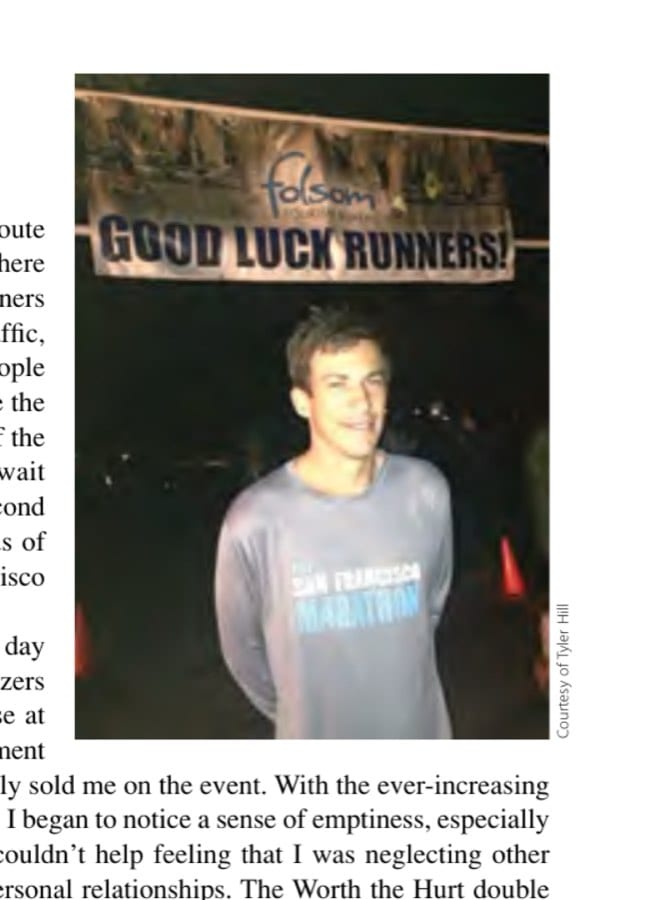
Tyler sporting his Worth the Hurt shirt at the start of his first 100.
Courtesy of Tyler Hill
▲
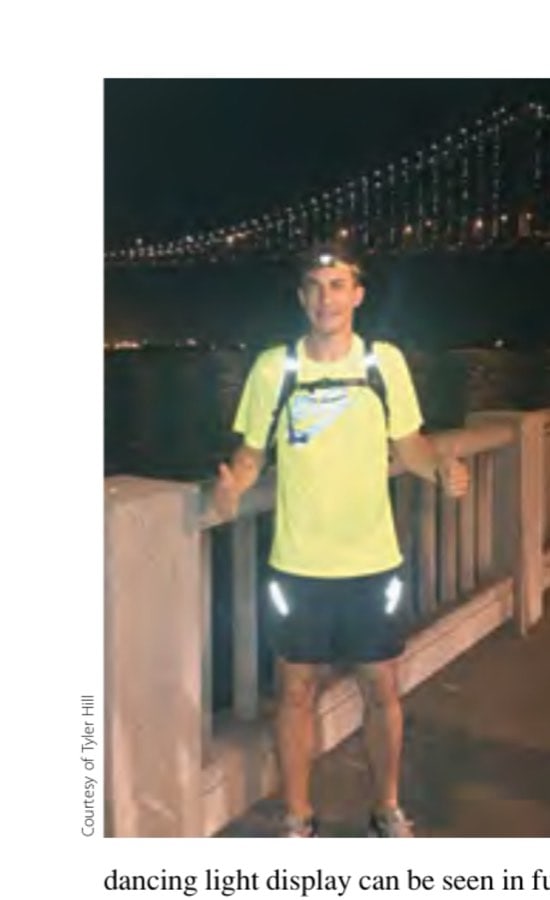
Minutes before embarking on the first of two marathons in San Francisco.
I spent the next five hours resting, but not sleeping. I was just too giddy to nap. Even though I was unsure about how lack of sleep would affect me, I decided it was best not to waste effort worrying about it or forcing myself to
sleep. This tactic paid off. Around 10:00 p.m. I knew it was time to get going, so I ate a quick bite, packed my pack, and began making my way down to the Muni stop with my girlfriend, who would see me off.
The San Francisco Marathon begins right in front of the Ferry Building on its iconic Embarcadero—a four-lane thoroughfare that runs along the city’s northern shore. The Bay Bridge sits directly in front of you, and at midnight, its
dancing light display can be seen in full force. As I left the Embarcadero subway stop, I chuckled at the fact that, for once, I was the crazy person riding Muni, as my race-day outfit attracted plenty of confused stares. Then it dawned on me:
maybe I am crazy. Either way, craziness is in the eye of the beholder. After leaving Muni, I walked up to the starting tent with my girlfriend and tried to enjoy the experience. As most ultrarunners do before a race, I pretended
as if it were just another stroll in the park. For a quick second, while walking into the starting tent, I thought I was at some sort of underground rave, with everybody adorned in blinking lights, backpacks, and weird outfits. This was
a different sort of party, however, and I bashfully stepped forward to introduce myself to the race officials.
All I need to do is follow the map About an hour later, I found myself running past AT&T Park, making conversation with another San Franciscan who, like me, was wondering how it would be possible for the out-of-town runners to navigate this course in the dark. To be fair, the race organizers had sent out a couple of people on bikes to follow the first and last of the pack, but that obviously didn’t help everyone in the middle. My directions were printed on paper, and I had highlighted the turns on streets that I was
not familiar with. I had a general idea of where the course should go, so I figured that if I could follow that, I should be fine. The first few miles proved easy, and I knew exactly where I was. As I crossed the Third Street Bridge, with the San Francisco Bay below my feet and the Giants ballpark right behind me, I smiled. This is adventure, I thought, and how lucky am I to have experiences like this?
Somewhere around mile four, I made my first wrong turn. As we were leaving a small, somewhat unknown neighborhood called the Dogpatch, I forgot for a second that I needed to make a right on Indiana Street. By the time I realized my mistake, I was about three or four blocks past and too antsy to turn back. As an alternative, I turned and headed up Mississippi, which eventually would take me to 17th, where I could reconnect with the official course. Mississippi Street, however, headed straight up and over Potrero Hill, whereas Indiana Street was entirely flat. Despite having a generous 48 or so miles left to run, I still found it too unthinkable to turn around and retrace my steps. Ah, it’s funny the way our ultrarunning minds work sometimes.
Looking back, I realize that if I had made that wrong turn closer to the end of the race, I would have undoubtedly turned back to avoid the hill. Initially, the navigation difficulties bugged me, but soon that irritation turned to excitement. I thought back to the many trail runs I had done and how each of them was bountifully marked with pink ribbons and chalk arrows. It was fun to be running through the streets of San Francisco at midnight with no one to guide you other than yourself and fellow runners.
Dealing with a great deal of awesomeness After the wrong-turn fiasco, we began making our way through the Mission and Haight districts, where we navigated through herds of inebriated young adults and speeding traffic. This section was fun because it was interesting to see the different reactions of the myriad 20- and 30-somethings as they watched us glide by.
Inevitably, I got stopped at a light at the intersection of 16th and Guerrero; the curious stares came on strong. One young man finally stepped up and asked what we were doing out there, and as I explained, he looked back at me with a fierce stare. He paused before responding, and I didn’t know whether he wanted to punch me or vomit or whether sensible words would somehow pass his lips. He had that drunken glazed-over look in his eyes. To my luck, as if receiving some divine intervention, he muttered a sincere and hearty, “That’s awesome.”
After this interaction, I had about 15 seconds before the light changed to think about what he had said and realize that, Yeah, this is awesome; I’m awesome. If it weren’t for my New Year’s resolution, it would likely be me standing there with the bar crowd, enviously looking on as weirdos with flashing lights ran by. I could see it all in my head: the night would continue as I drunkenly made my way
home, and eventually I would pass out, only to wake up the next morning with a vague, beer-soaked sense of remorse. I had changed for the better, and it felt good. The next leg of the run took us into the darkest and dreariest section of the course, where we would be forced to battle with the unseen forces of Golden Gate Park. In reality, the park is not that frightening, and running through it at night can be a calming and tranquil experience. The only things worth getting scared about are the fearless raccoons that crawl out of trash cans and walk by nonchalantly like bullies on a playground. Just pretend they are ugly cats, I thought.
Upon entering the park, I found myself running alone. There was literally no wind—a rare occurrence in San Francisco—and the trees and foliage seemed to speak to me with their stately presence. Now out of the chaos of busy urban neighborhoods, I fell into a reflective state, one which I thoroughly enjoyed. It is seldom that we get to push ourselves into unknowns, to strive for something that may well lie outside of our own capabilities. As I ran into the park, darkness fell around me, but lightness carried me forward. I ignored the scurrying and scattering from the bushes (most of which I eventually found to be lost runners!), ignored the uncertainties of the run, and ignored the nonsensical tendency to pick up the pace. With a Zen-like attitude, I proceeded through the darkness toward Ocean Beach.
The next stretch of running was interesting because it took me within a mile of my house, certainly bringing up urges to ditch the event and retreat to a warm bed. I’ve already put in 13 miles; that’s a solid run by anybody’s standard. The urges to stop converted to pure loneliness as I longed for the company of friends cheering me on or another person to run with. Although I had been running a solid 20 minutes with another participant, he did not seem to speak any English. This part of the course was all along Ocean Beach, and about 1.6 miles after leaving Golden Gate Park, there was a turnaround. I know I speak for most of us when I say that no matter what your level of running, or no matter what kind of event you are in, you always want to see how you stack up against the other runners. Even in this type of event, where you know that it really doesn’t matter (since the second leg of the race will be inundated with over 10,000 other participants and we were all already winners for our fund-raising efforts), you better believe that as that turnaround comes, you will be counting bodies as they run by: 10, 15, 20 passed me and I stopped counting. Who cares, Tyler? Run your race!
Time to blow out the carbon From the turnaround, the course headed back up the beach and through the park again and meandered through residential areas toward the Golden Gate Bridge. After bypassing the bridge, it took us down into the Marina where we ran across Crissy Field past Fort Mason, and back onto the Embarcadero. I have the fondest memories of the stretch running through the Marina and back onto the
Embarcadero. At this point in the morning, police were starting to block off the course, allowing runners to use the whole road. Passing Fisherman’s Wharf and returning back to the Embarcadero, I swung out wide into the middle of the sixlane thoroughfare. My mind filled the empty nighttime streets with thousands of cheering fans. Although I had been holding back for the last 24 miles, I thought to myself, Let’s open it up for a bit! My stride lengthened, the pace quickened, and I could almost hear distant cries at the finish line. Although I was not even halfway done, a part of me deep inside knew that I had already won.
My first marathon of the day took four hours and change. My goal was to do both under four, but considering the circumstances of the first loop, I decided that I was close enough. I had exactly an hour and a half to rest, recoup, and try again for sub-four, only this time my legs would not be fresh.
The in-between part of this event was honestly kind of funky. I must congratulate the organizers for setting up a nice VIP tent for the participants, fully stocked with food, hydration, and massage. I skipped the massage because I did not want to fall asleep. I did not skip the food and hydration, however, because I knew they would be crucial in fueling my sleep-deprived body to the finish line. Five a.m. passed and the starting gates were getting filled with fresh and nervous runners, all shaking their legs as they blew warm air into their cupped hands to try to stay warm. I fought the urge to sleep, and about two minutes before the start, I decided it was time to hobble back to the start. I did not have the slightest clue how this second leg would go. My legs hurt, my eyelids sagged, and once again I started running.
Now let’s take it back about three months to the point when I registered for the Worth the Hurt Ultramarathon online. As I mentioned earlier, part of the requirement for all participants is to raise at least $1,000 for a charity of their choice. Personally, I hate asking people for things, so I knew this would be a good challenge for me. It forced me outside of my comfort zone, which is essentially what running is all about as well. Ultimately, the reward always makes it worth it.
Choosing a charity was hard, but because I am an artist, I decided to support an organization called Creativity Explored, whose mission is to help developmentally disabled artists create, exhibit, and sell their art. At first, the fund-raising was slow going, but eventually it picked up. Using all of the resources I had, I was able to raise $1,750 in about two months’ time. Furthermore, I involved others in my running. I contacted people I had not talked to in years and told my story to colleagues at work, and I hope that I inspired others to tackle similar undertakings.
Getting beyond the I/me Seventeen hundred fifty dollars, I kept thinking as I made my second 26.2-mile loop; I couldn’t help being proud. The amount of money I raised was quite modest, and for some strange reason, this made me smile. I knew that in my hectic life,
Courtesy of Tyler Hill
▲
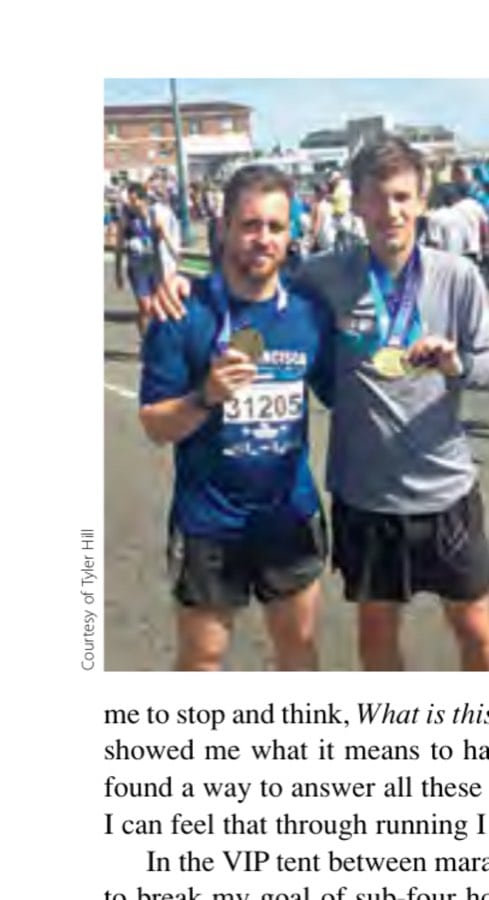
At the finish, with friend and fellow band member, Devon Kelts.
this number was the best I could do, and rather than sitting around and thinking about it, I actually did it. Like every other human being, my life consists of plenty of things that make me feel overwhelmed: I work, I write music, I
run, I have friends, and seldom does a moment go by that I am not racing from one end of the city to the next to try to make my dreams a reality. But that is the problem right there: I, I, I, me, me, me.
It always seems to be about me, even in the noble pursuit of improving myself through running. Worth the Hurt forced me to stop and think, What is this all for? Raising money for Creativity Explored showed me what it means to have purpose, to help somebody, to be selfless. I
found a way to answer all these questions, and now every time I take a footstep I can feel that through running I have made a difference. In the VIP tent between marathons, I had serious doubts that I would be able
to break my goal of sub-four hours for the second marathon. However, after a long morning of running and too many hours without sleep, I crossed the finish line of the San Francisco Marathon in 3:48. My legs still felt strong.
And what I learned from it Sleep deprivation can be a big foe, but don’t sweat it too hard. This race taught me that my body can handle running through the night and into the next morning, as long as I keep moving.
Pace yourself. “Negative split” seems to be a term long forgotten by the ultra community. In this race I ran my second marathon significantly faster than the first. As a result, I felt strong at the finish and for most of the second leg.
Choose races that are different. Although I prefer to run on trails, this road race was my favorite event of the year because of its uniqueness. Find purpose. I admire those who have found a way to bring their running
into the lives of others. It is important to strive for this on however large or small a scale you can manage.
This article originally appeared in Marathon & Beyond, Vol. 19, No. 2 (2015).
← Browse the full M&B ArchiveMore like this
1,000+ stories from 19 years of Marathon & Beyond
The complete archive of the legendary long-distance journal — digitized and free to read.
