

Need To Lose 14 Pounds To Run A Three-Hour Marathon
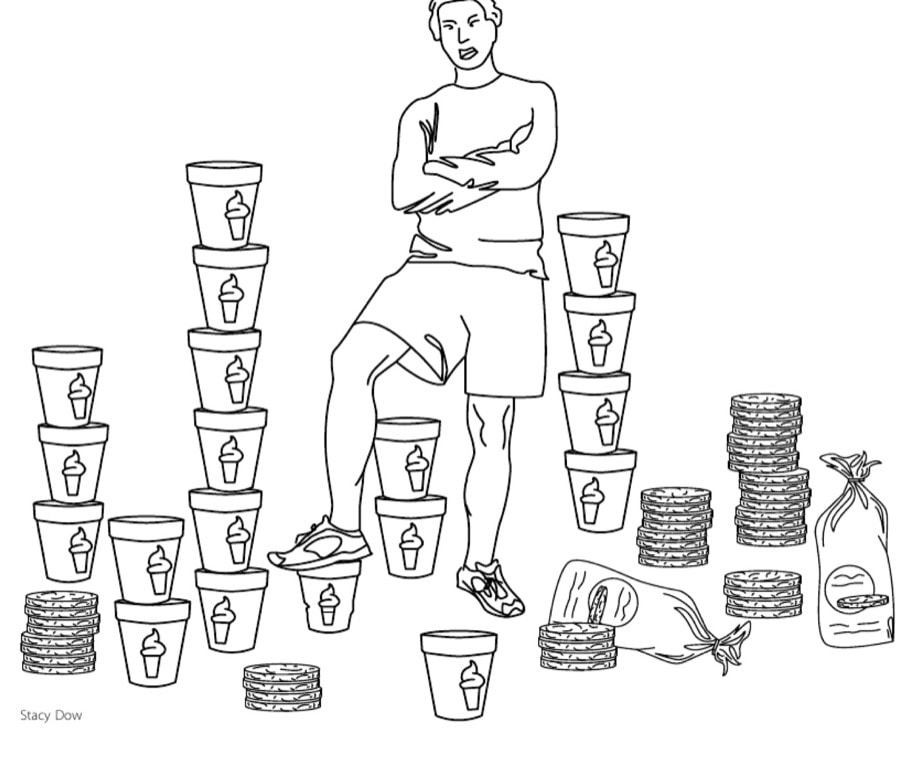
Ihate to reduce an issue as complex as marathon performance to how much I weigh, especially since rampant eating disorders have made the desire to be skinny politically incorrect, but the facts are clear. I’m being held back in marathon performance by an accumulation of approximately 49,000 calories of unneeded sustenance. I chalk it up to the 23.5 pints of fat-laden Ben & Jerry’s Cherry Garcia ice cream that I failed to resist during my current marathon-training regimen. I choose not to blame the 817 complex-carbohydrate-laced rice cakes I consumed to replenish my glycogen stores.
Bear with me. I know it’s not that simple. I will get to the other factors holding back my marathon performance. But before I go through all that only to realize that my potential ties back largely to a question of will, let me run through five weighty facts.
First, the rule of thumb about weight and marathon performance is that you slow down approximately two seconds per mile for each pound you are over your ideal weight. Most pundits—including Max Jones of the Valley Striders in Yorkshire, England, whose full-blown formula for predicting marathon performance is relatively well known—round off the impact to an even minute per pound for the entire marathon. Thus I’ve concluded that I need to lose 14 pounds, which will get me to six pounds lighter and thus six minutes faster than I was when I ran 3:06.
Second, the new body mass index (BMI) formula,1 released in 2001 by the United States government’s National Center for Chronic Disease Prevention and Health Promotion, shows that my current weight of 158 gives me a BMI of 26.3, well into the range it deems overweight. (I’m not very tall, if you were BMI = Weight (in pounds) divided by height (in inches), divided by height (in inches) again. Then multiply by 703. 1
wondering.) I thus seem to be part of the epidemic by which the newly revised BMI gauged 59 percent of all Americans to be overweight or obese. (That figure has since risen.) Third, even when I ran a 3:06 marathon at 150 pounds and 5 feet, 5 inches tall, my BMI was just a hair below overweight despite the fact that most people, myself included, regarded me as thin and healthy.
Fourth, if I lost the 14 pounds in order to hit 144 for a good shot at three hours, my BMI would still be 24, a mere point below the overweight boundary. Fifth—and this is where it gets really interesting—according to the BMI formula, I would still be in the healthy 18.5-and-above range of the BMI if I weighed 111 pounds. And by the one-minute-per-pound rule, I would then be running a nifty 2:27 marathon.
OF COURSE, 2:27 ISN’T THAT SIMPLE WHEN YOU’RE “SQUDGY” There’s a problem with the calculation that puts a much lighter me under 2:30 for 26.2 miles, of course. If I actually got down to 111 pounds, I’d be too dead to run.
Someone needs to explain the concept of body type to the BMI people at the National Center for Chronic Disease Prevention. My body type is fireplug (or, if you like: husky, stubby, stocky, or the pejorative “squdgy” favored by Rudyard Kipling). To get down to 111 pounds with my body type, I’d have to achieve zero percent body fat and shrink to 4 feet, 5 inches small. I’m not exaggerating, and my numbers are based on a relatively accurate bioelectrical impedance percentage-of-fat scale. To weigh 111 pounds at 5 feet, 6 inches may work out to a “healthy” 18.5 BMI, but with a stocky body type the more relevant figure is TOD (time of death).
On the other hand, maybe I would survive and live longer because of a lowered metabolic rate. Maybe the low end of healthy on the BMI is based on those experiments that found rats live 30 percent longer when their caloric intake is reduced by 50 percent. But I bet those skinny lab rats can’t even break four hours, no matter how many miles they put in on those little treadmills.
A BOWLING BALL OF WEIGHTY MATTERS Is weight really the explanation for the variation up and down in my last four marathon times from 3:06 to 3:24 and two times in between? It seems so. Certainly my conditioning was similar for all four runs. I put in the requisite 50 miles a week with sufficient speed training of various sorts, and I hit a consistent level of fitness based on my heart rate on treadmill trials. On the other hand, when I correlate my recent marathon times versus weight, much as Dan Horvath outlined in the January/February 2002 issue of this magazine
(see “Your Mileage May Vary”), and much as Max Jones in Yorkshire predicted more than a decade ago, my performance maps almost exactly to the amount I’m over my ideal weight. Well, at least it maps to the relative vicinity of my weight. Take the 1998 Paris Marathon. According to the somewhat intermittent log I kept of training runs prior to Paris, my heart rate on mile repeats was the same before my 3:24 in Paris as it was before my 3:06 at the 1999 Silicon Valley Marathon. Indeed, I was expecting to run a very good time. But I went to Paris weighing 156 and spent the week before the race eating Le Cuisine de Fat and Protein, enjoying sinfully rich Parisian food that was virtually devoid of complex carbohydrates. With a great deal of glycogen thus driven out of my body and with my weight ballooned up to about 160, I ran 18 minutes slower than my best.
True, the formula attributes only 10 of those extra minutes to excess weight. But I estimate that I lost about six more minutes from hitting The Wall sooner because of the weeklong, fat-induced purging of glycogen. And the final two minutes? Well, there was this potty stop in the Bois de Vincennes woods. That rich Parisian diet had me clogged up the last three days before the race, but it was nothing that 14 miles of running couldn’t unplug. And if I needed yet another minute, there was always the impact of the secondhand smoke I inhaled from the small number of French marathoners enjoying Gauloises before and after the race.
Those French marathoners who smoke, I am now sure, do so to keep their weight down.
TOO FAT TO PR When I came to what should have been the final two months of preparation for the race I had targeted as my first sub-3:00 marathon, it was clear. I shouldn’t even run it, except maybe as a long-run workout. Although I’d already built up to eight six-minute-mile repeats and sufficiently long weekend runs, and although my heart rate was staying in the same ranges as it did when I was training for my 3:06, I was 14 pounds too heavy. I had to postpone my assault on three hours until I lost that bowling ball’s worth of weight.
In a way, I longed for the days when I shopped for myself as a 146-pound bachelor. I had amazing willpower back then, at least while I was in the grocery store. It’s one of the reasons I was able to chalk up a 3:13 in my first-ever marathon. When I shopped I purchased vegetables, whichever low-calorie frozen dinners were on sale two for the price of one, fruits, bagels, and rice cakes—all washed down with diet soft drinks and bottled water. I knew that I had to draw the line in the grocery store, or it would not be drawn at all. I can’t tell you how many times I went shopping on the way home from a run and polished off a whole roll of rice cakes in the grocery store parking lot. If ice cream had been in the bag, I
would have eaten it all, too, utensils be damned. Fingers work fine for scooping ice cream until the knuckles get too cold. But that was a few years ago, and now I have a lovely wife and two young boys. Sylvia simply does not think like a runner shooting for a skinny time when she shops. She salivates when she sees raw meat in grocery store ads. She makes everything she cooks as tasty as Wolfgang Puck would, with butter or cream or olive oil or coconut milk or cheese or something French or Asian or fried in lard that she slathers on by the tens of grams.
Then there’s Sylvia’s love of ice cream. She prides herself on being financially responsible by buying whichever premium brand is on sale two for the price of one. She pretends not to know that they give you the discount even if you buy only one. But then it doesn’t really matter to her because she has willpower. Sylvia can not only let ice cream rest safely in the bag all the way home, she can let it sit in the freezer long enough to get that protective coating of ice on the top.
In lieu of willpower, I have binge power. I binge but never purge. I used to be able to get around the issue by making sure that everything I could find to eat was made from rice or some other suitably complex carbohydrate. But when I look for food to binge on these days, I find ice cream—and spoons! I find bags
Stacy Dow
of chocolate chips and salty snack foods, and tasty Gerber Biter Biscuits and 64ounce bags of Animal Crackers! I’m in heaven until I realize that I just added a minute to my marathon time.
I ONCE HAD HELP I did win the “You should exercise willpower at the store because it’s no contest at home” debate for a while after Sylvia and I first hooked up. In the months prior to running my 3:06, I had Sylvia bringing home rice cakes and Lean Cuisine and nary a pint of premium ice cream. It helped that she was about to attend her high school reunion.
To that end she meditated daily in front of her cherished six-pack midriff photo, taken the day she ran a triathlon after an extended weight-losing trip to the Third World during her early 30s. She could have run a heck of a marathon the day that photo was taken, based solely on the minute-per-pound formula.
It also helped that Sylvia and I went on an 11-day backpacking trip a few months before my 3:06, carrying 50-pound packs and eating single-Sierra-cup servings at every meal because, well, because that’s all you can carry when you’re packing 11 days’ worth of food. All told, I got down to 148, and even the final taper and requisite carboloading and hydration to pack on extra glycogen and water stores left me at a trim 150.
It has all been uphill from there, weightwise. And clearly I’ve entertained the thought that my wife, Sylvia’s, good cooking and my two young sons’ need for snack foods are partially to blame. On the other hand, registered dietitian David Grotto, a spokesman for the American Dietetic Association (ADA), recently told the Los Angeles Times that you can’t blame your spouse for buying and preparing foods that are too fattening. “A man needs to take the bull by the horns and make those changes himself,” Grotto said.
And I suppose he’s right. Although my family and I have settled into a routine of comfort food and toddler snacks, all I need is to be strong. I must make the adjustments necessary to get to 144 pounds and a three-hour marathon. And if I do, I’m counting on the bonus of a long, long run of this good life.
WOODY ALLEN BEATS LANCE ARMSTRONG AS MY MARATHON MAN Lance Armstrong is another proof point for the theory that weight is a key determinant in long-distance performance. Although some jealous competitors claim Armstrong’s success in the Tour de France has to be due to illegal drugs (or the red-blood-cell-enhancing properties of cancer drugs), Armstrong himself gives a great deal of credit to losing weight during his bout with cancer.
Now, no one would recommend battling cancer as a great way to lose weight. And whatever the cause, few would recommend a weight loss as extreme as Armstrong’s as he battled for his life. Armstrong experienced the almost complete atrophy of his considerable muscle mass. On the other hand, he says this personal deconstruction allowed him to rebuild carefully after he beat the cancer, adding muscle only where he wanted it. To that end, Armstrong says he avoided workouts that would bulk up his upper body and carefully controlled his daily caloric intake to stay 20 pounds below his 1996 Tour de France weight.
Think Armstrong wasn’t obsessive about his weight? In his book It’s Not About the Bike, he talks about measuring out pasta piece-by-piece and taking away the extra noodle to get the exact calorie count for which he was aiming.
Before the weight loss and the resculpting of his body, Lance Armstrong was a regular in the Tour de France but successful only as a “sprinter” (if 30-plus-kilometer time trials can be considered a sprint). He was never in contention for the overall endurance crown of cycling. But his success after the weight loss makes some sense on the basis of the weight/performance formula alone. Imagine a stocky 10K runner good enough to get invited as an elite runner to world-class marathons who then got 20 minutes faster by losing 20 pounds.
You would think Lance had to be at least relatively skinny before his illness, right? But according to Lance’s official Web site, he weighs 165 pounds on a 5-foot-10-inch frame, and that equals a BMI of 23.7. Gadzooks! He wasn’t skinny at all, not if healthy ranges from 18.5 to 25. And if he used to be 20 pounds heavier as a world-class time-trials rider, that means he had managed to be a world-class competitor in sprints with a BMI of 26.5, well into the overweight range and higher even than my current BMI.
It occurred to me that the weight listed on his Web site might be another one of Lance’s tactics, like his feigned discomfort on the first big 2001 Tour de France climb in the Pyrenees before he blew everybody away. Could Lance be misrepresenting his weight to keep his competitors satisfied when they reached a BMI of 23? Bingo.
Well, perhaps. There is actually some dispute about Lance’s weight. Most sources peg him at 175 for the 1996 Tour, which by BMI’s measure made him one-tenth of a point overweight. And if 175 was accurate, he weighed 155 during his first Tour de France victory. Further research confirmed that the official 165 on Lance’s Web site is questionable. Several independent sources on the Web said Lance was as light as 138 pounds during his first Tour de France win, for a BMI of 19.8.
I actually composed a message to Lance, asking him whether he knew the government said he would still be healthy at 18.5 BMI, or 129 pounds. Did he also know that by dropping from 165 to 129 he would improve his Tour de France
times by 20 percent (at least according to extrapolation I did with the formula I was obsessing over)? Did he further know he could improve 5 percent even if he actually weighed 138 but dropped to 129? And, by the way, Lance, which is it? How much do you really weigh?
SO WHO WAS OFF BASE? There were several reasons I decided not to send Mr. Armstrong the e-mail. First, I didn’t know his e-mail address, although I could come up with a dozen reasonable guesses. Second, if the e-mail actually reached him, he might report me to the FBI as a crazed bicycling fan with an eating/running disorder who was stalking him via the Internet.
Third, I’m sure exercise physiology could prove that reducing Lance’s Tour de France time by even 5 percent was not physically possible. Fourth, I was pretty certain the U.S. government was out of line with its take on the healthy range of weight for large-framed males.
And then, lo and behold, while searching for more reports on Lance’s weight and using Web-based calculators to figure the corresponding BMI repeatedly, I stumbled across the official Canadian government site on nutrition. The Canadians said the lower end of the healthy BMI range is 20, not 18.5. They also said that being in the 25 to 27 range was not “unhealthy” but rather “may lead to health problems in some people.” A bit of further investigation confirmed it. The United States government’s National Center for Chronic Disease Prevention and Health Promotion had fudged the BMI figures to push its weight-loss agenda. And that meant Lance Armstrong at 138 pounds and 19.8 BMI was already perfectly lean. He clearly couldn’t get faster by dropping below his ideal weight.
In any case, Lance and his coach would pay no attention to the one-metricfits-all BMI. They would use the scientific method to determine Lance’s true ideal weight given his unique, rebuilt body type. Besides, the real key to his success, which boosts his performance beyond the gains you can calculate in a formula, lies in native physical talent and his ability to win constant tests of will. The motto of the ancient Scottish Armstrong clan is “I remain unvanquished,” and Lance is the most unvanquished of all.
And that’s why Lance Armstrong is probably not the right running role model for me. I’ve been vanquished plenty (466th of 20,000 is the best I’ve ever finished in a marathon) and felt pretty good about it. I am simply not capable of competing anywhere near to Lance’s level. While I’m sure I can muster more willpower to control my eating, it won’t be with Lance’s exactitude. And clearly, even my hardest push is a joke compared with Lance Armstrong’s sheer grit. To aspire to be like Lance is to aspire too high.
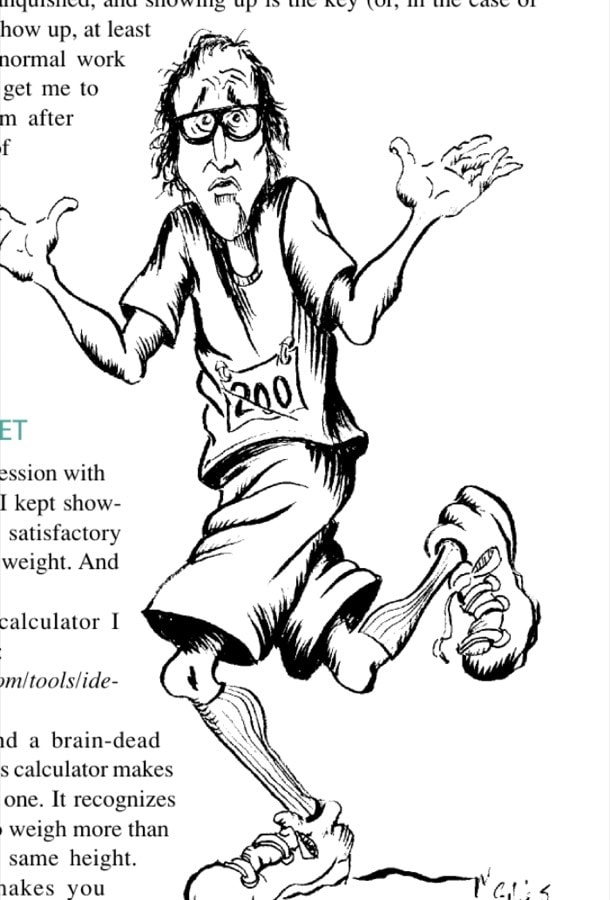
No, a more appropriate inspiration for me is Woody Allen. Woody tries things and then spins charmingly neurotic tales about his failures. Ahh! Now there’s a role model! I just have to work on the charming part.
Woody Allen is also skinny, one more thing to which I aspire. But most important, Woody Allen has a motto that fits me better. Instead of “I remain unvanquished,” Allen’s words of inspiration are “80 percent of success is showing up.”
Now, you may think that I juxtapose the Allen and Armstrong mottos for comic effect. Wrong: I’m completely serious. Woody Allen is my marathon man, no matter how admirable Armstrong. My personal running goals have nothing to do with remaining unvanquished, and showing up is the key (or, in the case of the feed trough, to not show up, at least not so regularly). My normal work ethic will be plenty to get me to the three-hour time I’m after and the long, long run of life with Sylvia and Theo I’m after. I just have to keep showing up.
GETTING TO MY IDEAL WEIGHT WITHOUT THE LOW-CARB DIET Of course, my clear obsession with the bias of BMI meant I kept showing up to search for a satisfactory calculation of my ideal weight. And I finally found it! The ideal weight calculator I found at Fitness Online: www.fitnessonline.com/tools/idealweight/ It isn’t built around a brain-dead metric like the BMI. This calculator makes you specify gender, for one. It recognizes that healthy men tend to weigh more than healthy women of the same height. More important, it makes you specify frame size. While you might
Michael Hughes
think that getting people to accurately gauge their frame would be difficult, the Fitness Online calculator has it down to a simple observation. If your index finger and thumb overlap when you encircle your wrist, your frame is small. If they meet, medium. If they fail to meet, large. Mine fail to meet. And my ideal weight when I specify that I have a large frame is as high as 160 (I’m 2 pounds under!) or as low as 144 (my magic three-hour marathon weight!).
I was feeling totally vindicated for a moment until I realized that even if I had clear proof of the BMI’s bias against large frames, I was still 14 pounds over my lowest ideal weight. Certainly the low-carbohydrate diet popular with sedentary dieters is not workable because much of the weight thus shed is due to water loss from reduced glycogen stores. Dehydration and reduced glycogen are not conducive to a fast marathon. In fact, it’s worse than that. When carbs dip low, the body begins to replace them by manufacturing ketone bodies. A person who has hit that nirvana of the low-carb diet, which is called ketosis, soon notices a funny taste in his mouth as well as a tendency for people to back away from his breath, which begins to smell like a mix of sour apples and fingernail polish remover. Worse for the runner, who tends not to worry about offensive body odors, the tissues that don’t do so well on ketones are the muscles used for movement, the red blood cells, and the brain. People tend not to run many workouts when their muscles, red blood cells, and brains are in a ketosis funk. For me, getting out to run requires my mind to overcome the lazy nature of my body. A weaker mind and a lazier body would guarantee failure.
In any case, the only basis for an enduring and healthy weight loss is the burning of more calories than one consumes. And since I am limited on how much I can cut consumption by my own moral shortcomings, I have no choice but to increase how many calories I burn.
What to do? As Woody said, just show up—only a little more often and for a little longer. It turns out that Max Jones’s formula for predicting marathon times is based on 60 miles per week, not my 50. And I’ll add in weight training (which I stopped once Theo was born if you don’t count carrying him to the car). The extra muscle mass will kick up my metabolic burn and help me drop weight faster.
I may even cross-train by showing up for some swimming. Nothing is as good at burning calories as struggling to keep from sinking like a rock, presuming you can get your mouth above water often enough to sustain some reasonable . percentage of VO2max.
And while I may never run that three-hour marathon, I will continue to show up for workout runs and races and push to achieve and maintain my ideal weight. That way I’ll stay in good enough shape to run marathons with my sons, Theo and Zane. Of course, by the time they start running marathons, I’ll be the one doing the toddling, so just showing up will count for plenty.
This article originally appeared in Marathon & Beyond, Vol. 9, No. 6 (2005).
← Browse the full M&B ArchiveMore like this
1,000+ stories from 19 years of Marathon & Beyond
The complete archive of the legendary long-distance journal — digitized and free to read.
