

On The Road With Joe LeMay
FIRED—AGAIN
It’s tough to sit down and write this, my last column for Marathon & Beyond, since it is my last source of income that I can count on. When I’m done with this column, it will be gone.
Yes, money is tight these days, and I can be quite whiney about it, just as I can be with a lot of things. People don’t like to talk about money, especially athletes. I don’t want to know how much So and So is getting because it will make me all jealous and whatnot, and I’ll wonder if it’s really true. It might bruise my already-shaky self-esteem.
After all, the only way to really find out what someone makes is to have access to their tax returns. Did you know that in Finland, tax returns are a matter of public record? Yes. I read it in the Wall Street Journal, so it must be true. It’s so the police know how much to fine you if you get a speeding ticket. They pull you over, punch up on their little Nokia gadgets how much you made last year, and write a ticket accordingly. One wealthy speeder paid a $10,000 ticket a couple years back.
Anyway, I’m writing about this now because my endorsement contract with Adidas is up, and, as of December 31, 2001, I’m in it just for the love of the game.
WE “TURNED PRO” IN 1981
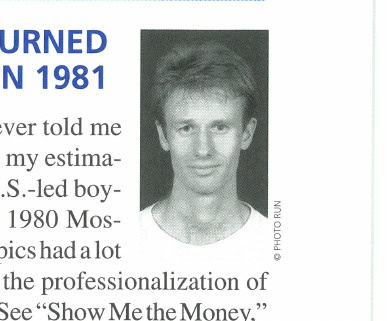
No one’s ever told me this, but in my estimation, the U.S.-led boycott of the 1980 Moscow Olympics had a lot to do with the professionalization of our sport. (See “Show Me the Money,” Marathon & Beyond, January/February 2002.)
I was only 13 at the time and didn’t have a lot to say on our foreign policy since I understood very little about it; but I knew I was full-out against this boycott, and history has looked favorably on this opinion. Afghanistan wasn’t worth the trouble, and Olympic boycotts simply aren’t effective.
Following those 1980 Games, athletes who once went to great lengths to maintain an amateur status for the sole purpose of competing in the Olympic Games thought they might as well not bother with that any longer.
The first road race to openly award prize money (“over the table,” as they say) was the Los Angeles Marathon of 1981, which was then called the Jordache Marathon, after the race sponsor. I should know about this because my coach, Tom Fleming, won the event and pocketed $50,000 for it: $25,000 official first-prize money and another $25,000 in his contract if he won the thing. He’ll tell you all about the experience at the least prompting.
To be sure, plenty of athletes were making money under the table leading up to that juncture. “I was making more money back then when I wasn’t allowed to than you are now that it’s okay,” Fleming, always the sympathetic coach, tells me frequently. The Jordache race did not ask permission from the governing body of track and field in the United States (The Athletics Congress, or TAC) to dole out the cash. In the spirit of the maxim “it’s easier to ask forgiveness later than for permission now,” they just went ahead and did it.
Almost immediately there was talk of banning Tom from competition. Threats were made, but no one followed through on them. People recognized that the age of the professional distance runner was at hand.
TRUST FUNDS
TAC created what were called “athlete trust funds.” Athletes could put any money they earned into a trust fund (almost invariably run by the Bank of Boulder) and take it out for training expenses. If you needed a Mercedes to get to the track (let’s say you’re Carl Lewis), then that’s a training expense.
Originally intended as a means of overseeing athletes’ income and keeping them poor enough to still be “amateurs,” the trust funds amounted to little more than extra paperwork and hassle for all parties involved. When I first came out of college in 1989, these trust funds were still in effect. My first prize money was a check for $500 made out to “TAC Trust Fund of Joseph LeMay,” which I won the summer following my graduation for a five-miler in the high 23-minute range.
“What am I supposed to do with this?” was my only thought.
So I got a list of approved trustees from TAC and sent my money off to some dude in Connecticut—the only East Coaster I saw on the list. I figured I wouldn’t touch that money until I really needed it or until I retired from competitive running. After all, more of those easy $500 races were coming, right?
That November I found myself broke and had to jump through a few hoops to get the money. Seems TAC would wait two weeks after you requested the money to send it since they were accustomed to seeing checks bounce.
Sometime the next year my trustee decided he was getting out of that business, and I was supposed to find a new one. I never did. Whenever the occasional check made out to “Trust Fund of . . . ” came in, I just went to my regular bank, stuck it in an envelope, and they never had a problem with it. With the ability of a high 28-minute 10K runner, I made about $4,000 to $6,000 per year at the time, and I saw no reason to bother TAC with that piddling sum. I was barely even a blip on their radar screen.
Finally, beginning in 1993, TAC, which had changed its name to USATF, abolished trust funds, and athletes were free to earn money without the oversight of any governing body other than the IRS. (By the way, if you have kids, one conversation you should have with them as they approach 18 is how to file an income tax return. I know it can be complicated, but the basics aren’t. At 18, I wasn’t even sure if I was supposed to file. I think the “tax talk” is more important than all the sex and drug talks the TV ads say you’re supposed to have with them. They already know about that stuff anyway.)
AMERICAN-ONLY CASH
So with the TAC monkey off your back, you can go nuts and make lots of cash on the “lucrative” road-racing circuit, right?
It’s not so easy.
Personally, I stayed at the $5,000 per year level until 1996, when I started to get a lot better. With the advent of the USA Running Circuit (USARC) in 1995, a few Americans were able to take advantage of the U.S. citizen-only prize money pools offered by some races to the point where they could actually make a living.
Keith Brantly was the first to take advantage of the USARC, winning the 1995 title and taking home $12,500 for it. His 2:14 to win the U.S. Marathon Championships that year won him $30,000, which, in my humble opinion, is a lot of money for a 2:14.
This was not a bad thing for many American distance runners, and I was able to score a couple of good paydays myself that I would have been eliminated from otherwise. For example, a win at the Gate River Run 15K in 1997 for my biggest-ever prize of $10,000 (I ran 43:35) and a second place at the New Haven 20K in 1996, where I got paid more than Joseph Kamau, the overall race winner: my $4,650 to his $2,500.
That particular event raised some questions regarding fairness in funneling prize money in a lopsided fashion to American runners, and I was the subject of some pre-New York City Marathon press in the New York Times pointing out those disparities. Specifically, it was an article by Marc Bloom comparing me with Joseph Kamau in both the New Haven and Falmouth Road Races. It wasn’t all that flattering, but I’ve always maintained that you know you’ve really arrived as an athlete when they take the time to write negative things about you.
While the USARC lives on with half the end-of-year purse it started out with (cut from $50,000 to $25,000 due to lack of sponsors), the question of its fairness and whether it’s the right track to take is still debated. In theory, it was supposed to make it easier for American distance runners to earn a living, thus giving them more time to train, thus allowing them to better compete with the rest of the world.
Although it has made it easier for them to earn a living, they haven’t been performing any better on the roads, and that’s not something that’s going to change anytime soon. While I don’t offer any long-term solutions, I will offer that it might be a problem that can’t be fixed with a checkbook.
SHOE COMPANIES
Even without American-only prize money, fairness is still an issue. In my opinion, over-the-table, out-in-the-open prize money is the best way to compensate athletes. As I like to say, “Put the money at the finish line.”
The running shoe contract is what most runners depend on for income, and it has created a kind of caste system for track and field athletes. On the top are the folks who ran really well in college, who have talent to burn, and get signed up as soon as they graduate. There aren’t too many of these people. They are Bob Kennedy, Adam Goucher, Suzy Hamilton, and the like. I know I just said this problem might not be fixable with a checkbook, but not having to work at a “real” job a single day in your entire adult life has to make some kind of difference.
Alisa Hill, a national-class 800-meter runner, who once had to go on Medicaid, was once asked about income disparities in the sport. “I don’t like to say disparaging things about other runners, but the fact that they have good deals has a lot to do with what keeps them on top.”
In other words, it’s like a “king of the hill” game. It’s hard to rise in the caste. Sure it can be done, but those who are on top tend to stay there because of the advantages a good shoe contract brings.
Of course, life is like that. The wealthy kid with the good education has a better chance at a good career than the poorer kid without the same benefits. But when you’re in a sport where you’re always fighting for table scraps, the difference between the haves and the have-nots becomes more apparent, with the have-nots working a day job, getting less sleep, and so on.
Consider the situation of Jason Pyrah, a two-time Olympian who had this to say after he won the indoor national mile title and was asked about his not having a shoe contract:
I was telling somebody that I was the only guy in the field who was unattached. The money’s not out there. I’m not really willing to run for nothing. I’m tired of the shoe companies wanting you to run for nothing or wanting you to run for a pair of shoes. That’s the way we, as athletes, should treat the sport? We should say just use me as a marketing tool and not get paid for it? . . . A lot of these other sports are getting paid huge contracts for doing that kind of thing. Why go and advertise for them and get paid nothing? I really think that the money’s out there, and we just got to make them pay for it. Bring some of that money back into the sport. . . . The rewards still aren’t there like we’d like them to be. It kind of gives us
the perspective that we can’t do it too much longer because of that kind of thing. We really need some support in the background financially to do it. Lucky for me I work for Home Depot in the Olympic Job Opportunities Program. I wouldn’t be able to do it without them. That’s been a great support for me since I’ve been back to Utah . . . and really make my Olympic dream come true.
Shoe companies aren’t fully to blame. We live in a winner-take-all society, and track and field is a sport with one overall winner per event, so it makes sense that shoe companies sign up only a few people at the very top. They’re businesses with responsibilities to their shareholders, and it’s not their job to prop up the sport.
I got my first and only shoe contract in 1996, and my first check arrived two weeks after my 30th birthday. It was rather late in my career for it to be a big help. It wasn’t as if the money was enough to allow me to quit my job. I can’t say how much since the terms are confidential, but unless you’re one of those top few people, these things run from about $6,000 per year on the low end to $15,000 on the high end, with a bonus schedule attached.
To get a bonus, you have to finish in the top three in a big event like the USATF Nationals, World Championships, or the Falmouth Road Race.
“That’s really hard to do,” I said when negotiating. “What if I finish, say, sixth place at Boston? Looks like I’d get nothing.”
“We like to emphasize the win, and we feel that we’re being generous by offering second- and third-place bonuses because how often do you even remember who came in second and third—never mind who finished sixth?” came the reply from my Adidas representative. Although he spoke in fluent corporate marketingese, he made sense, and I was in no position to argue. Besides, it was good to know that if I ever really did pop one while wearing three stripes, there would be a reward waiting.
For the record, while I did get a few bonuses made available because of my American citizenship, I did get one outright: a third-place finish in the 1997 Gasparilla Distance Classic in Tampa (before it dropped its prize money) behind Joe Kimani and Stephen Nyamu.
My Adidas rep always reminded me, “I like writing the bonus checks, Joe. It means that we made the right decision [in signing you].”
APPEARANCE FEES BAD
Appearance fees constitute an ugly aspect of the sport where an athlete can be treated unfairly. I’ve received only three appearance fees in my entire career, and they were all for $250 or less, so I don’t have a lot of experience in this arena. I’m not entirely against the idea of an appearance fee. After all, if some athletes attract more people to events and do a good job of promoting things, then they deserve a little compensation.
In the past, however, before the advent of prize money, an appearance fee was the only way an event could attract an athlete who wouldn’t otherwise come.
When all transactions were done under the table, some big names would walk off with a good payday and others, regardless of how well they performed, would walk off with nothing. The fact that a transaction was even taking place was supposed to be kept secret, and when someone occasionally or accidentally spilled the beans, enemies were made quickly.
The advent of prize money greatly reduced this problem, but it’s still out there. Sometimes an appearance fee goes to the guy who has the best agent or who has friends or who’s just savvy enough to know to ask for some cash.
In a sport where performance is so easily measurable, it’s one aspect where who you know is almost as important as what you know. “It’s not about money, it’s about respect,” said one sprinter as he pulled out of a European meet because the promoter wouldn’t meet his appearance fee demands. People have a problem saying it’s really about the money. Nothing hits home quite so profoundly.
When appearance fees become so large that they significantly detract from the overall prize money purse, the rest of the athletes are affected unfairly. Recall that Tiger Woods recently signed a large deal with the PGA Tour. Radio host Howard Stern commented: “They shouldn’t be giving him all that money. What’s he going to do [if they don’t], start his own golf tour? He has to play in golf tournaments or he won’t make a dime.”
I have to say I agree, and the same logic can be applied to marathons. There are a limited number of high-profile, large-purse marathons out there, and I have to believe that the top marathoners would compete anyway if one race wanted to redirect more of its money toward the finish line purse.
Or maybe there are market forces at work that I’m not seeing.
Maybe if you were to get Yuko Akimori at your race, you could sell the TV rights to Japan for a big markup. To be sure, Haile Gebrselassie’s run at London in 2002 is probably worth a significant appearance fee since the interest in the race will be that much greater.
Or it could be my ignorance as an American since, with most races here, it’s not usually any given star who sells the race to sponsors and advertisers; it’s the race itself. People would line the streets from Hopkinton to Boston on Patriots’ Day and spend lots of money at the expo regardless of who was running. The star of the Boston Marathon is the Boston Marathon.
The best predictor for tomorrow’s weather is today’s in this case. I don’t see much changing with prize money for runners. I think it will continue to be a very top-heavy sport, with very few people doing very well and the rest fighting for scraps.
Athletes in the United States aren’t likely to do any better unless distance running becomes more of a spectator sport with greater interest from the consuming public, which isn’t something that anyone says is coming on the horizon.
One idea that’s been talked about is the establishment of an athlete’s union. Sports with players’ unions do well. It probably won’t happen because it would require a buy-in from the athletes with the most to lose.
SAME SPOT, NEXT ISSUE
With the next issue, my wife Ellen takes over this column. She is a pig aficionado [For those playing catch-up, Joe and Ellen own a Vietnamese potbellied pig named Skunky. —Ed], who has, on a couple of occasions, won $1,000 or more in races. Be sure to ask her about her new course record of 4:41:22 in the Knickerbocker 60K.
This article originally appeared in Marathon & Beyond, Vol. 6, No. 2 (2002).
← Browse the full M&B ArchiveMore like this
1,000+ stories from 19 years of Marathon & Beyond
The complete archive of the legendary long-distance journal — digitized and free to read.
